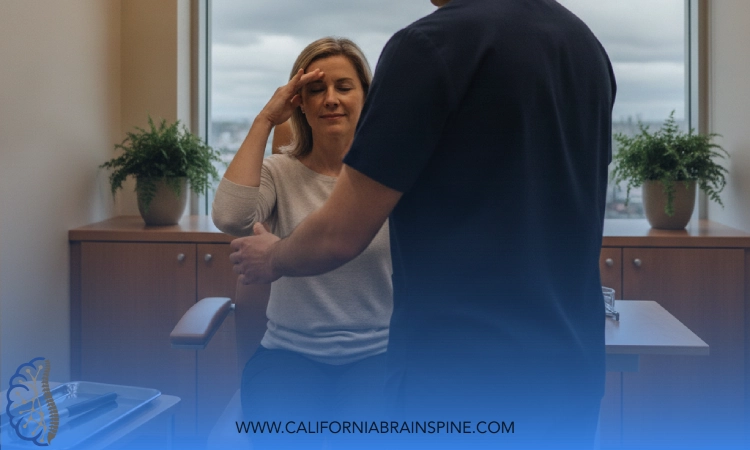

The movement, place or habit that sets off your vertigo is a useful clue about what is causing it, and the right response depends on which clue it is.
Vertigo triggers depend on why you have vertigo in the first place. A quick head turn can set off positional vertigo, a busy supermarket aisle can bring on visual motion sensitivity, and a short night or a skipped lunch can matter when migraine is part of the picture. I am Dr. Alireza Chizari, DC, DACNB, and in our Calabasas clinic this is one of the questions I am asked most often, usually by someone who has already started rearranging their life around the dizziness.
Maybe you sleep on one side now because rolling the other way makes the room spin. Maybe you plan the 101 around the hours when traffic feels calmer, or you stopped scrolling at your desk because the screen seems to slide. That pattern is worth writing down, because it tells a clinician where to look.
People are often surprised that the trigger and the cause are separate things. Rolling over may be the moment that exposes a problem in the inner ear. A grocery aisle may be the moment that exposes how your brain handles visual motion. Avoiding every trigger can reduce symptoms for a while, yet avoidance on its own does not explain why an ordinary movement is provoking your balance system.
Key Takeaway
Vertigo triggers differ by cause. Head position changes provoke BPPV, visually busy places can aggravate visual motion sensitivity and PPPD, and poor sleep, missed meals or stress can set off vestibular migraine. Stay safe during an attack, keep a record of what starts each episode, and bring that record to an evaluation instead of avoiding movement indefinitely.
Vertigo is a symptom, not a diagnosis: the feeling that you, or the room around you, is moving or spinning when nothing is. That is why a sensible list of vertigo triggers to avoid looks different from one person to the next.
What Are the Most Common Vertigo Triggers?
Usually, the most common vertigo triggers are changes in head position, such as rolling over in bed, looking up or bending down, which can set off brief, intense spinning in BPPV. Busy visual surroundings, poor sleep, missed meals, stress and bright light can also provoke episodes, especially when vestibular migraine or PPPD is involved.
Those are the vertigo triggers that come up again and again in my consultations. The list only becomes useful once it is matched to a cause, because the same movement can mean quite different things in different people.
Why the same trigger affects different people differently
A fast head turn can set off a short, violent spin in someone with BPPV, leave someone else feeling unsteady for the rest of the afternoon, and bring on a vestibular migraine episode in a third person. The movement is identical. What differs is the part of the balance system reacting to it.
That is also why I avoid handing every patient one universal list of vertigo triggers to avoid. The list gets more specific as the picture gets clearer, and a short, accurate list is far easier to live with than a long, general one.
When a trigger should not simply be avoided
Sometimes a trigger points straight at something that can be addressed. BPPV is the clearest example. The NIDCD, the federal research agency for hearing and balance, describes it as a brief, intense spell of vertigo set off by a specific change in head position, such as bending down to look under something, tilting the head to look up or over the shoulder, or rolling over in bed, in its overview of balance disorders.
When your pattern fits that description, a positional examination makes more sense than a lifetime of sleeping on one side.
A trigger earns a place on your list when it teaches us something about your balance system. The aim is a life in which fewer ordinary movements are treated as threats.
What Causes Vertigo, and How Is That Different From a Trigger?
Inner ear problems, which affect balance, are the most common causes of vertigo. The usual candidates include BPPV, labyrinthitis, vestibular neuritis, Ménière's disease and migraine, and certain medications can also cause it. Each of these is a cause. A trigger is the moment or circumstance that brings an episode on.
Knowing the difference changes what you do next. If a new medication and new dizziness arrived around the same time, that is a conversation for the prescribing physician rather than something to push through. If rolling over is what reliably sets the spinning off, the inner ear becomes the first place to look.
In practice, most people come in with a mixture: a clear trigger, a vague sense of being off balance between episodes, and a growing list of places they no longer go. Sorting the causes from the vertigo triggers is the first job of any evaluation.
What Does Triggered Vertigo Actually Feel Like?
One of the first things I ask is for people to set the word dizzy aside for a moment and describe the sensation itself. Spinning, rocking, floating, tilting and lightheadedness point in different directions, and the words you choose make vertigo triggers much easier to interpret.
Brief spinning after a bed turn
If rolling toward one side produces a strong spin that starts suddenly and settles fairly quickly, BPPV becomes one possibility. In BPPV, specific head positions can trigger brief, intense vertigo, and bed turns are one of the classic examples.
MedlinePlus has a plain-language page on benign positional vertigo if you want to read more about how it presents.
Rocking, swaying or disorientation in stores
Not everyone with a grocery store problem is having spinning vertigo. Some people describe floating, swaying, or a strange sense that the shelves and floor are drifting around them.
Persistent postural-perceptual dizziness, or PPPD, causes that kind of ongoing rocking or swaying unsteadiness rather than a spin. Symptoms are typically worse when upright, with head or body movement, and in visually complex or motion-rich places such as stores, traffic and crowds. PubMed Central has a clinical paper on PPPD for anyone who wants to read further.
Dizziness brought on by busy visual surroundings is also common in vestibular migraine, so a supermarket problem does not by itself mean PPPD.
One practical distinction
If the room spins briefly and intensely after one particular bed movement, that is a different clue from dizziness that builds slowly during a long walk around a supermarket. When you keep notes, record the trigger, how quickly it started, how long it lasted and how long you took to recover. A line that only says vertigo today tells a clinician very little.

Why Does Rolling Over in Bed Make Vertigo Worse?
Of all the vertigo triggers people describe to me, rolling over in bed tends to frighten them most, because it turns sleep into something unpredictable. People start sleeping propped up on pillows, or they turn their whole body as one block to keep the head still.
Why BPPV reacts to position
The inner ear contains tiny calcium crystals called otoconia. BPPV occurs when loose otoconia move into one of the semicircular canals, the loops that sense head rotation, and disturb how that canal senses movement. The NIDCD sets out the same mechanism in its definition of BPPV.
This is the usual explanation for BPPV, and it is why bed turns, looking up at a high shelf and bending to tie a shoe are such typical triggers. The movement itself is ordinary. The canal it disturbs is the part that is not working as it should.
Should you avoid the triggering side forever?
Temporary caution during an active phase is reasonable while the pattern is being worked out. Long-term avoidance, though, leaves the crystals where they are.
For BPPV, a clinician may perform a series of simple head movements, such as the Epley maneuver, to help move the crystals out of the canal. This is called canalith repositioning, and at California Brain & Spine Center it may be used when clinically appropriate after evaluation. Whether it suits you depends on the positional examination, not on the history alone.
Your vertigo has triggers, but you still do not know why
If bed turns, screens, stores, driving or standing keep setting off symptoms, a focused vestibular (inner ear balance system) and neurological evaluation can help sort out whether the pattern is positional, visual, migraine-related or something that needs a medical referral.
Why Do Screens, Stores and Scrolling Make Vertigo Worse?
Visual motion is one of the most misunderstood vertigo triggers. A person can sit completely still and still feel as though the room is moving, because the visual scene itself is making demands on the balance system.
Visual motion can overwhelm a sensitive balance system
One way to picture it: the brain keeps comparing what the eyes report with what the inner ear and the body report. Most of the time that comparison is effortless. When it is not running smoothly, a lot of moving scenery, patterned floors, crowds, fast scrolling and passing traffic can become hard to process.
Symptoms in PPPD are typically worse in exactly these visually complex, motion-rich places, and visually induced dizziness is very common in vestibular migraine too. Two different conditions can therefore share the same shopping-aisle trigger.
Why avoiding every screen can become a problem
Cutting back for a while can be sensible when symptoms are very reactive. Avoiding screens and stores permanently is a different matter. When someone is medically stable and rehabilitation is appropriate, vestibular rehabilitation uses an individualised, exercise-based plan.
Screens and stores can sit on your list of vertigo triggers for now, while the reason they bother you is worked out. They do not have to stay there for good.
If your world gets smaller every month because you keep removing stores, screens, roads, movements and activities, the shrinking itself is worth mentioning at your appointment.

Can Poor Sleep, Skipped Meals or Stress Trigger Vertigo?
They can, particularly when migraine is part of the picture. On their own, none of them causes vertigo in everyone.
Vestibular migraine triggers include sleep, meals, light and stress
Vestibular migraine is the most common neurological cause of vertigo in adults, and it catches people out because many who have it get no headache at all. Vertigo or dizziness is their main symptom, so migraine never crosses their mind.
Attacks are often provoked by the usual migraine triggers: stress, weather changes, menstruation, irregular sleep, missed meals, dehydration, bright lights, loud noise and motion sickness. These vertigo triggers vary a great deal from person to person.
NINDS keeps a patient page on migraine and its triggers that is worth reading alongside your own notes.
That does not mean everyone with vertigo should adopt a restrictive routine. It means a consistent link between certain habits and your episodes is worth raising when vestibular migraine is being considered. Our page on vestibular migraine therapy explains how that evaluation is approached.
Dehydration and skipped meals may cause something other than true vertigo
Someone who says their vertigo gets worse when they have not eaten or had enough water may be describing lightheadedness sitting on top of a vestibular problem. That distinction matters for the evaluation.
Lightheadedness when standing, when hungry, in the heat or after exertion deserves its own questions: does it follow standing up, and what do heart rate and blood pressure do when you stand? Those are asked and, when appropriate, measured rather than assumed.
Can Ménière's Disease or an Inner Ear Infection Trigger Vertigo?
Some vertigo has no obvious outside trigger at all. Ménière's disease is an inner ear disorder that causes episodes of vertigo along with ringing in the ear, hearing loss and a feeling of fullness in the ear. Limiting dietary salt, sometimes alongside a diuretic from your physician, may help control symptoms, which is one reason salt appears on some lists of vertigo triggers.
Vestibular neuritis is inflammation of the vestibular nerve that can be caused by a virus, and it mainly causes vertigo. Labyrinthitis is an infection or inflammation of the inner ear that causes dizziness and loss of balance.
When hearing changes, ear fullness or a recent illness sit alongside your vertigo, mention them early. They change which causes a clinician considers first, and some of them belong with ENT, audiology or medical neurology.
Can Anxiety Make Vertigo Worse Without Causing It?
It is a fair question, and the evaluation asks it directly rather than assuming the answer either way. Whether anxiety is part of the picture, and whether it came before or after the dizziness, is something to sort out rather than guess.
The questions are practical. Did a frightening episode happen somewhere specific? Do you now brace for it before walking back into that place? Has the list of places you avoid grown since?
None of this makes the symptoms imaginary. Asking about it is part of taking them seriously.
What Can Make Vertigo Worse When the Neck Is Involved?
If your dizziness began after whiplash, a concussion or another neck injury, or seems to change with neck movement or with holding one posture for a long stretch at a desk, the evaluation asks about that directly.
The word vertigo needs care here. True spinning vertigo still needs a proper vestibular and neurological assessment. Whether the neck plays any part is a question for the examination, and a tight neck should not automatically become the explanation for every spinning episode.
If the neck seems relevant, it should be examined rather than assumed: the injury history, how the neck moves, where it hurts, and whether the symptoms actually change when neck position changes.
Which Vertigo Triggers Point Toward Different Causes?
| Typical trigger pattern | Pattern suggesting something more | What the evaluation may look at |
|---|---|---|
| Rolling in bed or looking up brings a brief spin | Constant symptoms, or spinning with other neurological signs | Positional testing such as Dix-Hallpike (moving you from sitting to lying with the head turned and tipped back) and the roll test (turning the head side to side while lying flat), and the pattern of eye movements |
| Stores, traffic, crowds or scrolling make things worse | Symptoms continue even without visual stimulation | Visual motion sensitivity, PPPD features, how well the balance system is compensating |
| Poor sleep, bright light, stress or missed meals come before episodes | New neurological symptoms appear with the vertigo | Migraine history, neurological examination, episode pattern |
| Standing up brings lightheadedness or near-fainting | Palpitations or fainting | Orthostatic (lying or sitting, then standing) heart rate and blood pressure, when appropriate |
| Ringing, ear fullness or hearing changes come with episodes | Sudden hearing loss | Hearing history, with referral to ENT or audiology when indicated |
| Neck movement changes dizziness after whiplash | Severe headache, weakness, speech change, inability to walk | Neck contribution, only after neurological safety has been considered |
When vertigo is an emergency
If symptoms come on suddenly or severely - a sudden severe headache, weakness, trouble speaking, vision loss, or fainting - that is an emergency. Call 911 or go to an emergency room, not a clinic appointment.
With vertigo specifically, the danger signs also include double vision or loss of vision, hearing loss, trouble speaking, weakness in an arm or leg, and numbness or tingling. Any of these alongside vertigo needs emergency care.
The CDC also keeps a page on stroke warning signs that is worth reading once, before you ever need it.
How Are Vertigo Triggers Evaluated Before Treatment?
Dr. Alireza Chizari, DC, DACNB, a board-certified chiropractic neurologist at California Brain & Spine Center in Calabasas, uses functional neurology to treat vertigo triggers as part of the diagnostic history. Once urgent medical problems have been ruled out, the trigger shows which systems to challenge and measure.
Map the exact trigger
The first step is documenting what movement or environment starts an episode, how quickly it begins, how long it lasts and how long recovery takes. That timing can separate positional spinning from visually induced or standing-related symptoms.
Test for positional vertigo
When the history suggests BPPV, positional tests such as Dix-Hallpike and the supine roll test may be used. The direction and timing of the eye movements they provoke help decide whether canalith repositioning is appropriate.
Measure eye movement function
VNG (videonystagmography, which records the eyes with small cameras in goggles) and structured eye movement testing can record nystagmus (involuntary, jerking eye movements), gaze holding, tracking and visual-vestibular responses. Those findings are read together with the history; on their own they are not a diagnosis.
Challenge balance integration
Computerized balance testing can examine how vision, the inner ear and the body's position sense each contribute to standing steady. The pattern may help explain why darkness, busy places or soft surfaces feel so different from one another.
Check overlapping systems
Migraine history, concussion, neck symptoms, hearing changes, medications and responses to standing may all change the interpretation. Some findings belong with primary care, ENT or medical neurology, and a referral is part of a careful evaluation.
Turn avoidance into a progression plan
Once the driver is clearer, care may include, when clinically appropriate after evaluation, canalith repositioning, gaze stabilization (exercises for keeping vision steady while the head moves), habituation (exercises that deliberately repeat a movement that provokes symptoms), balance work, visual motion exposure or neck rehabilitation. Vestibular rehabilitation builds these into an individualised, exercise-based plan.
If you want the broader picture of how dizziness is assessed here, the page on our dizziness specialist in Calabasas walks through the full evaluation.
When a vestibular problem or motion sensitivity is found, vestibular rehab therapies explains how gaze, balance and habituation work is progressed from the examination findings.
If blurred or jumpy vision during head movement is one of your vertigo triggers, the guide to gaze stabilization exercises for dizziness explains why those exercises should be chosen and dosed for you rather than copied from a video.
How Do You Keep Track of Your Vertigo Triggers?
A written record turns a vague sense that everything sets it off into a pattern a clinician can use. It does not need an app. A note on your phone or a page by the bed works, as long as you fill it in soon after each episode.
For each episode, capture what you were doing or how your head moved just before it began, whether the sensation was spinning, rocking, floating or lightheadedness, how quickly it came on, how long it lasted, and how long you took to feel yourself again.
Add the context around it: how you slept the night before, whether you had eaten, where you were in your menstrual cycle if that applies, what the weather was doing, and whether there were bright lights, loud noise or a lot of visual movement nearby. Those details help separate a positional pattern from a migraine-related one.
Note hearing changes, ringing or ear fullness as well, and any new medication. Bring the record to your appointment. A written log of your vertigo triggers often says more than a single visit can.
What Should You Do About Your Vertigo Triggers This Week?
If symptoms are active and you have not been evaluated yet, the priority is safety rather than pushing yourself through home exercises. Your own vertigo triggers can still give useful clues while you arrange care.
- During an active attack, sit down before you lose your balance, and stay off ladders, heights and the road until the spinning has settled.
- Avoid repeatedly provoking severe positional spinning just to test yourself; write down the movement that sets it off and ask for a positional assessment.
- If screens are a trigger, slower scrolling and shorter sessions can make work more tolerable while the visual side is evaluated.
- Keep sleep and meals reasonably regular, especially if you have a history of migraine.
- If you already notice a reliable link between alcohol and your symptoms, leave it out while things are unstable.
- Pay attention to what happens when you stand up: lightheadedness or near-fainting instead of spinning is worth telling the clinician about, because the problem may not be mainly vestibular.
- Treat new neurological symptoms as an emergency: weakness, trouble speaking, new difficulty walking, vision changes or a sudden severe headache need emergency care, not a clinic appointment.
How Should People in Calabasas and Woodland Hills Think About Vertigo Triggers?
For people living in Calabasas and nearby Woodland Hills, ordinary life often reveals more about vertigo triggers than a quiet examination room. The 101 supplies visual flow. Supermarkets supply busy patterns. A day at the computer tests gaze stability, and bed turns test positional sensitivity.
I want you to notice those patterns without building your whole life around avoiding them. Someone who stops driving, shopping, exercising, turning their head and using screens can become badly restricted, even while the original vestibular problem is settling.
The useful question for each item on your list is whether it should stay restricted for now, be treated directly, or become part of graded rehabilitation later.
Why Measure Vertigo Triggers Before Treating Them?
I trained first as an electrical engineer and worked as a solar engineer before moving into healthcare, and that background still shapes how I work: measure a system before trying to change it. The longer story is on the About Dr. Alireza Chizari page.
With vertigo triggers, measuring first means I do not assume every head movement is BPPV, every screen problem is PPPD, every stiff neck explains the dizziness, or every anxious reaction is the whole story. The trigger gives me a hypothesis, and the examination tests whether it fits.
Frequently Asked Questions About Vertigo Triggers
What are the most common vertigo triggers at home?
Common vertigo triggers at home include rolling over in bed, looking up at a shelf and bending down, which can set off brief, intense spinning in BPPV. Screens, poor sleep, missed meals and stress matter more when vestibular migraine or PPPD is involved. Your own pattern is more useful than any universal avoidance list.
Why does my vertigo get worse when I roll over in bed?
Brief, intense spinning after rolling over is typical of BPPV, where loose calcium crystals in the inner ear drift into a semicircular canal and disturb how it senses movement. Positional testing is worth having rather than avoiding that side indefinitely. If episodes are prolonged or come with neurological symptoms, another explanation needs consideration.
Can screens and grocery stores trigger vertigo?
Yes. Busy visual surroundings are common vertigo triggers in PPPD and vestibular migraine, and they tend to cause swaying or unsteadiness more than spinning. Fast scrolling, traffic, crowds, patterned floors and long aisles can all provoke symptoms. Cutting back for a while may help, but permanent avoidance can make daily life smaller over time.
What vertigo triggers matter if migraine is involved?
Vestibular migraine attacks are often provoked by typical migraine triggers: stress, weather changes, menstruation, irregular sleep, missed meals, dehydration, bright lights, loud noise and motion sickness. Many people with vestibular migraine have no headache, so if these vertigo triggers keep coming before your episodes, raise vestibular migraine with your clinician rather than assuming BPPV.
When should someone in Calabasas or Los Angeles worry about worsening vertigo?
Call 911 for vertigo with double vision or vision loss, hearing loss, trouble speaking, weakness in an arm or leg, numbness or tingling, or a sudden severe headache. For non-emergency vertigo triggers that are becoming more frequent or restrictive, a vestibular evaluation in Calabasas can help work out why your list keeps growing.
How I Think About Vertigo Triggers to Avoid
I think of vertigo triggers as clues rather than permanent rules. A bed turn, a screen, a store aisle, a skipped meal or the moment you stand up can each say something different about your balance system. Protect yourself while symptoms are active, identify the driver carefully, and then, when it is appropriate, work toward tolerating ordinary life again.
If you live in Calabasas or Woodland Hills and your list keeps getting longer, I would like to help you find out why.
California Brain & Spine Center | (818) 649-5300 | Calabasas, CA 91302
Book online at californiabrainspine.janeapp.com
This content is for educational purposes only and is not medical advice. Consult a qualified healthcare provider about your specific situation.
Your list of vertigo triggers keeps growing
If you avoid more movements and places every month, an evaluation can help separate a positional problem that may respond to repositioning from visual or vestibular sensitivity that may benefit from carefully graded rehabilitation.