Non-invasive · Painless · Calabasas
Pulsed Electromagnetic
Field Therapy (PEMF)
Give your cells the environment they need to heal.
Chronic pain that won’t quit. Neuropathy dismissed as “permanent.” A concussion recovery that stalled. Your body runs on electricity — and when injury or inflammation weakens a cell’s electrical charge, healing slows. Dr. Alireza Chizari, DC, DACNB, our board-certified functional neurologist, integrates PEMF to restore that cellular environment — with an engineer’s understanding of how electromagnetic fields actually interact with human physiology.
The quick, honest answer
What you need to know about PEMF
What it does
Recharges the cell
Delivers low-frequency electromagnetic pulses to your tissues — supporting cellular energy production, circulation, and tissue repair from the inside out.
Who it helps
Pain, neuropathy & inflammation
Patients with chronic pain, peripheral neuropathy, post-concussion symptoms, inflammation, autonomic dysfunction, and slow-healing injuries.
What to expect
20–30 painless minutes
Completely painless, no downtime. Most patients feel gentle warmth or tingling — many find it relaxing. Care always begins with a neurological evaluation.
The science, simply
Your body operates on electricity
Every thought, movement, and repair process depends on electrical signals traveling through neurons, muscles, and tissues. When cells are damaged by injury, inflammation, or chronic stress, their electrical charge weakens — reducing their ability to produce energy, absorb nutrients, clear waste, and communicate.
PEMF delivers low-frequency electromagnetic pulses that interact with the cell membrane, prompting ion channels to open and close in a controlled rhythm. This helps restore the cell’s natural electrochemical balance. We never use PEMF in isolation — it’s always paired with a comprehensive neurological evaluation to determine which tissues need support, and at what frequency and intensity.
At the cellular level
Four things PEMF supports
Not magic — applied cellular physiology. Restoring the cell’s electrochemical balance drives four measurable effects.
Increases ATP Production
ATP is the cell’s energy currency. PEMF stimulates mitochondria to produce more of it — the fuel cells need to repair and function properly.
Enhances Circulation
Improves microcirculation by dilating blood vessels, increasing oxygen and nutrient delivery while accelerating waste removal.
Reduces Inflammation
Influences inflammatory cytokines and prostaglandins, calming chronic inflammation at the cellular level — without medication side effects.
Supports Nerve Function
Can modulate nerve activity, support neurovascular health, and help regulate autonomic function — relevant for dysautonomia and post-concussion cases.
Where it may help
Conditions we commonly pair PEMF with
PEMF is not a standalone solution — it’s most effective integrated into a personalized plan. If your condition isn’t listed, it doesn’t mean PEMF can’t help; it means you need an evaluation.
Post-Concussion Syndrome
Supports neurovascular recovery, reduces brain inflammation, improves cerebral blood flow — pairs with concussion care
Peripheral Neuropathy
Enhances nerve-cell membrane health, improves sensation, reduces pain and tingling — often paired with LLLT
Chronic Pain
Back, neck, and joint pain: reduces inflammation, accelerates tissue repair, and modulates pain signaling
Autonomic Dysfunction
Supports vagal tone, heart-rate variability, and autonomic regulation — often paired with GammaCore for dysautonomia
Soft Tissue Injuries
Accelerates ligament and muscle healing, reduces swelling and scar-tissue formation
Chronic Fatigue
Increases cellular energy production and supports mitochondrial function — often paired with HBOT
Never a standalone service
PEMF works best as part of a compounding plan
The real power of PEMF shows when it’s layered with complementary therapies — each addressing a different part of the same recovery. Dr. Chizari sequences these deliberately, based on your evaluation.
Your session, step by step
What a PEMF session actually involves
Positioning & setup
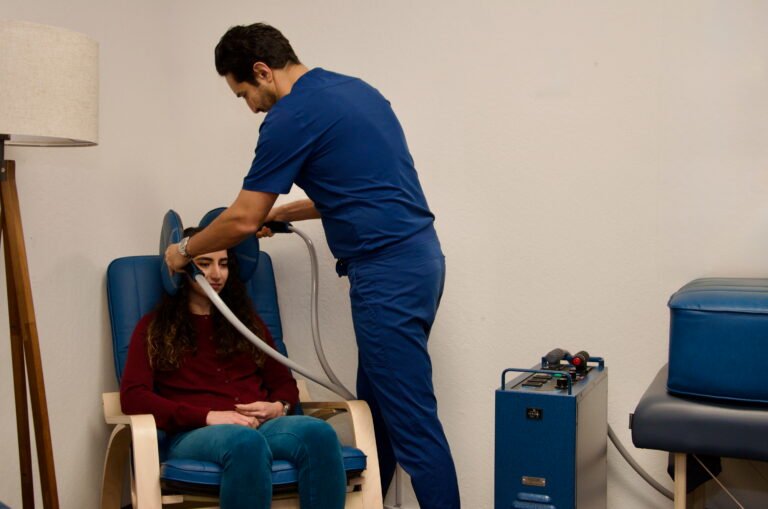
You lie comfortably on a treatment table, fully clothed. PEMF applicators (coils or pads) are placed over the targeted area — no direct skin contact required.
The session
Most sessions run 20–30 minutes. You may feel gentle warmth, tingling, or a pulsing sensation. Many patients find it relaxing and report feeling energized afterward.
No downtime
Completely non-invasive — no recovery period. You return to normal activities immediately after the session.
Protocol & progress
Most patients start with 2–3 sessions weekly for 8–12 total, then taper. Dr. Chizari adjusts based on objective markers and your response — not guesswork.
Watch
PEMF basics — what you’ll feel in session one
A quick, honest walkthrough for first-timers: session flow, what you’ll feel, and why we often pair PEMF with neurorehabilitation or soft-tissue care. Comfort, safety, and typical dosing — so you know exactly what to expect before booking.
Honest clinical communication
Safety, sensations — and who should hold off
PEMF is non-invasive and generally well-tolerated. But it isn’t right for everyone — a few conditions require caution or a modified approach.
What most patients feel
- Gentle warmth or tingling over the treated area
- A mild pulsing sensation during the session
- A brief boost in energy afterward
- Deep relaxation — some patients nearly fall asleep
If anything feels uncomfortable, intensity is adjusted immediately. Most patients experience no side effects at all.
Tell us before starting if you have
- An implanted electronic device — pacemaker, cochlear implant, neurostimulator, or insulin pump (a key contraindication)
- Pregnancy
- Active bleeding or certain types of cancer
- A history of seizures
These factors don’t automatically disqualify you, but they require careful evaluation and sometimes modified protocols. Dr. Chizari screens for them during your assessment.
A patient story worth sharing
L., 52 — teacher from Thousand Oaks
Details changed to protect privacy; shared with permission. Representative of possible outcomes — not a guarantee of any specific result.
After two years of worsening peripheral neuropathy — numb, burning, unreliable feet — L. had seen three neurologists, tried multiple medications, and been told the nerve damage was permanent. Her evaluation here found compromised lower-limb circulation, reduced nerve conduction, and poor balance: she couldn’t stand on one foot for more than two seconds, and rated her pain a constant 7 out of 10. Her plan combined PEMF targeting the lower legs, LLLT for mitochondrial support, and structured balance rehab, three times weekly. By week four, the burning eased. By week eight, she held a one-foot stand for twelve seconds and her pain had dropped to a 3. At three months, her nerve conduction studies showed measurable improvement — something she’d been told was unlikely.
She still manages mild residual numbness — but she teaches a full day without debilitating pain, and her balance confidence is back. That’s what recovery looks like when you address root causes.
Not all PEMF is equal
Why patients choose our clinic for PEMF
Effectiveness depends on device quality, correct frequency and intensity, accurate targeting, and integration into a real care plan.
Expert Neurological Evaluation
Advanced clinical neuroscience training behind every assessment — a precise diagnosis, not a generic protocol.
Clinical-Grade Equipment
Professional PEMF devices with precise frequency control and validated protocols — not consumer-level gadgets.
Integrated Care
PEMF is never delivered in isolation — always part of a broader plan with rehabilitation and complementary therapies.
Objective Progress Tracking
Regular reassessment using objective measurements — balance testing, range of motion, exam findings — not just how you feel.
Common questions
Frequently asked questions
How long does it take to see results from PEMF?
Response time varies by condition and physiology. Some patients feel improvements in pain and inflammation within the first few sessions; others need several weeks. For chronic conditions like neuropathy or post-concussion syndrome, expect an 8 to 12 week timeline before assessing full effectiveness.
Can PEMF therapy replace medication?
No — PEMF is a complementary tool, not a substitute for necessary medication. It may support your body’s healing and reduce reliance on pain medication over time, but never stop or adjust medication without consulting your prescribing physician. We coordinate with your medical team when appropriate.
Is PEMF therapy painful?
No — it’s completely painless. Most patients feel gentle warmth, tingling, or a pulsing sensation, and many find it deeply relaxing. If you experience any discomfort, the intensity can be adjusted immediately.
How much does PEMF therapy cost in Calabasas?
Pricing depends on the protocol, session frequency, and whether PEMF is combined with other therapies. Single sessions typically range from $75 to $150, and package pricing is often available for multi-session protocols. You’ll receive transparent pricing based on your specific plan during your evaluation.
Does insurance cover PEMF therapy?
Coverage varies by provider and plan. Some cover PEMF when it’s part of a medically necessary treatment plan for a documented condition. Our team can provide billing codes and documentation to submit — we recommend confirming coverage with your insurer before starting.
Can PEMF help with post-concussion syndrome?
Yes — PEMF can support neurovascular recovery, reduce neuroinflammation, and improve cerebral blood flow. We typically pair it with LLLT, vestibular rehabilitation, and cognitive exercises within the NeuroRevive Program. PEMF alone is rarely sufficient for complex post-concussion cases.
A final, honest word
PEMF is not magic.
It’s applied cellular physiology.
Used correctly, in the right clinical context, and as part of a comprehensive care plan, PEMF can make a meaningful difference in your recovery. If chronic pain, neuropathy, or post-concussion symptoms haven’t responded to conventional treatment, Dr. Chizari will determine honestly whether PEMF belongs in your plan — starting with a comprehensive neurological evaluation.
California Brain & Spine Center · 4768 Park Granada, Ste 107, Calabasas, CA 91302 · Serving Thousand Oaks, Agoura Hills, Westlake Village & Woodland Hills