Non-surgical · Calabasas · Functional neurology
Dizziness Specialist Near Me
in Calabasas, CA
When the world won't hold still, everything else gets harder.
When you search for a dizziness specialist near me, you want someone who will find out why the room keeps moving. Spinning rooms, unsteady steps and the worry about the next episode can shape your whole day. At California Brain & Spine Center in Calabasas, Dr. Alireza Chizari, DC, DACNB, a Board-Certified Functional Neurologist, looks for the underlying cause of your dizziness and builds a personalized, non-surgical plan around what the testing finds.
The hidden disruption
More than dizziness: a disrupted balance network
Feeling the room spin, or feeling that you are spinning, is frightening. A balance disorder is a condition that makes you feel unsteady or dizzy. If you are unsure whether what you feel counts as dizziness or vertigo, here is how dizziness and vertigo differ. According to the National Institute on Deafness and Other Communication Disorders, balance relies on signals to the brain from the eyes, the inner ears, and the muscles and touch sensors in the legs.
As a dizziness specialist in Calabasas, Dr. Chizari offers non-surgical assessment and rehabilitation for people in Calabasas, Agoura Hills and Woodland Hills. The practice also sees people from across Los Angeles and Southern California who are looking for a vertigo specialist within reach of the 101. When the assessment shows that imbalance is the bigger problem, care may continue in the Balance Disorder Therapy program.
Start your recovery →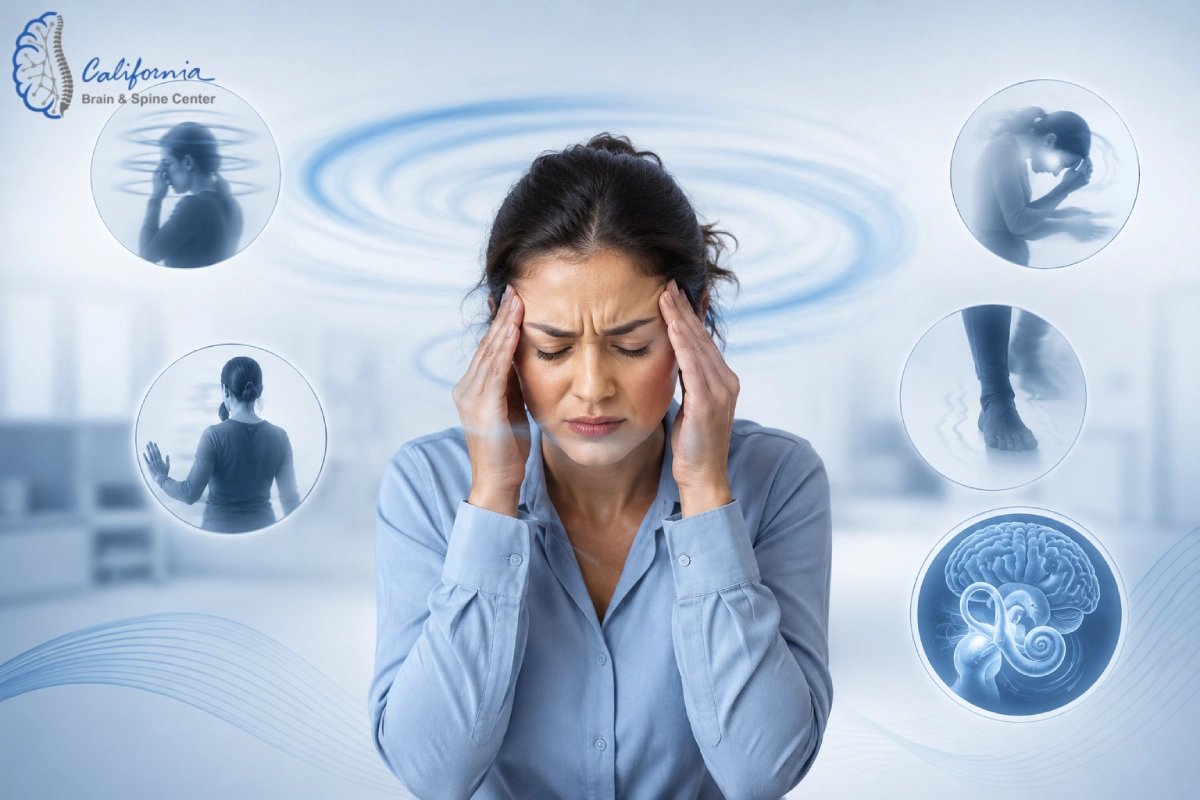
Understanding dizziness
Dizziness and balance disorders we treat in Calabasas
"Dizziness" is a symptom with many possible causes, each needing a different plan, so identifying yours comes first. For an overview, read why you might feel dizzy all the time. Dr. Chizari also evaluates Ménière's disease and Mal de Débarquement Syndrome (MdDS).
BPPV
Brief, intense spinning triggered by specific changes in head position (more on positional vertigo). Guidelines recommend a repositioning procedure for the posterior canal type (affecting the rear balance canal of the inner ear).
Vestibular Migraine
Assessed alongside your headache history during the neurodiagnostic assessment
Cervicogenic Dizziness
Dizziness thought to be linked to the neck. It rarely involves true spinning, and the diagnosis is debated, so other causes are checked first
Vestibular Neuritis
Assessed with eye-movement, balance and inner-ear testing during the neurodiagnostic assessment
PPPD
Persistent postural-perceptual dizziness: non-spinning dizziness and unsteadiness that gets worse with your own movement
Post-Trauma Dizziness
Assessed with the same eye, balance and inner-ear testing
Know the difference
Symptoms we treat, and when to go to the ER first
Some causes of dizziness need emergency care before anything else, and telling you which is which is the first part of a dizziness specialist's job.
We help with symptoms like these
- Vertigo: a spinning or tilting sensation
- Unsteadiness while standing or walking
- Light-headedness or feeling you might faint
- Nausea or motion sensitivity
If these sound familiar, the 120-minute neurodiagnostic assessment is designed to look for the cause. No referral needed.
Call 911 or go to the ER first if dizziness comes with
- Sudden trouble walking, loss of balance or lack of coordination
- Sudden numbness or weakness on one side of the body
- Sudden confusion or trouble speaking
- Sudden trouble seeing
- A sudden, severe headache with no known cause
The CDC lists these as signs of stroke. If symptoms come on suddenly or severely - a sudden severe headache, weakness, trouble speaking, vision loss, or fainting - that is an emergency. Call 911 or go to an emergency room, not a clinic appointment. Once you have been medically cleared, Dr. Chizari can take it from there.
By the numbers
You're not alone, and it's often treatable
- The NIDCD defines a balance disorder as a condition that makes you feel unsteady or dizzy
- Balance depends on three sources of signals: the eyes, the inner ears, and the muscles and touch sensors in the legs
- A Cochrane review found moderate to strong evidence that vestibular rehabilitation is a safe, effective way to manage unilateral peripheral vestibular dysfunction (a problem with the inner-ear balance system on one side)
- Sudden dizziness or loss of balance can be a sign of stroke, which is why 911 comes before any clinic appointment
Your path to steady
What to expect at your first visit
Knowing what happens can make the first visit easier. Here is how it works, step by step, with no referral needed.
Comprehensive evaluation
The 120-minute neurodiagnostic assessment starts with your history, then gentle, non-invasive testing of eye movements, balance and inner-ear function. One common check, the Dix-Hallpike test, moves your head into positions that can briefly bring on vertigo in BPPV, and the eye movements it provokes help identify the posterior canal type. Dr. Chizari talks you through each test.
Your answers, in plain language
Dr. Chizari explains what the testing found and why you may feel the way you do. If testing points to posterior canal BPPV, clinical practice guidelines recommend a canalith repositioning procedure, which may be done during the visit when clinically appropriate. If a finding calls for medical neurology, an ENT or imaging, he refers you and explains why.
Retraining, in clinic and at home
Your plan may combine in-clinic sessions with short home exercises between visits. The same tests are repeated over time, so you and Dr. Chizari can see what is changing.
Our approach
Dizziness treatment in Calabasas, without surgery
Treatment is chosen by cause. For posterior canal BPPV, guidelines recommend repositioning, and research supports vestibular rehabilitation for unilateral peripheral vestibular dysfunction. When a cause calls for medication, surgery or imaging, that care belongs to your physician, an ENT or medical neurology, and Dr. Chizari works alongside them.
Lower risk profile
No anesthesia, no incisions and no hospital stay. Care uses movement, eye and balance exercises chosen after evaluation.
Precision diagnostics
Eye-movement, balance and inner-ear testing, including the Dix-Hallpike test for positional vertigo, is used to look for the underlying cause.
Whole-person focus
Balance depends on vision, the inner ears and body sensors together, so care may work on all three rather than one symptom at a time.
Measurable progress
Tests from your first assessment are repeated over time, so changes are measured instead of guessed at. Results vary from person to person.
Inside the program
Treatments that match the cause
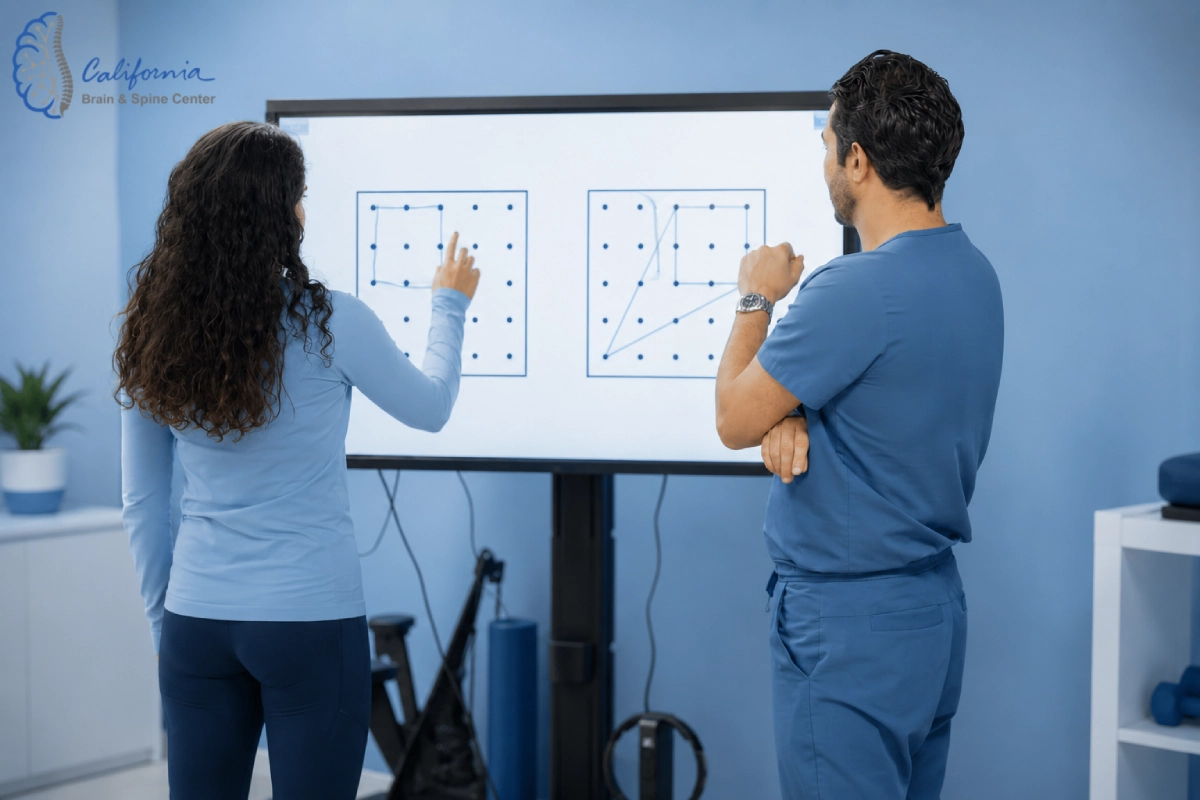
Every plan begins with the 120-minute neurodiagnostic assessment. From there, Dr. Chizari may combine the approaches below, when clinically appropriate after evaluation.
Patient reviews
Real experiences from our patients
Many patients come to California Brain & Spine Center after persistent dizziness, vertigo or imbalance has continued to interfere with daily life. Read what our patients have shared about their experiences with our clinic.
Google reviews
Reviews from patients of California Brain & Spine Center in Calabasas.
Search "California Brain & Spine Center Calabasas" on Google to read our patient reviews.
Reviews reflect individual experiences. Results vary from person to person, and no specific outcome is promised.
Watch
See how vestibular rehabilitation works
In this short video, Dr. Chizari explains how functional neurology looks at the brain's vestibular pathways, and how vestibular rehabilitation uses movement to work with them.
Common questions
Frequently asked questions
How do I know if my dizziness is serious?
Dizziness that comes on suddenly with trouble walking, trouble speaking, one-sided weakness or numbness, or loss of vision can be a sign of stroke and needs 911. Dizziness that keeps coming back, or comes with headaches or hearing changes, is worth an evaluation.
Do I need an MRI or CT scan for dizziness?
Not always. Depending on the person, the NIDCD notes that a balance evaluation may include a hearing exam, blood tests, videonystagmography (recorded eye movements) or imaging of the head and brain. If your findings suggest imaging or a medical cause, Dr. Chizari refers you to your primary care provider, an ENT or medical neurology.
Can vertigo be treated without surgery or long-term medication?
For some causes, yes. Guidelines recommend a canalith repositioning procedure for posterior canal BPPV, and a Cochrane review supports vestibular rehabilitation for unilateral peripheral vestibular dysfunction. Whether either fits you depends on the cause. When medication or surgery needs to be considered, that decision belongs to your physician or an ENT.
How long does non-surgical dizziness treatment take?
It depends on the cause, so no timeline is promised. Care starts with the 120-minute neurodiagnostic assessment. In studies of BPPV, repositioning maneuvers worked better in the short term than exercise alone, and combining the two was associated with longer-term functional recovery. Your progress is re-measured with the same tests over time.
Can I drive while dizzy?
If dizziness affects your focus or reaction time, hold off on driving until you have been cleared. Dr. Chizari gives written guidance for your situation and coordinates with your primary care provider or physician whenever needed.
Take the next step
Ready to Feel Steadier Again?
Life in Calabasas should feel steady. If you have been searching for a dizziness specialist near me in the San Fernando Valley, Dr. Chizari at California Brain & Spine Center in Calabasas can look for the cause of your dizziness and plan non-surgical care around it.
California Brain & Spine Center · 4768 Park Granada, Ste 107, Calabasas, CA 91302
This content is for educational purposes only and is not medical advice. Consult a qualified healthcare provider about your specific situation.