Non-invasive · Evidence-informed · Calabasas
Hyperbaric Oxygen
Therapy (HBOT)
A smarter environment for the body to heal itself.
Exhausted after a concussion that never fully resolved. Fogged in by a brain injury conventional medicine brushed off. Running out of answers. Dr. Alireza Chizari, DC, DACNB, our board-certified functional neurologist, integrates HBOT because flooding oxygen-starved tissue with pressurized, pure oxygen can restart processes the body had quietly given up on — cellular repair, neuroplasticity, new blood-vessel formation, and genuine reduction in neurological inflammation.
The quick, honest answer
What you need to know about HBOT
What it is
Pressurized pure oxygen
A non-invasive therapy where you breathe 100% oxygen inside a pressurized chamber — delivering far more oxygen to your tissues than breathing normal air.
Who benefits most
Stalled neurological recovery
People recovering from concussion, traumatic brain injury, post-COVID neurological symptoms, chronic fatigue, brain fog, inflammation, and poor cognitive function.
Best next step
Assessment, not assumptions
Most neurological protocols begin with 20–40 sessions — but your plan is set only after a comprehensive neurological evaluation. Treatment begins with assessment.
Why oxygen, why the brain
Your brain is your most oxygen-hungry organ
The brain is about 2% of your body weight but consumes roughly 20% of your oxygen. When injury, inflammation, or poor circulation disrupts that supply, its ability to repair itself slows dramatically. Cells that are alive but barely functioning — the “ischemic penumbra” — can stay stuck in that compromised state for months or years unless the environment changes.
HBOT changes the environment. Breathing medical-grade oxygen at pressures typically between 1.5 and 2.0 ATA dissolves far more oxygen directly into your blood plasma, bypassing the normal hemoglobin transport system — so oxygen reaches tissue that even healthy red blood cells struggle to penetrate.
The biology
Six mechanisms HBOT activates
Not a magic bullet — a physiological catalyst. Here’s what the research and clinical evidence currently support.
Tissue Re-oxygenation
Oxygen floods hypoxic cells, supporting ATP energy production and easing the metabolic crisis that follows brain injury
Anti-Inflammatory Action
Shown to reduce pro-inflammatory cytokines and calm the neuroinflammatory response behind post-concussion syndrome and brain fog
Angiogenesis
Stimulates the formation of new blood vessels where circulation has been compromised — key for TBI and post-surgical healing
Stem Cell Mobilization
Research indicates HBOT can release stem cells from bone marrow into circulation, where they migrate toward damaged tissue
Neuroplasticity Support
A better oxygen environment may support the neuroplastic changes recovery needs — especially paired with targeted rehabilitation
Collagen & Wound Healing
Beyond the brain, HBOT accelerates healing in connective tissue, surgical wounds, and areas of chronic inflammation
Combining HBOT with Low-Level Laser Therapy (LLLT) can amplify mitochondrial recovery — the two work synergistically on cellular energy and tissue repair.
Where it may help
Conditions where HBOT may play a meaningful role
HBOT is not a universal solution — never suggested without a thorough evaluation first. For the right patient, it can be a genuinely meaningful part of recovery.
Post-Concussion & TBI
Reduces neuroinflammation, supports neurovascular repair and metabolic recovery — often combined with concussion care and the NeuroRevive Program.
Brain Fog & Cognitive Decline
Improves cerebral oxygenation and energy metabolism to support sharper mental function — often alongside LLLT and neuroplasticity work.
Chronic Fatigue & Dysautonomia
Supports autonomic regulation and cellular energy restoration — paired with GammaCore and PEMF when appropriate.
Post-Surgical & Vestibular
Accelerates tissue healing and supports the brainstem and cerebellar health that vestibular rehabilitation depends on.
Why standard medicine sometimes misses this
“My MRI was normal” — yet you still don’t feel right
Many patients still suffer because the problem is metabolic and functional, not structural. The neurons are alive but not firing efficiently. The mitochondria aren’t producing ATP at the rate the brain needs. The neurovascular unit is disrupted.
This is precisely where HBOT has shown its most consistent clinical promise — peer-reviewed research has demonstrated improvements in cerebral blood flow, neurovascular coupling, and validated cognitive assessment scores after concussion and mild TBI. Dr. Chizari uses functional neurological evaluation to understand what the brain is actually doing — not just what it looks like on a scan.
Inside the chamber
What a session actually feels like
The unknown is often more stressful than the thing itself. Here’s the honest walkthrough.
Settle in & pressurize
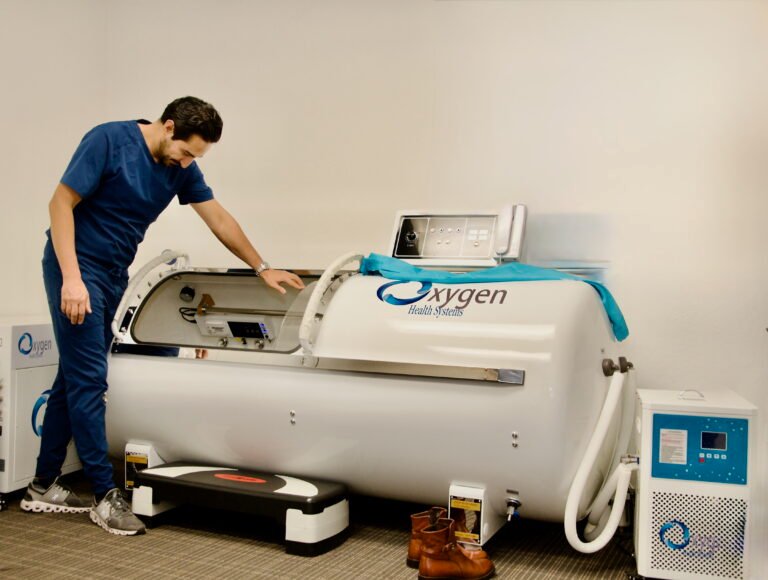
You relax inside a modern, spacious acrylic chamber — watch a video, listen to music, or rest. As it pressurizes to 1.5–2.0 ATA you may feel mild ear pressure, like descending in a plane; swallowing equalizes it quickly.
The active session
For roughly 60–90 minutes you breathe 100% oxygen under pressure while a trained technician maintains continuous visual and intercom contact. Most patients find it deeply relaxing.
Decompress & go
The chamber returns to normal pressure gradually and comfortably. Most patients feel calm or noticeably clearer afterward — and return to normal activities immediately. No downtime required.
Watch
A calm walkthrough of our HBOT chamber
An honest, step-by-step look inside — what pressurization feels like, how long sessions last, and what most patients experience. The goal is simple: reduce uncertainty so your first visit feels familiar and purposeful.
Honest clinical communication
Safety, candidacy — and what HBOT cannot do
HBOT is not the right tool for every patient or every condition. A detailed evaluation is always the first step.
Common & minor effects
- Mild ear pressure during pressurization — resolves quickly with swallowing
- Temporary fatigue after the first few sessions as the body adjusts
- Brief, uncommon light-headedness right after a session
- Mild sinus discomfort if you arrive congested
Serious complications are rare and minimized through screening, supervision, and clinical protocol.
Tell us before starting if you have
- An untreated collapsed lung (pneumothorax) — an absolute contraindication
- Certain ear or sinus conditions
- An active respiratory infection
- Certain medications, including some chemotherapy drugs
- Pregnancy, significant claustrophobia, or a seizure history
These are discussed openly during your evaluation — candidacy and safety come before any protocol.
The pathway
HBOT is never a standalone service
It’s always embedded in a care pathway that begins with your neurology, not just your symptoms.
Evaluation first
A thorough functional neurological exam — neurovascular and autonomic function, cognitive and vestibular performance, brainstem integration, and review of prior imaging and labs. We never schedule sessions before this.
Personalized plan & trial
Dr. Chizari sets your target pressure, session length, frequency, and phase length (commonly 20–40 sessions). Your first session is always a supervised trial to confirm how you respond.
Treatment & outcome review
Sessions run 2–5 times weekly with built-in clinical check-ins. At the end of the series, a formal re-evaluation compares objective markers to your baseline — and you decide together on next steps.
A patient story worth sharing
Marcus, 38 — Thousand Oaks
Details changed to protect privacy; shared with permission. Representative of possible outcomes — not a guarantee of any specific result.
Fourteen months after a moderate car accident, Marcus had been cleared by two ER physicians and told his imaging looked fine — but he couldn’t hold a complex thought, his reading comprehension had collapsed, and he woke exhausted after ten hours of sleep. Two neurologists suggested anxiety. His evaluation with Dr. Chizari told a different story: significant asymmetries in cerebellar timing, suppressed smooth-pursuit eye control, and patterns consistent with neurovascular dysfunction after TBI. He began 30 sessions of HBOT at 1.75 ATA alongside cognitive rehabilitation and LLLT. By session twelve, his first fully present afternoon in a year. By twenty-five, back to work full-time — with measurable improvement across every compromised domain at outcome review.
“I had started to believe this was just who I was now. I can’t explain the relief of finding out that wasn’t true.”
Common questions
Frequently asked questions
Is Hyperbaric Oxygen Therapy FDA-approved?
HBOT holds FDA clearance for a specific list of conditions — including carbon monoxide poisoning, certain wound-healing disorders, radiation injury, and decompression sickness. For neurological applications such as post-concussion syndrome and TBI, it’s increasingly used as an off-label but evidence-supported approach. Dr. Chizari will discuss the research and clinical rationale specific to your situation.
How many HBOT sessions will I need?
For neurological and brain-injury conditions, most protocols involve 20–40 sessions in the initial phase, and some patients benefit from a longer series or maintenance schedule. The exact number is set by your evaluation findings, your response to early sessions, and your goals — not a fixed package.
Can I combine HBOT with treatments I’m already receiving?
In most cases, yes — HBOT is designed to complement other evidence-based neurological and rehabilitation therapies. It’s important that Dr. Chizari has a complete picture of your current medications and treatments to rule out contraindications, so transparency during intake is essential.
Will HBOT feel claustrophobic?
Most patients are pleasantly surprised by how comfortable the chamber is — modern, spacious, and transparent, so you can watch a video, listen to audio, or rest. Patients with significant claustrophobia are identified during intake and the approach is adjusted accordingly.
How soon will I notice results?
It varies by individual and condition. Some notice subtle improvements in clarity or energy within the first five to ten sessions; for others, changes are gradual and clearest when comparing objective testing at the end of the series. HBOT is a process, not a single-session fix — approach it with realistic expectations.
Does insurance cover HBOT for brain injury?
Coverage varies significantly by carrier and diagnosis codes. Our team can help you understand your coverage and what documentation may support a claim. Call our office at (818) 649-5300 to discuss financial considerations before your evaluation.
A final, honest word
Not a cure. Not a promise.
A better environment to heal.
HBOT gives the body’s own repair systems a better environment to work in — for the right patient, in the right clinical context. If you’ve been struggling with the aftermath of a brain injury, a concussion that won’t clear, or a recovery that simply stalled, Dr. Chizari will look carefully at what’s actually happening and build the most intelligent path forward — never sell you a service you don’t need.
California Brain & Spine Center · 4768 Park Granada, Ste 107, Calabasas, CA 91302 · Serving Los Angeles, Thousand Oaks, Malibu & surrounding communities