Non-invasive · Non-drug · Calabasas
Brain Fog Treatment
Calabasas
When the haze will not lift, the first step is finding out what is driving it.
Does it feel as if a heavy cloud sits between you and your own thoughts? Can't find the right word, finish a sentence, or focus on the road? Brain fog can follow a concussion, long COVID, hormonal changes, stress or poor sleep. Brain fog treatment here starts with the why. Dr. Alireza Chizari, DC, DACNB, a Board-Certified Functional Neurologist, looks for what is driving the haze and builds a plan around what the evaluation finds.
The quick, honest answer
Brain fog treatment at a glance
What it is
A cluster, not a disease
Brain fog is not a diagnosis in itself. It is a term for a range of symptoms that affect thinking. These can include trouble concentrating, forgetfulness, losing your train of thought, not finding the right words, slowed thinking and mental exhaustion (Cleveland Clinic).
Who it may help
When the haze won't lift
People whose fog followed a concussion, long COVID, hormone shifts, chronic stress or burnout, especially those who were told their tests look "normal" while daily life clearly isn't.
Your next step
Find the driver first
A structured evaluation looks at your thinking, your vestibular (inner-ear balance) system and your autonomic (automatic body functions) system to see what may be driving the fog. Brain fog itself has no single specific treatment, so care is aimed at the likely cause.
Is it really "just stress"?
What brain fog actually feels like
Patients bring these complaints most often. Each one can seem minor. Together they can derail work, study, sport and relationships.
Slowed Processing
Everything takes longer: reading, replying, deciding. It feels like thinking through mud
Short-Term Memory Slips
Misplaced keys, missed appointments, losing the thread of what you just read
Word-Finding Trouble
The word is right there, and then it isn't. Sentences stall mid-thought
Trouble Concentrating
Focus slips partway through a task, even one you do every day
Mental Exhaustion
Drained after modest tasks, such as a meeting, an errand or a single focused hour
Losing Your Train of Thought
Drifting out of conversations, or losing the point halfway through a sentence
After a concussion, brain fog can come with other thinking symptoms, such as memory problems or feeling slowed down. If dizziness is part of your picture, see our dizziness specialist program in Calabasas.

Why it happens
Brain fog is a symptom, not a diagnosis
Brain fog is a term for a range of thinking symptoms, and it has many possible causes. One normal test result does not explain it. The evaluation therefore looks at how several systems are working together.
- Brain fog can be associated with lack of sleep, stress, hormonal changes such as menopause, autoimmune conditions, low blood sugar, mental health conditions and long COVID. After a concussion, thinking symptoms can include feeling foggy, slowed down, or having trouble with attention and memory (CDC).
- People with POTS often describe their thinking difficulties as brain fog. In some, fog when upright may be associated with increased fight-or-flight nervous system activation (published study).
- Brain fog is among the symptoms that most distinguish long COVID, alongside post-exertional malaise, fatigue and dizziness (NIH).
- How long brain fog lasts varies with the cause, which is why the evaluation comes before any plan.
Finding the driver
Our six-step brain fog evaluation
Each part of the 120-minute neurodiagnostic assessment looks for what may be causing the fog, not only the label.
Detailed case history
Triggers, timeline, lifestyle, sleep and current medications. Your history often points to where to look.
Neuro-cognitive screening
Processing speed, working memory and executive function are measured objectively rather than estimated.
Eye-tracking & vestibular testing
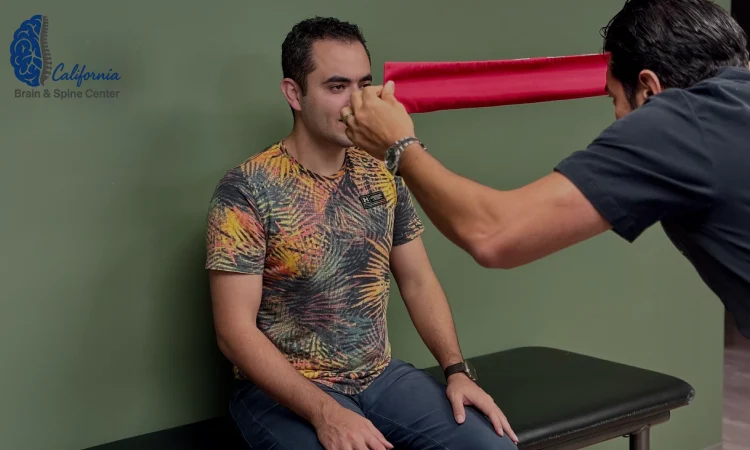
Video oculography records how your eyes track and hold focus, alongside testing of the inner-ear balance system.
Balance & gait analysis
Balance and walking are measured with objective metrics rather than judged by eye.
Autonomic & heart rate variability (HRV) assessment
Heart-rate and autonomic responses are checked, including how you respond to standing. See how brain fog shows up in POTS.
Labs, imaging & referral
Results you already have are reviewed. When findings point outside functional neurology, labs or imaging are coordinated with your primary care provider or medical neurology.
Watch
Stuck in a mental haze? The way out
In one minute: how cognitive performance is measured, and how targeted stimulation may be used when clinically appropriate after evaluation.
Personalized care
Brain fog treatment options
Your plan may include the options below, when clinically appropriate after evaluation. It is never a fixed protocol. No single program can be promised to work. In an NIH randomized trial (RECOVER-NEURO), the rehabilitation approaches tested for long COVID brain fog did not prove effective.

Is this right for you?
Why conservative care, and who it fits
You may be a good candidate if
- Fog has lingered more than a few weeks after a head injury (see cognitive therapy for brain fog after a brain injury)
- You struggle to concentrate on screens or reading for long
- Word-finding problems appeared that weren't there before
- Dizziness or imbalance comes with the mental fatigue
- You're a student-athlete whose grades or reaction times dropped
- You feel "off" after long COVID or sustained stress and burnout
If brain fog lasts more than a few weeks, keeps getting worse, or comes with new symptoms, it is worth an evaluation, especially when it disrupts your daily routine. No recovery timeline is promised. Any plan is set after your evaluation.
Why non-surgical care makes sense here
- No incisions, no anesthesia and no downtime
- Cause focus: care follows your findings, because brain fog itself has no single specific treatment
- Retesting: objective measures are repeated so the plan can be adjusted
- Coordination: return-to-learn and return-to-work guidance, plus referral to your primary care provider or medical neurology when findings point there
If symptoms come on suddenly or severely - a sudden severe headache, weakness, trouble speaking, vision loss, or fainting - that is an emergency. Call 911 or go to an emergency room, not a clinic appointment.
After a head injury, the CDC also lists these danger signs that need emergency care: a headache that gets worse and does not go away, repeated vomiting, seizures, increasing confusion, or drowsiness and being unable to wake up.
Clinic questions
A question patients often ask
Answered by Dr. Chizari.
One question patients often ask me is whether their brain fog is real when their tests have come back normal. Brain fog is a term for a range of symptoms that affect thinking. It is not a diagnosis in itself, so one normal result does not explain it. The evaluation looks at attention, memory, eye movements, balance and how your nervous system responds to standing. Then we go through what the findings suggest and what they do not.
Your first visit is the 120-minute neurodiagnostic assessment. Findings are recorded as numbers, so later retesting can show what has changed and what has not. To read more first, see treatment options for brain fog after illness or injury.
Common questions
Frequently asked questions
How do you tell brain fog apart from ADHD or early dementia?
Cognitive testing, eye-movement and vestibular screening, and your history can show whether the pattern fits brain fog or points somewhere else, such as lifelong attention differences or a neurodegenerative condition. If findings suggest another diagnosis, Dr. Chizari refers you to your primary care provider or medical neurology. An honest answer matters more than keeping you here.
Do I need an MRI or CT scan?
Not always. Whether imaging makes sense depends on your history and exam. When it does, it is arranged through your primary care provider or medical neurology. Sudden one-sided weakness, a seizure or a severe new headache is different: those need emergency care first, not a scheduled scan.
How long until I feel clearer?
It depends on the cause, and no timeline is promised. Brain fog is a symptom with many possible causes, and how long it lasts varies with that cause. If fog lasts more than a few weeks, keeps getting worse, or comes with new symptoms, it is worth an evaluation. Your own retesting guides the plan, not an average.
Do you offer brain fog treatment near Pacific Palisades and Venice?
Yes. California Brain & Spine Center is in Calabasas and serves Pacific Palisades and Venice. It also serves the Westside, including Bel Air, Westwood and Mar Vista. If you searched for brain fog treatment near me anywhere in Los Angeles, the first step is the same 120-minute neurodiagnostic assessment.
Can I keep working during treatment?
Usually, yes. Many people continue working or studying during care. Sessions can often be scheduled before or after work hours. The home program is designed to fit into a normal day without overloading your nervous system.
Is brain fog treatment covered by insurance?
Coverage varies by plan and diagnosis codes, so there is no single answer. Contact our office before your first visit, and we'll help you understand your benefits, what your plan may cover and what documentation may support a claim before care begins.
Clear the cloud
Find out what is driving
your brain fog.
Your haze may have begun after COVID-19, a sports injury, hormone changes or months of unrelenting stress. Whatever the start, the first step is finding out what may be driving it. Dr. Chizari offers non-surgical brain fog treatment in Calabasas for people from the San Fernando Valley to the Westside of Los Angeles.
California Brain & Spine Center · 4768 Park Granada, Ste 107, Calabasas, CA 91302
This content is for educational purposes only and is not medical advice. Consult a qualified healthcare provider about your specific situation.