
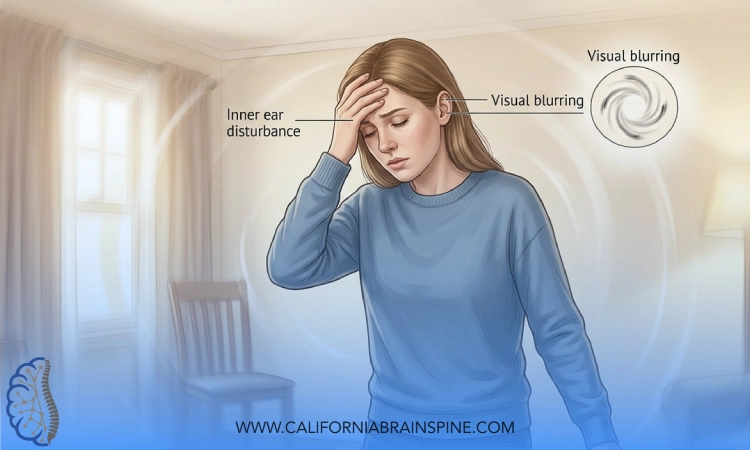
Months of constant dizziness, a clean MRI, and nobody explaining the rest: this is the part that usually goes missing.
Why am I dizzy all the time when every scan comes back clean? The likeliest explanation is not something the scan missed. It is how your brain is combining the balance signals arriving from your inner ears, your eyes and your neck. The most common cause of chronic vestibular symptoms is a functional disorder, meaning the balance hardware is intact while the processing has not recalibrated, and current models put constant dizziness in exactly that place. That is the honest answer to "why am I dizzy all the time," and it is the one almost nobody is handed after normal imaging.
I, Dr. Alireza Chizari, DC, DACNB, a board-certified chiropractic neurologist practicing functional neurology at California Brain & Spine Center in Calabasas, see one kind of patient more than any other. They have been dizzy all the time for months. They have had an MRI, blood work, an ECG, sometimes a tilt table. Everything came back normal. They were told it was probably anxiety, or dehydration, or that they should give it time.
They are usually not reassured by that, and they are right not to be. Normal structural imaging rules out a small number of serious things. It says very little about how the brain is processing balance information, which is where most persistent dizziness actually lives. This guide walks through what constant dizziness usually turns out to be, the ten neurological causes worth checking, and what a proper evaluation looks at once the scans are clean.
Key Takeaway
Constant dizziness is rarely one thing. Current models put it in how the brain combines signals from the inner ear, the eyes and the neck, rather than in damage a scan can show. That is why imaging can come back normal while the symptom stays, and it is also why the problem is usually testable.
Why Do I Feel Dizzy All the Time?
The most common cause of chronic vestibular symptoms is persistent postural-perceptual dizziness, a functional disorder rather than a structural one. Current models describe a brain trying to weight inner-ear, visual and neck signals that no longer agree. Imaging does not show any of that, which is why a scan can come back clean while constant dizziness stays.
Most common is not the same as only, and constant dizziness has more than one route into it. The specific reason still matters, because what helps differs completely depending on which system is involved, and that is what the rest of this guide works through.
What happens when the balance signals disagree
Your sense of balance is not produced by the inner ear alone. The National Institute on Deafness and Other Communication Disorders describes it as a series of signals reaching the brain from several organs at once: the eyes, the ears, and the muscles and touch sensors in the legs. Three streams of information, one continuous answer to the question of where your head is in space.
The brain does not average those streams. It weights them, moment to moment, according to which one it currently trusts. Stand on a firm floor in good light and vision does most of the work. Walk across sand in the dark and the inner ear and the legs take over. That re-weighting is meant to be automatic and invisible.
Chronic dizziness is what it feels like when the re-weighting stops working well. Current models of persistent dizziness point at exactly this: researchers describe altered predictive processing of sensory input and changes in motion perception, and a more recent model proposes that the nervous system starts prioritizing postural stability over fluid, automatic movement. In plainer words, the system stops trusting its own sensors and begins bracing instead. Bracing is expensive, it is conscious, and it feels like being slightly off balance all day.
When constant dizziness is something else
Not every case follows that pattern, and the exceptions are worth naming early. MedlinePlus lists common causes that may include a sudden drop in blood pressure, dehydration, getting up too quickly, certain medicines, inner ear problems such as Meniere's disease or benign paroxysmal positional vertigo, motion sickness, migraines, and a head injury or ear surgery. Dizziness also becomes more common with age, partly because people accumulate both health conditions and medications.
Cardiovascular causes of constant dizziness deserve their own line. Problems that affect blood flow to the brain, such as an irregular heartbeat, low blood pressure or narrowed arteries, may make you feel dizzy, which is why I want that work done, or at least considered, before anyone pursues a neurological explanation. It belongs with your primary care provider or a cardiologist rather than with me.
What Kind of Dizzy Are You?
"Dizzy" is one word doing at least four jobs, and the confusion costs people more time than almost anything else I see.
Dizziness is a lightheaded, woozy or unsteady feeling, while vertigo is the false sense that you or the room is spinning even when nothing is moving. MedlinePlus draws that distinction first for a reason: it is the sorting question worth answering before any test is run.
Four patterns, and each points somewhere different:
- Spinning. You or the room turns. This points toward the vestibular system, the balance apparatus of the inner ear and its connections into the brain.
- Lightheadedness. The sense that you might faint. This points more toward blood flow and the autonomic nervous system, the automatic machinery behind heart rate and blood pressure.
- Unsteadiness. Wobbling on your feet with no spinning at all. This suggests the integration of balance signals rather than any one sensor.
- Floating or detachment. A "not quite here" feeling, often worse in busy visual environments. This is a fourth pattern again, and it has its own name and its own criteria.
Describing which one you have is ten minutes well spent before an appointment. "Dizzy all the time" narrows nothing. "I feel like I am on a boat, worse in supermarkets, better when I lie down" narrows it to two or three possibilities immediately.
Constant dizziness is also common. NIDCD reports that about 15 percent of American adults, roughly 33 million people, had a balance or dizziness problem in 2008. Whatever the current figure is, constant dizziness is not a rare complaint, and it is not a complaint anyone should have to argue their way into being taken seriously.

What Are the 10 Neurological Causes of Dizziness Worth Checking?
These are the ten neurological causes of dizziness I look for most often in people who have been dizzy all the time for months with normal tests. They are not equally common, and more than one is frequently present at the same time. None of them is a diagnosis you can give yourself from a list, which is the point of the evaluation described further down.
1. Vestibular migraine
This is the cause I see missed most often in people who are dizzy every day without spinning attacks. Vestibular migraine is migraine expressed through the balance system rather than through head pain. In my experience the connection is often only made once someone is asked about their headache history directly.
The Barany Society diagnostic criteria describe a diagnosis built on recurrent vestibular symptoms, a history of migraine, a temporal association between the two, and the exclusion of other causes. Qualifying symptoms include head-motion-induced dizziness with nausea, and acute episodes last between five minutes and seventy-two hours at moderate or severe intensity. Between episodes, many of the patients I see describe a low-grade background unsteadiness that never fully clears.
2. Benign paroxysmal positional vertigo
BPPV produces short, intense spinning triggered by a specific change in head position: rolling over in bed, lying back, looking up. NIDCD describes it as occurring when loose otoconia, the tiny crystals of the inner ear, tumble into one of the semicircular canals and interfere with how the canal reports movement. It can follow a head injury, or develop simply with age.
Each episode is brief and intense, which is how NIDCD describes it, and each one is tied to a specific change in head position rather than running through the day. BPPV is mechanical, and repositioning maneuvers are the usual approach. If your dizziness is position-triggered and short-lived, read our guide to positional vertigo and BPPV home maneuvers before assuming anything more complicated. What BPPV does not explain well is constant dizziness that runs all day with no positional trigger at all.
3. Persistent postural-perceptual dizziness
PPPD is the diagnosis that fits a large number of the "dizzy all the time, tests normal" group, and it is the one patients tell me they have never heard of.
The Barany Society consensus criteria for PPPD describe dizziness, unsteadiness or non-spinning vertigo present on most days for three months or more, made worse by upright posture, by active or passive movement, and by moving or complex visual stimuli. The same document classifies it as a chronic functional vestibular disorder and states plainly that it is not a structural or psychiatric condition. It may be precipitated by anything that disrupts balance, including a peripheral or central vestibular disorder, another medical illness, or psychological distress.
Two things follow from that. The first is that a normal MRI does not argue against it. The second is that it may be precipitated by an earlier vestibular event that has since settled, such as a bout of BPPV or of labyrinthitis, which is inflammation in the inner ear system responsible for hearing and balance. If crowded supermarkets, scrolling on a phone, or freeway driving reliably make you worse, this belongs on the list.
4. Post-concussion syndrome and mild traumatic brain injury
Lightheadedness, dizziness, vertigo and loss of balance or coordination are recognized symptoms of traumatic brain injury, and the National Institute of Neurological Disorders and Stroke defines post-concussion syndrome as involving symptoms that last for weeks or longer. Weeks or longer is the institute's own phrasing, and it is deliberately not a prediction about any one person.
What often lingers is something imaging does not show. A review of vestibulo-ocular dysfunction after mild traumatic brain injury reports that people frequently describe dizziness, fatigue and brain fog after a concussion, that those symptoms are associated with the development of chronic symptoms, and that objective impairments are commonly found on testing of smooth pursuit, saccades, vergence, the vestibulo-ocular reflex and visual motion sensitivity. A separate review names BPPV, vestibulo-ocular reflex impairment, visual motion sensitivity and balance impairment as the most common vestibular disturbances after a sport-related concussion. Many patients date their constant dizziness to a head impact months or years earlier and were told at the time that they were fine, which was true of the scan and not of the symptom. Our concussion treatment in Calabasas is built around this specific pattern.
5. POTS and autonomic nervous system disorders
If your constant dizziness is lightheadedness rather than spinning, is worse on standing, worse in heat, worse in the shower, and better lying down, the autonomic nervous system deserves attention. Dehydration sits on MedlinePlus's list of common causes of dizziness too, and telling the two apart comes before anything else is assumed, which is what our guide to POTS or dehydration works through.
NINDS describes orthostatic intolerance as symptoms that appear on standing and are relieved by lying down, with dizziness and fainting among the common ones. In postural tachycardia syndrome specifically, NINDS describes a heart rate that may increase by more than 30 beats per minute, or exceed 120 beats per minute, within ten minutes of standing, with a threshold of at least 40 beats per minute in adolescents. NINDS also names fainting and palpitations among the symptoms that often occur on standing.
That is a description, not a self-test. Diagnosis, including the tilt table test, belongs to the medical work-up. Where an autonomic pattern is part of the picture, our POTS treatment in Calabasas and dysautonomia care describe how it is assessed here and what falls outside our scope.
6. Central vestibular involvement
Some chronic dizziness originates in the brainstem and cerebellum rather than the inner ear. The clues I look for are different: dizziness that fits no positional pattern, difficulty with fine coordination, changes in speech, double vision, or unsteadiness that is markedly worse in the dark.
This category is the reason a careful neurological examination still matters when imaging is normal, and the reason some findings warrant onward referral to medical neurology rather than rehabilitation. Our guide to central vs peripheral vertigo sets out how that split is made in the examination room and what each side means for the plan when chronic dizziness is the presenting problem.
In my experience it is also an uncommon explanation for someone who has been dizzy all the time for a year with nothing else changing, which fits the wider picture that the most common cause of chronic vestibular symptoms is persistent postural-perceptual dizziness, a functional disorder rather than a structural one. That is a statement about which explanation is commonest, not a reason to skip the examination, which is why the clues above are checked in person rather than inferred from how long the constant dizziness has lasted.
7. Cervicogenic dizziness
The upper neck carries a dense supply of position sensors. A narrative review of proprioceptive cervicogenic dizziness describes their input as being integrated with the visual and vestibular systems in the central nervous system to keep the head, eyes, neck and body moving together, and describes cervicogenic dizziness as what may occur when that cervical input changes and conflicts with the other two.
What the research actually pairs together is dizziness and neck pain. The syndrome is defined by that combination, which is why the neck earns a specific look when chronic dizziness arrives alongside neck pain, and why it can be set aside when it does not.
Honesty matters here more than in most of this list. Cervicogenic dizziness is a clinical syndrome of dizziness with associated neck pain, it has no definitive clinical or laboratory test, and it is therefore a diagnosis of exclusion, one that requires vestibular, medical and vascular causes to be ruled out first. That makes it both easy to miss and easy to over-apply. In my experience neck contribution is common and is rarely the whole story on its own, and it is worth assessing specifically in anyone whose dizziness began after a car accident, a fall, or a long stretch of sustained screen posture.
8. Anxiety and autonomic hypervigilance
This one needs care, because it is the explanation most patients have already been handed dismissively.
The research does not describe anxiety creating persistent dizziness out of nothing. What it describes is closer to maintenance than to cause: early models of persistent postural-perceptual dizziness emphasized the adverse effects of anxiety on postural control and spatial orientation, and current models add altered predictive processing of sensory input. A third-generation model adds the nervous system prioritizing postural stability over fluid, automatic movement. What that looks like in clinic is a person leaning harder on vision, holding the postural muscles tight, and monitoring balance consciously rather than automatically.
That is a genuine neurological mechanism and a modifiable one. It is not a way of saying the symptom is imagined, and nobody should have to hear it framed that way.
9. Medication effects and metabolic contributors
Certain medicines are a recognized cause of chronic dizziness, and NIDCD puts the question first in the work-up: the first thing a clinician does with a balance problem is establish whether another health condition or a medication is responsible. NINDS makes the same point specifically for autonomic symptoms, listing anti-depressants, anti-psychotics, some blood pressure and heart medications, and diuretics as drugs that may cause or worsen them, and advising that a healthcare provider be consulted before any medication is started or stopped.
I want to be exact about scope here. Medication management is not something this practice does, and nothing in this article is a reason to change a prescription. What a medication review does is take a cheap, common explanation off the table early.
Two patterns are worth raising with the prescriber rather than filing away. The first is constant dizziness that began within a few weeks of starting or increasing a medication. The second is constant dizziness that arrived alongside fatigue and cold intolerance, or alongside heavy periods, where your primary care provider can decide whether basic blood work is warranted. Neither is glamorous, and in my experience both are missed regularly, because the symptom sounds neurological and gets routed accordingly.
10. Visual-vestibular mismatch and sensory integration problems
The final category is where several of the others converge. When the visual system and the vestibular system disagree about what is happening, and the brain has come to lean too heavily on vision, ordinary environments turn provocative: supermarket aisles, patterned floors, scrolling screens, passenger travel.
This is measurable, and it is the kind of thing targeted retraining is designed for. Our NeuroSensory Integration approach is built around it.
A normal MRI does not mean nothing is wrong. It means nothing structural is wrong, which is a much smaller statement than most people are led to believe.
Why Am I Dizzy All the Time but My Tests Are Normal?
This deserves its own section, because "why am I dizzy all the time but my tests are normal" is the sentence I hear most.
Standard testing is built to find structural and acute problems: tumors, strokes, bleeds, severe inner ear damage, cardiac arrhythmia. Those are the things that must not be missed, and ruling them out matters. Once they are excluded, though, the testing has done its job and stopped.
What it has not examined is function. Whether your eyes hold a target steadily while your head moves. Whether your gaze returns accurately after a rapid movement. Whether your postural sway increases disproportionately when you close your eyes or stand on foam. Whether your pupils respond normally. Whether your heart rate and blood pressure behave appropriately across a full ten-minute stand.
Those are measurable and repeatable, and none of them is what a scan is looking at. After a mild traumatic brain injury, objective impairments are commonly found on exactly this kind of eye-movement and visual-motion testing. The consensus criteria for PPPD make the same point from the other direction by classifying it as a functional vestibular disorder that is neither structural nor psychiatric. The gap between "no structural disease" and "functioning normally" is a gap standard imaging was never designed to look into, and it is where a functional vestibular disorder sits.
Dizzy Every Day, With a Folder of Normal Test Results?
A structured evaluation measures what the scans did not: gaze stability, postural sway, visual dependence, and how your heart rate behaves across a full ten minutes of standing. Calabasas, California.
How Do You Stop Feeling Dizzy Every Day?
Two habits, in my experience, tend to keep chronic dizziness going, and both feel entirely sensible while you are doing them.
Avoidance is the first. Stopping driving, skipping the supermarket, avoiding the gym, holding your head still, gripping handrails, moving carefully. Each of those reduces symptoms in the moment, and the patients I see who have leaned on them longest tend to have the smallest tolerable range left. That fits how the field understands recovery: vestibular rehabilitation methods were developed to enhance adaptation to vestibular loss, habituation to changing sensory conditions, and sensory reweighting during compensation. Every one of those depends on exposure to the signals the system finds difficult.
Conscious balancing is the second. Once constant dizziness feels dangerous, people start monitoring their own stability deliberately: checking the floor, watching their feet, thinking about each step. The current PPPD model describes the same thing at the level of the nervous system, as postural stability being prioritized over fluid, automatic movement. In my clinic, people often report being steadier when distracted and worse when concentrating on not falling.
What tends to help is the reverse of both:
- Graded re-exposure to the movement that provokes symptoms, dosed so that symptoms rise mildly and settle rather than build through the day. There is moderate to strong randomized-trial evidence that vestibular rehabilitation is a safe and effective approach for unilateral peripheral vestibular dysfunction, with no reported adverse effects; for BPPV specifically, repositioning maneuvers work better in the short term than exercises alone. The same field review notes that vestibular rehabilitation is often used unspecifically, irrespective of the clinical findings, which is the argument for assessing before prescribing exercises. Our vestibular rehab therapies follow that distinction.
- Reducing visual dependence by practicing balance tasks with the eyes closed or on softer surfaces, where it is safe to do so.
- Consistent sleep and hydration. MedlinePlus lists dehydration among the common causes of dizziness and vertigo, and sleep is the variable patients in my clinic most often report a difference from.
- Addressing any migraine pattern that is running alongside, since unaddressed migraine physiology can limit progress on everything else.
Down-regulating a heightened threat response has a role here too, though it is important to say what the evidence actually covers. Relaxation techniques research summarized by NCCIH describes practices that bring about the body's relaxation response, meaning slower breathing, lower blood pressure and a reduced heart rate, and a 2018 review of sixteen studies in people with anxiety disorders found relaxation therapy reduced symptoms of anxiety, depression, phobia and worry. That is evidence about anxiety, not about chronic dizziness. It supports the retraining rather than substituting for it.
How Do You Read Your Own Dizziness Pattern?
Timing and triggers separate an inner-ear problem from a central one better than severity does. Brief spinning provoked by specific head positions points at the inner ear. Constant dizziness worsened by upright posture, by motion and by busy visual environments points at central processing. Coordination changes, speech changes or double vision alongside dizziness need prompt medical assessment instead of either, and our guide to when dizziness needs an MRI sets out which findings make imaging the next step rather than rehabilitation.
Before any appointment, the table below is worth ten minutes. The pattern narrows the field of constant dizziness faster than any single test, and it gives whoever sees you something better to work with than "dizzy all the time."
| What you experience | Pattern that points somewhere specific | What the evaluation looks at |
|---|---|---|
| Brief, intense spinning | Triggered by rolling over or looking up; brief each time | Positional testing for each semicircular canal |
| Constant floating or rocking | Worse standing, in crowds and on screens; better lying down | Visual dependence and postural sway measurement |
| Lightheaded on standing | Worse in heat and showers; heart rate climbs on standing | Ten-minute orthostatic heart rate and blood pressure response |
| Dizziness with head pain or nausea | Episodes of five minutes to three days; head-motion sensitive | Migraine history, eye movement and gaze stability testing |
| Dizziness with neck pain | Neck pain and the dizziness arrive together rather than separately | Upper cervical assessment and neck-eye reflex testing |
| Unsteady, worse in the dark | Coordination or speech changes, or double vision alongside | Cerebellar and brainstem examination, referral if indicated |
Dizziness that needs urgent care, not an appointment
If symptoms come on suddenly or severely, a sudden severe headache, weakness, trouble speaking, vision loss, or fainting, that is an emergency. Call 911 or go to an emergency room, not a clinic appointment. MedlinePlus is explicit on the same point: get emergency help right away if you have sudden or severe dizziness or vertigo along with vision problems, slurred speech or weakness, because these may be signs of a more serious condition.
Alongside new or severe dizziness or vertigo, treat these as urgent too:
- Loss of feeling or movement in an arm or a leg, or weakness on one side.
- Stumbling or trouble walking, or a new inability to coordinate your limbs.
- Loss of feeling or weakness in the face, or slurred speech.
How Is Constant Dizziness Evaluated in Calabasas?
At California Brain & Spine Center, the dizziness evaluation in Calabasas is built to measure the things standard testing skipped. My background was in electrical engineering before it was in healthcare, and the habit that carried over is simple enough: measure the system before you adjust it.
Depending on the history, an assessment may include eye movement recording and gaze stability testing, positional testing for each semicircular canal, computerized balance and postural sway measurement under altered visual and surface conditions, visual-vestibular integration testing, upper cervical assessment, pupillary responses, and an orthostatic screen, meaning heart rate and blood pressure measured across a full ten minutes of standing rather than a quick check. Any of these may be included when clinically appropriate after evaluation, not as a fixed menu.
The point is not to collect tests. It is to establish which system is producing the symptom, because vestibular migraine, BPPV, PPPD and autonomic dizziness look similar from the outside and are managed completely differently. Where the findings point outside our scope, referral to medical neurology or back to your primary care provider is the right answer, and I will say so rather than treat around it.
Care from there may draw on vestibular retraining, or, where cognitive symptoms travel alongside, on brain fog treatment in Calabasas. Patients reach the clinic from across Calabasas, Encino and the wider Los Angeles area, and the first step is the same for all of them: a detailed evaluation before anything is recommended.
What a typical case looks like
Cases like this are common in our Calabasas clinic. Someone in their mid-forties, working long hours in law, has been dizzy all the time for fourteen months. Not spinning. The description is that the floor feels slightly soft, all day, every day, and that the supermarket has become something to avoid because the aisles make it worse.
The MRI, the cardiology work-up and the blood work were all normal. They were told it was stress, which they found insulting, and then anxiety, which they had reluctantly started to believe. They were still working full days, describing themselves as operating at about sixty percent, and had stopped raising it with anyone.
In cases like this, the history usually contains the detail that matters. In a case like this it is that the whole thing started after a viral illness with two days of genuine spinning that then settled, which is a classic setup for PPPD. Testing of that kind of patient often shows strong visual dependence, with postural sway increasing markedly on an unstable surface, and impaired gaze stability during rapid head movement. Nothing structural, and everything measurable.
Care in a case like that focuses on graded visual-vestibular retraining rather than avoidance, alongside addressing the visual-dependence habit directly. What tends to follow is partial and meaningful rather than total: supermarket tolerance returning, background floating easing without disappearing. In my experience that pattern is typical for PPPD, and it depends entirely on what the evaluation finds. It is not something anyone can promise in advance.
Your Most Common Questions About Being Dizzy All the Time
Why am I dizzy all the time but my tests are normal?
Standard tests look for structural disease: strokes, tumors, severe inner ear damage. The most common cause of chronic vestibular symptoms is persistent postural-perceptual dizziness, a functional disorder: the balance hardware is intact while the brain's integration of inner ear, visual and neck signals has not recalibrated. That is measurable with different testing, and not with an MRI.
Can anxiety alone cause constant dizziness?
Research does not describe anxiety creating persistent dizziness out of nothing. Early models of persistent postural-perceptual dizziness describe anxiety acting on postural control and spatial orientation, which is closer to maintaining constant dizziness than to starting it. That is a real neurological mechanism, and mechanisms can be worked with.
Can dizziness after a concussion last for months?
Dizziness is among the recognized symptoms of traumatic brain injury, and NINDS defines post-concussion syndrome as symptoms lasting weeks or longer. Reviews of vestibulo-ocular dysfunction after mild traumatic brain injury report that people frequently describe dizziness, fatigue and brain fog afterwards, and that objective impairments are commonly found on eye-movement and visual-motion testing, which imaging does not assess.
When should I see a specialist for chronic dizziness in Calabasas or Los Angeles?
Consider an evaluation if constant dizziness has lasted more than a few weeks, if it is affecting driving, work or shopping, or if you have been told your tests are normal without being given an explanation. Call California Brain & Spine Center at (818) 649-5300. Sudden dizziness with neurological signs needs emergency care instead.
Does being dizzy all the time mean something serious?
Usually not. The most common cause of chronic vestibular symptoms is persistent postural-perceptual dizziness, a functional disorder rather than a dangerous one, and being dizzy all the time for months with no other neurological signs fits that picture. The patterns that warrant urgency are sudden onset, one-sided weakness, and speech or vision changes.
Normal imaging rules out structural disease. It does not tell you how your balance system is working.
If you have been dizzy all the time for months and nobody has measured anything beyond a scan, that gap is worth closing. I, Dr. Alireza Chizari, DC, DACNB, measure it directly, and I will tell you plainly when the answer belongs with someone else.
This content is for educational purposes only and is not medical advice. Consult a qualified healthcare provider about your specific situation.
California Brain & Spine Center | (818) 649-5300 | 4768 Park Granada, Ste 107, Calabasas, CA 91302
Bring Us the Pattern, Not Just the Word "Dizzy"
Describe when it started, what makes it worse, and what the scans showed. Dr. Alireza Chizari, DC, DACNB maps the rest. Book online or call the Calabasas clinic.