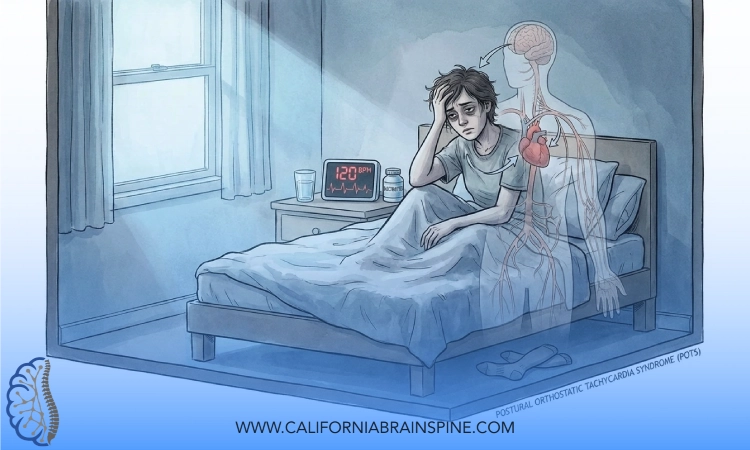
If you have POTS and wake up with a racing heart, your heart may race on the first stand of the morning because the heart-rate rise on standing tends to be larger early in the day, and many people with POTS have lower blood volume to meet it.
With POTS, a racing heart on waking often traces to the first stand of the day: the heart-rate rise on standing tends to be larger in the morning, and many people with POTS have lower blood volume to meet it. A pounding pulse within a few minutes of getting out of bed can shape the whole day before it has properly started.
I am Dr. Alireza Chizari, DC, DACNB, a Board-Certified Functional Neurologist, and I practice functional neurology at California Brain & Spine Center in Calabasas. Some of the people I see with POTS have slept a full night and still feel as though their body never switched off. Some have been told their tests are normal. Both of those experiences deserve a real explanation, and in my office the explanation starts with timing.
Timing matters because it changes what is worth checking. A heart that races on the first stand of the day points in one direction, a heart that wakes you while you are lying still points in another, and a racing heart with chest pain or fainting is a different matter altogether. If you would like the wider picture of the condition first, the practice's page on dysautonomia and POTS covers it, and the rest of this article stays with the night and the morning.
Key Takeaway
POTS can make your heart race on the first stand of the day because the heart-rate rise on standing tends to be larger in the morning, and many people with POTS have lower blood volume. A racing heart that wakes you while lying still has several possible causes, so it deserves an evaluation rather than an assumption.
POTS Waking Up With Racing Heart: Can POTS Cause It?
Yes, it can. With POTS, the first stand of the day matters: the heart-rate jump on standing tends to be larger in the morning, and lower blood volume, which many people with POTS have, can leave less blood to meet it. Other causes need ruling out, too.
The answer has two parts worth separating: what happens when you stand, and what happens while you are still asleep. They can feel alike at six in the morning, and they are checked in different ways.
The First Stand of the Day
POTS, short for postural orthostatic tachycardia syndrome, is a condition in which heart rate rises by at least 30 beats per minute (40 or more in people under 19) within 10 minutes of standing up from lying down. That threshold is the one described in a review by Lei and colleagues in the Cleveland Clinic Journal of Medicine.
The word doing the work in that definition is standing. After a night lying flat, getting out of bed is the first upright moment your body meets, and the same review reports that people with POTS tend to have a larger heart-rate jump on standing in the morning than later in the day. The same review notes that testing early in the day is preferred for that reason, because a morning test is more likely to catch the pattern.
Blood volume is the second piece. That review describes low circulating blood volume, called hypovolemia, in many people with POTS. With less blood in circulation, there can be less to meet that first stand, which is one way to understand why the pulse can climb so quickly in the minutes after you get up.
When the Racing Heart Wakes You While You Are Lying Down
A heart that pounds hard enough to wake you, before you have stood up at all, is a different pattern and deserves to be treated as one. A review of sleep in POTS, published in Autonomic Neuroscience, notes that some people with POTS describe hyperadrenergic (adrenaline-type) symptoms at night, such as palpitations, racing thoughts or heavy sweating, that keep them awake.
That same experience has everyday causes too. Anxiety or stress, caffeine, alcohol, an overactive thyroid, anemia, low blood sugar and dehydration can all make a heart race, so a pounding heart at three in the morning is a reason to look at the whole picture before putting the POTS label on it. People living with POTS and sleep problems can have more than one thing going on at once, and sorting those threads apart is most of the work.
A Racing Heart Every Morning Is Worth Understanding
If your mornings start with a pounding pulse, a complimentary consultation at the Calabasas office is a chance to talk through the pattern and decide together whether a full neurodiagnostic assessment makes sense.
Is POTS Worse in the Morning?
POTS can be worse in the morning, and research offers one clear reason: people with POTS tend to have a larger heart-rate rise on standing early in the day than they do later on.
People type "is POTS worse in the morning" into a search bar because they notice it long before anyone names it. You may find that getting dressed, standing at the bathroom sink, a hot shower or the walk to the car takes more out of you before noon than the same things do in the evening. You may have started planning meetings, school runs or errands for the afternoon without quite deciding to. That rearranging of the day is useful information, and it is worth writing down.
Why Morning Testing Gives a Clearer Picture
Because the standing heart-rate rise in POTS tends to be greater in the morning, the review in the Cleveland Clinic Journal of Medicine describes early-day evaluation as the way to get the most sensitive result. In practical terms, a heart rate measured while you sit in an afternoon appointment may not show the pattern that greets you at dawn, and a single reading taken lying down says little about what happens when you stand.
This is also why notes from home can be more useful than people expect. A pulse written down lying in bed and again after standing, on a few different mornings, gives a clinician something a one-off reading cannot.
Which POTS Symptoms Show Up First Thing in the Morning?
The POTS symptoms people describe to me in the first hour are usually the ones tied to standing: a fast or pounding heartbeat that starts once you are out of bed, which fits the research finding that the standing heart-rate rise tends to be larger in the morning. Some also describe feeling drained by small, ordinary tasks, such as standing in line or taking a shower, well before the day has really begun.
When lightheadedness or unsteadiness is a bigger morning problem than the heartbeat, the practice's page on dizziness covers that side of the evaluation.
A note on normal results
POTS is defined by what happens when you stand, measured over several minutes. A resting heart rate or a test done lying down can come back normal while the standing pattern goes unmeasured. A normal result tells you what was checked, and that is worth asking about before you conclude that nothing is there.
How Can You Tell Whether POTS Is Behind a Morning Racing Heart?
The timing of a racing heart is one useful clue: a heart that races after you stand points toward the pattern POTS is defined by, while one that wakes you lying still has a wider list of possible causes.
The table below sets out the patterns I ask about, what each can point toward, and what gets looked at. It is a way of organising a conversation, and none of the rows is a diagnosis on its own.
| Pattern | What it may point toward | What gets looked at |
|---|---|---|
| Heart races within minutes of getting out of bed | The standing pattern POTS is defined by, which tends to be stronger in the morning | Heart rate lying down and over the minutes after standing |
| A pounding heart wakes you from sleep, with racing thoughts or sweating | Night-time symptoms some people with POTS describe; stress or anxiety are also possible | The day-and-night pattern and what happens when you then stand |
| Worse after coffee late in the day or alcohol the evening before | Caffeine and alcohol, which can make the heart race on their own | The timing of symptoms against the evening before |
| Racing heart with no clear link to standing, day or night | Other causes such as an overactive thyroid, anemia, low blood sugar or dehydration | Checks arranged with the physician who manages your general care |
| Fainting is the main problem | Fainting is not a main feature of POTS, so other causes need investigating | A medical workup for fainting |
| Racing heart with passing out, chest pain or pressure, or trouble breathing | An emergency | Call 911 or go to an emergency room, not a clinic appointment |
It is common to recognise yourself in more than one row. A person can have POTS and still drink coffee late, carry a stressful day into the night and run low on fluids, and each of those can add to the pounding felt on waking. The value of the table is in noticing which row describes your worst mornings, because that is the row an evaluation starts from.
POTS and Sleep: How Does POTS Affect Sleep?
POTS can affect sleep: in a controlled study published in the Journal of Clinical Sleep Medicine, people with POTS reported more sleep problems, worse sleep adequacy and more fatigue than healthy controls.
A second, smaller study, in Frontiers in Neurology, found that people with POTS scored as sleepier and reported lower sleep quality on standard sleep questionnaires. The same researchers measured heart-rate variability, a reading of how the heartbeat is adjusted from moment to moment, across the stages of sleep, and found it reduced in people with POTS. Because the study was small, the fair reading is that the autonomic nervous system may behave differently during sleep in POTS, a possibility the research raises and has not yet settled.
The overlap between POTS and sleep has drawn enough attention to have its own review of the literature on sleep disturbances in POTS. For anyone who has wondered whether their exhaustion is just stress, that body of research is worth knowing about: poor sleep in POTS is something researchers measure and study.
POTS and Sleep Issues: What They Can Feel Like
POTS and sleep issues can take several shapes, and the shape matters more than the label. Lying awake wired but tired, aware of every heartbeat, is one. Falling asleep easily and then jolting awake in the small hours is another. Sleeping straight through and still getting up as though the night did nothing is a third, and it tends to puzzle people most, because on paper the sleep looks fine.
The words you use for your nights are worth keeping. "Wired but tired," "my heart races out of nowhere," "I slept nine hours and woke up exhausted": each describes a different part of the night, and each leads to different questions at an evaluation. When you describe your sleep to a clinician, use your own words rather than the ones you think they want to hear.
POTS and Insomnia: When Falling Asleep Is the Hard Part
Trouble falling asleep can be part of the POTS and insomnia picture. The review in Autonomic Neuroscience describes people whose palpitations, racing thoughts or sweating keep them up at night, which fits the wired-but-tired feeling people often put into words before anyone gives them a term for it.
Whether POTS can cause insomnia on its own is a fair question. The studies show more sleep problems in people with POTS than in healthy controls, without proving that POTS is the single cause for any one person. Stress, caffeine later in the day and alcohol in the evening can also make the heart race, and each of them can keep a person awake with or without POTS. That is why the questions at an evaluation cover the evening as well as the night.
Why You Can Wake Up Unrefreshed After a Full Night
Waking up unrefreshed after eight or nine hours in bed matches what the sleep studies above capture: people with POTS reported more fatigue and lower sleep quality than people without it. The small heart-rate variability study adds one possible piece, that the autonomic nervous system may behave differently overnight in POTS than it does in people without the condition.
What Else Can Wake You With a Racing Heart?
A racing heart on waking can have many causes besides POTS, including anxiety or stress, caffeine, alcohol, an overactive thyroid, anemia, low blood sugar and dehydration, according to the Cleveland Clinic's guidance on heart palpitations.
That list is the reason I avoid calling every night-time palpitation POTS, even in someone who already has the diagnosis. Some of the causes on it, such as an overactive thyroid or anemia, belong with the physician who manages your general health. Others are about the evening before: a late coffee, a glass of wine with dinner, a long day with too little to drink. Putting those next to your mornings is often the quickest way to see which of them matter for you.
Fainting Is a Separate Question
Fainting is not a main feature of POTS. The review in the Cleveland Clinic Journal of Medicine is direct about it: when fainting is the main complaint, other causes should be investigated. If your mornings include actually passing out, rather than feeling close to it, that needs its own medical workup, and it should not be folded into a POTS explanation simply because the heartbeat is also fast.
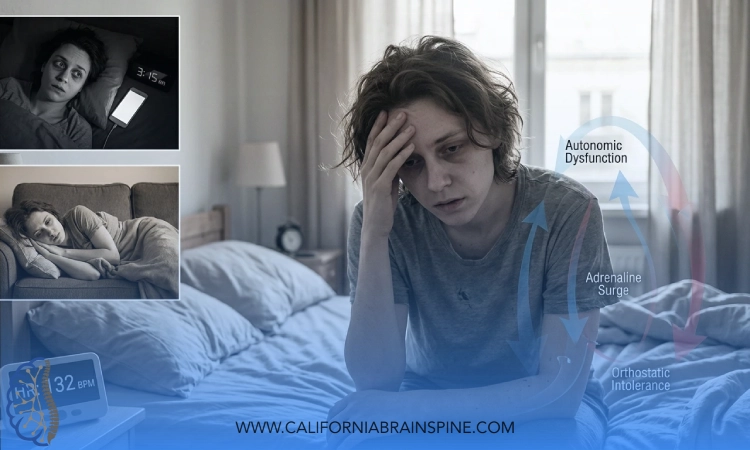
When Is Waking Up With a Racing Heart an Emergency?
Waking up with a racing heart is an emergency when it comes with passing out, chest pain or pressure, or trouble breathing; the Cleveland Clinic's palpitations guidance lists all three as reasons for emergency care.
When to call 911
If symptoms come on suddenly or severely - a sudden severe headache, weakness, trouble speaking, vision loss, or fainting - that is an emergency. Call 911 or go to an emergency room, not a clinic appointment.
The same applies to a racing heart with passing out, chest pain or pressure, or trouble breathing. These are situations for emergency care, and they come before any question about POTS.
Everything else in this article is about the slower pattern that repeats morning after morning. That pattern deserves attention too, on a different timescale.
When Should You Get Checked for a Racing Heart on Waking?
It is worth an evaluation if waking with a racing heart keeps happening, is getting worse, or comes with new symptoms, and worth one sooner if fainting is part of it.
The same threshold applies if you already have a POTS diagnosis and your mornings have changed. A shift in your usual pattern is information, whatever label you already carry, and it is easier to act on while you can still describe what changed.
Before that appointment, rough notes help more than memory. A few mornings are usually enough to show a pattern, and the notes do not need to be precise:
- Whether the racing heart woke you or started when you stood up, and roughly what time it was.
- Your pulse, if you have a watch or home monitor, lying in bed and again after a few minutes standing.
- What you had the evening before, especially caffeine, alcohol and how much you drank overall.
- How the night went: trouble falling asleep, waking in the night, or waking unrefreshed.
- Anything that needs attention first, such as fainting, chest pain or trouble breathing.
Sit or lie down if you feel faint while taking a reading. The notes are there to show a pattern, and no reading is worth a fall.
What Does a POTS Evaluation Look At?
A POTS evaluation at California Brain & Spine Center starts with the 120-minute neurodiagnostic assessment, which may include heart rate and blood pressure lying and standing, balance and eye-movement testing, and a detailed history of your day-and-night pattern.
When I, Dr. Alireza Chizari, DC, DACNB, go through that history with someone, I read the night and the morning together: when the racing heart starts, whether standing changes it, how sleep went, what was eaten and drunk the evening before, and what the rest of the day looks like. The notes described above make that conversation faster and more accurate.
What the Standing Test Looks At
An active stand test compares heart rate lying down with heart rate over the minutes after standing up. It is the measurement the POTS definition is built on: a rise of 30 beats per minute or more (40 or more under 19) within 10 minutes. Because the rise tends to be larger in the morning, the time of day a test is done can change what it shows, and that is worth knowing whenever you compare results from different visits.
Balance and eye-movement testing sit in the same assessment because people who come in with a racing heart often describe dizziness or unsteadiness as well, and those symptoms deserve their own measurement instead of an assumption that they share a cause with the heartbeat.
An assessment like this does not replace cardiology, sleep medicine or the physician who manages your general care. When something points outside functional neurology, such as fainting as the main complaint or signs of a sleep disorder, the right next step is a referral to cardiology, sleep medicine or medical neurology, and I say so plainly.
Questions Patients Often Ask Me
One question patients often ask me is whether a heart that races out of nowhere means something is wrong with the heart itself. My answer starts with the pattern. A racing heart that follows standing points toward orthostatic changes, meaning how your heart rate and blood pressure adjust when you stand up, and a racing heart that comes with chest pain, fainting or breathlessness goes to emergency or cardiology care first, before anything else is discussed.
Another question I hear comes from people who already have a POTS diagnosis and still feel lost about what happens next. What I check first is how the body handles the move from lying to standing, how the nights actually go, and which symptoms change with position. People are sometimes surprised by how much of the first visit is history. The timing of a symptom often tells me more than a single reading does, and the history is where the timing lives.
"Dr. Chizari took the time to listen, explain what was going on, and create a plan that felt personalized to me."
From a Google review
At the first visit, results are explained as they come in: what each test looked at, what it showed, and which questions it leaves open.
What Can Help With POTS Sleep and Morning Symptoms?
What helps with POTS sleep and morning symptoms depends on what an evaluation finds, so a plan starts from your own pattern instead of a general list.
One small change has patient guidance behind it. The Cleveland Clinic's advice on POTS says raising the head of the bed may help ease symptoms. It costs little to try, but ask your physician first, especially if you have another heart, kidney or circulation condition.
Fluids, salt, compression garments and medication often come up in conversations about POTS. Those are decisions for the physician who manages your care, because they are not suitable for everyone, and an amount that suits one person can be the wrong amount for another.
At California Brain & Spine Center, care may include, when clinically appropriate after evaluation, neurological rehabilitation built around what the assessment found, including balance and eye-movement work when dizziness is part of the picture. The practical side is planned around your mornings as well: which tasks can move later in the day, where you can sit down, and how to space out the things that make your heart race.
Other non-invasive options the practice offers, such as low-level laser therapy or gammaCore vagus nerve stimulation, are discussed only when clinically appropriate after evaluation. None of them stands in for emergency care, cardiology or sleep medicine when those are needed.
Where Can You Get a POTS Evaluation in Calabasas and Agoura Hills?
California Brain & Spine Center sees people with POTS from Calabasas, Agoura Hills and across Los Angeles at its office at 4768 Park Granada, Suite 107, just off the 101.
Consultations are with Dr. Alireza Chizari, DC, DACNB, and begin with a complimentary consultation to decide whether the full assessment makes sense for you. Most people with POTS are women and girls from their teens to middle age, although men can have it too, according to Cleveland Clinic patient guidance. That means the people I see with this pattern are often in the middle of careers, study or raising a family, and some have learned to plan the whole day around how the first hour goes. If your morning includes a drive on the 101 after a night like that, you already know why the first hour matters.
What Do People Ask About POTS, Sleep and Mornings?
These are questions about POTS, sleep and a racing heart that I hear often in my office in Calabasas, with short answers you can take to your own appointment.
Why do I wake up with a racing heart if I have POTS?
If you have POTS, a racing heart on waking can come from the first stand of the day, because the heart-rate rise on standing tends to be larger in the morning. Lower blood volume can add to it. A racing heart that wakes you while lying still has other possible causes and deserves an evaluation.
Can POTS cause insomnia?
POTS is associated with sleep problems: in a controlled study, people with POTS reported more sleep problems and more fatigue than healthy controls, and some describe palpitations or racing thoughts that keep them awake. POTS and insomnia can overlap, but stress, caffeine and alcohol can also keep a heart racing at night, so the pattern needs checking.
Is POTS syndrome more common in women?
Yes. Most people with POTS syndrome are women and girls between their teens and middle age, according to Cleveland Clinic patient guidance, though men can have it too. That matters for anyone who wonders whether a racing heart on waking is just anxiety: the pattern is worth measuring standing up before any label is attached.
Does POTS affect sleep even if I sleep eight hours?
It can. People with POTS reported lower sleep quality and more sleepiness than controls on sleep questionnaires in one study, and a small study suggests the autonomic nervous system may behave differently during sleep. Hours in bed and restful sleep are different things, which is why waking up unrefreshed after a full night deserves attention.
Where can I get a POTS evaluation near Calabasas or Los Angeles?
California Brain & Spine Center in Calabasas offers a complimentary consultation and a 120-minute neurodiagnostic assessment for people with POTS who wake with a racing heart, feel dizzy in the morning or sleep poorly. The office is at 4768 Park Granada, Suite 107, off the 101, and serves Calabasas and the greater Los Angeles area.
Should I raise the head of my bed if I have POTS?
It may help. Cleveland Clinic patient guidance says raising the head of the bed may ease POTS symptoms. If you have POTS and wake up with a racing heart, it is a simple change to discuss with your physician first, especially if you have another heart, kidney or circulation condition.
POTS Waking Up With Racing Heart: What Should You Do Next?
If you keep waking up with a racing heart, the next step is to find out which pattern you have, starting with what happens on the first stand of the day.
I would rather measure your morning than guess at it. For people with POTS who wake up with a racing heart, a careful look at standing heart rate, sleep and the rest of the day-and-night pattern can give a frightening morning a clearer explanation and a next step. If anything in the emergency section above applies to you, that comes first. If not, writing down a few mornings and bringing them to a visit is a good place to begin.
California Brain & Spine Center | (818) 649-5300 | Calabasas, CA 91302
Book online at californiabrainspine.janeapp.com.
This content is for educational purposes only and is not medical advice. Consult a qualified healthcare provider about your specific situation.
Bring Your Morning Notes to a First Visit
If waking with a racing heart has become part of your routine, a complimentary consultation in Calabasas is a calm place to start working out why.