
Both can make the room tilt when you stand up. One of them is fixed with a glass of water. Here is how to tell POTS and dehydration apart, and what to do when water has stopped being the answer.
“Drink more water” is good advice for about a week. If you are still lightheaded every time you stand after a month of doing exactly that, the question of POTS or dehydration is a fair one to ask, and it deserves a better answer than a shrug.
I am Dr. Alireza Chizari, DC, DACNB, a board-certified chiropractic neurologist, and functional neurology at California Brain & Spine Center in Calabasas is where a lot of these conversations end up. The person across from me has usually been told two or three times that they are dehydrated, out of shape, or anxious. They have the water bottle to prove they listened. What nobody has done is measure what their heart rate and blood pressure actually do in the first ten minutes of standing, which is the one thing that separates the two explanations.
This article does three things. It explains why dehydration makes people dizzy at all, so you can recognise the plain version when you have it. It explains what POTS is and why it looks so similar from the inside. Then it walks through the differences that a careful history and a standing test can pick up, so you know what to ask for.
Key Takeaway
Dehydration makes you dizzy because there is less fluid in the circulation, and it settles once the fluid is replaced. POTS is a fast heart rate on standing that can persist however well hydrated you are, and dehydration can make it worse. A ten-minute standing measurement is what tells POTS and dehydration apart.
Can Dehydration Cause Dizziness, and What Does It Feel Like?
Yes. Dizziness and dehydration go together because losing too much fluid leaves less blood volume for the heart to push upward when you stand. The National Library of Medicine lists dizziness among the adult signs of dehydration, beside strong thirst, dry mouth, dark urine and tiredness, with a sudden drop in blood pressure among the common causes.
Dehydration is the loss of too much fluid from the body, and it has ordinary causes: diarrhoea, vomiting, sweating heavily, a fever, urinating more than usual because of a medicine or an illness, or simply not drinking enough. MedlinePlus, the National Library of Medicine’s patient resource, lists the adult signs as feeling very thirsty, a dry mouth, urinating and sweating less than usual, dark-coloured urine, dry skin, feeling tired, and dizziness. That list is worth reading twice, because the dizziness in it rarely travels alone. It arrives with thirst and dark urine, and it arrives after something that cost you fluid.
Why dehydration makes you lightheaded
Standing up asks the circulation to work against gravity. When there is less fluid in the system, less blood makes it back to the heart on the way up, and the brain registers that shortfall as a lightheaded, woozy, unsteady feeling. Orthostatic hypotension is the term for blood pressure that drops when you shift from lying down to standing, and MedlinePlus notes that a drop of as little as 20 mmHg can cause problems for some people, that this kind of drop usually lasts only a few seconds or minutes, and that a provider may suggest drinking more fluids when dehydration is the cause. So dehydration lightheadedness has a shape: it comes on with the change of position, it eases when you sit, and it fades as you rehydrate.
One distinction matters here, because patients use the words interchangeably and clinicians do not. Dizziness is that lightheaded or unsteady feeling. Vertigo is the sensation that you or the room is spinning when nothing is moving. MedlinePlus is clear that dizziness and vertigo are not the same thing, and that a sudden drop in blood pressure, dehydration and getting up too quickly sit on its list of common causes of dizziness and vertigo, alongside inner-ear problems, certain medicines, motion sickness, migraine and head injury. What dehydration produces in my patients is almost always the lightheaded kind; a spinning room is worth describing to whoever evaluates you in exactly those words, because it points the examination elsewhere.
How long does dizziness from dehydration last?
There is no honest number to give you, and I distrust the pages that offer one. What the sources support is a pattern rather than a clock. The treatment for dehydration is to replace the fluids and electrolytes that were lost, and a lightheaded spell from a positional drop in blood pressure usually lasts seconds to minutes once you sit or lie down. If the dizziness is tied to dehydration, it should track the fluid: better as you rehydrate over the day, gone once the cause has been dealt with. What should not happen is dizziness every morning, every time you stand, for weeks, while your urine is pale and your thirst is normal. That is the point where “dehydration” stops being an explanation and becomes a label that has outlived its evidence.
The National Library of Medicine also draws a hard line for when dehydration is an emergency rather than a home problem: get medical help right away if it comes with confusion, fainting, no urination, a rapid heartbeat, rapid breathing or shock, and severe cases may need intravenous fluids in hospital. That list belongs to dehydration alone. Keep it in mind when you read the POTS section, because “rapid heartbeat” is on it, and it is the overlap that causes most of the confusion.
What Is POTS, and How Is It Different From Being Dehydrated?
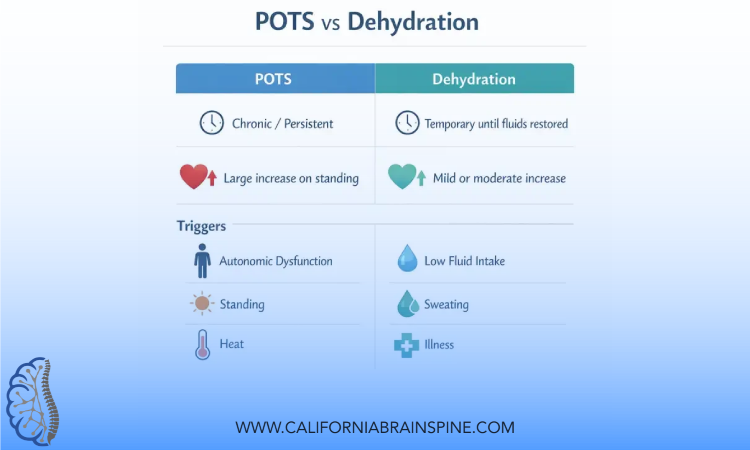
POTS, postural orthostatic tachycardia syndrome, is a condition in which the heart rate climbs abnormally on standing without a matching fall in blood pressure. The National Institute of Neurological Disorders and Stroke describes the classic symptom as a fast heartbeat: a person’s heart rate may increase by more than 30 beats per minute, or exceed 120 beats per minute, within 10 minutes of standing, and in adolescents the threshold is a rise of at least 40. That criterion is a measurement, and it is the first thing that makes POTS different from dehydration. You can drink your way out of dehydration. The standing response of POTS can persist however well hydrated you are.
The symptoms are where the two overlap. NINDS lists lightheadedness or dizziness, fainting and palpitations on standing, along with exhaustion, headaches and other symptoms, and notes that POTS symptoms may come and go over time. Read that beside the dehydration list and you can see why so many people are sent home with a water bottle. Both produce dizziness on standing. Both can produce a racing heart. The difference is in what sits underneath and what happens when you fix the fluid.
It also helps to know that dizziness is not required for the diagnosis. The classic symptom is the fast heartbeat, and some people have POTS without dizziness at all: their complaint is the pounding, the exhaustion or the headaches, and the lightheadedness is minor or absent. If you have been told you cannot have POTS because you do not faint, that reasoning is backwards.
Underneath the symptoms is the autonomic nervous system, the part that runs heart rate, blood pressure and blood-vessel tone without asking you. NINDS uses the term orthostatic intolerance for symptoms that occur when a person stands up and are relieved by lying down, and explains that dizziness or fainting happen because not enough blood flows back to the heart on the way up. In dehydration, not enough blood gets back because there is less of it. In POTS, the volume may be normal and the regulation is what is off, or the volume is low as well, which brings us to the part most people are never told.
POTS and Dehydration Together: Why Does Losing Fluid Make It Worse?
Because a good share of people with POTS are running on low volume to begin with. The NCBI Bookshelf review of the condition reports that up to 70% of patients with postural orthostatic tachycardia syndrome exhibit decreased plasma, red blood cell, and total blood volumes, with the degree varying between studies, and describes volume depletion as one of several proposed mechanisms alongside excess sympathetic drive, autoimmune dysfunction and physical deconditioning. It also notes a secondary low-volume state in people with gut conditions that cause fluid loss or poor intake. So dehydration and POTS stack: one sits on top of the other rather than competing for the same symptom.
That is why the question “does dehydration make POTS worse” has a short answer, which is yes, and why the longer answer matters more. A person with POTS who gets dehydrated loses volume from a system that may already be short of it, and the standing symptoms can get worse with it. The same review lists increased fluid intake of 2 to 3 litres and salt increased slowly to as much as 10 grams among the conservative measures, together with compression garments, physical counter-manoeuvres such as leg crossing and muscle contraction, and avoiding caffeine, alcohol and prolonged heat. NINDS puts the everyday version plainly: increasing salt intake and staying hydrated can help regulate blood pressure and increase blood volume, and drinking at least 16 ounces of water before getting up can give a temporary boost.
Notice what those measures are. They are the treatment for the fluid part of POTS, and they can help. They are not the whole treatment, which is why a person can be doing every one of them faithfully and still stand up into a racing heart. Water improves the volume problem. It does not, on its own, retrain the regulation problem, and it cannot tell you which one you have. Certain medicines can muddy the picture as well: NINDS notes that diuretics and some drugs used for blood pressure and heart conditions may cause or worsen POTS symptoms, so a medication list belongs in any honest evaluation.
POTS or Dehydration: How Can You Tell the Difference?
The lightheaded second after standing feels the same in both, so the moment itself will not tell you. The difference shows up over time and under measurement, and the table below is the version of it I walk through in the clinic. Read the first column for what people usually describe, the second for the patterns that mean the dehydration explanation has run out, and the third for what an evaluation actually looks at. If you already have dizziness when standing up that has lasted more than a few weeks, the second column is the one to read slowly.
| What patients typically describe | Patterns that suggest something more | What the evaluation looks at |
|---|---|---|
| Lightheaded after a hot day, a hard workout or a stomach bug, with real thirst and dark urine | Lightheaded most mornings, on ordinary days, with pale urine and normal thirst | The history: what preceded each spell, and whether fluid loss explains it |
| Better within a day of drinking and eating normally | No better after weeks of deliberate fluid and salt | Whether symptoms track fluid intake or ignore it |
| A brief wobble on standing that passes in seconds | A heart that is still pounding several minutes into standing, or a rate that keeps climbing | Heart rate and blood pressure lying down and at timed intervals across ten minutes of standing |
| Symptoms that arrive once and leave | Symptoms that come and go for months | The timeline: when it started and what it has followed since |
| Dizziness alone | Dizziness with exhaustion, headaches or palpitations | The wider autonomic picture, not one symptom in isolation |
| Improves with rest | Improves with lying down specifically, and returns on standing | The orthostatic pattern: relieved by lying down is the signature of orthostatic intolerance |
The most useful line in that table is the one about lying down. Dehydration gets better with rest of any kind and with fluid. Orthostatic intolerance gets better with lying down specifically, because the problem is the upright position and not the fluid, and it comes straight back when you stand. If you have started to plan your day around when you can be horizontal, you are describing the second pattern, and it is worth saying so out loud to whoever evaluates you.
When Dizziness Is an Emergency, Not an Appointment
Dehydration with confusion, fainting, no urination, a rapid heartbeat, rapid breathing or signs of shock needs medical help right away, not a consultation. Sudden or severe dizziness with vision problems, slurred speech or weakness is an emergency whatever the cause.
If symptoms come on suddenly or severely – a sudden severe headache, weakness, trouble speaking, vision loss, or fainting – that is an emergency. Call 911 or go to an emergency room, not a clinic appointment.
Still Dizzy After Doing Everything Right?
If the water bottle has not fixed it, the next step is measurement. An autonomic nervous system evaluation at California Brain & Spine Center in Calabasas records what your heart rate and blood pressure do across ten minutes of standing, before anyone recommends care.
How Is POTS Diagnosed, and When Should You Get Tested?
NINDS is candid that diagnosing POTS can be challenging because its symptoms resemble other conditions, which is how people end up with a delayed diagnosis and a tour of specialists before anyone measures the standing response. The measurement itself is not exotic. Clinicians record heart rate and blood pressure and watch how the body responds to a change of position, and the tilt table test is a common tool: the person lies flat on a table that is tilted upright while both numbers are monitored. A significant rise in heart rate without a significant fall in blood pressure strongly suggests POTS.
The adult criterion in the NCBI Bookshelf review is a heart-rate increase of at least 30 beats per minute within the first ten minutes of standing or head-up tilt, in the absence of orthostatic hypotension. The same review describes the active stand test: the person lies down for ten minutes while a baseline is taken, then stands, and blood pressure and heart rate are measured again at one, three, five and ten minutes. Two things in that description are worth underlining for anyone who has been told they are “just dehydrated”. First, the test is timed, and the single reading a rushed appointment takes at the one-minute mark can miss a rate that is still climbing. Second, the blood pressure has to be recorded as well, because a big blood-pressure drop points away from POTS and toward orthostatic hypotension, which has its own causes, dehydration among them.
Ask for this test when the pattern in the second column of the table above is yours: the dizziness has outlasted the thing that was supposed to explain it, or you have done the fluid and salt part properly for weeks and your body still treats standing as a problem. If no one has confirmed it is POTS, the formal POTS diagnosis process is worth understanding before the appointment, so that you know what a complete evaluation includes and can tell when you have not had one.
What Helps When It Is POTS, and What Helps When It Is Dehydration?
Dehydration is the simpler case, and it is fine to say so. Replace the fluid and electrolytes that were lost, deal with whatever caused the loss, and the dizziness should follow the fluid out. If it does not, or if the emergency signs above appear, that is a medical visit rather than a bigger glass of water.
POTS keeps the fluid and salt measures and adds to them. NINDS reports that research suggests cardiovascular rehabilitation, with physical activity that builds slowly in intensity, can improve tolerance to standing, and the NCBI Bookshelf review describes exercise conditioning as a fundamental part of treatment, recommended as a gradual programme for all patients. The word gradual is doing real work in both sentences. Neither source says “go to the gym”; both describe a programme that builds slowly in intensity, which is a different instruction from the one most people have been given.
At California Brain & Spine Center the evaluation comes first, because a plan built for POTS is wrong for someone whose problem is a medication or an inner ear, and the standing test is what sorts that out. Where the results point to an autonomic pattern, care is built around what was measured: the fluid and salt foundations, reconditioning that builds slowly in intensity, and neurological rehabilitation that targets the regulation problem, offered when clinically appropriate after the evaluation. Nobody can promise you a result from any of it, and I would be wary of anyone who does. What the evaluation gives you is a measured starting point and a way to tell whether things are moving.
Most of the people I see with this question live along the 101 corridor, in Calabasas, Thousand Oaks and the surrounding valley, and a surprising number of them have already been dizzy for a year or more. That length of time is what happens when the first explanation was plausible enough that nobody checked it, and it says nothing about the patient.
A Pattern I See in Calabasas: When “Drink More Water” Was Not Enough
Cases like this are common in our Calabasas clinic. Someone in their thirties, working long hours, who has been lightheaded on standing for most of a year. The first doctor said dehydration, and it was a reasonable guess, because the spells had started during a hot summer. The second doctor, months later, said anxiety, because the heart was racing and the tests were normal. By the time this person sits down with me they are drinking three litres a day, carrying electrolyte sachets in their bag, and quietly convinced that something is being missed.
The evaluation begins with lying down for ten minutes while a baseline is taken, then standing, with heart rate and blood pressure recorded at timed intervals, along with a careful history of when the spells started, what they follow, and what relieves them. In the pattern I am describing, the blood pressure holds and the heart rate climbs steadily across the ten minutes, well past the threshold, and the person recognises the feeling at the eight-minute mark as the one they have been living with. That is the moment the word dehydration finally leaves the conversation, because three litres a day and pale urine do not fit dehydration’s own signs, and the standing response says something else is going on.
What follows is a plan for what was measured rather than for what was assumed: the fluid and salt work kept, a reconditioning programme that builds slowly in intensity, and neurological rehabilitation directed at the autonomic regulation problem, offered through the POTS treatment program in Calabasas when clinically appropriate. Improvement in the cases that go well is partial and gradual: fewer mornings lost, a longer window of standing before the pounding starts, a slower climb on the retest some weeks later. Not every case moves this way, and I would be misleading you to suggest it did. The honest promise is a real answer to the question, and a plan that is built on it.
Common Questions About POTS and Dehydration
Does POTS make you thirsty?
Thirst is a dehydration sign, and the NCBI Bookshelf review reports that up to 70% of people with POTS have reduced blood volume, so many are told to drink and salt deliberately and some do notice more thirst. Strong thirst with dark urine still points to dehydration first; the standing heart-rate test is what says whether POTS sits underneath it.
Can dehydration mimic POTS?
Yes, for a while. Dehydration produces dizziness on standing and can produce a racing heart, which is exactly the POTS picture from the inside. The difference is that dehydration settles as the fluid is replaced. Dizziness on standing that persists for weeks with normal hydration is no longer mimicry, and it deserves a timed standing measurement.
Does dehydration make POTS worse?
Yes. Up to 70% of people with POTS show reduced blood volume in some studies, and losing fluid on top of that can make the standing symptoms worse. That is why fluid and salt are part of the care: staying hydrated and increasing salt can help regulate blood pressure and blood volume, without being the whole answer on their own.
Can you have POTS without dizziness?
Yes. The classic symptom is the fast heartbeat on standing, and dizziness is common but not required. Some people notice mainly the pounding, exhaustion or headaches, with little or no lightheadedness. Being told you cannot have POTS because you do not feel faint is not a reason to stop asking.
Where can POTS or dehydration dizziness be evaluated near Calabasas?
California Brain & Spine Center is at 4768 Park Granada, Ste 107, Calabasas, CA 91302, serving Calabasas, Thousand Oaks and the greater Los Angeles area. Dr. Alireza Chizari, DC, DACNB performs the standing measurement and the wider neurological evaluation personally. Book a complimentary consultation at californiabrainspine.janeapp.com or call (818) 649-5300.
This content is for educational purposes only and is not medical advice. Consult a qualified healthcare provider about your specific situation.
If you have read this far, you probably already suspect which column you belong in. My advice is the same either way: stop guessing. If it is dehydration, a week of honest fluid and a look at what caused the loss will tell you. If it is not, ten minutes of standing with the numbers written down will tell you that too, and it is a far better use of your time than another year of “just drink more water”. California Brain & Spine Center | (818) 649-5300 | Calabasas, CA 91302, or book at californiabrainspine.janeapp.com.
Get the Standing Test, Not Another Guess
A 120-minute neurodiagnostic assessment with Dr. Alireza Chizari, DC, DACNB measures the standing response, the eye movements and the balance system before anyone recommends care. California Brain & Spine Center, 4768 Park Granada, Ste 107, Calabasas, CA 91302.