Start POTS exercise reclined, on a recumbent bike, a rowing machine or in a pool, and add upright work gradually.
POTS exercise usually starts reclined, on a recumbent bike, a rowing machine or in the pool, with upright work added gradually once the reclined sessions are repeatable. If you have POTS, someone has probably told you to exercise, and you have probably tried. A walk or twenty minutes on an elliptical left your heart pounding, your head light and the rest of the day gone. POTS exercise can help, and where you start matters more than how hard you push. I am Dr. Alireza Chizari, DC, DACNB, a Board-Certified Functional Neurologist at California Brain & Spine Center in Calabasas, and this is how I approach it.
That reclined start is the approach the research describes, and it is the order I follow when I plan exercise as part of POTS treatment in Calabasas, after an evaluation rather than before it.
Standing is the part of daily life that POTS makes hardest, so taking it out of the first stage lets your heart and legs train while limiting orthostatic stress, the strain that being upright places on your circulation. The harder questions are how much, how often and when to stand up, and those answers depend on the person.
Key Takeaway
POTS exercise usually starts reclined, on a recumbent bike, a rowing machine or in a pool, because standing is what provokes symptoms. The expert consensus describes a regular, structured, graduated and supervised program, with upright exercise added gradually. Feeling worse at first is common. The research is still developing, so the plan is set after an evaluation.
What Is a Good POTS Exercise to Start With?
Usually, a good POTS exercise to start with is a reclined one: a recumbent bike, a rowing machine or swimming. The Heart Rhythm Society consensus statement advises non-upright exercise at first to limit orthostatic stress on the heart, and Cleveland Clinic describes reclined aerobic exercise, with core and leg strengthening, as often the most helpful.
Why Reclined Exercise Takes the Load Off
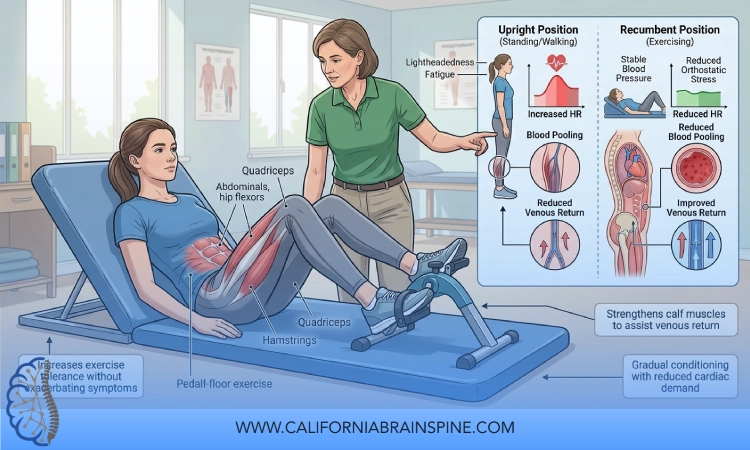
Reclined exercise still asks your heart and leg muscles to work. What it reduces is orthostatic stress, the strain that being upright places on your circulation. The Heart Rhythm Society expert consensus statement on POTS advises that exercise should start out non-upright, using rowing machines, recumbent cycles and swimming, to minimize orthostatic stress on the heart.
Strength belongs in the first stage too. Cleveland Clinic's guide to POTS describes reclined aerobic exercise such as swimming, rowing and recumbent cycling as often the most helpful, alongside strengthening the core and leg muscles.
When the Reclined Start Needs Adjusting
A reclined start is a framework, and the details change from person to person. The researchers who developed the Dallas protocol note that many patients feel more tired, or have other POTS symptoms flare, when they first start an exercise program, so I usually set the first sessions shorter than people expect.
Safety around the machine matters as well. Cleveland Clinic notes that the biggest physical risk of POTS is getting hurt if you faint and fall, which is worth thinking about at the pool edge or when getting off a bike. If exercise has ever left you much worse for a day or more, mention it at the evaluation, because the plan is built around how you recover as well as how you exercise.
Why Does Upright Exercise Feel So Hard With POTS?
Upright exercise feels hard with POTS because being upright already pushes the heart rate up, and exercise is added to that load.
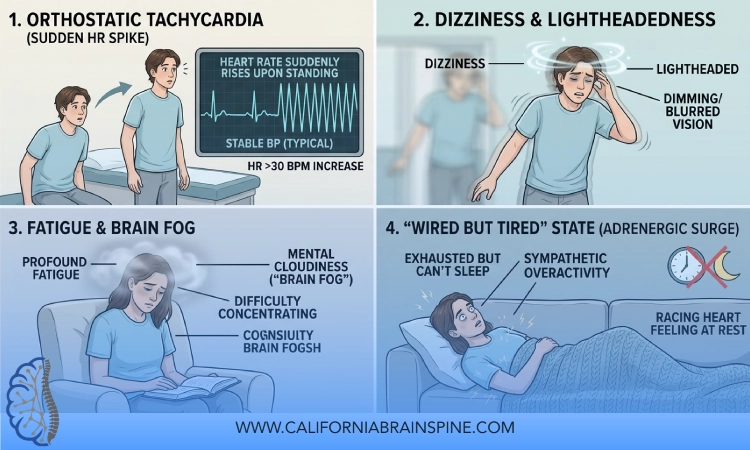
Postural orthostatic tachycardia syndrome (POTS) is defined by consensus criteria in adults as symptoms of orthostatic intolerance (symptoms brought on by being upright) lasting at least three months, together with a sustained heart-rate rise of at least 30 beats per minute within 10 minutes of being upright, as a recent systematic review of exercise in POTS summarizes.
For teenagers the number is different. Vanderbilt University Medical Center's Autonomic Dysfunction Center lists a rise of at least 40 beats per minute for ages 12 to 19, which is worth knowing if you are a parent reading a teen's standing-test results.
Most people with POTS are women and girls aged 15 to 50, according to Cleveland Clinic, although males can have it too.
A Smaller Heart and Less Blood Volume
In some people with POTS, researchers have described a smaller heart combined with reduced blood volume. On standing, that combination is associated with a large drop in the amount of blood pumped with each beat, which is one proposed reason the heart rate climbs. Qi Fu and Benjamin Levine set this out in their review of exercise and non-drug treatment for POTS.
That mechanism is why the research treats exercise as more than general fitness advice. The training is aimed at the heart and the blood volume themselves.
What Are Recumbent Exercises, and Why Do They Help With POTS?
Recumbent exercises are workouts done lying down or reclined, such as a recumbent bike, a rowing machine or swimming, and for POTS they let you train while limiting the stress of being upright.
Qi Fu and Benjamin Levine, who developed the Dallas protocol, describe starting with horizontal exercise (rowing, swimming, a recumbent bike) as a critical strategy. A rowing machine adds upper-body and trunk work, swimming takes you off your feet entirely, and a recumbent bike works the legs from a supported seat.
Which Recumbent Exercises for POTS Come First?
In the published programs, the first stage uses the recumbent bike, rowing and swimming, with strengthening for the legs and core added alongside. Which one you start on depends on what you can get to and what you tolerate, and it can change as the sessions add up.
Is Recumbent Exercise for POTS a Real Workout?
Yes, and it can be a hard one. A rowing machine at a steady pace is demanding, a recumbent bike can be pushed until you are breathing hard, and swimming works the whole body. Lying back reduces one stress, the upright load, while the effort itself still has to be dosed.
This is why I do not hand out a fixed number of minutes simply because someone has POTS. Duration, resistance, effort and how you recover afterward all go into the starting dose.
Is a Recumbent Bike for POTS Better Than Walking?
A recumbent bike for POTS is usually easier to tolerate than walking at the start, because the seat takes away the upright load while the legs still do the work.
Walking stays on the list as a goal. In the protocol Fu and Levine describe, upright exercise such as an upright bike, treadmill walking or jogging is added around the end of the second month or the start of the third, after the horizontal start.
Is Biking Good for POTS If the Bike Is Upright?
An upright stationary bike asks more of you than a recumbent one, because you are sitting up against gravity. In the published protocol it belongs to the later, upright stage, and someone who handles recumbent cycling well may move toward it when the plan calls for it.
Recumbent Bike, POTS and Heart Rate: What to Watch
Heart rate is one signal on a recumbent bike. How you feel that evening and the next morning is another, and it often tells me more about whether the dose was right. I have left heart-rate zone numbers out of this article on purpose: zones are set for the individual by the clinician managing the plan, and a number copied from a website can be wrong for you.
A useful habit is a short note after each session: what you did, how you felt during it, and how you felt the next day. Over time, that record shows whether the plan should hold, step up or step back.
Standing workouts keep setting off a flare?
A recumbent-first plan starts from what your system tolerates today. In Calabasas, the 120-minute neurodiagnostic assessment looks at how your heart rate and blood pressure respond to standing before any exercise plan is set.
Is Rowing or Swimming Better Than Cycling for POTS?
Rowing, swimming and recumbent cycling are all reclined options for POTS, and the right one depends on the person more than on the machine.
A POTS rowing machine workout keeps the body near horizontal while adding upper-body and trunk demand. Swimming removes standing entirely, but water temperature, getting in and out of the pool and the risk of feeling faint near water all need thought.
Cleveland Clinic lists all three as reclined aerobic exercise that is often the most helpful for POTS, so the choice comes down to access, tolerance and safety.
Should Strength Training Be Part of POTS Exercise?
Strength training is usually part of POTS exercise, focused on the core and the leg muscles, and done lying down or seated at first.
Cleveland Clinic describes strengthening the core and leg muscles alongside reclined aerobic exercise. Which strength work suits you is part of the plan set after an evaluation.
What Does the Research Say About Exercise for POTS?
Exercise is considered a first-line non-drug treatment for POTS, but the same systematic review found that nearly all the studies behind it had a moderate to high risk of bias, so the evidence is still developing.
The Heart Rhythm Society's expert consensus statement says a regular, structured and progressive exercise program can be effective for people with POTS.
The physiology comes from the Dallas work. In studies by Fu and Levine, about three months of training was associated with increases in heart size and mass, blood volume and peak aerobic capacity in people with POTS.
Exercise for POTS therefore has expert backing and a plausible mechanism, while the trials remain imperfect. A sensible plan respects both: it takes exercise seriously, and it watches your response closely instead of assuming one protocol fits everyone.
How Does a Recumbent-First POTS Exercise Plan Progress?
A recumbent-first POTS exercise plan progresses in stages: reclined aerobic work and strengthening first, then upright exercise added gradually once the reclined sessions are repeatable.
The Heart Rhythm Society consensus statement describes the program as regular, structured, graduated and supervised. Regular means sessions you can repeat across the week; graduated means each step up is small; supervised means someone is watching how you respond and adjusting with you.
In the published Dallas protocol, patients first trained 3 to 4 times per week for 25 to 30 minutes per session. That figure describes a research program, and your own starting point may be shorter. It is set after an evaluation.
| Stage | What the research describes | What the plan looks at |
|---|---|---|
| Reclined start | Horizontal exercise at the beginning (rowing, swimming, a recumbent bike); in the Dallas protocol, 3 to 4 sessions a week of 25 to 30 minutes at first | Whether sessions can be repeated, and how you feel later that day and the next |
| Strength | Strengthening for the core and leg muscles alongside reclined aerobic work | Exercise choice around joints and pain, and keeping the work off your feet at first |
| Upright stage | Upright bike, treadmill walking or jogging added around the end of month two or the start of month three | Whether added upright time sets off a flare, and stepping back a level if it does |
| Support measures | Compression garments, and more salt and fluid, decided individually with a clinician | What has already been tried, and who manages it with you |
| Supervision | A regular, structured, graduated and supervised program; a semi-supervised study had one of the lowest dropout rates | How often you check in, and how the plan is adjusted between visits |
Why Do Some People Feel Worse When They Start POTS Exercise?
Many people feel more tired, or have a flare of other POTS symptoms, when they first start an exercise program, according to the researchers who developed the Dallas protocol.
That early dip is one reason people stop. The systematic review found that dropout from POTS exercise studies varies widely, and one of the few semi-supervised programs had one of the lowest dropout rates, which suggests support and setting may affect whether people stay with it.
So I would rather you start smaller than you expect and stay at that level until it feels routine. A dose you can repeat is more useful than an ambitious first week you cannot.
A more useful question than 'Did I finish the workout?'
Ask whether you could do the same session again two days later and still function in between. Exercise for POTS is judged by recovery as much as by the session itself.
Do Salt, Fluids and Compression Matter Around POTS Exercise?
Salt, fluids and compression garments are other non-drug measures in the Heart Rhythm Society consensus statement, and they may help, but the amounts and whether they suit you should be set with your clinician.
Compression garments are intended to reduce venous pooling, blood collecting in the lower body when you are upright, and more salt and fluid is intended to increase blood volume. Both are decided individually, alongside whoever manages the rest of your medical care.
When exercise symptoms mean emergency care
If symptoms come on suddenly or severely - a sudden severe headache, weakness, trouble speaking, vision loss, or fainting - that is an emergency. Call 911 or go to an emergency room, not a clinic appointment.
Cleveland Clinic notes that the biggest physical risk of POTS is getting hurt if you faint and fall, so set sessions up where a faint would be safe: a recumbent bike rather than a treadmill at the start, and someone nearby when you are in the pool.
When Should Exercise for POTS Move From Recumbent to Upright?
Exercise for POTS usually moves toward upright work once the reclined sessions are repeatable and recovery is acceptable; in the published protocol, upright exercise was added around the end of the second month or the start of the third.
That timing belongs to a research protocol. It describes what was studied, and it is not a schedule anyone should hold you to.
The step up can be small: a semi-reclined position, a few minutes on an upright bike at the end of a recumbent session, a short walk. If the step up sets off a flare that lasts, the plan steps back to the last level you handled and tries again later.
The aim is upright life: standing through a meeting, getting through the grocery store, walking in from the parking lot. A longer time on the bike counts for less if the rest of your day disappears afterward.
How Do I Approach POTS Exercise for Patients in Calabasas and Thousand Oaks?
For patients in Calabasas and Thousand Oaks, I plan POTS exercise around ordinary days: the commute on the 101, a long day at a desk, a weekend that includes standing on the sideline of a child's game.
POTS sits within the wider group of autonomic conditions, and the page on dysautonomia covers the other symptoms that can come with it.
Dizziness on standing is one thing; dizziness when you turn your head or walk through a busy store is another. When both are present, the second is assessed on its own, and the vestibular rehab therapies page explains that separate route.
What Do Patients Ask Me Before Starting a POTS Exercise Plan?
One question patients often ask me, Dr. Alireza Chizari, DC, DACNB, is whether exercise is safe for them at all.
My answer starts with measurement. Before I suggest any program, the 120-minute neurodiagnostic assessment looks at how heart rate and blood pressure change as you move from lying down to standing, and, when dizziness is part of the picture, at balance and eye movements. I also go through with you what you have already tried, what happened afterward, and what you need to be able to do again.
Another question is whether to simply push through. I do not plan it that way. The consensus statement calls for a graduated program, and graduated means each level is earned by handling the one before it.
What patients most often misunderstand is the early dip. Feeling more tired in the first stretch of a program is common in the research, and it is something I plan for when setting the dose. Hydration, salt and compression questions are coordinated with your medical providers rather than handed out as universal rules. If you want to know how I came to this work, my background is on the About Dr. Alireza Chizari page.
"Dr. Chizari took the time to listen, explain what was going on, and create a plan that felt personalized to me."
From a Google review
Frequently Asked Questions About POTS Exercise
These are the shorter questions about POTS exercise that come up most often around starting a plan.
Can I Do POTS Exercises at Home?
Many POTS exercises can be done at home, especially recumbent cycling and floor-based strengthening, once the starting level is set. A systematic review found that a semi-supervised program had one of the lowest dropout rates, which suggests some supervision may help people stay with a plan, even when most sessions happen at home.
How Long Should Each POTS Exercise Session Be?
There is no single answer for POTS exercise sessions. In the published Dallas protocol, patients first trained 3 to 4 times per week for 25 to 30 minutes per session, but that was a research program. Your starting point may be shorter, and it is set after an evaluation of how you respond to standing.
Why Do I Feel Worse After Starting Recumbent Exercise for POTS?
Feeling worse at first is common. The researchers behind the Dallas protocol report that many patients feel more tired, or notice other POTS symptoms flare, when they start. It is a signal to review the dose and recovery with your clinician, and to step back a level if a flare lasts, rather than quit.
Do Teenagers With POTS Follow the Same Exercise Plan?
Teenagers are assessed against a different number. Vanderbilt University Medical Center's Autonomic Dysfunction Center lists a heart-rate rise of at least 40 beats per minute for ages 12 to 19, compared with 30 for adults. For POTS exercise, the plan is set to the individual after an evaluation, at any age.
Where Can I Get Help Planning POTS Exercise in Calabasas or Los Angeles?
At California Brain & Spine Center in Calabasas, a POTS exercise plan starts with the 120-minute neurodiagnostic assessment, which looks at how your heart rate and blood pressure respond to standing, alongside balance and eye-movement testing when dizziness is involved. The plan, and how it progresses toward upright exercise, follows from those findings.
Where Should You Start With POTS Exercise?
Start with POTS exercise that is reclined, small and repeatable, and let each next level be earned by handling the current one.
I approach POTS exercise as a dose fitted to the person. Recumbent work comes first because it limits orthostatic stress while the heart and legs train, and upright work follows when your response says it is time. More about the practice and the conditions I work with is on the California Brain & Spine Center home page.
California Brain & Spine Center | (818) 649-5300 | Calabasas, CA 91302
Book a complimentary consultation online
This content is for educational purposes only and is not medical advice. Consult a qualified healthcare provider about your specific situation.
Plan your exercise around how you actually respond
A complimentary consultation is a place to start: what you have tried, what happens when you stand, and whether the full assessment in Calabasas makes sense for you.