
A practical guide to how vestibular therapy may help the brain make better use of balance signals from the inner ear, eyes, neck, and body.
If turning your head, standing up, walking through a grocery store, scrolling on a screen, or riding in a car makes you feel dizzy or unsteady, the problem may involve more than one part of your balance system. Your brain has to combine information from the inner ear, vision, the neck, and the rest of the body every second. When those signals stop matching well, ordinary movement can suddenly feel demanding.
Vestibular therapy is designed to address that coordination problem through targeted exercises and carefully measured exposure. It is not simply a list of balance drills, and it is not appropriate for every cause of dizziness. The useful question is not only whether vestibular therapy can help dizziness. The more important question is whether your symptoms match a pattern that can be trained safely and whether the exercises are selected from a clear evaluation.
Key Takeaway
Vestibular therapy is a personalized exercise program that may help the brain adapt to confusing balance signals from the inner ear, eyes, neck, and body. It is often considered for dizziness, vertigo, motion sensitivity, unsteadiness, and some post concussion symptoms, but the right program depends on identifying the cause first.
What Is Vestibular Therapy?
Vestibular therapy, also called vestibular rehabilitation therapy or VRT, uses targeted head, eye, balance, walking, and movement exercises to help the nervous system process balance information more efficiently. The goal is not to force symptoms away. The goal is to help the brain respond more accurately to motion and sensory input over time.
Your sense of balance depends on several information systems working together. The vestibular organs of the inner ear detect head movement and gravity. Your eyes provide visual orientation. Your feet, joints, muscles, and neck provide proprioception, which tells the brain where the body is positioned in space.
Normally, those signals reinforce one another. You turn your head, the inner ear detects the movement, your eyes stay stable on the target, your neck reports the new head position, and your posture adjusts automatically. You do not have to consciously manage any of this.
When one part of that network becomes unreliable, the reports reaching the brain may no longer agree. A person can then feel spinning, rocking, floating, swaying, blurred vision with movement, nausea, disorientation, or an unexplained loss of confidence while walking. Some people feel relatively steady when sitting still but become symptomatic as soon as the head, eyes, or environment starts moving.
Vestibular therapy does not switch those signals off. Instead, it creates controlled opportunities for the brain to practice using them more effectively. In that sense, the program is a form of neurological retraining. The exercises are chosen to create the right amount of challenge for a specific weakness without overwhelming the patient.
This is also why two people who both say, “I am dizzy,” may need very different care. One may have brief positional vertigo caused by displaced inner ear crystals. Another may have reduced gaze stability after a vestibular injury. Another may be visually dependent after a concussion and feel overwhelmed in stores or traffic. A fourth may have a central balance problem involving how the brain processes the signals. The symptom word can be the same while the clinical target is completely different.
How Does Vestibular Therapy Work?
Vestibular rehabilitation commonly relies on three well described rehabilitation mechanisms: adaptation, habituation, and substitution. These terms sound technical, but each describes a practical way the brain can learn to manage balance information more effectively.
Adaptation helps recalibrate gaze stability
One of the vestibular system's important jobs is to keep vision stable while the head moves. If you can look at a street sign while walking and the words remain clear, your vestibular ocular reflex is doing its job. When that reflex is not working efficiently, head movement can make the visual world bounce, blur, or feel delayed.
Gaze stabilization exercises may ask a patient to keep the eyes on a fixed target while moving the head at a controlled speed. The exercise is progressed based on accuracy and tolerance. The point is not to make the person as dizzy as possible. The point is to give the nervous system enough repeated practice to improve the relationship between head movement and eye stability.
Habituation reduces unnecessary overreaction to motion
Some people become highly sensitive to movements or environments that are not dangerous but repeatedly trigger symptoms. Bending down, turning quickly, walking through a crowded store, scrolling on a phone, or watching traffic may create a disproportionate dizziness response. Avoiding every trigger can feel safer in the short term, but it may also prevent the nervous system from relearning that the movement can be tolerated.
Habituation uses graded exposure. A provoking movement is introduced at a level the patient can recover from, then repeated over time. If the exercise is appropriate, the nervous system may become less reactive to that specific pattern. The amount matters. An exercise that creates a brief, manageable increase in symptoms can be very different from one that causes a severe flare for the rest of the day.
Substitution helps the brain use reliable information better
Sometimes one source of balance information remains limited. In that situation, rehabilitation may help the brain make better use of other dependable inputs, such as vision or proprioception. Balance training on different surfaces, walking tasks, or changes in visual conditions may be used to strengthen how the nervous system selects and combines the information that is available.
This does not mean the brain should become dependent on vision for everything. In fact, some dizzy patients are already too visually dependent and feel worse when surrounded by moving visual information. A good program tries to identify the existing strategy before deciding whether it needs to be strengthened, reduced, or balanced with another input.
BPPV is an important exception
Benign paroxysmal positional vertigo, usually called BPPV, often causes short bursts of spinning when a person rolls in bed, looks up, bends down, or changes head position. In many cases the problem is mechanical. Small calcium carbonate particles have moved into a semicircular canal where they do not belong.
When testing confirms BPPV, the most relevant intervention may be a canalith repositioning maneuver rather than weeks of generic habituation exercises. This distinction is one of the strongest reasons to evaluate dizziness before choosing a home program. The movement that treats one cause can be irrelevant to another.
Research also supports vestibular rehabilitation for appropriate peripheral vestibular disorders. A Cochrane systematic review reported moderate to strong evidence that vestibular rehabilitation is safe and effective for unilateral peripheral vestibular dysfunction. Evidence does not mean every dizzy patient should receive the same exercises. It means a properly selected program has a meaningful role when the diagnosis and rehabilitation target fit.
What does the right exercise dose feel like?
Patients often assume that harder exercise must create faster progress. Vestibular therapy does not work that way. The nervous system needs a challenge it can process and recover from. Too little may fail to create adaptation. Too much may produce a flare that makes the patient more guarded, more fatigued, and less able to practice consistently.
A mild temporary increase in dizziness can occur during some exercises. What matters is how intense the reaction is, how quickly it settles, and whether function improves over time. If a drill repeatedly causes hours of severe symptoms, the program may need a lower dose, a different target, or a reassessment of the diagnosis.
Who May Benefit From Vestibular Therapy?
Balance problems can come from many causes, so the presence of dizziness alone does not prove that vestibular therapy is the right answer. It is most useful when the evaluation identifies a motion, gaze, balance, sensory integration, or compensation problem that can be trained.
People commonly considered for vestibular therapy include those with BPPV, vestibular neuritis after the acute phase, labyrinthitis after the acute phase, persistent imbalance after a vestibular injury, motion sensitivity, visual motion sensitivity, and dizziness that continues after a concussion. It may also be part of care for selected people with vestibular migraine, although migraine management itself still needs to be addressed.
Other patients have central patterns, meaning the difficulty is related more to processing inside the brain than to the inner ear alone. Symptoms can overlap so heavily that it is difficult to tell from sensation alone. Our article on central vestibular disorders explains why certain neurological patterns deserve a broader evaluation.
For some people the main complaint is not spinning. They describe a floor that feels soft, a body that feels like it is floating, a sensation of being pulled to one side, or an inability to trust their balance in the dark. Others feel relatively normal at home but become symptomatic in supermarkets, restaurants, airports, traffic, or large open spaces. The visual environment itself becomes part of the trigger.
Post concussion patients may notice a different cluster. They can become dizzy with head turns, mentally foggy after screen use, nauseated in the car, visually overwhelmed in crowds, or unusually tired after tasks that combine movement and attention. Those symptoms may reflect interaction between the vestibular system, eye movements, neck position sense, cognition, and autonomic regulation rather than one isolated problem.
Neck injury can complicate the picture as well. The upper neck contains dense position sensors that contribute information about head orientation. After whiplash, a sports injury, or concussion, altered neck motion and position sense can overlap with vestibular symptoms. That does not mean every dizzy person needs neck treatment. It means the neck should not automatically be ignored when the history points in that direction.
| Common presentation | Pattern that needs broader attention | What an evaluation may examine |
|---|---|---|
| Brief spinning when rolling over or looking up | New severe imbalance with weakness, numbness, or speech difficulty | Positional testing and neurological screening |
| Rocking, floating, or swaying with movement | Symptoms that steadily worsen without a clear trigger | Gaze stability, balance reactions, gait, and sensory integration |
| Discomfort in stores, traffic, crowds, or scrolling screens | New double vision, severe headache, or loss of coordination | Eye movements and visual vestibular interaction |
| Dizziness that lingers after a concussion | Progressive neurological changes or significant new confusion | Vestibular, visual, cervical, cognitive, and autonomic interaction |
| Unsteadiness in the dark or on uneven ground | Falls associated with fainting or loss of consciousness | Proprioception, posture, gait, and balance strategy |
California Brain & Spine Center also maintains a broader overview of vestibular rehab therapies in Calabasas for patients who want to understand how local vestibular care can be organized around dizziness, vertigo, imbalance, motion sensitivity, and related neurological symptoms.
What Happens During a Vestibular Therapy Evaluation in Calabasas?
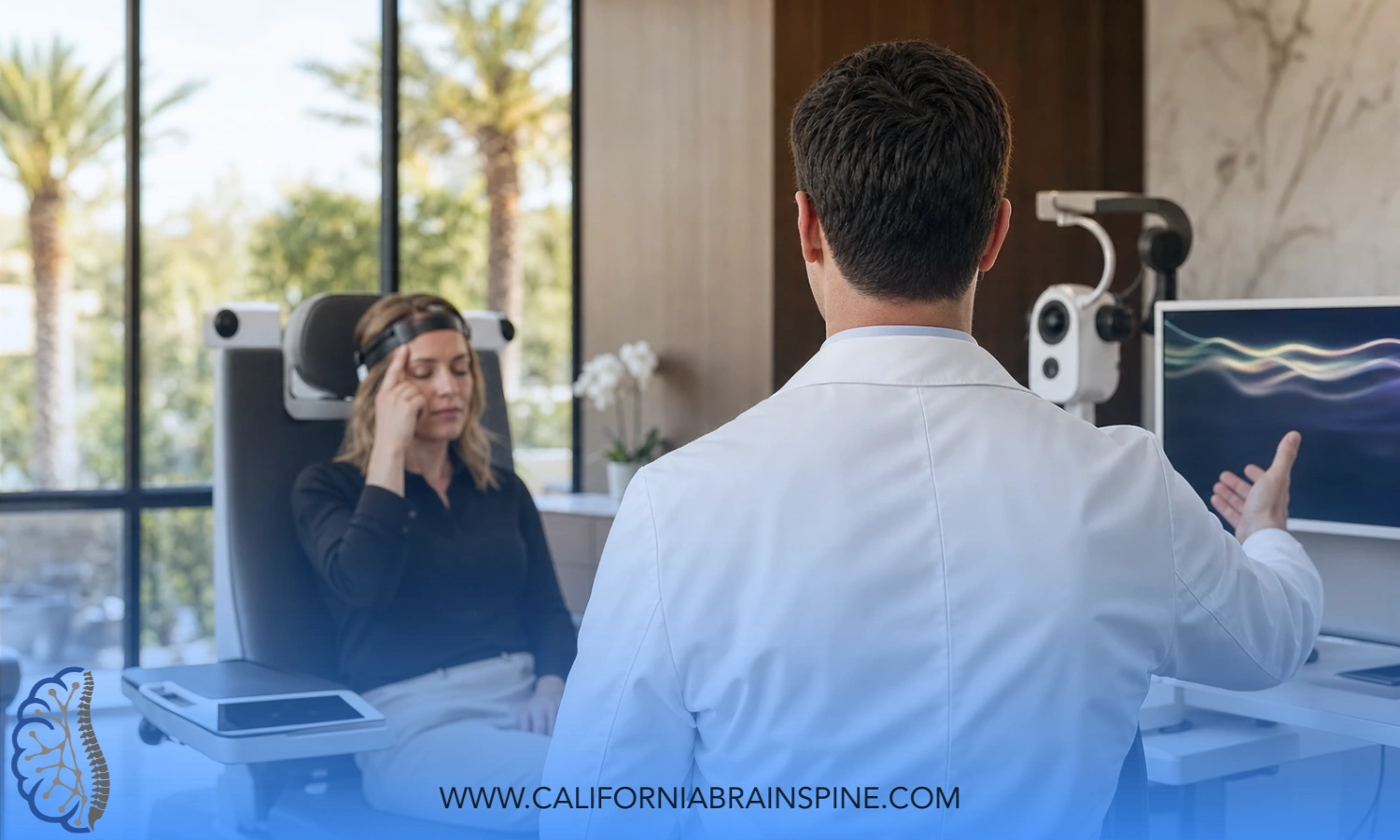
At California Brain & Spine Center in Calabasas, Dr. Alireza Chizari, DC, DACNB, a board certified chiropractic neurologist, begins with a 120 minute neurodiagnostic assessment. The purpose is to understand how the patient's symptoms relate to eye movements, balance, gait, sensory integration, the neck, and other neurological findings before recommending a rehabilitation plan.
The history matters as much as the exercise list. A useful evaluation asks what the dizziness feels like, when it started, whether it is constant or episodic, which movements provoke it, how long a flare lasts, whether hearing changes are present, whether there was a concussion or whiplash injury, and what daily activities have become difficult. Driving, stores, stairs, screens, exercise, and walking in the dark can all provide clues.
Eye movement testing
Eye movements offer information about how the brain coordinates visual targets and head motion. Depending on the case, testing may look at fixation, tracking, saccades, gaze stability, and whether symptoms appear when the eyes or head move. A patient who becomes dizzy while reading signs during walking may have a different problem from someone who becomes dizzy only when rolling in bed.
Balance, gait, and sensory integration
Standing balance can be tested under different conditions to see how much the patient depends on vision, proprioception, or vestibular input. Walking may be observed with head turns, changes in speed, or other tasks when appropriate. The purpose is not to create a performance test for its own sake. It is to identify the situations where the nervous system loses efficiency.
Neck and proprioceptive contribution
When the history includes whiplash, concussion, chronic neck tension, or dizziness linked to neck movement, cervical motion and position sense may deserve attention. The neck and vestibular system both contribute information about head orientation. If their signals conflict, the patient may feel disoriented even when standard imaging does not explain the symptom pattern.
Autonomic and symptom tolerance
Some patients also report lightheadedness with standing, rapid heart rate, exercise intolerance, fatigue, or symptoms that worsen with heat. Those patterns can change how aggressively rehabilitation should be introduced. A patient who cannot tolerate upright activity for long may need a different starting dose from someone whose only problem is brief positional vertigo.
Once the findings are mapped, treatment can be matched more precisely. A plan may include vestibular rehabilitation, balance disorder therapy, canalith repositioning when BPPV is confirmed, or other targeted neurological rehabilitation. In selected cases, supportive care such as hyperbaric oxygen therapy may be considered when clinically appropriate after evaluation. It is not a substitute for identifying the rehabilitation target.
If dizziness is affecting driving, work, exercise, or confidence and the cause remains unclear, a structured dizziness evaluation in Calabasas can help determine whether the main issue appears peripheral, central, visual, cervical, autonomic, or mixed. The practice may also work alongside primary care physicians, ENTs, physical therapists, and other specialists when a case requires broader medical coordination.
What Is Vestibular Therapy Like After a Concussion?
Concussion related dizziness is rarely just a matter of being weak or out of shape. A concussion can disrupt several systems that normally cooperate automatically. Eye movements may be less efficient. Head motion may provoke nausea. The neck may provide inaccurate position information. Busy visual environments may create overload. Heart rate and exercise tolerance can change. Attention and memory can feel worse because the brain is spending more effort simply trying to stay oriented.
That is why post concussion vestibular therapy often needs more conservative pacing than a simple balance program. A patient who becomes symptomatic after ten seconds of a visual task should not automatically be pushed through several minutes because a generic protocol says so. The exercise dose should be based on the response that is actually observed.
Why stores, screens, and driving can feel so difficult
A grocery store is a surprisingly demanding neurological environment. The body is moving forward while the head turns from shelf to shelf. The eyes scan labels at different distances. Other people cross the visual field. Bright lights and repeating patterns add visual information. The brain must filter all of that while maintaining posture and attention.
If visual and vestibular processing are not well coordinated after a concussion, the store can feel as if it is moving. A similar problem can appear when scrolling on a phone, riding as a passenger, or driving in dense traffic. Rehabilitation may gradually expose the patient to versions of these tasks in a controlled way, but only after the evaluation identifies which component is provoking the overload.
Why brain fog can overlap with dizziness
Brain fog does not always come from the same cause. In some patients, the nervous system appears to be using excessive effort to stabilize vision, track movement, maintain balance, and manage sensory input. That constant demand can leave less capacity for reading, working, conversation, or multitasking.
Improving vestibular and visual efficiency may reduce some of that workload when those systems are genuinely part of the problem. It should not be presented as a guaranteed cure for brain fog. The purpose of the evaluation is to determine whether the symptoms move together and whether objective findings support a shared rehabilitation target.
Why the neck may need to be assessed after concussion
A head injury often involves force to the neck as well as the brain. A person may therefore have vestibular symptoms, visual symptoms, and altered cervical position sense at the same time. If head turns make the patient dizzy, it matters whether the trigger is inner ear motion, visual instability, neck input, or a combination.
This is another reason copied exercise programs can fail. A head turning drill may be useful for one patient and far too provocative for another. The correct starting point can only be selected after understanding the pattern.

Can You Do Vestibular Therapy at Home?
Home exercises are a normal part of many vestibular therapy programs. Repetition between visits is often necessary because neurological adaptation develops through consistent practice. The important distinction is that home practice and self diagnosis are not the same thing.
A generic video cannot know whether your dizziness is caused by BPPV, vestibular loss, migraine, visual dependence, a central neurological issue, neck input, autonomic intolerance, or something unrelated to the vestibular system. It also cannot see whether your eyes stay on target, whether your posture changes, whether you compensate in an unusual way, or whether the symptoms take minutes or hours to settle afterward.
If you have already tried home exercises and felt worse, that does not automatically mean vestibular therapy cannot help. It may mean the exercise was wrong for the diagnosis, the starting speed was too fast, the duration was too long, the environment was too complex, or another system needed attention first.
How do you know whether the exercises are helping?
Progress should show up in function, not only in how hard an exercise feels. A patient might tolerate faster head turns while keeping a target clear. Walking in a store may become easier. The person may recover more quickly after a visual trigger. Standing on an uneven surface may require less effort. Driving may feel more predictable.
Objective retesting is useful because symptoms can fluctuate from day to day. Repeating the same gaze, balance, or gait measure from the initial evaluation can show whether a specific system is actually changing. If nothing changes despite consistent practice, the plan should be reconsidered rather than repeated indefinitely.
What does realistic progress look like?
Recovery is often uneven. A better week can be followed by a difficult day after poor sleep, a stressful schedule, travel, migraine activity, or too much exercise. A temporary setback does not necessarily mean the program has failed. What matters is the trend across time and whether daily function is becoming more reliable.
Consider a composite example based on patterns commonly seen in complex dizziness cases. A person from Woodland Hills has spent months avoiding the freeway and grocery stores because head turns and visual motion create dizziness. Standard tests have not provided a satisfying explanation, and the person has gradually organized daily life around avoiding triggers.
The evaluation identifies reduced gaze stability with head movement and heavy dependence on vision for balance. The rehabilitation program begins below the level that creates a prolonged flare. Over several weeks the exercises are progressed as retesting shows better tolerance. The first meaningful change may not be “no dizziness.” It may be that a short grocery trip is possible without needing the rest of the day to recover.
Later, the person may tolerate longer computer work, more head movement while walking, or a familiar drive with less anticipatory fear. That example is not a promise and it is not a report about one identifiable patient. It illustrates a more useful way to think about vestibular therapy: matched care, measured against the original findings, and adjusted according to the nervous system's response.
When Dizziness Needs Urgent Medical Attention
Dizziness is not always a rehabilitation problem. Seek urgent medical care for sudden severe dizziness with new weakness, facial drooping, trouble speaking, severe or unusual headache, new double vision, fainting, chest pain, new confusion, major loss of coordination, or symptoms after a serious head injury. Call 911 or go to an emergency department when stroke, cardiac, or other emergency symptoms are possible.
Frequently Asked Questions About Vestibular Therapy
Is vestibular therapy only for vertigo?
No. Spinning vertigo is one reason a person may be referred for vestibular rehabilitation, but other patterns include rocking, floating, visual motion sensitivity, unsteadiness, difficulty walking with head turns, and dizziness after a concussion. The useful question is whether testing identifies a vestibular or sensory integration problem that can be trained.
How long does vestibular therapy take?
There is no single timeline for how long vestibular therapy takes. A straightforward positional problem may respond very differently from chronic dizziness involving migraine, concussion, neck injury, visual dependence, or autonomic symptoms. Progress should be based on the diagnosis, symptom tolerance, functional goals, and retesting rather than a fixed number of visits.
Can vestibular therapy make dizziness worse at first?
Some exercises can create a mild temporary increase in symptoms because they deliberately challenge a movement or sensory pattern the nervous system finds difficult. That reaction should be monitored. Severe flares that last for hours or days can indicate that the dose is too high or that the exercise target needs to be reconsidered.
What is vestibular therapy like after a concussion?
After a concussion, care may involve gaze stability, eye movement control, balance, walking, visual motion tolerance, cervical position sense, and gradual return to daily activity. Because concussion symptoms can involve several systems at once, the program is often paced carefully and adjusted according to the patient's response.
Is vestibular therapy covered by insurance?
Coverage depends on the insurance plan, provider type, and how services are billed. Patients should confirm benefits directly with their insurer and ask the clinic about costs before beginning care. California Brain & Spine Center offers a complimentary consultation so patients can understand the evaluation process before deciding on next steps.
Where can I get a vestibular therapy evaluation near Calabasas?
California Brain & Spine Center is located at 4768 Park Granada, Ste 107, Calabasas, CA 91302. Dr. Alireza Chizari, DC, DACNB performs the neurodiagnostic assessment. Patients can book online or call the clinic to ask whether an evaluation fits their symptoms.
This content is for educational purposes only and is not medical advice. Individual symptoms require evaluation by an appropriately qualified healthcare professional.
Get Clarity on Your Dizziness
A structured evaluation at our Calabasas clinic can help identify which parts of the balance system need attention before a rehabilitation plan is recommended. California Brain & Spine Center, 4768 Park Granada, Ste 107, Calabasas, CA 91302.