VOMS Diagnostic Accuracy After Concussion: What a Positive or Negative Screen Adds
- Published
- No Comments
- Updated November 16, 2026
Clinical Evidence Review. For sports medicine physicians and athletic trainers who run concussion assessments, and for the medical neurology and rehabilitation clinicians who receive Vestibular/Ocular Motor Screening (VOMS) findings.
Clinical answer
In athletes assessed within days of a suspected sport-related concussion, a positive VOMS result adds modest diagnostic information to a multimodal evaluation, and a negative result may lower the probability of concussion without excluding it. VOMS diagnostic accuracy depends on the population, the scoring method and the reference standard: across sport-related concussion studies, sensitivity ranged from 58% to 96% and specificity from 46% to 92%, with no pooled estimate [6]. VOMS is a screen. It does not diagnose concussion on its own, localise a lesion or clear an athlete to return to play.
Safety first
Danger signs after a head injury sit outside any screening pathway. Seizures, repeated vomiting, a headache that gets worse and does not go away, increasing drowsiness or inability to wake, slurred speech, weakness or numbness, one pupil larger than the other and increasing confusion call for emergency assessment, and VOMS has no role until that is done [14].
The instruction for athletes and families is the same: If symptoms come on suddenly or severely – a sudden severe headache, weakness, trouble speaking, vision loss, or fainting – that is an emergency. Call 911 or go to an emergency room, not a clinic appointment.
In this review
- What VOMS measures and how it is scored
- Accuracy in published studies (evidence table)
- Why the estimates may not transfer to the sideline or primary care
- What a positive screen adds
- What a negative screen excludes
- Serial testing and measurement error
- Near point of convergence as a referral trigger
- Where VOMS fits in a multimodal assessment
- A referral reasoning sequence
- References
What Does VOMS Measure, and How Is It Scored?
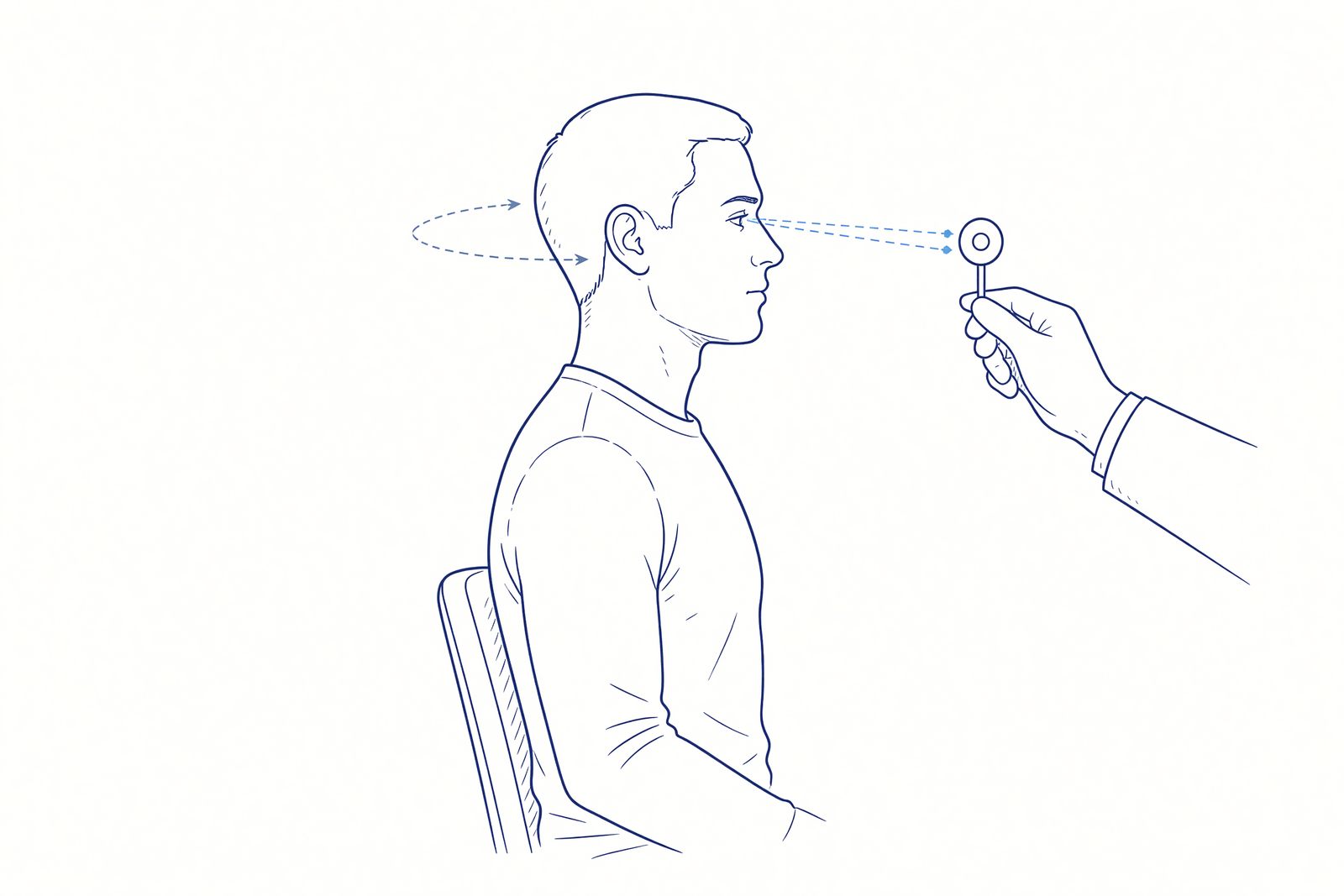
VOMS is a brief screen of five domains: smooth pursuit, horizontal and vertical saccades, convergence (including near point of convergence distance), the horizontal vestibular ocular reflex and visual motion sensitivity [1]. It is scored mainly by the symptoms each item provokes, alongside a measured near point of convergence (NPC) distance.
A systematic review of 17 studies found a wide variety of approaches to administering and scoring VOMS [6]. Some studies count item symptom scores, some use an overall score and some use the change from pre-test symptoms. A result reported as “positive VOMS” with nothing else leaves the receiving clinician unable to tell which threshold was crossed.
For patients who ask what eye movement testing involves, the practice keeps a plain-language page on eye tracking and antisaccade testing. This review does not repeat it.
How Accurate Is VOMS in Published Studies?
Reported accuracy is high in athletes tested within days of injury and compared with healthy controls, and lower or more uneven under other designs and scoring methods. The table places each estimate beside the conditions that produced it.
| Study | Population and timing | Scoring and reference standard | Estimate | Applicability limit |
|---|---|---|---|---|
| Mucha 2014 [1] | Sixty-four adolescents (mean age 13.9 years) at a specialty concussion clinic, about 5.5 days after a sport-related concussion, versus healthy controls | A model combining VOMS measures. Clinical diagnosis; case-control | Area under the curve (AUC) 0.89 (95% CI, 0.84 to 0.95) | No pre-injury baseline; clinic-referred sample; preliminary |
| Kontos 2021, CARE Consortium [2] | 285 concussed collegiate athletes within 3 days of injury versus 285 matched healthy controls | Item symptom scores and overall score. Matched healthy controls; case-control | Overall score AUC 0.91 | Healthy-control comparison; collegiate athletes |
| Ferris 2021, CARE Consortium [3] | 419 collegiate student-athletes with preseason and acute assessments | VOMS added to the full Sport Concussion Assessment Tool 3 (SCAT3) | Overall diagnostic ability up by 4.4%, to AUC 0.848 | Added value within a battery, not stand-alone accuracy |
| Büttner 2021 [4] | Amateur athletes with sport-related concussion versus matched controls | Diagnosis by emergency department physicians | Sensitivity 96%, specificity 46%; positive predictive value 64%, negative predictive value 92% | Small sample; predictive values reflect this study’s case mix |
| Elbin 2022 [5] | Adolescents with sport-related concussion | Change scores from pre-test symptoms | Item change scores AUC .55 to .71; overall change score AUC .73 | A different scoring method; not comparable with total-score studies |
| Thomas 2023, systematic review [6] | 17 studies, with the accuracy evidence drawn from sport-related concussion | Varied administration, scoring and reference standards | Sensitivity 58% to 96%, specificity 46% to 92%; no pooled estimate | Marked heterogeneity between studies |
Two readings follow from the table. The two highest estimates (AUC 0.89 and 0.91) come from comparisons with healthy controls [1] [2]. And when VOMS was added to the full SCAT3 in 419 collegiate student-athletes, overall diagnostic ability rose by 4.4%, to an AUC of 0.848, which describes added value within a battery and not stand-alone accuracy [3].
Why VOMS Diagnostic Accuracy May Not Transfer to the Sideline or Primary Care
Most accuracy estimates come from diagnosed athletes compared with healthy controls, a design that can overstate accuracy compared with real diagnostic uncertainty.
At the sideline or in primary care, the clinician is sorting athletes who all have a possible injury, some of whom are symptomatic for other reasons. A study that compares clear cases with healthy controls does not test that distinction. The authors of the original validation study note two further limits: there were no pre-injury baseline measures, and the sample represented patients presenting to a concussion clinic [1]. In the one study in the table whose cases were diagnosed by emergency department physicians, sensitivity was 96% and specificity 46% [4].
Evidence limitations
The statement that these estimates may not transfer to sideline or primary care settings is our editorial interpretation of the study designs. The studies themselves do not report it as a finding. A study in an undifferentiated sideline or primary care population, with one reference standard applied to every participant, would change this interpretation.
What Does a Positive VOMS Screen Add?
A positive screen adds modest diagnostic information to a multimodal battery and documents vestibular or oculomotor symptom provocation. On its own it does not confirm concussion.
False positives are frequent enough to plan for. Among 263 healthy Division I collegiate athletes tested at baseline, 11% scored above clinical cut-off levels, and female sex and a history of motion sickness were risk factors [8]. In 416 healthy US military personnel, item false-positive rates ranged from 10.6% for smooth pursuits to 17.5% for NPC, and they were associated with age and a history of mild traumatic brain injury (mTBI), migraine or motion sickness [9].
Clinical implication
Before interpreting a positive screen, record motion sickness history, migraine history, prior mTBI, age and sex, and the symptoms present before testing began. In an athlete with a motion sickness or migraine history, provocation may reflect a pre-existing trait and not the injury [8] [9]. This is our reading of the false-positive studies, not a published recommendation.
A positive screen may also carry prognostic information, with caution. In one retrospective chart review of youth and adolescent athletes, symptom provocation or clinical abnormality in every domain except NPC was associated with longer recovery [11]. A later scoping review found that VOMS did not reliably separate normal from prolonged recovery [7]. The association does not predict recovery time for an individual athlete.
What Does a Negative VOMS Screen Exclude?
A negative screen in the first days after injury may lower the probability of concussion, but it does not exclude one.
The strongest support for ruling out comes from one small matched-cohort study of amateur athletes, where sensitivity was 96% and the negative predictive value was 92%. Its authors concluded that VOMS may be most useful as a screening tool to rule out, rather than confirm, sport-related concussion [4]. Predictive values depend on the case mix of the study that produced them, so those figures do not transfer to a sideline, a clinic or a school. Across sport-related concussion studies, reported sensitivity was as low as 58% [6].
Timing limits the reading further. The accuracy studies in the table tested athletes within days of injury, and the systematic review that informed the international office assessment tool found that current sport-related concussion tools have limited utility beyond 72 hours [12]. A negative screen obtained later sits outside the window those studies describe. At any time point, a negative VOMS leaves the history, the symptom report and the other components of the evaluation to carry the decision.
Serial Testing: How Much Change Is Real?
In one collegiate cohort retested a year apart, the minimum detectable change was 4 cm for NPC distance and 10 for the VOMS overall score, so smaller changes may be measurement error [10].
That analysis followed 378 athletes who completed preseason VOMS in two consecutive years, and false positives ranged from 5.3% to 15.9% [10]. The scoping review described the reliability of the VOMS total score as conflicting [7]. A small improvement between visits may therefore not indicate recovery, and a small worsening may not indicate a setback.
The scoring method has to stay the same across visits. In adolescents with sport-related concussion, item change scores from pre-test symptoms gave AUC values of .55 to .71, and the overall change score gave .73 [5]. Those figures come from a different sample and a different method than the total-score studies, so the two approaches cannot be compared directly or swapped partway through a series.
Near Point of Convergence: A Referral Trigger, Not a Diagnosis
A receded near point of convergence on VOMS may warrant referral for a binocular vision examination. It does not diagnose convergence insufficiency or concussion.
Convergence insufficiency is a binocular vision condition that an eye doctor identifies with dedicated testing of how the eyes work together at near, and a person can have perfect vision and still have it [13]. The referral step is our inference; the source supports the point that diagnosis needs that dedicated testing. The scoping review states that the NPC assessment should not be used to diagnose sport-related concussion [7]. NPC also had the highest item false-positive rate (17.5%) among healthy military personnel [9], and it was the one domain not associated with longer recovery in the retrospective review [11].
Evidence on treating convergence insufficiency after concussion is outside the scope of this review. Patients who ask about visual symptoms can be pointed to the practice’s page on vision problems after concussion.
Where Does VOMS Fit in a Multimodal Concussion Assessment?
VOMS is one component of a multimodal assessment, and the reviews that support its use say so directly.
The systematic review that informed the international office assessment tool supported a multimodal clinical assessment in the subacute phase that includes a modified VOMS alongside tandem gait and provocative exercise tests. It added that the tool’s psychometric properties still need study [12]. The scoping review of ocular tools reached the same position: they should remain within a multi-modal assessment at this time [7]. Tandem gait and exercise testing are outside the scope of this review.
Three limits follow. VOMS does not establish a concussion diagnosis by itself, which remains a clinical judgement. Symptom provocation on a screen does not identify where in the vestibular or oculomotor pathways a problem arises, so VOMS is not a lesion localiser. And none of the studies summarised here supports using a VOMS result as return-to-play clearance.
A Referral Reasoning Sequence for VOMS Findings
The sequence below is an editorial synthesis of the evidence above for the clinician running the assessment. It has not been validated as an algorithm.
- Check for danger signs first. If any are present, arrange emergency assessment and do not screen [14].
- Record the context before testing. Note the time since injury, pre-test symptoms, and any history of motion sickness, migraine or prior mTBI, with age and sex [8] [9].
- Administer VOMS and write down the scoring method. State whether the result is item scores, an overall score or a change from pre-test symptoms, and give NPC distance in centimetres [6].
- If the screen is positive, read it with the rest of the multimodal evaluation and the confounders. Persistent provocation may be a reason to request further vestibular or oculomotor evaluation.
- If NPC is receded, consider referral for a binocular vision examination [13].
- If the screen is negative, keep the question open when the history, symptoms or other components point toward concussion.
- On repeat testing, use the same method and read changes against the minimum detectable change [10].
- Keep return-to-play decisions with the full clinical assessment, never with a VOMS result alone.
What the receiving clinician needs on the referral
- Date of injury and date of each VOMS administration
- Scoring method used, with item-level results where available
- Symptoms reported before testing began
- NPC distance, and how it was measured
- Motion sickness, migraine and prior mTBI history
- The other components of the evaluation that were completed
- The clinical question the referral is asking
Some patients arrive having completed a symptom self-check, such as the practice’s post-concussion symptom self-assessment. It is a patient education tool and does not replace the pre-test symptom record.
Read this way, VOMS diagnostic accuracy is a set of study-specific estimates, and the written record of method, timing and confounders is what lets the next clinician use the result.
Methods Note
This is a narrative review with a documented, non-exhaustive search. Sources were found through web search and confirmed against PubMed Central, Europe PMC and Crossref records. Evidence checked on November 9, 2026. The original validation study was read in open full text and the scoping review in open full text in part; the other journal articles were read as abstracts, so their findings are reported as far as the abstracts state them. No pooling or formal grading of evidence was performed.
For healthcare professionals. This is an educational narrative review, not a clinical guideline and not an accredited continuing-education activity, and it does not replace clinical judgement.
References
- Mucha A, Collins MW, Elbin RJ, et al. A Brief Vestibular/Ocular Motor Screening (VOMS) assessment to evaluate concussions: preliminary findings. Am J Sports Med. 2014;42(10):2479-2486. Full text on PubMed Central
- Kontos AP, Eagle SR, Marchetti G, et al. Discriminative validity of Vestibular Ocular Motor Screening in identifying concussion among collegiate athletes: a NCAA-DoD CARE Consortium study. Am J Sports Med. 2021;49(8):2211-2217. PMID 33979240. Europe PMC record
- Ferris LM, Kontos AP, Eagle SR, et al. Predictive accuracy of the Sport Concussion Assessment Tool 3 and Vestibular/Ocular-Motor Screening, individually and in combination: a NCAA-DoD CARE Consortium analysis. Am J Sports Med. 2021;49(4):1040-1048. PMID 33600216. Europe PMC record
- Büttner F, Howell DR, Doherty C, Blake C, Ryan J, Delahunt E. Clinical detection and recovery of vestibular and oculomotor impairments among amateur athletes following sport-related concussion: a prospective, matched-cohort study. J Head Trauma Rehabil. 2021;36(2):87-95. doi:10.1097/HTR.0000000000000608. PMID 32898028. Europe PMC record
- Elbin RJ, Eagle SR, Marchetti GF, et al. Using change scores on the vestibular ocular motor screening (VOMS) tool to identify concussion in adolescents. Appl Neuropsychol Child. 2022;11(4):591-597. PMID 33896282. Europe PMC record
- Thomas CE, Thomas SH, Bloom B. Vestibular/ocular motor screening (VOMS) score for identification of concussion in cases of non-severe head injury: a systematic review. Journal of Concussion. 2023. doi:10.1177/20597002231160941. Journal page
- Walshe A, Daly E, Ryan L. Clinical utility of ocular assessments in sport-related concussion: a scoping review. J Funct Morphol Kinesiol. 2024;9(3):157. PMID 39311265. Full text on PubMed Central
- Kontos AP, Sufrinko A, Elbin RJ, Puskar A, Collins MW. Reliability and associated risk factors for performance on the Vestibular/Ocular Motor Screening (VOMS) tool in healthy collegiate athletes. Am J Sports Med. 2016;44(6):1400-1406. PMID 26980845. Europe PMC record
- Kontos AP, Monti K, Eagle SR, et al. False-positive rates and associated risk factors on the Vestibular-Ocular Motor Screening and modified Balance Error Scoring System in US military personnel. J Athl Train. 2022;57(5):458-463. PMID 35696602. Europe PMC record
- Eagle SR, Ferris LM, Mucha A, et al. Minimum detectable change and false positive rates of the vestibular/ocular motor screening (VOMS) tool: an NCAA-DoD CARE Consortium analysis. Brain Inj. 2021;35(12-13):1563-1568. PMID 34543099. Europe PMC record
- Anzalone AJ, Blueitt D, Case T, et al. A positive Vestibular/Ocular Motor Screening (VOMS) is associated with increased recovery time after sports-related concussion in youth and adolescent athletes. Am J Sports Med. 2017;45(2):474-479. PMID 27789472. Europe PMC record
- Patricios JS, Schneider GM, van Ierssel J, et al. Beyond acute concussion assessment to office management: a systematic review informing the development of a Sport Concussion Office Assessment Tool (SCOAT6) for adults and children. Br J Sports Med. 2023;57(11):737-748. PMID 37316204. Europe PMC record
- National Eye Institute (NIH). Convergence Insufficiency. National Eye Institute page
- CDC HEADS UP. Signs and Symptoms of Concussion (danger signs). CDC page
Refer a patient
California Brain & Spine Center in Calabasas is a functional neurology practice led by Dr. Alireza Chizari, DC, DACNB, a board-certified chiropractic neurologist. For patients with persistent post-concussion symptoms, including dizziness and visual complaints, the practice offers a neurodiagnostic assessment and, when clinically appropriate after evaluation, neurological rehabilitation. It works alongside the patient’s existing clinicians, including primary care, medical neurology, ENT and physical therapy. Imaging decisions, medication management, the diagnosis of convergence insufficiency and return-to-play clearance stay with the referring physician and the relevant specialists.
Refer by email: info@californiabrainspine.com
California Brain & Spine Center | (818) 649-5300 | Calabasas, CA 91302

Dr. Alireza Chizari
This article has been medically reviewed for clinical accuracy by Dr. Alireza Chizari, DC, DACNB. Committed to evidence-based practice, Dr. Chizari ensures all content reflects the highest standards of functional neurology care.
Comments
Find our article more easily in Google.
FAQ
What is Functional Neurology?
Functional Neurology is a healthcare specialty that focuses on assessing and rehabilitating the nervous system’s function. It emphasizes neuroplasticity—the brain’s ability to adapt and reorganize—using non-invasive, evidence-based interventions to improve neurological performance.
How does Functional Neurology differ from traditional neurology?
Traditional neurology often concentrates on diagnosing and treating neurological diseases through medications or surgery. In contrast, Functional Neurology aims to optimize the nervous system’s function by identifying and addressing dysfunctions through personalized, non-pharmaceutical interventions.
Is Functional Neurology a replacement for traditional medical care?
No. Functional Neurology is intended to complement, not replace, traditional medical care. Practitioners often collaborate with medical professionals to provide comprehensive care.
What conditions can Functional Neurology help manage?
Functional Neurology has been applied to various conditions, including:
• Concussions and Post-Concussion Syndrome
• Traumatic Brain Injuries (TBI)
• Vestibular Disorders
• Migraines and Headaches
• Neurodevelopmental Disorders (e.g., ADHD, Autism)
• Movement Disorders
• Dysautonomia
• Peripheral Neuropathy
• Functional Neurological Disorder (FND)
Can Functional Neurology assist with neurodegenerative diseases?
While Functional Neurology does not cure neurodegenerative diseases, it can help manage symptoms and improve quality of life by optimizing the function of existing neural pathways.
What diagnostic methods are used in Functional Neurology?
Functional Neurologists employ various assessments, including:
• Videonystagmography (VNG)
• Computerized Posturography
• Oculomotor Testing
• Vestibular Function Tests
• Neurocognitive Evaluations
How is a patient’s progress monitored?
Progress is tracked through repeated assessments, patient-reported outcomes, and objective measures such as balance tests, eye movement tracking, and cognitive performance evaluations.
What therapies are commonly used in Functional Neurology?
Interventions may include:
- Vestibular Rehabilitation
- Oculomotor Exercises
- Sensorimotor Integration
- Cognitive Training
- Balance and Coordination Exercises
- Nutritional Counseling
- Lifestyle Modifications
Are these therapies personalized?
Absolutely. Treatment plans are tailored to the individual’s specific neurological findings, symptoms, and functional goals.
Who can benefit from Functional Neurology?
Individuals with unresolved neurological symptoms, those seeking non-pharmaceutical interventions, or patients aiming to optimize brain function can benefit from Functional Neurology.
Is Functional Neurology suitable for children?
Yes. Children with developmental delays, learning difficulties, or neurodevelopmental disorders may benefit from Functional Neurology approaches.
How does Functional Neurology complement other medical treatments?
It can serve as an adjunct to traditional medical care, enhancing outcomes by addressing functional aspects of the nervous system that may not be targeted by conventional treatments.
How is technology integrated into Functional Neurology?
Technological tools such as virtual reality, neurofeedback, and advanced diagnostic equipment are increasingly used to assess and enhance neurological function.
What is the role of research in Functional Neurology?
Ongoing research continues to refine assessment techniques, therapeutic interventions, and our understanding of neuroplasticity, contributing to the evolution of Functional Neurology practices.