
When the letter chart says your eyes are fine but a page of text still blurs, the answer often lies in how your eyes move, team and focus.
Blurry vision after concussion is one of the visual symptoms commonly reported, and it can be linked to the brain pathways that move, team and focus the eyes, even when the eyes themselves are healthy.
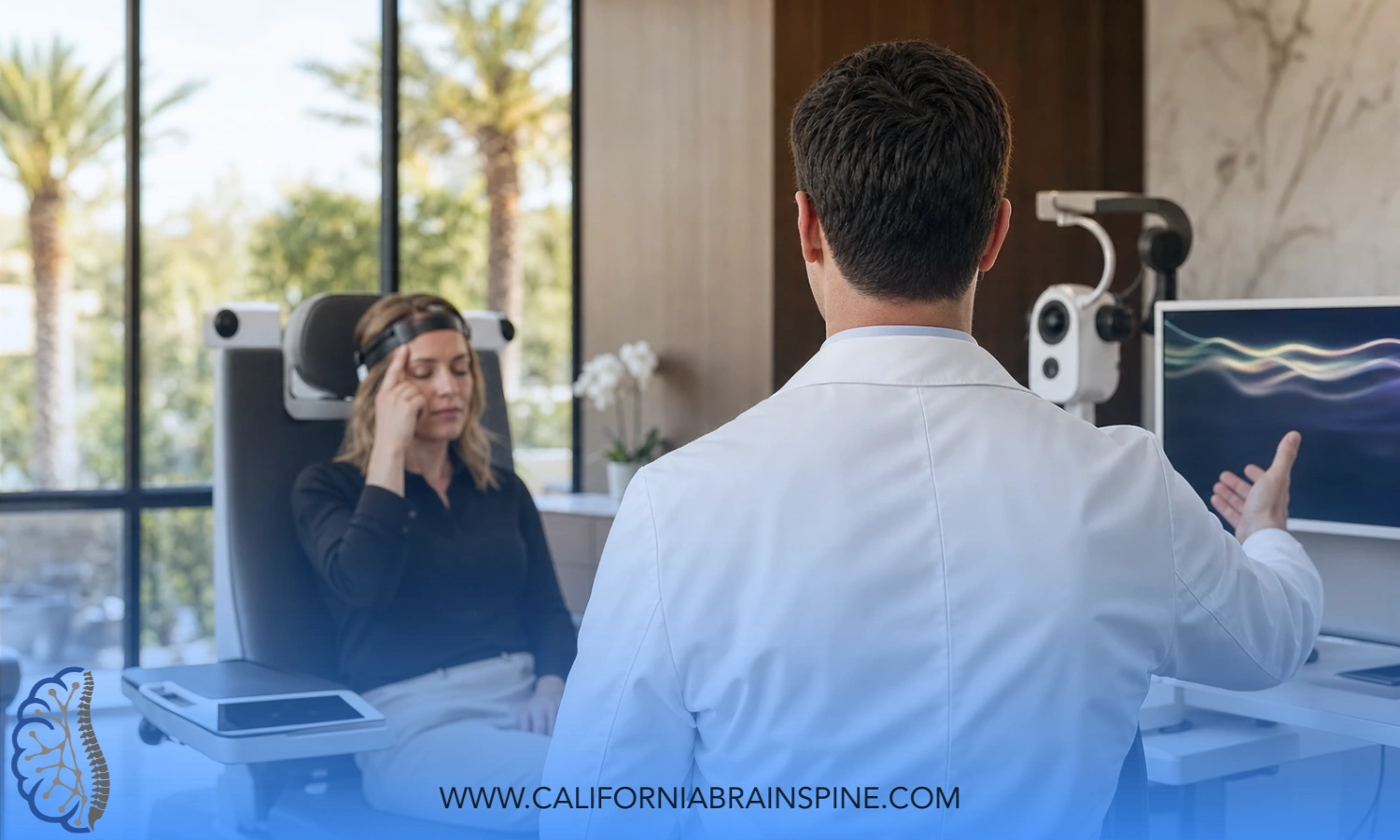
I am Dr. Alireza Chizari, DC, DACNB, and at California Brain & Spine Center in Calabasas I evaluate a pattern that is widely described after a head injury. The eye chart can come back normal, yet close work such as reading or screen time may take longer because of fatigue, headache, double vision or losing your place, and scrolling a phone may bring on dizziness and nausea. That gap between a normal test and a hard working day is real, and parts of it can be measured.
What follows explains what may be going on, how it is tested, and what care can involve. I do not give timelines, since an individual course cannot be predicted in advance, but the process is something I can lay out clearly.
Key Takeaway
Blurry vision after concussion is common and can be linked to how the brain controls eye teaming, focusing and tracking, which a letter chart may not capture. These functions can be tested. When a specific problem such as convergence insufficiency is found, targeted vision rehabilitation may help. The next step is an evaluation of how your eyes work together.
Is blurry vision after concussion normal?
Yes, blurry vision after concussion is among the visual symptoms commonly reported, alongside trouble focusing, reading or tracking, double vision and light sensitivity. It is often linked to the brain pathways that move and team the eyes, which are considered especially vulnerable to concussive injury, so it deserves an evaluation rather than guesswork.
Those symptoms appear together in a review of concussion-related vision disorders in the journal Eye and Brain, which describes blurry vision, difficulty focusing, reading or tracking, double vision and photophobia as common after concussion. If your blur arrived with the head injury and gets worse with reading or screens, you are describing a recognized pattern.
Why the blur shows up when your eyes are healthy
The same review notes that the pathways behind smooth pursuit, saccades and vergence are especially vulnerable to concussive injury. Those circuits glide your eyes along a line of text, jump them to the next word, and turn them inward together so a near target stays single and sharp. When they tire or misfire, the image the brain receives can soften, double or drift.
The review also reports that best-corrected visual acuity, the letter-chart result, is generally not affected by a concussion. A normal chart reading therefore may not capture how your eyes move, team and focus under the load of a working day.
When blurry vision is a warning sign instead
The blur described above builds gradually with reading and screens. A different set of signs after a head injury is never something to book an appointment for: the CDC lists danger signs including one pupil larger than the other, a headache that gets worse and does not go away, repeated vomiting, slurred speech, weakness or numbness, seizures, increasing confusion, or loss of consciousness. Any of these needs emergency care, not a clinic appointment, and the safety box further down repeats them.
What do vision problems after concussion feel like?
People rarely use clinical words for it. They say the words start to crawl, that they read the same line over and over, that the office monitor feels too bright by mid-morning, or that a grocery aisle suddenly feels too busy to look at.
A randomized clinical trial in the British Journal of Sports Medicine describes concussion-related vision symptoms as reading difficulties, eye strain, blurred or double vision, trouble switching focus between near and far, light sensitivity and discomfort in busy, dynamic environments, and notes that they may interfere with school, work and sport. In daily life, vision problems after concussion often look like this:
- Text that blurs or doubles the longer you read, so close work takes longer than it used to
- Losing your place on a line and rereading sentences, often with fatigue or headache alongside
- Eye strain after screen work, and dizziness or nausea when you scroll
- Focus that lags when you look from the dashboard to the road, or from a slide to your notes
- Bright rooms and screens that feel harsh because of light sensitivity
A note on screens
Scrolling asks your eyes to follow moving text while holding focus at close range, and after a concussion it may bring on dizziness and nausea. If your phone is the first thing that sets symptoms off each day, write that down before an evaluation. Knowing exactly which tasks trigger the blur gives the testing a place to start.
Why does a concussion cause blurry vision?
Ophthalmology references on post-concussion syndrome describe three problems as the most common visual disorders after a mild traumatic brain injury: convergence insufficiency, accommodative insufficiency and mild saccadic dysfunction. Each can blur the picture in its own way.
Eye teaming: convergence insufficiency
Convergence insufficiency is an eye-teaming problem in which the two eyes have trouble turning inward together and holding that position for close work. When teaming slips during reading, a near target can blur or split into two, and the extra effort of pulling it back into one image may show up as eye strain and headache.
Focusing: accommodative insufficiency
Accommodation is the focusing adjustment that sharpens a near target. When it is weak after a concussion, print that starts out clear may soften as you read, and moving your gaze between near and far can leave one of them blurred for a moment longer than it should.
Tracking: saccades and smooth pursuit
Saccades are the quick jumps your eyes make from word to word, and smooth pursuit is the steady glide that follows something moving. Both run on the pathways described as especially vulnerable to concussive injury. Small errors here may show up as losing your place, needing to reread, or feeling unsettled by motion on a screen.
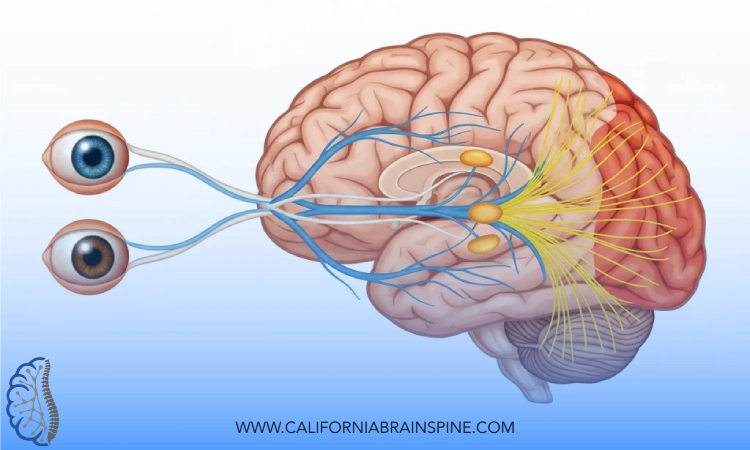
A clean eye chart answers one question well, how sharp your vision is. It says much less about how your eyes move, team and focus through a page of text.
Reading and screens harder since your concussion?
An evaluation of eye teaming, focusing and tracking can show which part of the system is struggling, so care is aimed at the right target.
How is blurry vision after concussion evaluated?
The evaluation looks at how your eyes perform under the kind of load that reading and screens demand, rather than at a single snapshot of sharpness. Eye teaming can be assessed with near point of convergence tests, and focusing can be assessed by bringing a target toward you to measure how much your eyes can adjust, a value called accommodative amplitude.
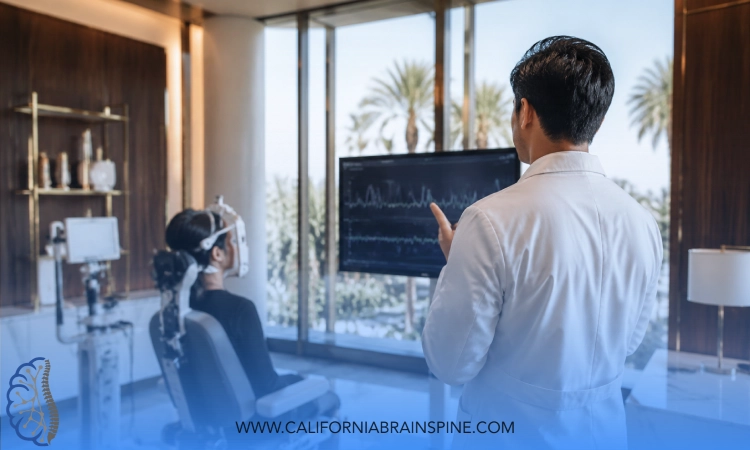
The Vestibular/Ocular Motor Screening, known as VOMS, checks eye movements together with the balance system. That pairing matters when scrolling or busy places also bring on dizziness. Video-oculography can record saccades and smooth pursuit and may detect subtle problems that watching the eyes alone can miss.
Dr. Alireza Chizari, DC, DACNB, a board-certified chiropractic neurologist, runs these assessments at California Brain & Spine Center in Calabasas as part of a functional neurology evaluation after concussion. It sits alongside an eye health exam by an eye doctor, and anything that points toward medical neurology is referred there.
The table below sets out how blurry vision after concussion and the symptoms that travel with it tend to present, which patterns suggest something more, and what the evaluation looks at for each.
| Typical presentation | Pattern that suggests something more | What the evaluation looks at |
|---|---|---|
| Print blurs the longer you read | Words doubling up close, eye strain, close work that takes longer than it used to | Near point of convergence and other eye-teaming measures |
| Trouble switching focus between near and far | Near targets that stay soft, or focus that lags between distances | Accommodative amplitude, measured by bringing a target toward you |
| Losing your place on a line | Frequent rereading, with fatigue or headache during close work | Saccades and smooth pursuit, with video-oculography where it adds detail |
| Eye strain on screens | Dizziness or nausea when scrolling, discomfort in busy, moving places | VOMS, which checks eye movements together with vestibular function |
| Bright light feels harsh | Light sensitivity that makes screens or bright rooms hard to tolerate | Symptom triggers, and whether tinted lenses may be worth discussing |
| Any vision change after a head injury | One pupil larger than the other, a worsening headache, repeated vomiting, increasing confusion | Not a clinic question: call 911 or go to an emergency room |
Can blurry vision after concussion be treated?
Care depends on which part of the system is struggling, so it starts from what the evaluation finds. For persistent visual symptoms after a brain injury, ophthalmology references describe vision rehabilitation, such as eye-movement or convergence exercises, as the mainstay of care, and tinted lenses may help with light sensitivity.
Randomized trial evidence exists for eye teaming in particular. In the CONCUSS trial of adolescents and young adults with concussion-related convergence insufficiency, office-based vergence and accommodative therapy was associated with improvement in both the clinical eye-teaming measures and symptoms, compared with delayed therapy. That result applies to that specific problem, which is one more reason to identify the problem first.
Waiting it out is not always the neutral choice it seems. In one study of emergency department patients with mild traumatic brain injury, higher convergence-insufficiency symptom scores were associated with developing post-concussion syndrome. A single study cannot predict any one person's course, but it suggests eye-teaming symptoms are worth assessing.
At California Brain & Spine Center, care may include, when clinically appropriate after evaluation, neurological rehabilitation with eye-movement, convergence and focusing exercises, plus balance work where dizziness is part of the picture. The approach to visual disturbances after concussion is set out on its own service page, and progress is checked by repeating the same measures rather than by impression.
When vision changes after a head injury are an emergency
If symptoms after a concussion are severe or rapidly worsening - such as one pupil larger than the other, a headache that gets worse and does not go away, repeated vomiting, slurred speech, weakness or numbness, seizures, increasing confusion, or loss of consciousness - call 911 or go to an emergency room, not a clinic appointment.
If symptoms come on suddenly or severely - a sudden severe headache, weakness, trouble speaking, vision loss, or fainting - that is an emergency. Call 911 or go to an emergency room, not a clinic appointment.
Where can I have blurry vision after concussion checked near Calabasas?
The clinic sits at 4768 Park Granada in Calabasas, close to the 101 for people coming from Agoura Hills and the rest of the West Valley. If your days run on screens and a commute, the evaluation is built around the tasks that set your symptoms off: reading, screen work, and the constant glances between mirror, dashboard and road.
For students after a sports concussion, vision-related symptoms may interfere with return to school. Reading, and switching focus from the board to a notebook, are among the tasks these problems may affect.
Questions people ask about blurry vision after concussion
Can blurry vision after concussion happen with a normal eye exam?
Yes. Blurry vision after concussion can appear even when the letter chart is normal, because best-corrected visual acuity is generally not affected by a concussion. The problem may sit in how the eyes team, focus and track, which a chart result may not capture. Those functions need their own tests.
Why do screens make my vision worse after a concussion?
Screens combine close focus, constant small eye jumps and scrolling motion. After a concussion, close work can take longer because of fatigue, headache, double vision, losing your place or trouble focusing, and scrolling may bring on dizziness and nausea. Noting which screen tasks set symptoms off gives the evaluation something specific to test.
Does blurry vision after concussion go away on its own?
Blurry vision after concussion does not follow one predictable course, and I do not give timelines, because an individual course cannot be predicted in advance. One study linked higher eye-teaming symptom scores with developing post-concussion syndrome, which is a reason to have persistent blur assessed rather than simply waiting.
What treatment helps blurry vision after concussion?
It depends on what the evaluation finds. When blurry vision after concussion is linked to eye teaming, a randomized trial found office-based vergence and accommodative therapy was associated with improvement in eye-teaming measures and symptoms. More broadly, vision rehabilitation with eye-movement or convergence exercises is commonly used, and tinted lenses may help light sensitivity.
Do I still need an eye doctor if I come to Calabasas for a concussion vision evaluation?
Yes. An eye health exam by an eye doctor remains part of the picture, and anything that points to eye disease or to medical neurology belongs there. The functional neurology evaluation at California Brain & Spine Center in Calabasas looks at something different: how the brain drives eye teaming, focusing, tracking and balance.
What should I do next about blurry vision after concussion?
If blurry vision after concussion is making a page of text or a day of screen work harder than it should be, you do not need to justify getting it checked. What you notice is where the evaluation begins, and the tests exist to find which part of your visual system is carrying the strain.
I would rather measure how your eyes team, focus and track than guess at it. After the evaluation I explain plainly what we found, what can be worked on here, and what belongs with an eye doctor or medical neurology.
California Brain & Spine Center | (818) 649-5300 | Calabasas, CA 91302
Book online at californiabrainspine.janeapp.com.
This content is for educational purposes only and is not medical advice. Consult a qualified healthcare provider about your specific situation.
Get your eye teaming, focusing and tracking measured
A complimentary consultation is the place to talk through what you notice and whether a full evaluation makes sense for you.