Why a migraine can reach the jaw, how jaw-joint problems and the upper neck fit in, and which jaw pain needs urgent care rather than an appointment.
Yes, migraine jaw pain is real, and the connection you have noticed has a basis in how the nerves of the head are wired. A migraine can spread pain into the upper and lower jaw, because the nerve involved in migraine pain also carries sensation from the face and jaw. In my practice in Calabasas, people who notice this are often unsure whether to book a dentist, a headache appointment, or both.
You might feel it as an ache along the jaw during an attack, soreness in the chewing muscles, or pain at the temple that seems to rise out of the jaw when you chew. Perhaps it shows up on a day when you are already running on half a tank, still finishing the 101 commute and the meetings because stopping does not feel like an option. When the headache and the jaw pain keep arriving together, two questions matter: which one is driving the other, and whether anything needs ruling out first. Both are questions I work through in a migraine and headache evaluation at the practice.
I am Dr. Alireza Chizari, DC, DACNB, a Board-Certified Functional Neurologist and the founder of California Brain & Spine Center in Calabasas. I worked as an electrical engineer before I became a clinician, and I still look at pain the way I once looked at a circuit: find where the signals meet before deciding where the fault sits.
Key Takeaway
Migraine can cause jaw pain, because pain signals from the head and the jaw travel along the trigeminal nerve and meet at the same brainstem relay. Jaw-joint disorders (TMD) and migraine often occur together, and neck pain can be felt in the head. Jaw pain with chest symptoms, or with temple tenderness and vision changes, needs urgent care.
Does Migraine Cause Jaw Pain?
Yes, migraine can cause jaw pain. Migraine pain can spread into the nerve areas of the upper and lower jaw, which belong to the trigeminal nerve. That is the short answer to 'does migraine cause jaw pain', and it is also why the ache is sometimes mistaken for a jaw-joint disorder (TMD).
A review in the British Dental Journal states it directly: migraine pain can cause pain in the maxillary and mandibular nerve areas, which cover the upper and lower jaw, along with allodynia, a state in which a light touch that would not normally hurt becomes painful. The authors add that this discomfort is probably sometimes misdiagnosed as a temporomandibular disorder, the medical name for a group of jaw-joint and jaw-muscle problems.
Where the jaw pain comes from
The trigeminal nerve is involved in the sensation of facial and jaw pain during a migraine episode. One of its branches, the mandibular branch, supplies the jaw. When a migraine is underway, the jaw sits inside the territory that migraine pain can reach, so the ache can be felt there without the jaw joint itself being the source.
That is also why jaw pain from a migraine can be confusing. It feels local, and local pain invites a local explanation, yet the signal may be coming from the same process that is producing the headache.
When the jaw pain points somewhere else
Jaw pain during a headache does not always come from the migraine. The international classification of headache disorders recognises a separate headache caused by a painful jaw disorder: pain in the temple area that is affected by jaw movement, chewing or clenching. Jaw pain while eating or talking can also be a sign of conditions that need urgent care, which the safety section below spells out.
This is why the headache history matters as much as the jaw examination. The same review notes that assessment of headache history is essential so clinicians avoid overlooking an underlying migraine in someone who comes in with jaw symptoms. When I evaluate jaw pain with headache, the order in which the two symptoms appear is one of the first things I ask about.
What Does Migraine Jaw Pain Feel Like?
Migraine jaw pain can feel like an ache or tenderness in the upper or lower jaw during a migraine attack, sometimes with skin that hurts at a light touch.
Because the pain sits in the nerve areas of the jaw, it can be read as a jaw-joint problem. The features that point more toward a temporomandibular disorder are different. The NIDCR, the NIH's dental and craniofacial research branch, lists pain in the chewing muscles or jaw joint as the most common symptom, along with painful clicking, popping or grating, and limited movement or locking of the jaw. It also notes that jaw disorders can occur alongside headaches.
Temple pain that changes when you chew, talk or clench points toward the headache that a jaw disorder can cause. Pain that rises and settles with the migraine points more toward migraine jaw pain. The two often occur together, so a mix of both is possible, and that is worth knowing before anyone settles on a single explanation.
Worth noting down before an evaluation
For a few weeks of headaches, write down when the jaw pain starts compared with the headache, whether chewing, talking or clenching changes it, whether the jaw clicks or locks, how the neck feels, and anything else that comes with the attack, such as sensitivity to light or nausea. That record gives the headache history a head start and makes the first visit more useful.
Why Do I Get Migraine and Jaw Pain at the Same Time?
Migraine and jaw pain at the same time can come from three patterns: migraine pain spreading into the jaw, a jaw-joint disorder running alongside migraine, or pain referred between the upper neck and the head. More than one can be present at once.
Each pattern has its own wiring, and an engineer's habit helps here: trace the lines back to where they meet.
One relay for head pain and jaw pain
Pain from tissues inside the skull and pain from the face and jaw both arrive at the same relay in the brainstem, a cluster of nerve cells called the trigeminal nucleus caudalis. From there, the signals travel on to the parts of the brain that register pain and the distress that comes with it.
In engineering terms, two input lines feed one junction box. Once two signals share a junction, the output can be harder to trace back to its source. This shared relay is one proposed reason head pain and jaw pain overlap in migraine, and it fits the way the two can feel like a single pain: a headache that seems to live in the jaw, or a jaw that aches as the headache builds.
Where the neck comes in
The upper neck adds a third input. A review by Castien and De Hertogh in Frontiers in Neurology describes how pain fibres from the neck and from the trigeminal system converge on the C1 and C2 levels of the spinal cord, the first two segments just below the skull. The authors call that convergence a neuro-anatomical basis for referred pain, which means pain that starts in the neck can be felt in the head, and pain in the head can be felt in the neck.
If you also live with chronic neck and spine pain, this is worth knowing. A stiff, sore upper neck is not proof that the neck is behind the migraine jaw pain, but it is a good reason to examine the neck as well as the jaw.
How a jaw-joint disorder and migraine can feed each other
Temporomandibular disorders (TMD) are a group of more than 30 conditions that cause pain and dysfunction in the jaw joint and the muscles that control jaw movement, as the NIDCR defines them. Temporomandibular disorders and migraine often coexist, and a systematic review summarised by Medical News Today suggests the link may run both ways: migraine and tension-type headache may increase the risk of developing a joint- or muscle-related jaw disorder.
So a TMJ migraine, as people often call it, can describe two overlapping conditions as much as one. The jaw disorder can produce its own temple headache, and the migraine may raise the risk of the jaw disorder. Seeing them as a pair changes which questions an evaluation asks, and it is one reason a dental opinion and a headache evaluation can both have a place.
Not sure whether it is the jaw, the neck or the migraine?
A complimentary consultation in Calabasas is a chance to talk through your pattern and decide whether a full neurodiagnostic assessment makes sense for you.
Is It Migraine, TMD or Both?
Migraine, TMD and pain referred from the neck can feel alike, so the pattern around the pain is what separates them, which is why a careful headache history comes first.
The table below sets out the patterns side by side. It is a guide to the questions an evaluation asks and no substitute for one, and its last two rows are emergencies that belong with urgent medical care.
| What you notice | What it can point toward | What the evaluation looks at |
|---|---|---|
| A jaw ache that comes with the migraine attack | Migraine pain spreading into the nerve areas of the jaw | When the jaw pain starts and stops relative to the headache |
| Temple pain that changes with chewing, clenching or jaw movement | A headache caused by a painful jaw disorder | How jaw movement and chewing affect the pain |
| Clicking, popping or grating, locking, or limited opening | A temporomandibular disorder (TMD) | How the jaw moves, with a dental or TMD referral when the joint itself needs care |
| Head pain alongside upper neck pain | Pain referred between the upper neck and the head | How the upper neck moves and how neck findings relate to the headache |
| Jaw pain when eating or talking, with new severe headaches, temple or scalp tenderness, or vision problems | Possible giant cell (temporal) arteritis | Not a clinic question: urgent medical care today |
| Jaw, neck or back discomfort with chest discomfort, shortness of breath or light-headedness | Possible heart attack | Not a clinic question: call 911 |
More than one row can fit the same person, and that is useful information too, since a migraine, a jaw disorder and neck pain can sit together. If dizziness also comes with your headaches, the article comparing vestibular migraine and regular migraine covers that side of the picture.
When Is Jaw Pain With a Headache an Emergency?
Jaw pain with a headache needs emergency or urgent care when it comes with chest discomfort, shortness of breath or light-headedness, which can signal a heart attack, or with temple tenderness and vision problems, which can signal giant cell arteritis.
The CDC lists pain or discomfort in the jaw, neck or back among the symptoms of a heart attack, especially alongside chest discomfort, shortness of breath, or feeling weak or light-headed. The NHS describes jaw pain while eating or talking, together with new, frequent, severe headaches, tenderness at the temples or scalp, or vision problems, as possible signs of giant cell (temporal) arteritis, which can lead to stroke or blindness if it is not treated quickly.
Go to urgent or emergency care, not a clinic appointment, if
- Jaw, neck or back pain comes with chest discomfort, shortness of breath, or feeling weak or light-headed. Call 911.
- Jaw pain when eating or talking comes with new severe headaches, tenderness at the temples or scalp, or vision problems. Get urgent medical care today.
If symptoms come on suddenly or severely - a sudden severe headache, weakness, trouble speaking, vision loss, or fainting - that is an emergency. Call 911 or go to an emergency room, not a clinic appointment.
Naming these is not meant to alarm you. It is there so that a heart attack or giant cell arteritis is never taken for a migraine and left to wait.
What Does an Evaluation for Migraine Jaw Pain Involve in Calabasas?
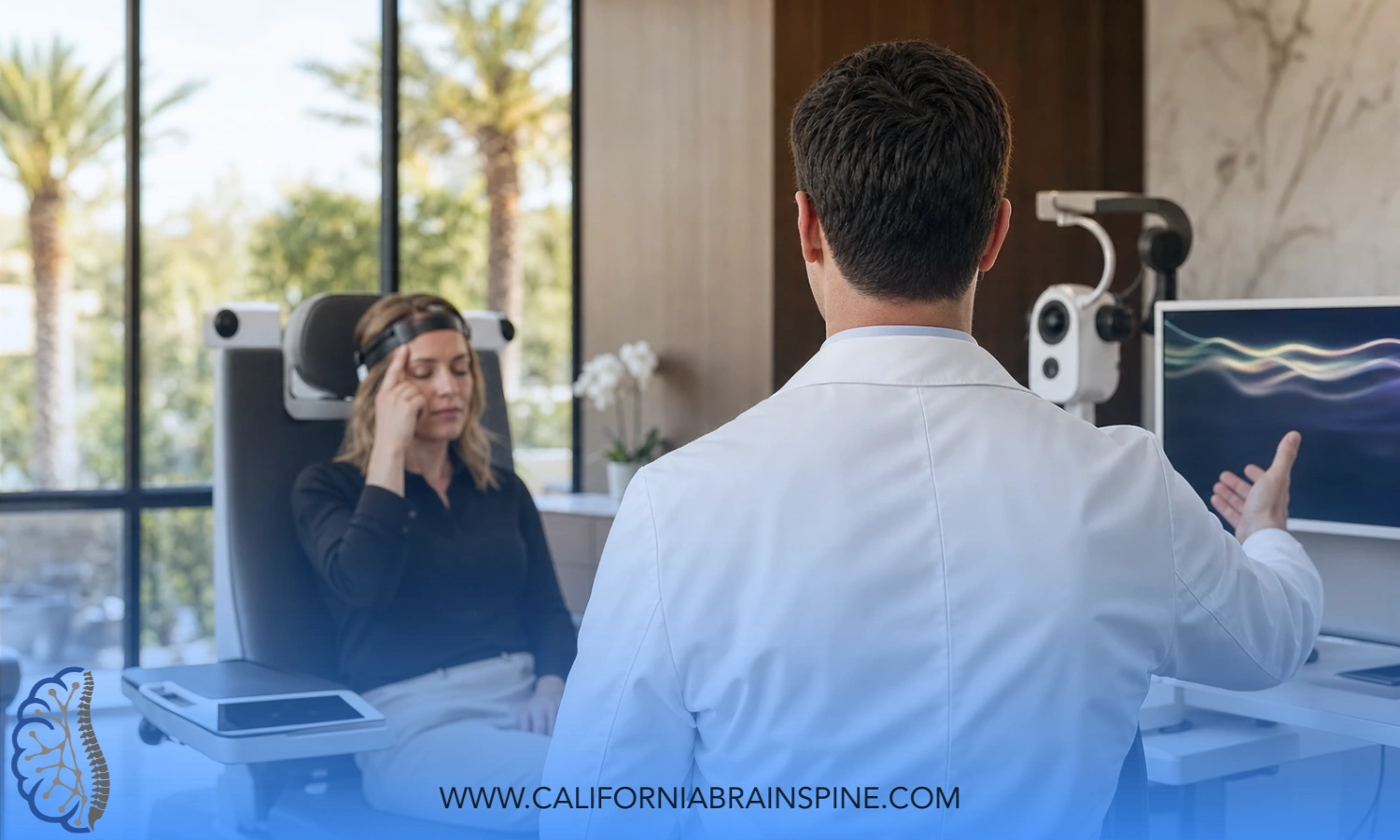
An evaluation for migraine jaw pain with Dr. Alireza Chizari, DC, DACNB at California Brain & Spine Center begins with a 120-minute neurodiagnostic assessment, and its first part is a detailed headache and jaw history.
I ask when the jaw pain starts relative to the headache, what chewing, talking and clenching do to it, whether the jaw clicks or locks, how the neck feels, and what else arrives with an attack. I also ask what you have already tried and what a dentist or other clinicians have already found, so the evaluation builds on work that has been done.
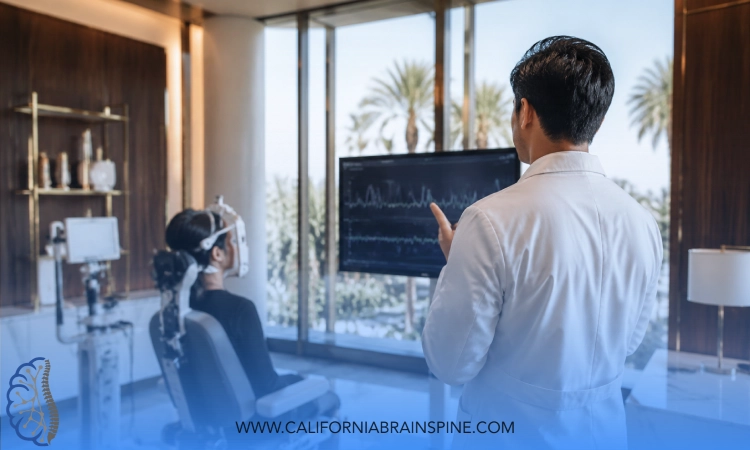
The examination that follows looks at how the nervous system is working as a whole. Depending on the history, it can include eye-tracking and balance testing, a check of how the upper neck moves, and a look at how the jaw opens and closes. I go through the results with you and explain what each one means for the next step, including when that next step is a referral.
When a dentist is the right first appointment
Clicking, locking or limited opening of the jaw points toward a dentist or a TMD specialist first, while jaw pain that rises and settles with the headache points toward a headache evaluation. Some people need both, and the order matters less than making sure each question gets asked.
I want to be plain about scope. I do not fit mouthguards, adjust bites or treat the jaw joint the way a dentist or orofacial pain specialist does, and I do not prescribe medication or read imaging as a diagnosis. When an evaluation suggests the jaw joint itself is a main part of the problem, I refer to dental or TMD care. When findings call for imaging, medication or a medical diagnosis, I refer to primary care or medical neurology. The practice works alongside those clinicians, never in place of them.
What care may follow
Care that may follow, when clinically appropriate after evaluation, includes Gonstead chiropractic care for the neck and neurological rehabilitation. Neither is a promise of a result, and neither replaces dental care for a jaw-joint problem.
The practice sits on Park Granada in Calabasas, close to the 101, and patients come from across the West Valley, including Agoura Hills a few minutes to the west, for an evaluation that is a short drive along the freeway.
What Do Patients Often Ask Me About Jaw Pain and Migraine?
Patients often ask me whether the jaw causes the migraine or the migraine causes the jaw pain, and my honest answer is that research points both ways, so the evaluation looks at each direction.
That answer frustrates some people, because a single cause would be tidier. A jaw disorder can bring on a temple headache of its own, and migraine may raise the risk of developing a jaw disorder, so in one person the two can be pushing on each other. Sorting out which side is louder right now is a large part of what the first visit is for.
Another question I hear is whether functional neurology is different from medical neurology, dental care or physical therapy. It is a different lens on the same problem. Functional neurology looks at how parts of the nervous system are working, through examination and testing, and uses non-drug rehabilitation where it fits. I hold a Doctor of Chiropractic degree and board certification in chiropractic neurology, which is what DC, DACNB stands for, and I work alongside medical neurology, primary care and dentists rather than replacing any of them.
A third comes from people who have tried medications, diet changes and even acupuncture, and want to know what is left. My answer is that the next useful step is often a clearer map of the pattern before another treatment: which pain comes first, what the jaw and neck are doing, and whether a dental opinion belongs in the plan.
The thing people most often misunderstand is the idea that one appointment has to settle everything. Jaw pain with migraine can involve the jaw, the neck and the migraine together, so it can take more than one kind of clinician to answer the question well. Every first visit at the practice follows the same order: listen first, test second, and explain the results in plain language before any plan is agreed.
"He listened carefully to all my concerns and took the time to explain my condition and the treatment options in a way that was clear and easy to understand."
From a Google review
Migraine Jaw Pain: Common Questions
Migraine jaw pain questions come in many forms, and the short answers below cover the ones people search for most, with the detail in the sections above.
Can migraines cause jaw pain?
Yes. Migraines can cause jaw pain because migraine pain can spread into the upper and lower jaw, which the trigeminal nerve supplies. Migraine jaw pain can be mistaken for a jaw-joint disorder, so a headache history that records when the jaw pain starts relative to the headache helps tell the two apart.
Is a TMJ migraine the same as migraine jaw pain?
Not quite. Migraine jaw pain is pain from the migraine itself reaching the jaw. A TMJ migraine usually describes a jaw-joint disorder and migraine present together, or a headache caused by the jaw disorder, felt in the temple and changed by chewing or clenching. The two often coexist and can be assessed together.
Is neck pain connected to migraine jaw pain?
Yes, the two can be connected. Pain fibres from the upper neck and the trigeminal system meet at the C1 and C2 levels of the spinal cord, which gives a basis for pain to be referred between the neck and the head. That is why an evaluation of migraine jaw pain examines the upper neck too.
Can migraine and jaw pain happen at the same time without TMD?
Yes. Migraine and jaw pain at the same time can happen without any jaw-joint disorder, because migraine pain itself can spread into the nerve areas of the jaw. When TMD is also present, the two often coexist, and research suggests migraine may raise the risk of developing it. A careful history helps sort out which applies.
When should I worry about jaw pain with a headache?
Call 911 if jaw, neck or back discomfort comes with chest discomfort, shortness of breath, or feeling weak or light-headed. Get urgent medical care if jaw pain when eating or talking comes with new severe headaches, temple or scalp tenderness, or vision problems, which can be signs of giant cell arteritis.
Where can I get migraine jaw pain evaluated in Calabasas or Los Angeles?
California Brain & Spine Center in Calabasas evaluates migraine jaw pain with a 120-minute neurodiagnostic assessment led by Dr. Alireza Chizari, DC, DACNB, a Board-Certified Functional Neurologist. The practice serves the Los Angeles area along the 101 and refers to dental or TMD care when the jaw joint itself needs treatment.
If migraine jaw pain keeps coming back, the next step is to rule out the urgent causes first, then look at the headache, the jaw and the neck together. Going to work with a headache that has settled into your jaw is exhausting, and a clear picture of the pattern is a reasonable place to start.
I would be glad to look at the pattern with you, explain what I find, and tell you plainly when someone else is the right person to see.
California Brain & Spine Center | (818) 649-5300 | Calabasas, CA 91302
Book online: californiabrainspine.janeapp.com
This content is for educational purposes only and is not medical advice. Consult a qualified healthcare provider about your specific situation.
Ready to look at the whole pattern?
Book a complimentary consultation at California Brain & Spine Center in Calabasas, and bring your headache notes with you.

Dr. Alireza Chizari
This article has been medically reviewed for clinical accuracy by Dr. Alireza Chizari, DC, DACNB. Committed to evidence-based practice, Dr. Chizari ensures all content reflects the highest standards of functional neurology care.
Comments
Find our article more easily in Google.
FAQ
What is Functional Neurology?
Functional Neurology is a healthcare specialty that focuses on assessing and rehabilitating the nervous system’s function. It emphasizes neuroplasticity—the brain’s ability to adapt and reorganize—using non-invasive, evidence-based interventions to improve neurological performance.
How does Functional Neurology differ from traditional neurology?
Traditional neurology often concentrates on diagnosing and treating neurological diseases through medications or surgery. In contrast, Functional Neurology aims to optimize the nervous system’s function by identifying and addressing dysfunctions through personalized, non-pharmaceutical interventions.
Is Functional Neurology a replacement for traditional medical care?
No. Functional Neurology is intended to complement, not replace, traditional medical care. Practitioners often collaborate with medical professionals to provide comprehensive care.
What conditions can Functional Neurology help manage?
Functional Neurology has been applied to various conditions, including:
• Concussions and Post-Concussion Syndrome
• Traumatic Brain Injuries (TBI)
• Vestibular Disorders
• Migraines and Headaches
• Neurodevelopmental Disorders (e.g., ADHD, Autism)
• Movement Disorders
• Dysautonomia
• Peripheral Neuropathy
• Functional Neurological Disorder (FND)
Can Functional Neurology assist with neurodegenerative diseases?
While Functional Neurology does not cure neurodegenerative diseases, it can help manage symptoms and improve quality of life by optimizing the function of existing neural pathways.
What diagnostic methods are used in Functional Neurology?
Functional Neurologists employ various assessments, including:
• Videonystagmography (VNG)
• Computerized Posturography
• Oculomotor Testing
• Vestibular Function Tests
• Neurocognitive Evaluations
How is a patient’s progress monitored?
Progress is tracked through repeated assessments, patient-reported outcomes, and objective measures such as balance tests, eye movement tracking, and cognitive performance evaluations.
What therapies are commonly used in Functional Neurology?
Interventions may include:
- Vestibular Rehabilitation
- Oculomotor Exercises
- Sensorimotor Integration
- Cognitive Training
- Balance and Coordination Exercises
- Nutritional Counseling
- Lifestyle Modifications
Are these therapies personalized?
Absolutely. Treatment plans are tailored to the individual’s specific neurological findings, symptoms, and functional goals.
Who can benefit from Functional Neurology?
Individuals with unresolved neurological symptoms, those seeking non-pharmaceutical interventions, or patients aiming to optimize brain function can benefit from Functional Neurology.
Is Functional Neurology suitable for children?
Yes. Children with developmental delays, learning difficulties, or neurodevelopmental disorders may benefit from Functional Neurology approaches.
How does Functional Neurology complement other medical treatments?
It can serve as an adjunct to traditional medical care, enhancing outcomes by addressing functional aspects of the nervous system that may not be targeted by conventional treatments.
How is technology integrated into Functional Neurology?
Technological tools such as virtual reality, neurofeedback, and advanced diagnostic equipment are increasingly used to assess and enhance neurological function.
What is the role of research in Functional Neurology?
Ongoing research continues to refine assessment techniques, therapeutic interventions, and our understanding of neuroplasticity, contributing to the evolution of Functional Neurology practices.