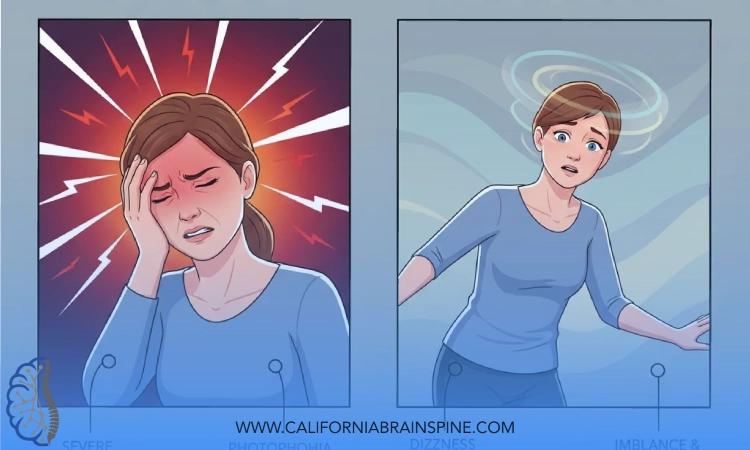
Both are migraine; the difference is whether the attack takes over your balance or your head, and how carefully the evaluation reads that pattern.
I am Dr. Alireza Chizari, DC, DACNB, and I want to answer the vestibular migraine vs migraine question before anything else, because most people who type it have already been told at least once that their tests are normal. Vestibular migraine and migraine share the same underlying biology. What separates them is which symptoms take over the attack. In vestibular migraine, vertigo, dizziness, motion sensitivity and imbalance can dominate an episode, sometimes with little or no headache at all. In a typical migraine attack, the headache itself is usually the center of the experience.
At California Brain & Spine Center in Calabasas, I regularly meet someone who says, “I cannot have migraine, my head barely hurts.” The same person feels unstable in a grocery aisle, nauseated as a passenger on the 101, dizzy while scrolling, or suddenly certain the floor has shifted underneath them. That pattern can still fit vestibular migraine, because the diagnostic criteria do not require a headache during every vestibular episode.
The reverse is just as true. Having migraine and an occasional dizzy spell does not, on its own, make it vestibular migraine. The diagnosis rests on a pattern of repeated episodes, on how long they last, on a current or past history of migraine, on migraine features showing up during the vestibular episodes, and on whether another vestibular or neurological condition explains the whole picture better.
Vestibular migraine is a migraine disorder in which repeated episodes of vertigo or other vestibular symptoms, of moderate or severe intensity and lasting between 5 minutes and 72 hours, occur in someone with a current or past history of migraine, with migraine features accompanying at least some of those episodes. That is how the International Classification of Headache Disorders defines it, and it is the definition the rest of this article works from.
Key Takeaway
Vestibular migraine centers on recurrent vertigo, dizziness, motion sensitivity or imbalance, and an episode may carry little or no headache. A typical migraine attack centers on headache with nausea, or light and sound sensitivity. Both are migraine, both are diagnosed on the pattern rather than on a single test, and the next step is an evaluation that reads the pattern.
Vestibular migraine vs migraine: what is the actual difference?
Usually, vestibular migraine vs migraine comes down to which symptom dominates. Vestibular migraine centers on recurrent vertigo, dizziness, motion sensitivity or imbalance, and a given episode may carry little or no headache. A typical migraine centers on headache with nausea, or light and sound sensitivity. Both share migraine biology, so overlap in nausea, light and sound sensitivity is expected.
Can vestibular migraine happen without a headache?
Yes, in some attacks. For the person living with it, this is the part of the vestibular migraine vs migraine comparison that causes real confusion. The criteria ask that at least half of the vestibular episodes come with at least one migraine feature: a migraine-type headache, light and sound sensitivity together, or a visual aura. The remaining episodes can be dizziness alone, and even the episodes that count can qualify through light and sound sensitivity rather than through pain. The updated Bárány Society and International Headache Society diagnostic criteria set this out in full.
The diagnosis also rests on a pattern of repeated episodes, never on a single attack. One bad afternoon of vertigo with a headache tells us very little on its own. The same episode returning in a recognizable shape over months tells us a great deal.
Can a regular migraine include dizziness too?
Yes. A dizzy spell during a migraine attack does not, by itself, turn that migraine into vestibular migraine. The criteria grade vestibular symptoms as moderate when they interfere with daily activities and as severe when daily activities cannot continue, and it is symptoms at that level, recurring as part of the migraine pattern, that carry the diagnosis. A vague lightheadedness you can work through is a different thing from a spinning room that puts you on the floor.
The useful question is whether the vestibular symptoms form a recurring, migraine-linked pattern that no other condition explains better.
What does vestibular migraine feel like compared with a regular migraine?
I tend to open this conversation with a single question: which symptom forces you to change your plans? For a typical migraine the answer is usually the headache. For vestibular migraine it is more often motion, balance, or the stability of whatever you happen to be looking at.
Vestibular migraine may feel like spinning, rocking, tilting or motion intolerance
The vestibular symptoms that qualify under the criteria include spontaneous vertigo, which can be a false sense that you are moving or a false sense that the room is spinning or flowing; positional vertigo after a change of head position; vertigo set off by a large or complex moving visual scene; vertigo during head movement; and head-motion dizziness with nausea. Some people describe true spinning. Others say the floor feels soft, the room tilts, or their head cannot keep up with their body when they turn.
Intensity matters as much as the sensation. The criteria rate these symptoms as moderate when they interfere with but do not prevent daily activities, and as severe when daily activities cannot be continued. In practice that is the line between an annoying day and a cancelled one.
A typical migraine attack is more often dominated by headache
By the same classification, a typical migraine without aura is a headache attack lasting 4 to 72 hours when untreated, with at least two of the following: one-sided location, a pulsating quality, moderate or severe pain, and worsening with routine physical activity, accompanied during the headache by nausea or vomiting, or by sensitivity to light and sound.
So the comparison turns on the dominant pattern rather than a strict split between dizziness and headache. A migraine can include dizziness, and a vestibular migraine episode can include a severe, one-sided, pulsating headache.
A practical clue
If scrolling, grocery aisles, driving, elevators, quick head turns or visually busy rooms repeatedly bring on symptoms around your migraine episodes, that vestibular pattern deserves attention even when the headache is mild. Vertigo triggered by a complex moving visual scene, and vertigo during head motion, are both symptom types the criteria recognize.
Why does vestibular migraine affect balance so strongly?
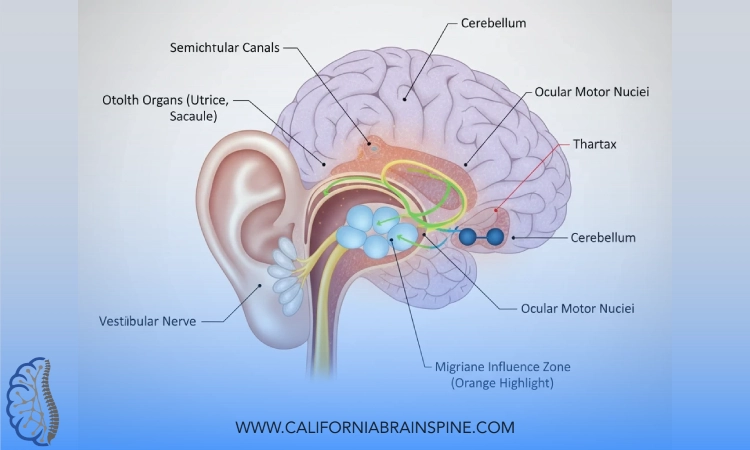
The honest answer is that the mechanism of vestibular migraine is not fully understood. There is no single confirmed lesion or biomarker that explains every patient, and the explanations below are proposals, held loosely.
Migraine and vestibular pathways overlap
One proposed explanation is that the brain's balance pathways and the pain-processing pathways involved in migraine, including the trigeminal system, overlap and influence each other, so that a migraine process can disturb balance and motion perception as readily as it produces pain. The StatPearls summary of vestibular migraine on the NCBI Bookshelf lays out the proposed pathways.
That framing matters for you, because it helps explain why an ear examination and a hearing test can come back normal while the dizziness is very real.
Visual information can become unusually provocative
Many people arrive with a normal MRI and a normal hearing test and still cannot tolerate a supermarket, fast scrolling, heavy traffic or a visually busy restaurant. Vertigo triggered by a complex or large moving visual stimulus is one of the symptom types the criteria specifically name, so this pattern belongs in the conversation even though it sounds strange to say out loud. On its own it proves nothing. Read alongside the migraine history and the other episodes, it becomes one piece of the pattern.
There is no single vestibular migraine test
Vestibular migraine is diagnosed clinically, on the pattern of symptoms and the migraine history. Testing is used to look for other causes rather than to prove the diagnosis, and vertigo and headache overlap across enough conditions that the evaluation has to distinguish vestibular migraine from Ménière's disease, BPPV, and stroke or TIA (a transient ischemic attack, a brief stroke-like episode that clears on its own), among others. The history and the examination are what separate them. Interpreting imaging and managing medication stay with medical neurology; the functional neurology evaluation sits alongside that care rather than in place of it.
Dizziness keeps being called an ear problem, but the pattern feels more complicated?
If vertigo, visual motion sensitivity, light sensitivity or imbalance keeps returning around your migraines without a clear explanation, a functional neurology and vestibular evaluation in Calabasas may help determine whether the pattern fits vestibular migraine or something else.
How do vestibular migraine vs migraine symptoms compare side by side?
The table below puts the two patterns next to each other, using the classification's own criteria for each column. Read it as a guide to the pattern rather than a checklist; a single row never settles the question.
| Clinical feature | Vestibular migraine pattern | Typical migraine pattern |
|---|---|---|
| Dominant complaint | Vertigo, dizziness, imbalance or motion intolerance, at a moderate or severe level | Headache, typically one-sided and pulsating, moderate or severe |
| Headache during every episode | Not required; at least half of episodes need a migraine feature, which can be light and sound sensitivity or visual aura rather than pain | The headache is the defining feature of the attack |
| Qualifying duration | Vestibular symptoms lasting 5 minutes to 72 hours | Headache lasting 4 to 72 hours when untreated |
| Nausea, light and sound sensitivity | Common migraine features that can accompany the vertigo | Nausea or vomiting, or light and sound sensitivity, during the headache |
| Visual motion sensitivity | Vertigo triggered by a large or complex moving visual scene is a recognized symptom type | Can occur, but is not part of the core criteria |
| How the diagnosis is made | On a pattern of repeated episodes plus a current or past migraine history; testing looks for other causes | On the pattern of headache attacks against the criteria above |
What are the weird symptoms of vestibular migraine?
The phrase “vestibular migraine weird symptoms” comes up so often because the sensations rarely fit the stereotype of migraine. Some people describe the ground moving under their feet, sudden internal spinning with nothing visibly moving, the visual surround flowing sideways, nausea in an elevator, or a patterned floor that seems to swim. Each of those maps onto a symptom type the classification recognizes: internal vertigo, external vertigo, visually-induced vertigo, and head-motion dizziness with nausea.
None of them is diagnostic alone. Similar sensations can occur with Ménière's disease, with BPPV, and, in sudden cases, with a stroke or TIA, which is exactly why the history and the examination do the separating. The diagnosis gets stronger only when recurrent vestibular episodes, a migraine history, migraine features during the episodes, the duration pattern and the exclusion of competing causes all fit together. One unusual symptom, however vivid, is a reason to look closer rather than a conclusion.
When is vertigo not safe to assume is vestibular migraine?
A migraine diagnosis on your chart should never become a reason to wave away new neurological symptoms. Sudden vertigo can come from a stroke or a transient ischemic attack rather than from migraine, and the two cannot be told apart from home.
Safety note: sudden or severe symptoms are an emergency
If symptoms come on suddenly or severely - a sudden severe headache, weakness, trouble speaking, vision loss, or fainting - that is an emergency. Call 911 or go to an emergency room, not a clinic appointment.
A familiar history of migraine does not make every new episode a migraine. Vertigo that arrives with new weakness, numbness, confusion, slurred speech, double vision, or a headache unlike your usual ones needs emergency assessment before any vestibular rehabilitation or routine migraine care.
How does the evaluation separate vestibular migraine vs migraine?
I approach this by separating the migraine history from the vestibular history first, and only then looking for the relationship between them. The order matters, because a dizziness story and a headache story told at the same time tend to blur into each other. In my clinic the process runs roughly as follows.
The sensation gets defined before anything else. Spinning, rocking, swaying, visual motion intolerance, head-motion dizziness and lightheadedness are separated rather than filed under one word, because the classification itself distinguishes internal vertigo, external vertigo, positional vertigo, visually-induced vertigo and head-motion vertigo, and each narrows the differential, the list of conditions that could explain the dizziness, in a slightly different direction. Someone whose main problem is persistent, day-to-day dizziness may find that broader list of causes on our dizziness specialist page for Calabasas a useful place to start.
Duration and frequency come next. Episode length in vestibular migraine varies widely from person to person: some people have episodes lasting minutes, others hours, others several days, and the core episode rarely runs past the upper limit in the criteria. A positional attack lasting seconds is read very differently from several hours of visually triggered vertigo, so how long each episode lasts, and how often it returns, is written down carefully rather than estimated in the room.
Then the migraine features are connected to the episodes. Headache, light and sound sensitivity, visual aura and nausea are lined up against the timing of the vestibular episodes, because the criteria ask for those features during at least half of them. A dizziness diary that also notes light sensitivity and aura is, for that reason, far more useful than one that only records the spinning.
Eye movements and vestibular function are examined when the history calls for it. When clinically appropriate, the examination may include positional testing, gaze assessment, eye-movement recording, vestibulo-ocular reflex testing, which checks how steady your eyes stay on a target while your head moves, and balance measures. None of these confirms vestibular migraine. Their value is in finding another vestibular condition, or a rehabilitation target, that the history alone would miss. Where balance or motion sensitivity persists between attacks, our vestibular rehab therapies page explains how gaze, balance and habituation work may be used when the findings support them.
Competing diagnoses are looked for deliberately. Ménière's disease, BPPV, and stroke or TIA can each produce vertigo that overlaps with migraine, and the history and examination are what tell them apart. Dizziness that began after a head injury is evaluated on its own terms; the concussion treatment page for Calabasas is the better resource for that situation.
Only after the pattern is clear does the conversation turn to care, and even then the plan may differ for two people carrying the same label, depending on what the examination found.
How does vestibular migraine treatment differ from regular migraine treatment?
There is considerable overlap. Much of what is done for vestibular migraine draws on the approaches used for migraine generally: trigger management and, where a physician prescribes it, medication.
Medication decisions belong with the prescribing clinician
Whether acute or preventive migraine medication is appropriate, and which one, depends on your medical history, your other medications and your attack pattern, and that decision belongs with your physician or with medical neurology. This page is written to help you understand the pattern. It should never function as a prescribing guide.
Vestibular rehabilitation may be considered for some people
This is where vestibular migraine vs migraine can lead to a practical difference in care. Someone whose main limitation is headache may have no reason for vestibular work at all. For some people with vestibular migraine, a supervised, exercise-based vestibular rehabilitation program may be considered as part of care, alongside trigger management and any medication a physician prescribes, when clinically appropriate after evaluation.
How that work is structured at the clinic, and what it may include, is described on the vestibular migraine therapy page. Vestibular rehabilitation sits beside migraine management rather than in place of it, and its focus is the balance, gaze and motion-tolerance problems that remain relevant to a particular person once the rest of the plan is in place.
What does vestibular migraine vs migraine care look like in Calabasas and Agoura Hills, and what should you expect from an evaluation?
For people in Calabasas and nearby Agoura Hills, the difference shows up in ordinary life. Someone with a conventional migraine may cancel dinner because the head pain and the light sensitivity are severe. Someone with vestibular migraine may cancel because the drive over the hill, the restaurant lighting, the patterned floor and the movement around the table make them feel unstable before the food arrives.
Both experiences can be disabling, and neither is more legitimate than the other. The point of distinguishing vestibular migraine vs migraine is to match the evaluation and the plan to what you actually cannot do comfortably, which is rarely the thing written on the referral.
I, Dr. Alireza Chizari, DC, DACNB, practice functional neurology at California Brain & Spine Center in Calabasas, and the principle behind every vestibular evaluation here is the same: understand why you are dizzy before deciding what, if anything, should be rehabilitated.
If you have spent months moving between ENT visits, imaging and routine migraine appointments, and you keep hearing “your tests are normal” while a busy store still produces nausea and unsteadiness within minutes, I want you to know what a visit with me actually involves, so that you can walk in knowing what to expect.
I start with the migraine history and the timing of the vestibular episodes, in that order, and I ask you to describe the dizziness in your own words rather than choosing from a list. Then, when clinically appropriate, the examination may look at positional responses, eye movements, gaze stability, visual motion tolerance and balance. My training runs from electrical engineering to clinical neuroscience, and the habit that carried over is a simple one: measure the system before trying to change it. The longer version of that story lives on the About page.
Two outcomes are common, and I say this plainly because both are useful. Sometimes the examination points toward another vestibular condition, such as a positional problem, and the plan changes accordingly. Sometimes the findings, the history and the migraine features line up with vestibular migraine, in which case migraine management stays with your prescribing physician and my role stays on the rehabilitation side, where it may include carefully dosed vestibular work, gaze exercises, balance training and gradual exposure to visual motion, built around your tolerance. Symptoms can still return, and I say so plainly. The aim is to shrink how much of your day the pattern is allowed to take.
Frequently asked questions about vestibular migraine vs migraine
What is the biggest difference in vestibular migraine vs migraine?
The biggest difference is usually the dominant symptom. Vestibular migraine places recurrent vertigo, dizziness, motion sensitivity or imbalance at the center of the episode, while a typical migraine centers on headache. Both can bring nausea and sensitivity to light and sound. Vestibular migraine also requires a current or past migraine history, so the pattern matters more than any single attack.
Can vestibular migraine occur without a headache?
Yes, in some attacks. The diagnostic criteria do not require headache during every vestibular episode; at least half of the episodes need at least one migraine feature, and light and sound sensitivity or a visual aura can serve as that feature instead of pain. This is one reason recurrent dizziness so often gets filed as an inner-ear problem first.
How long does a vestibular migraine last?
In vestibular migraine vs migraine, a qualifying vestibular episode lasts 5 minutes to 72 hours. Episode length varies widely, with some people describing minutes, others hours, others several days, and the core episode rarely running past the upper limit. Continuous daily dizziness is a reason to look for another or an overlapping cause rather than to assume migraine.
Is vestibular migraine treatment different from regular migraine treatment?
The two overlap substantially. Trigger management and, where a physician prescribes it, medication are shared ground, and medication decisions stay with your prescribing clinician. The difference is that for some people with vestibular migraine, a supervised vestibular rehabilitation program may be considered as part of care, when clinically appropriate after evaluation, alongside rather than instead of migraine management.
When should someone in Calabasas or Los Angeles get evaluated for vestibular migraine?
Consider a vestibular migraine evaluation in Calabasas when recurrent vertigo, motion sensitivity or imbalance appears alongside a migraine history or migraine features and starts interfering with driving, work, shopping, screens or exercise, which is the moderate-or-severe level the criteria describe. Recurring episodes matter more than one bad day. Sudden or severe symptoms - call 911, not us.
How do I explain vestibular migraine vs migraine to patients in Calabasas?
I explain vestibular migraine vs migraine by asking what dominates the attack. If recurrent vertigo, motion sensitivity and imbalance sit at the center of your migraine pattern, and the migraine history and features are there to support it, vestibular migraine becomes more likely. The diagnosis should still be made carefully, on the whole pattern, and the plan should follow what your history and examination actually show rather than the label alone. If that pattern sounds like yours, the clinic is here in Calabasas.
This content is for educational purposes only and is not medical advice. Consult a qualified healthcare provider about your specific situation.
California Brain & Spine Center | (818) 649-5300 | Calabasas, CA 91302
Book a complimentary consultation online
Your migraine is managed, but the dizziness still runs your day
If the headache is better and motion, balance, screens, driving or busy rooms remain difficult, a vestibular evaluation may help identify whether rehabilitation targets remain alongside the migraine care you already have.