A physician makes the POTS diagnosis against consensus criteria, and a functional neurology evaluation in Calabasas measures the standing pattern that sits underneath it.
A POTS diagnosis is made by a physician, against published consensus criteria, once other causes of a fast heart rate have been ruled out. I am Dr. Alireza Chizari, DC, DACNB, a board-certified chiropractic neurologist at California Brain & Spine Center in Calabasas, and my functional neurology evaluation sits alongside that medical work: I measure how your nervous system behaves when you stand, and I look at the vestibular (inner-ear balance), visual and thinking findings that so often travel with it. The pattern that brings people to the question is usually the same one. You can sit through a meeting reasonably well. Then you stand up, and soon after standing your heart is pounding, the room tilts a little, your legs feel unreliable, and your thinking goes soft at the edges. If you are reading about POTS diagnosis it is probably because that pattern has been going on for months and somebody has already told you that your tests are normal.
Postural orthostatic tachycardia syndrome, or POTS, is a chronic form of orthostatic intolerance, which means the body copes poorly with being upright. Standing produces a large, sustained rise in heart rate together with symptoms. Blood pressure holds, and that is what separates POTS from classic orthostatic hypotension, where the pressure falls. Both halves of that definition are measured, which is why the pulse alone never settles the question.
This article walks the whole sequence in order: what the criteria actually say, how a stand test differs from a tilt-table test, what has to be ruled out before anyone settles on POTS, what a POTS diagnosis does and does not change afterwards, and what to bring to the appointment so the person examining you has something better to work with than 'I get dizzy sometimes'.
Key takeaway
A POTS diagnosis rests on four things together: chronic symptoms that appear on standing and ease when you lie down, a sustained heart-rate rise of at least 30 beats per minute within 10 minutes upright (40 for ages 12 to 19), no significant fall in blood pressure, and no other condition that explains the fast heart rate better.
How is POTS diagnosed?
Usually, POTS is diagnosed in three moves. First, heart rate and blood pressure are measured lying down and then standing. Second, the result is checked against consensus criteria: a sustained rise of at least 30 beats per minute within 10 minutes, no orthostatic hypotension, symptoms for at least 3 months. Third, other causes of a fast heart rate are excluded.
Why standing is where the problem shows
The criteria are written around posture: heart rate lying down, heart rate standing, and the difference between the two. That is why the abnormality behind a POTS diagnosis only appears in relation to posture, and why a resting pulse taken in a chair can look perfectly ordinary while the standing one does not.
What POTS feels like from the inside
The people I see describe a strange split between sitting and standing. They can manage a desk. Then a grocery line, a hot shower, or a few minutes standing at school pick-up brings on a racing heart, a wave of weakness, or a mental slowness they struggle to explain to anyone who has not felt it. The Heart Rhythm Society's expert consensus statement describes the same picture in clinical terms: frequent symptoms on standing such as lightheadedness, palpitations, tremulousness, generalized weakness, blurred vision, exercise intolerance and fatigue, which improve on lying back down.
In my clinic the flares people report most often follow heat, an illness, a poor night's sleep, or an afternoon spent on their feet. A review in the journal Circulation notes that POTS is seen most often in women and usually begins in adolescence or young adulthood, which matches who tends to bring this story into my office.
Why 'your tests are normal' is not the end of the story
A normal ECG, a normal echocardiogram and normal blood work do not, by themselves, exclude a POTS diagnosis, because the abnormality is postural and those tests are done lying down or sitting. Their results still matter. They answer a different question, which is whether the heart itself is structurally and electrically sound, and that question has to be answered before the postural one means much.
The same Circulation review makes a point I repeat often: because its symptoms overlap with anxiety, panic disorder and deconditioning, POTS can be mistaken for those conditions before an orthostatic test is done. If that has happened to you, it does not mean the symptoms were imagined. It means the measurement that shows them had not been taken yet.
What POTS is not
A brief heart-rate spike in the first seconds after standing does not establish POTS on its own. Dizziness alone does not. A single smartwatch reading does not. The consensus criteria ask for a sustained rise, chronic orthostatic symptoms, the absence of significant orthostatic hypotension, and the exclusion of other explanations for the tachycardia, all present at the same time. A fast heart rate is a finding. A POTS diagnosis is a pattern, and the same number can mean very different things depending on posture, symptoms, blood pressure, medication, hydration and history.
A practical clue to bring with you
If symptoms reliably appear after standing and settle when you lie down, keep a log for a week: when you stood, how long it took for the symptoms to arrive, what they were, and how long lying down took to settle them. A reproducible relationship between posture and symptoms gives whoever is weighing a POTS diagnosis far more to work with than a general description, and it shortens the conversation about whether the pattern is real.
What are the POTS diagnosis criteria?
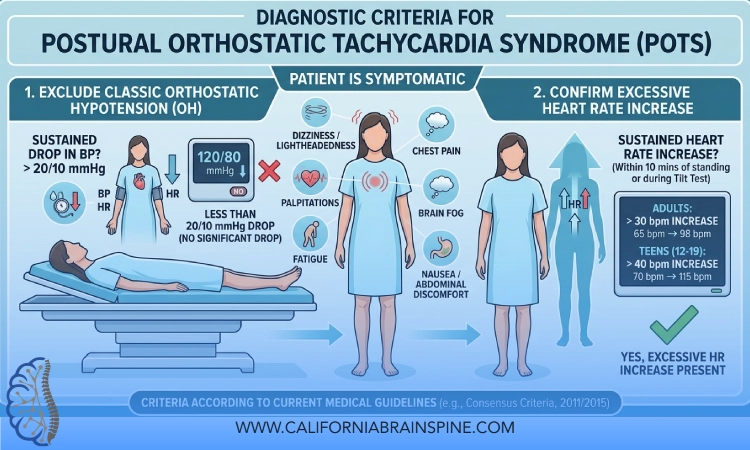
I explain the criteria the same way to every patient who asks: the heart-rate number gets the attention, and the diagnosis is the whole pattern fitting together. Four elements of the POTS criteria have to line up, and each one has a reason for being there.
The adult heart-rate criterion
For adults, the accepted criteria call for a sustained heart-rate increase of at least 30 beats per minute within 10 minutes of standing or head-up tilt. The rise is measured against your own resting value taken lying down, so a clinician looks at the difference between the two readings rather than at a single universal target number. The National Institutes of Health expert consensus, published in Autonomic Neuroscience, sets that threshold out in full and underpins every current POTS diagnosis.
The adolescent criterion
For people aged 12 to 19, the required increase is at least 40 beats per minute within the same window. The same NIH consensus sets that separate bar for adolescents, so the adult number is not the one to apply to a teenager. Parents researching POTS in teens should ask which threshold was used when their child was assessed; the NHLBI page for that expert consensus meeting is linked here as background reading.
Blood pressure must hold
The criteria require the absence of orthostatic hypotension, defined as a drop in systolic blood pressure of more than 20 mm Hg on standing. A sustained fall of that size points to a different hemodynamic pattern, a different behaviour of blood pressure and blood flow, that needs its own evaluation, which is why heart rate is never read without the blood pressure beside it. Two people can share an identical pulse response and belong in entirely different categories once the second number is in.
Symptoms must be chronic
The current NIH consensus asks for symptoms lasting at least 3 months. Older definitions used a longer window, so you may see a different figure in older sources. Either way, a fast heart rate during a fever, a stomach bug, a stretch of dehydration or an acute painful episode does not meet the bar on its own, and a POTS diagnosis is not made from one bad week.
Nothing else explains it better
The last criterion is the one that takes the longest. There must be no other overt cause of sinus tachycardia, a fast heart rate that still comes from the heart's own normal pacemaker, such as anemia, hyperthyroidism, dehydration, or a medication effect. The NIH consensus lists those mimics alongside the diagnostic criteria; a separate clinical review is linked here for readers who want more depth. That ruling-out is your physician's work, done with laboratory testing and a medication review, and it is the part of a POTS diagnosis that cannot be skipped in the interest of speed.
The heart-rate threshold gets the attention. The diagnosis depends on context: symptoms, posture, duration, blood pressure and the alternatives all have to make sense together.
What tests are used for a POTS diagnosis?
The Heart Rhythm Society statement cited above describes the initial evaluation as a detailed history, a physical examination with orthostatic vital signs, and an ECG (electrocardiogram). Further tests, such as ambulatory heart-rate monitoring, an echocardiogram, blood studies or formal autonomic testing, are added according to what those first findings show. A POTS diagnosis is assembled in layers rather than delivered by one machine, and knowing what each layer is for makes the process far less bewildering.
Is there a single POTS test?
No. People often arrive asking for 'the POTS test', and the honest answer is that the orthostatic measurement is the centre of the work-up, and everything around it exists to confirm that the measurement means what it appears to mean. The stand test or tilt-table test shows the pattern; the ECG, the blood work and the monitoring show that nothing else is producing it. Skipping the second half leaves you with a number and no explanation.
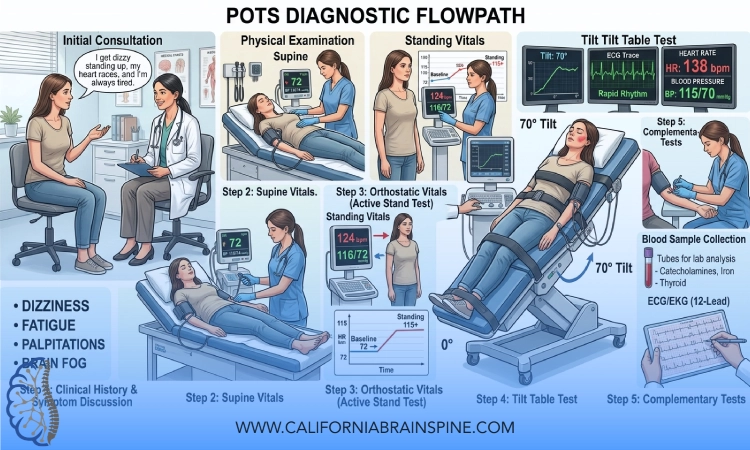
The active stand test
An active stand test is the practical bedside version of the orthostatic measurement, and the first move in most POTS diagnosis work-ups. You rest lying down until a true baseline is established, then stand while heart rate and blood pressure are taken repeatedly over the following minutes, with your symptoms noted alongside the numbers. The clinician is watching for two things: whether the rise is sustained rather than a momentary jump in the first seconds, and whether the symptoms you came in with arrive during the same window. Medications, hydration and what you did that morning are recorded too, because all of them can shift the result.
The tilt-table test
A tilt-table test moves you from horizontal to upright on a supported table while the same measurements are recorded. It is the other way of taking the orthostatic measurement described in the Heart Rhythm Society statement, and it is your physician who decides whether your case calls for it. If one is ordered for you, a patient-facing tilt-table overview is linked here so you know what to expect on the day.
Do you need a tilt table for a POTS diagnosis?
Not always. Either method can support the diagnosis, and a carefully performed stand test may be enough in the right clinical context. The choice depends on your symptoms, on how much uncertainty remains, on safety, on what has already been tested, and on which alternative diagnoses are still open. The right test is the one that answers the remaining question safely, and that is not always the most elaborate one available.
Blood work, rhythm monitoring and formal autonomic testing
Blood work looks for the mimics: iron status, thyroid function, and markers of dehydration. Ambulatory rhythm monitoring records the heart over an extended period to check whether the tachycardia is truly posture-dependent or is happening at rest as well. An echocardiogram looks at the structure of the heart. In some specialised autonomic centres, formal autonomic function testing, for example sudomotor testing, which measures sweat responses, or the Valsalva manoeuvre, a controlled breath-hold that shows how heart rate and blood pressure react, may be used to characterise the pattern of autonomic dysfunction in more detail. Every one of those is ordered by a physician or cardiologist, and none of them is performed at California Brain & Spine Center, which is why the clinic's evaluation is described as sitting alongside the medical work-up and never in place of it.
If standing is where your day falls apart
A structured orthostatic and neurological evaluation in Calabasas can document whether your symptoms form a reproducible pattern, and make clear what still needs to go back to your physician.
What has to be ruled out before a POTS diagnosis?
A person can clear the heart-rate threshold and still have another condition that explains the response better. That is why a physician spends time on the mimics before settling on a POTS diagnosis, and why I ask about medications, recent illness, diet and blood loss in my own history-taking even though the laboratory side is not mine to order. The table below sets out the patterns that most often send an evaluation in a different direction, and what usually gets looked at when they appear.
| Typical presentation | Patterns that suggest something more | What the evaluation looks at |
|---|---|---|
| Heart rate climbs on standing with long-standing lightheadedness | A large, sustained drop in blood pressure at the same time | Orthostatic hypotension and other autonomic patterns, with your physician |
| Palpitations mainly when upright | The rapid rhythm also happens at rest, with no link to posture | ECG, ambulatory rhythm monitoring and cardiology review when indicated |
| Fatigue and dizziness with standing | Recent blood loss, a restrictive diet, pallor or generalized weakness | Anemia and iron status, hydration and related laboratory work |
| Persistent tachycardia | Weight loss, tremor, heat intolerance or other endocrine clues | Thyroid function and other medical causes when clinically appropriate |
| Symptoms after starting or changing a medication | Timing closely follows a stimulant, diuretic or other relevant drug | Medication review with the prescribing clinician |
| Orthostatic symptoms after an illness | Recent fever, dehydration, infection or prolonged bed rest | Whether a temporary physiological stress explains the tachycardia better |
When it is an emergency, not an appointment
If symptoms come on suddenly or severely - a sudden severe headache, weakness, trouble speaking, vision loss, or fainting - that is an emergency. Call 911 or go to an emergency room, not a clinic appointment.
- Chest pain or pressure, or severe shortness of breath, with or without a fast heart rate.
- Fainting with an injury, or repeated unexplained fainting, which can signal a cardiac or other serious condition rather than POTS.
- A racing or irregular heartbeat at rest that does not settle when you lie down.
- Signs of major bleeding or severe dehydration, especially with confusion or a new inability to stand at all.
Do not assume a new severe symptom is POTS because you already carry an orthostatic pattern. Urgent conditions are excluded first, by emergency or primary care.
How do you get diagnosed with POTS, step by step?
Usually, you get diagnosed with POTS by bringing a symptom log to a physician, having orthostatic vital signs measured lying and standing, completing an ECG and the blood work that excludes mimics, and, where the picture stays unclear, a tilt-table or monitoring study. The POTS diagnosis is made against the consensus criteria, by the physician, with those results in hand.
Here is how the sequence runs when someone comes to California Brain & Spine Center with this question, and where each step hands off to medical neurology or cardiology.
Step one: Map the orthostatic story
The evaluation starts with when the symptoms began, what happens in the minutes after you stand, how quickly lying down helps, and what sets off a flare. An illness, a concussion, surgery, pregnancy, a medication change, a heatwave, a big meal or a hard workout can all be relevant context, and so can the order in which symptoms arrive. If you kept the log described earlier, this is where it earns its keep, because a week of timestamps says more than a year of general impressions.
Step two: Measure orthostatic vital signs
Heart rate and blood pressure are compared from rest to upright, and your symptoms are written down at the same moments, because the numbers only mean something next to what you were actually feeling when they were taken. I want to know whether the lightheadedness arrived with the heart-rate rise or a few minutes later, and whether the blood pressure held steady or slipped, since those details separate one pattern from another.
Step three: Compare the findings with the criteria
The sustained rise, the blood-pressure response, the duration of symptoms and the orthostatic complaints are set against the consensus criteria described above. An isolated abnormal number is not interpreted on its own. Where the pattern is consistent with POTS, that finding goes to your physician, who makes or confirms the POTS diagnosis and decides which further medical tests are warranted. I document what I measured; the diagnosis itself is theirs to make.
Step four: Screen neurological, vestibular and cognitive function
When dizziness, motion sensitivity, imbalance, brain fog or post-concussion symptoms sit alongside the orthostatic ones, eye movements, balance, coordination and vestibular responses are assessed too. This is the part of the evaluation that is distinctly functional neurology, and it does not replace cardiac testing when cardiac testing is indicated. Where the story began with a head injury, the concussion treatment page explains how those overlapping findings are evaluated.
Step five: Identify the medical work-up still needed
Depending on the presentation, you may need laboratory studies, an ECG, rhythm monitoring, an echocardiogram, tilt testing or another medical evaluation. I write down what I found and what I think still needs asking, so the next clinician is not starting from a blank page. That handoff is how a different condition avoids being mistaken for POTS, and it is also how the practice works alongside primary care, medical neurology and cardiology rather than around them.
Step six: Build the next plan
Once the pattern is clearer, the plan is matched to your findings, your functional limits and your medical needs. Neurological rehabilitation may address autonomic regulation, conditioning, dizziness, balance or visual motion sensitivity when that is clinically appropriate after evaluation, while your physician handles the medical side of the POTS diagnosis and anything that involves medication.
What to bring to the appointment
Bring the symptom log, every previous test result you can lay hands on (ECG, echocardiogram, blood work, any monitoring report), a current medication and supplement list with doses, and a note of what you drank and ate that morning. Wear something you can stand in comfortably for several minutes. If a family member has watched an episode, their description of what you looked like is often more precise than your own memory of it, and it belongs in the record too.
What does a POTS diagnosis involve for patients in Calabasas and Woodland Hills?
For the people I see from Calabasas and nearby Woodland Hills, the difficulty is rarely noticing that something is wrong. Many of them are still commuting the 101, still working long hours in entertainment, tech, real estate or law, still running a household, and quietly planning every day around elevators, shade, parking spots, queue lengths and the nearest place to sit. That gap between looking functional and feeling physiologically unstable is clinically relevant, and it deserves to be written into the record rather than dismissed as coping.
The same orthostatic pattern behind a POTS diagnosis can appear alongside other autonomic symptoms in some people. Patients with that broader picture may find the dysautonomia page a useful companion to this one, since the evaluation it describes covers more of the autonomic system than the standing test alone.
A useful evaluation connects the measurements to those real limits: standing tolerance, shower tolerance, whether you can walk a full supermarket, how clearly you think after ten minutes upright, and how long you take to recover after activity. My own path into this field ran through electrical engineering before functional neurology, and the habit it left is simple: measure the system before trying to change it. The About page tells that story; here it matters only because a POTS diagnosis built on measurement is one you can act on.
What happens after a POTS diagnosis?
A POTS diagnosis is a description of a pattern, and what it changes is the plan. The Heart Rhythm Society statement describes the measures that are commonly recommended first: increased fluid and salt intake where appropriate for you, compression garments, and a structured, graded exercise programme, with medication considered by your physician when those are not enough. None of that is prescribed here, and none of it should be started on the strength of an article; it is listed so that you recognise the conversation when it comes.
Within functional neurology, the work after a POTS diagnosis is the rehabilitation side of that plan. Graded activity tolerance, autonomic regulation strategies, balance work and visual-vestibular exercises are selected from what the examination actually showed, and adjusted as your tolerance changes. The POTS treatment page describes that side of the work at a service level, and the ground rules are the same on every page: assessment before treatment, and nothing promised that the findings do not support.
Because the diagnosis was built on measurements, progress can be tracked the same way. Standing tolerance, the size of the heart-rate rise, how many errands fit into a morning, how long a shower is possible before the drained feeling arrives: those are the markers that tell you whether a change in the plan is helping, and they are far more useful than a general sense of feeling better or worse.
You should also know what a POTS diagnosis does not settle. It does not tell you how long a flare lasts or how your body responds to a given plan, because those vary from person to person and I do not give timelines that the evidence cannot back. What it does give you is a name for the pattern, a set of things to measure, and a way to tell whether the plan is working, which is more than a normal test result can give you on its own.
Frequently asked questions about POTS diagnosis
How is POTS diagnosed if my resting heart rate is normal?
A normal resting pulse does not rule a POTS diagnosis out, because the criteria are about what happens after you stand. A person can have an ordinary heart rate lying down and still show the sustained rise on standing. Heart rate, blood pressure, symptoms, duration and the alternative causes are assessed together, in the upright position.
What are the main POTS diagnosis criteria in adults?
The main POTS diagnosis criteria are a sustained heart-rate increase of at least 30 beats per minute within 10 minutes of standing or head-up tilt, chronic orthostatic symptoms, no orthostatic hypotension, symptoms lasting at least 3 months under the current NIH consensus, and no other condition that explains the fast heart rate better.
Can you get a POTS diagnosis without a tilt-table test?
Yes, a tilt-table test is not required in every case. A properly performed active stand test, together with your symptom history and the exclusion of other causes, may give a physician enough to work with. Which method is used is your physician's decision, made against the rest of your findings.
How do you get diagnosed with POTS if previous tests were normal?
Ask whether heart rate and blood pressure were ever measured lying down and then standing over several minutes. Normal routine tests do not exclude POTS, because the abnormality shows up with posture. Depending on your history, cardiac, laboratory, endocrine or autonomic testing may still be appropriate, and a written symptom log makes that conversation with your physician much quicker.
Where can someone in Calabasas or Los Angeles start a POTS diagnosis work-up?
A practical starting point is a clinician who takes orthostatic measurements correctly and reviews your history for the mimics. California Brain & Spine Center evaluates the neurological and orthostatic pattern in Calabasas and refers the medical side of a POTS diagnosis, including blood work, cardiac testing and medication questions, to your physician or a cardiologist.
The short version, from me
The functional neurology work I do at California Brain & Spine Center in Calabasas rests on one practical idea: objective findings should guide the plan, and the boundary between what I measure and what your physician diagnoses should stay clearly drawn. So here is the clearest answer I can give to how POTS is diagnosed. Someone listens to the story, measures the body's response to standing, compares the findings with the accepted criteria, and makes sure no other condition explains the tachycardia better. A good POTS diagnosis should make your symptoms more understandable, and it should tell you what to do next.
If standing is where your days come apart, bring the log, bring the old test results, and let the pattern behind a POTS diagnosis be measured in the position where it lives. This content is for educational purposes only and is not medical advice. Consult a qualified healthcare provider about your specific situation.
California Brain & Spine Center | (818) 649-5300 | Calabasas, CA 91302
Book a complimentary consultation online
Have your symptoms been measured in the position that triggers them?
If standing reliably brings on a racing heart, dizziness, brain fog or near-fainting, the next useful step may be a structured orthostatic and neurological evaluation rather than another general symptom checklist.