
POTS (Postural Orthostatic Tachycardia Syndrome): Symptoms, Diagnosis, and Treatment Options
If you are living with a racing heartbeat when you stand up, dizziness, brain fog, fatigue, or that unsettling feeling that your body cannot “stay steady,” you are not imagining it. Many people with POTS feel dismissed because routine tests can look normal while day-to-day life keeps shrinking.
I, Dr. Alireza Chizari, DC, DACNB, wrote this page to help you understand what POTS is, why it can be so disruptive, and what a thorough, evidence-informed diagnostic approach looks like. You are the hero here. You are the one doing the hard work of functioning through symptoms that others cannot see.
At California Brain and Spine Center in Calabasas, California, my role is to guide you with clarity and clinical precision. This page explains how POTS is evaluated, what other conditions can mimic it, and what treatment options may help you move toward steadier days.
When standing up changes everything: what POTS can feel like
I often hear the same frustration: “When I sit or lie down, I feel somewhat normal. When I stand, everything starts.” That upright shift is a major clue in POTS.
POTS is part of a broader category called dysautonomia, meaning the autonomic nervous system is not regulating heart rate, blood flow, and symptom signals the way you expect. In many cases, the body compensates for standing by increasing heart rate more than it should, which can trigger a cascade of symptoms.
The “upright load” that your nervous system has to manage
When you stand, gravity pulls blood toward your lower body. A healthy autonomic system responds quickly by tightening blood vessels and balancing heart rate. In POTS, that coordination can be inefficient, delayed, or overwhelmed, and your symptoms can flare even if you look fine on the outside.
POTS symptoms that patients describe most often
I want you to feel seen here. People do not come in saying, “I have POTS.” They come in describing patterns that have quietly taken over their lives.
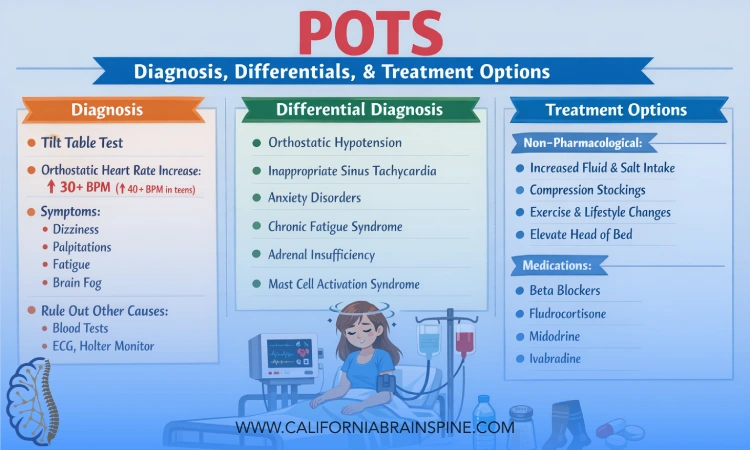
Common POTS symptoms can include:
-
Lightheadedness or feeling faint when standing
-
Heart racing, pounding, or palpitations upright
-
Fatigue that feels disproportionate to activity
-
Brain fog, slowed thinking, or poor concentration
-
Head pressure or headaches
-
Shortness of breath sensation without a clear lung cause
-
Shakiness, tremor, or internal “wired” feeling
-
Nausea, bloating, or appetite changes
-
Heat intolerance and symptom flares in warm environments
-
Exercise intolerance or post-activity crashes
✅ If you recognize yourself in this list, you are not alone, and you deserve a structured clinical plan rather than guesswork.
“You do not need to prove your symptoms are real. You need the right roadmap to understand them and the right team to walk it with you.”
Who POTS affects and why it is often missed
I see POTS in teenagers, young adults, working professionals, and parents who are trying to keep up with life while their physiology is constantly pulling them off balance. Many patients report symptoms after a viral illness, prolonged stress, concussion, periods of deconditioning, or other health events that change nervous system regulation.
POTS is frequently missed because:
-
Symptoms overlap with anxiety, vestibular disorders, and fatigue syndromes
-
People compensate quietly until they cannot
-
Standard imaging and basic bloodwork may not explain the pattern
-
The most important clues are sometimes in posture-related symptom timing and orthostatic measurements
If you have been told “it’s just stress,” I take that seriously, but I do not stop there. Stress can amplify symptoms, but it is not a diagnosis. Your body’s regulation deserves a deeper look.
How POTS is evaluated: what a careful diagnostic approach includes
At California Brain and Spine Center, patients with suspected POTS are evaluated with a structured, step-by-step process that emphasizes safety, pattern recognition, and clinical reasoning. The goal is to identify whether POTS is likely, what may be contributing to it, and what should be ruled out.
A POTS-focused evaluation may include:
-
Detailed symptom history with posture triggers, timelines, and crash patterns
-
Orthostatic vital signs (heart rate and blood pressure changes from lying to standing)
-
Review of medications, hydration patterns, sleep, and nutrition factors
-
Screening for vestibular and neurological contributors to dizziness and balance symptoms
-
Coordination with appropriate medical testing when indicated (labs, cardiology input, or tilt-table testing)
What a tilt-table test can clarify
A tilt-table test is not always required, but it can help confirm an orthostatic pattern when the clinical picture is unclear. It may also help distinguish POTS from other forms of orthostatic intolerance and fainting patterns.
“A clear diagnosis is not a label. It is a turning point that turns fear into a plan.”
Conditions that can mimic POTS and must be considered
Because POTS symptoms overlap with many other issues, a responsible clinician always considers differentials. This is not to doubt you. It is to protect you.
Common conditions that can look like POTS include:
-
Orthostatic hypotension (blood pressure drop on standing)
-
Vasovagal syncope (fainting pattern with different triggers and physiology)
-
Cardiac rhythm issues (certain arrhythmias)
-
Anemia, iron deficiency, thyroid dysfunction, vitamin deficiencies
-
Dehydration or electrolyte imbalance
-
Medication side effects (including stimulants, blood pressure agents, and others)
-
Vestibular disorders that cause dizziness and imbalance without autonomic origin
-
Post-concussion autonomic changes and persistent neurological symptoms
-
Panic attacks (which can coexist but should not automatically replace medical evaluation)
A strong plan starts with the right question: is this primarily autonomic, vestibular, neurological, cardiovascular, metabolic, or a combination?
POTS treatment options: building a layered plan instead of chasing quick fixes
POTS management is rarely one magic intervention. It is typically a layered strategy that supports circulation, nervous system regulation, and functional capacity. When people improve, it is often because the plan is consistent, individualized, and built around their real triggers.
Management options for POTS may include:
-
Hydration and electrolyte strategy tailored to your health profile
-
Salt optimization when appropriate and medically safe
-
Compression support to reduce blood pooling in the lower body
-
Graded exercise progression, often starting recumbent and building slowly
-
Sleep and circadian stabilization
-
Pacing strategies to reduce crashes and protect recovery
-
Trigger mapping (heat, long standing, heavy meals, sudden posture changes)
-
Coordinated medical care when medications are appropriate and prescribed by the right provider
At California Brain and Spine Center, the clinical lens is often broader because symptoms rarely exist in isolation. When dizziness, balance disruption, visual strain, and brain fog are part of the picture, patients may also benefit from evidence-informed neurological rehabilitation strategies such as vestibular rehabilitation, cognitive rehabilitation, neuroplasticity-based training, and NeuroSensory Integration (NSI), based on evaluation findings.
In select cases, non-invasive neurology tools may be considered as supportive care, not as promises or shortcuts. Depending on your presentation, this can include technologies such as Low-Level Laser Therapy (LLLT), Pulsed Electromagnetic Field (PEMF), Hyperbaric Oxygen Therapy (HBOT), or GammaCore vagus nerve stimulation as part of a broader plan, when clinically appropriate.
“Your nervous system can change. Not overnight, not by force, but through the right inputs repeated with patience and precision.”
What care can look like in Calabasas: a nervous-system-first clinical strategy
I built my clinical approach through an unusual path. Before healthcare, I studied Electrical Engineering in Iran, completed a master’s in Advanced Engineering and Management in the UK, and worked in the United States as a solar engineer. That engineering foundation shaped how I think: patterns, systems, signals, and root causes.
After seeing my mother recover from a frozen shoulder through chiropractic care, I earned my Doctor of Chiropractic degree from Life Chiropractic College West, specializing in the Gonstead technique, and then pursued postdoctoral education in Clinical Neuroscience. Today, in Calabasas, I work with complex neurological, vestibular, and dysautonomia presentations including POTS, post-concussion symptoms, dizziness, balance disorders, brain fog, and memory issues.
Patients come to us from Calabasas and across Southern California because they want a plan that respects complexity and focuses on function. The goal is not to “power through.” The goal is to help you build steadier physiology and steadier life.
Red flags: when dizziness or rapid heart rate needs urgent evaluation
Most people with POTS are not in immediate danger, but some symptoms should never be ignored. If any of the following occur, seek urgent medical care or emergency evaluation:
-
Chest pain, chest pressure, or new severe shortness of breath
-
Fainting with injury, repeated fainting, or fainting without warning
-
One-sided weakness, slurred speech, facial droop, or sudden vision loss
-
Black or bloody stools, vomiting blood, or signs of severe dehydration
-
New severe headache unlike your typical pattern
-
Rapid heart rate at rest with severe symptoms, especially if accompanied by confusion or fainting
If you feel unsafe, trust that instinct and get evaluated immediately.
“Safety is not fear. Safety is wisdom. Getting checked is a form of strength, not overreaction.”
A short patient story: from daily crashes to steadier days
Some time ago, a patient I will call A. came to see me after months of feeling “unsteady in my own body.” Standing in a grocery line made her heart race. Heat triggered dizziness. She had brain fog at work and felt embarrassed that she could not explain it clearly. Basic tests were reassuring, but her life was getting smaller.
I started by mapping her symptom pattern carefully and checking orthostatic measures. Her story strongly fit POTS, but it also included vestibular-type dizziness and visual sensitivity. We built a layered plan with hydration and pacing strategies, a gradual recumbent exercise progression, and a clinical program focused on nervous system regulation. Based on her evaluation, we also integrated vestibular rehabilitation and targeted cognitive rehabilitation work for attention and processing speed. Over time, her crashes became less frequent, her standing tolerance improved, and she told me something I still remember: “I feel like I can trust my body again.”
That is the real goal. Not perfection. Progress you can feel in daily life.
Your most common questions about POTS
Can POTS go away, or is it permanent?
POTS can improve significantly for many people, especially when triggers are addressed and conditioning is rebuilt gradually. The timeline varies. Some patients stabilize in months, others need longer. The most important factor is having a plan that is realistic, paced, and individualized.
How do I know if my symptoms are POTS or anxiety?
POTS and anxiety can feel similar because both can involve palpitations and dizziness. The key difference is pattern and physiology. In POTS, symptoms are strongly linked to posture and orthostatic changes. A careful history plus orthostatic vital signs can help clarify the difference. Also, some people have both, and treating one does not mean ignoring the other.
Do I need a tilt-table test to diagnose POTS?
Not always. Many cases can be identified with a clear symptom pattern and orthostatic vital signs taken correctly. Tilt-table testing can help when the picture is confusing, when fainting is frequent, or when confirmation is needed for medical coordination.
What is the safest way to start exercising with POTS?
In many cases, starting with recumbent exercise (such as a recumbent bike) and progressing slowly is safer than jumping into upright cardio. The goal is consistency without triggering major crashes. A graded plan should be built around your baseline and recovery capacity.
Can concussion or vestibular problems be connected to POTS symptoms?
Yes, some patients develop autonomic regulation problems after concussion or alongside vestibular dysfunction. That is one reason a combined neurological and vestibular perspective can matter when dizziness, visual strain, and brain fog are part of your story.
What should I do if my symptoms suddenly worsen?
A flare can happen from dehydration, heat, illness, sleep loss, overexertion, or medication changes. If symptoms are severe, new, or include red flags like chest pain or fainting with injury, seek urgent evaluation. Otherwise, document the trigger, stabilize hydration and rest, and consider a clinical review to adjust your plan.
Conclusion
I want to leave you with clarity. POTS is real, and it can be life-altering, but it is also a condition where a structured plan often makes a meaningful difference. The key steps are: recognizing the posture-linked pattern, ruling out look-alike conditions, and building a layered management strategy that supports circulation, nervous system regulation, and functional tolerance.
If you are dealing with POTS symptoms in Calabasas or anywhere in Southern California, you do not have to navigate this alone. I, Dr. Alireza Chizari, DC, DACNB, and my team at California Brain and Spine Center can help you understand what is driving your symptoms and what options may fit your case.
If you are ready, contact our clinic to request an appointment and a personalized neurological, vestibular, and dysautonomia-informed evaluation. The goal is not just symptom management. The goal is helping you move toward a steadier, more functional life.