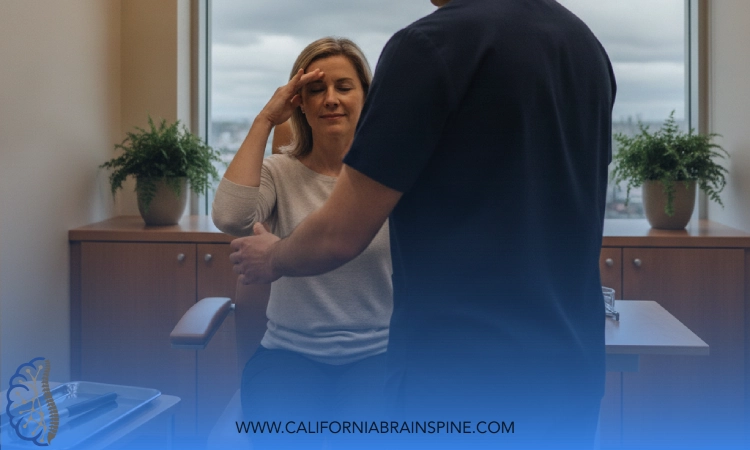

The BPPV maneuver is chosen by the canal involved, and the canal is read from your eye movements during positional testing, which is why a dozen home attempts can change nothing and one well-aimed one can help.
The BPPV maneuver that fits your case is decided by which inner-ear canal the loose crystals have drifted into, and that canal is read from your eye movements during positional testing, not guessed from the symptoms. In Calabasas, as anywhere, the pattern usually begins the same way. You roll over in bed, the room tips and spins briefly, and then it stops, until the next time you look up at a shelf or bend to tie a shoe. A BPPV maneuver, performed for the right canal on the right side, is the treatment the current clinical practice guideline recommends for that pattern. Performed for the wrong canal, it does very little, and a dozen careful attempts at home cannot change that.
Everything below is about how that choice gets made, what the sequence looks like in the room, and what to do when it has not helped.
Key Takeaway
BPPV is an inner-ear disorder in which loose crystals drift into a semicircular canal and make certain head positions bring on brief spinning. The BPPV maneuver, a canalith repositioning procedure, is the guideline-recommended treatment for the posterior canal. The side and the canal have to be identified first, which is what a positional evaluation in Calabasas is for.
What Is the BPPV Maneuver, and Does It Work?
Yes, when the diagnosis is right. A BPPV maneuver is a canalith repositioning procedure: a timed sequence of head and body positions designed to guide displaced inner-ear crystals out of the semicircular canal they drifted into. The Epley maneuver is the familiar form. Guidelines recommend it for posterior-canal BPPV, and it can relieve symptoms in many patients.
How the maneuver moves the crystals
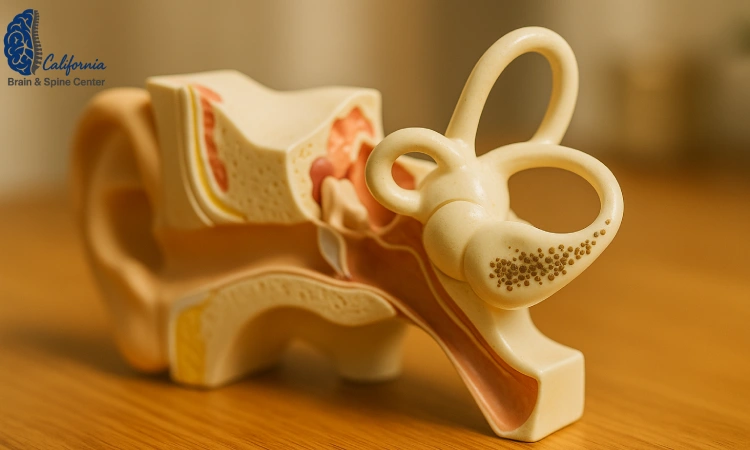
BPPV is thought to arise when tiny calcium carbonate crystals, called otoconia, come loose from a part of the inner ear called the utricle and drift into one of the semicircular canals, according to the American Academy of Otolaryngology guideline. Once they are in a canal, every change in head position moves them, and the moving crystals stimulate that canal in a way it was never meant to be stimulated. Your brain receives a rotation signal with nothing rotating.
A canalith repositioning procedure uses gravity against that problem. Each position in the sequence is held long enough for the crystals to settle, and each turn is chosen so that they travel along the canal and back toward the chamber they came from. The Epley maneuver is the widely known form. It is the version most people have read about, and the guideline's treatment statement recommends a canalith repositioning procedure as the treatment for posterior-canal BPPV.
Two things follow from that mechanism. The first is that the maneuver can relieve symptoms in many patients once the correct canal is being treated, which is why identifying the canal matters more than the sequence. The second is that a procedure aimed at the posterior canal does nothing useful for crystals sitting in the lateral canal, which is why an unlucky guess feels like a treatment that failed when it was a treatment that was never pointed at the problem.
Why the honest answer comes with a condition
The guideline is explicit that BPPV should be distinguished from other causes of imbalance, dizziness and vertigo, including disorders of the central nervous system, before it is treated as BPPV. A repositioning sequence performed on someone whose spinning has a different cause is not merely wasted; it delays the evaluation that would have found the cause. That is the condition attached to every yes in this article.
An episode can also settle without any treatment at all. Observation with follow-up is listed in the same guideline as a reasonable initial option in some patients. So an improvement after a home attempt does not, by itself, prove the attempt did anything. I mention it because it matters later, when a maneuver seems not to be working and you are deciding what to do next.
What Does Positional Vertigo Feel Like, and Why Does It Happen?
Benign paroxysmal positional vertigo is a disorder of the inner ear characterized by repeated episodes of positional vertigo: brief spinning brought on by a change in head position, as the clinical practice guideline defines it. That definition carries the three things people describe to me. The spinning is real spinning, the room or you turning. It comes in bursts. And it is tied to a position, which is why lying back, sitting up, rolling over and looking up are the usual triggers.
Your own words for it are likely more specific than the definition: an episode, a flare, the morning you could not get out of bed without holding the frame, the reason you sleep propped up now. Those descriptions are not exaggeration, and they are not imagined; they are the shape of a positional disorder as lived, and they are exactly what the history part of the evaluation is listening for.
Vertigo and dizziness are different words, and the guideline lists them separately for a reason. Lightheadedness, a floating feeling, or the sense that you might faint are dizziness in the broad sense and point toward different systems, and the guideline asks clinicians to tell BPPV apart from those other causes of imbalance, dizziness and vertigo before treating it. If what you feel is constant unsteadiness with no true spinning, the maneuver is unlikely to be the right tool, and the evaluation has a wider job to do.
What the name is telling you
Benign is the medical word for a condition that is not, in itself, harmful. Paroxysmal says it comes in bursts. Positional says a head position brings it on. None of those words mean mild. A hard episode can be frightening, can leave you gripping the bedframe, and can still be entirely consistent with the diagnosis.
The crystals and the canal
The inner ear has a chamber called the utricle where small calcium carbonate crystals sit on a membrane and help register gravity and straight-line movement. Beside it are the fluid-filled semicircular canals that register rotation. BPPV is thought to occur when some of those crystals are displaced from the utricle into one of the canals, as the guideline describes. In the canal, a head movement makes them stimulate that canal abnormally, and the brain is told it is rotating.
Why the spinning is brief and follows head movement
Because the crystals only move when your head does, the false rotation signal is tied to the movement and fades once the crystals come to rest. That is the mechanical reason the episodes are brief and positional rather than continuous, and it is the same reason a repositioning maneuver has something to work with: a thing in the wrong place can be moved.
The guideline asks clinicians to assess anyone with BPPV for impaired mobility or balance and for an increased risk of falling. A spinning episode on a staircase is a safety question before it is a diagnostic one, and it is part of why I ask about the layout of your house.
How Is BPPV Diagnosed Before Any Maneuver?
Every BPPV maneuver is side-specific and canal-specific, so the diagnosis has to answer two questions before anyone lies back: which ear, and which canal. The guideline sets out how, and the method is older and simpler than most people expect.
The Dix-Hallpike test
Posterior-canal BPPV is diagnosed clinically when the Dix-Hallpike maneuver provokes vertigo together with a characteristic torsional, upbeating nystagmus, a rhythmic eye movement a clinician can see, per the guideline's first key action statement. You sit upright, your head is turned 45 degrees to one side, and you are brought quickly to lying flat with the neck extended about 20 degrees and the tested ear down. If that ear is the one carrying the crystals, the spinning is provoked and the eyes beat in a pattern that names the canal. The other side is then tested the same way.
The eye movement is the part a home attempt cannot see. The spinning tells you something moved; the direction of the nystagmus tells you where, and which way the crystals are travelling. At the clinic in Calabasas the test is done while eye movement is recorded, so the canal and the side are observed rather than estimated, and there is a record to compare against if the episode returns.
The supine roll test for the lateral canal
If your history fits BPPV but the Dix-Hallpike test shows horizontal nystagmus, or none at all, the guideline recommends a supine roll test to check for lateral, or horizontal, canal BPPV. You lie flat and your head is turned to each side in turn while the eyes are watched. Lateral-canal BPPV is the form that the standard Epley sequence is not designed for, and in my experience it is a common reason a carefully performed home Epley changes nothing at all.
Ruling out the conditions that mimic it
The guideline directs clinicians to differentiate BPPV from other causes of imbalance, dizziness and vertigo, including central nervous system causes, before treating it, or to refer to someone who can. In practice that means the positional testing sits inside a wider look: the history, the pattern and length of the episodes, gait and balance, and the eye movements themselves. Vestibular migraine is one of the conditions that has to be considered when the story does not quite fit.
The same evaluation looks for factors that change how BPPV is managed: impaired mobility or balance, a central nervous system disorder, a lack of support at home, and an increased risk of falling. Those do not change the diagnosis. They change whether a maneuver is done in the room with someone steadying your shoulders, whether it is repeated the same day, and whether the plan includes balance work afterwards.
Done the Epley maneuver a dozen times and still spinning?
That usually means the wrong canal, the wrong side, or a different diagnosis. Positional testing with eye movement recording in Calabasas answers which one.
Which BPPV Maneuver Fits Which Canal?
The guideline's treatment recommendation is specific: patients with posterior-canal BPPV should be treated with a canalith repositioning procedure, or referred to a clinician who can perform one. The Epley maneuver is the familiar form of that procedure. Other sequences exist, and a few have a place, but the choice between them matters less than the two things established above. Treat the right side and the right canal and the sequence is a detail; get either one wrong and the sequence is irrelevant.
The Epley maneuver for the posterior canal
Here is what the procedure looks like in the room when the right posterior canal is involved. For a left-sided problem every direction is mirrored, which is exactly why the side has to be known first. Each position is held until any spinning has settled, so that the crystals come to rest before the next move carries them further along the canal.
- You sit upright with your legs extended and your head turned 45 degrees toward the affected right ear, the same starting position as the Dix-Hallpike test.
- You are brought back to lying flat with the head still turned and the neck slightly extended, and held there until the spinning passes.
- Without the head being lifted, it is turned to the opposite side so it now faces 45 degrees to the left, and held again while the eyes are watched.
- You roll onto your left side while the head keeps turning in the same direction, so your nose points toward the floor, the last position in the sequence before sitting up.
- You sit up slowly on that side with the chin slightly tucked, and the eyes are checked once more before anyone decides whether to repeat.
In clinic the sequence is repeated if the eyes say there is still movement in the canal, and stopped when they say there is not. That is the difference between doing the maneuver and doing it blind. The guideline's recommendation concerns the procedure performed for a confirmed posterior-canal diagnosis; it is not evidence for an Epley performed on a guess.
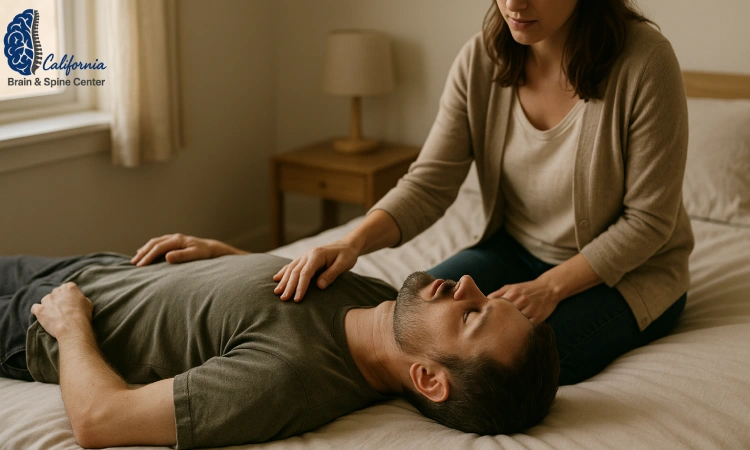
Watch the sequence before you try it
Reading the steps and seeing them are different things, and the timing is easier to understand watched than described. The video below walks through the repositioning as it is done in the room, and it is worth a few minutes before any attempt, especially the pauses.
The lateral canal needs a different sequence
When the supine roll test shows lateral-canal involvement, the posterior-canal Epley is the wrong tool. Repositioning for the lateral canal is done lying flat and turning the body around its long axis in stages, away from the affected ear, so that the crystals travel the length of that canal instead. The direction depends on the side, and the side is read from the eye movement during the roll test, which is why this is a form of BPPV I would not want anyone to treat by trial and error at home.
Semont, the half-somersault, and Brandt-Daroff
The Semont maneuver treats the posterior canal by moving you quickly from lying on one side to lying on the other with the head held at a fixed angle. It is an alternative repositioning sequence that some clinicians prefer. It changes nothing about the requirement that the canal and the side be known before you start.

The half-somersault, sometimes called the Foster maneuver, is a kneeling version designed to be done alone, without a bed edge or a second person. It still asks you to look up and then tuck your head under, so it is no way around a neck that does not tolerate the movement, and it is still a posterior-canal sequence with the same dependence on knowing the side. If a home version appeals, this is the one many people can do without help.

Brandt-Daroff exercises are a different kind of thing. They are repeated side-lying movements, done in sets over days, rather than a single timed sequence performed once. The guideline lists vestibular rehabilitation, self-administered or with a clinician, as an option in the treatment of BPPV. In my experience they are the wrong first choice when a correct repositioning is available, and a reasonable choice for the off-balance feeling that can linger once the spinning itself has settled.
Guessing the canal is the expensive part. Watching the eyes turns a coin flip into an observation.
Is waiting ever the right call?
Sometimes it is. The guideline lists observation with follow-up as a reasonable initial option in some patients, because an episode of BPPV can settle on its own. Observation still needs a date attached to it, though: the same guideline asks for reassessment within a month of either observation or treatment, to document whether the symptoms have settled or persist. If you are choosing to wait, decide now when waiting stops.
Why Is the BPPV Maneuver Not Working for Me?
There are three usual explanations for a maneuver that has changed nothing, and none of them is that you did it badly. The affected side was the other one. The canal was the lateral canal, so the posterior-canal sequence was never going to reach the crystals. Or the condition is not BPPV, and the spinning has a cause the guideline asks to be ruled out before repositioning is tried.
After a few correctly performed sessions without any change, the useful move is to stop repeating and to get the diagnosis re-examined. Persisting is a mistake I see often, and it is an understandable one, because the instructions online read as if technique were the whole story. The table below is how I think through what the pattern is saying.
| Typical presentation | Patterns that suggest something more | What the evaluation looks at |
|---|---|---|
| Brief spinning set off by a change in head position | Spinning that is constant, or prolonged, with no positional trigger | Timing and triggers in the history; positional testing for each canal |
| Set off by lying back, sitting up, or looking up | Set off mainly by rolling side to side, or by nothing in particular | Dix-Hallpike and supine roll test, to separate posterior from lateral canal |
| Hearing unchanged | New hearing loss, ringing, or fullness in one ear | Referral for audiological and medical assessment alongside the positional exam |
| No headache with the episode | Head pain, light or sound sensitivity, or prolonged attacks | Migraine history and a screen for vestibular migraine |
| Walking is steady between episodes | Marked unsteadiness, weakness, double vision, or trouble speaking | Central nervous system screen; emergency care (911 / emergency room), not repositioning |
| A maneuver on the identified side changed the pattern | The same maneuver repeated many times with no change at all | Re-examination of side and canal; reassessment within a month |
When positional vertigo is not a clinic appointment
The guideline is clear that BPPV has to be told apart from central nervous system causes of vertigo, and some of those are time-critical. If symptoms come on suddenly or severely - a sudden severe headache, weakness, trouble speaking, vision loss, or fainting - that is an emergency. Call 911 or go to an emergency room, not a clinic appointment. The same applies to vertigo that started after a head or neck injury, to vertigo with new hearing loss in one ear, and to unsteadiness so severe you cannot walk. A repositioning maneuver is a treatment for BPPV. It is not a test for whether something else is going on.
What Should You Expect After the BPPV Maneuver?
Whether the spinning settles on the same day or takes longer varies from person to person, and I do not put a number on it. What the guideline does set is the follow-up: patients should be reassessed within a month of an initial period of observation or treatment, to document whether symptoms have settled or persist. That visit is where a maneuver that half-worked gets examined rather than repeated on faith, and it is where the side and canal get confirmed or corrected.
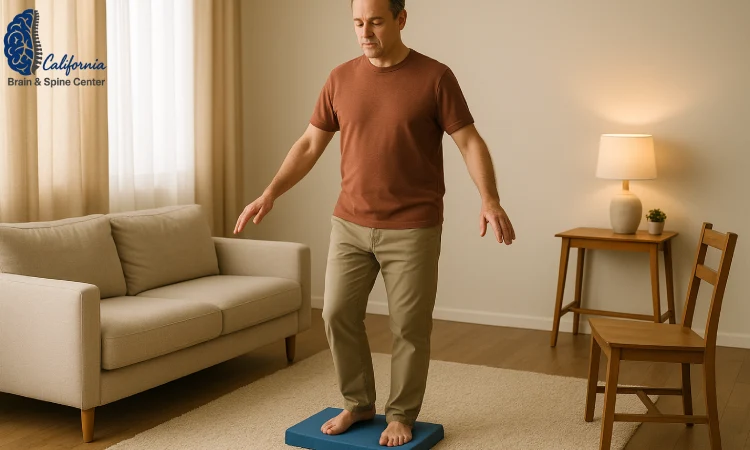
Two other things are part of every conversation I have after a repositioning, because the guideline asks for them and because they matter more than the aftercare folklore. The first is safety. BPPV has an effect on how safely you move, in the shower, on stairs, in the car, and the evaluation has already looked at mobility, balance and fall risk to decide what precautions make sense for you rather than for a generic patient. The second is recurrence.
Can BPPV come back?
Yes, it can recur, and the guideline asks clinicians to say so plainly rather than let a return feel like a failure of the first treatment. Knowing which side and which canal were involved the first time is practical information for the next episode, and it is one of the better arguments for having the canal identified properly at least once. A recurrence is handled the same way as the first episode: confirm the canal, choose the sequence, reassess within the month.
What vestibular rehabilitation adds
Vestibular rehabilitation, whether self-administered or guided by a clinician, is listed in the guideline as an option in the treatment of BPPV. Where the spinning has settled and an off-balance feeling has not, that is where I turn to it. At the clinic the vestibular rehabilitation therapies we use are chosen after the evaluation and may include gaze stability and balance retraining when clinically appropriate. They are a complement to repositioning, and they are no substitute for a repositioning that has not yet been done for the right canal.
When Should the BPPV Maneuver Be Done in Clinic in Calabasas?
Plenty of people manage a first episode on their own, and I would rather you tried a maneuver than spent months waiting. The case for having it done in clinic comes down to one thing already described: at home you are guessing the canal, and in the room it is observed. Positional testing with Dr. Alireza Chizari, DC, DACNB, at California Brain & Spine Center, a functional neurology practice in Calabasas, is performed while eye movement is recorded, the canal and side are read from the nystagmus, and the repositioning that follows, when clinically appropriate after evaluation, is chosen and timed to what the eyes showed.
The evaluation is wider than the two positional tests, because the guideline's rule about ruling out other causes applies to us as much as to anyone. It may include gaze stability testing, balance and postural measurement under altered visual conditions, and a screen for the mimics in the table above. Where the picture turns out not to be BPPV at all, our dizziness specialist services in Calabasas are built for that wider question.
Where the spinning has settled and the ground still moves, balance disorder therapy takes over, again after evaluation rather than as a default. Repositioning is designed to move the crystals out of a canal; it does not, by itself, teach the brain to trust its balance signals again, and that second job is a different kind of work.
And where the story is constant unsteadiness with no true spinning, the maneuver was never the right question. The causes behind feeling dizzy all the time are a different article and a different examination, and I would rather say so here than have you try a positional sequence for a problem that has no position in it.
If you are driving in from Woodland Hills or along the 101 corridor after several rounds of a home maneuver that changed nothing, the frustration is understandable. The technique may well have been fine. The target was wrong, and nobody could have known that without watching the eyes.
Your Questions About the BPPV Maneuver
Can I do the BPPV maneuver at home?
Often, yes, once the side and canal are known. A BPPV maneuver done at home on a confirmed posterior-canal diagnosis is reasonable, and the guideline lists self-administered vestibular exercises as an option. What a home attempt cannot do is identify the side or the canal, and the guideline asks that mobility, balance, home support and fall risk be checked first.
How is the affected side found before a BPPV maneuver?
Usually with the Dix-Hallpike test. You are brought from sitting to lying flat with the head turned 45 degrees and the tested ear down, and the clinician watches for spinning with a torsional, upbeating eye movement. That eye movement names the posterior canal on that side. If it is horizontal or absent, a supine roll test checks the lateral canal.
Why is the Epley maneuver not working for me?
Usually because the target was wrong rather than the technique. The Epley maneuver is designed for the posterior canal; if the crystals sit in the lateral canal, or in the other ear, the sequence never reaches them. Or the vertigo is not BPPV at all. After a few correct sessions without change, get the diagnosis re-examined.
Can BPPV come back after the maneuver?
Yes, BPPV can recur, and the guideline asks clinicians to tell patients so, along with the safety implications and the value of follow-up. A return is not a sign the first BPPV maneuver failed. Knowing which side and canal were involved makes the next evaluation quicker, and reassessment within a month of any treatment is the standard the guideline sets.
Who performs the BPPV maneuver in Calabasas or Los Angeles?
At California Brain & Spine Center in Calabasas, I perform positional testing with eye movement recording and, when clinically appropriate after evaluation, the repositioning that follows. Patients come from across Los Angeles. Book if a home BPPV maneuver has not helped or if you cannot tell which side is affected; anything on the safety list is an emergency room question.
This content is for educational purposes only and is not medical advice. Consult a qualified healthcare provider about your specific situation.
If I could leave you with one thing, it is that the BPPV maneuver is only as good as the diagnosis in front of it. The spinning tells you something moved; the eyes tell you where, and that is the part worth having done properly at least once. If a home attempt has not helped, or you are not sure which side is involved, that is a reasonable moment to be seen. That is what the evaluation in Calabasas is for. California Brain & Spine Center | (818) 649-5300 | Calabasas, CA 91302. Book online at californiabrainspine.janeapp.com.
Not sure which side, which canal, or whether it is BPPV at all?
At California Brain & Spine Center in Calabasas, the canal is read from your eye movements during positional testing and the maneuver is chosen from what they show.