

Anxiety can cause dizziness, dizziness can cause anxiety, and working out which one is driving the other is a clinical question rather than a character question.
Can anxiety cause dizziness? Yes. It is one of several recognized causes of feeling lightheaded or unsteady, alongside inner ear problems, low blood pressure, and standing up too quickly (NHS conditions guidance on dizziness and its common causes). It is a real physiological effect. You are not inventing it.
What that short answer leaves out is the part that often goes unsaid: the relationship runs in both directions. I am Dr. Alireza Chizari, DC, DACNB, a Board-Certified Functional Neurologist at California Brain & Spine Center in Calabasas, and most of the people who ask me this question have already been told their dizziness is anxiety. For some of them, that is the explanation. For others, anxiety is one part of a picture that also includes the inner ear or the autonomic nervous system, and nobody has measured those yet.
So this article is about telling the difference, and about what an evaluation can actually look at when the answer is not obvious. One thing to say plainly before we start: this is written to sit alongside mental health care, not in place of it. If you are working with a therapist or a physician on anxiety, keep doing that. Nothing here is a reason to stop.
Key Takeaway
Can anxiety cause dizziness? Yes, it can. Anxiety is one recognized cause among several, and it can produce lightheadedness through changes in breathing and autonomic activity. Chronic dizziness can also produce anxiety. And some dizziness attributed to anxiety has a vestibular or autonomic explanation that testing can check. Anxiety care and vestibular care are not alternatives to each other.
Can Anxiety Cause Vertigo?
Yes, though with a distinction worth making. Can anxiety cause vertigo in the strict sense of the room spinning? Less often. Anxiety more typically produces lightheadedness, floating, or unsteadiness. True rotational vertigo more often points toward the inner ear or the brain's balance pathways, and that is worth testing rather than assuming.
Why anxiety tends to produce lightheadedness rather than spinning
Anxiety changes how you breathe before it changes much else. Breathing speeds up and gets shallower, often without your noticing, and hyperventilation on its own can produce lightheadedness and tingling in the hands and around the mouth. Layered on top of that is a shift in heart rate and blood flow that belongs to the body's threat response. The sensation that comes out of all this is usually a swimmy, floaty, about-to-grey-out feeling. It is not usually the world rotating.
When spinning vertigo points somewhere else
Benign paroxysmal positional vertigo (BPPV) is a common inner ear cause of brief spinning vertigo triggered by changes in head position, and it is typically identified with positional testing rather than with imaging (AAO-HNS clinical practice guideline on benign paroxysmal positional vertigo, Bhattacharyya et al.). It is the kind of thing that can be checked with a simple positional test by someone who is looking for it, and it is typically found that way rather than on a scan.
Vestibular migraine is the other common explanation people miss, because it can cause episodes of dizziness or vertigo sometimes without any headache at the time, which is why patients rarely connect it to migraine at all (Barany Society and International Headache Society consensus criteria). If your dizziness arrives in episodes, and you have any history of migraine or motion sensitivity, that association is worth raising.
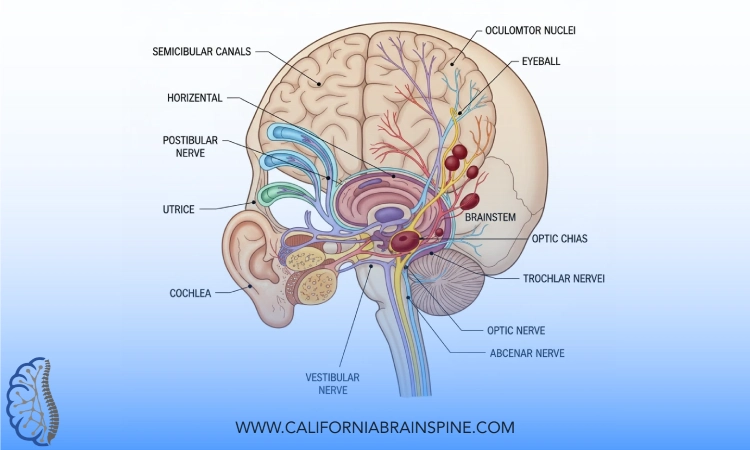
How Can Anxiety Cause Dizziness in the First Place?
Anxiety is not a mood that stays in your head. It is a whole-body state, and the systems it recruits are the same ones responsible for keeping you upright and oriented in space. That overlap is the whole mechanism.
The first route is breathing. Over-breathing, even the mild kind you would never describe as hyperventilating, changes the carbon dioxide level in your blood enough to alter how the brain feels: lightheaded, slightly unreal, fingers tingling. Many people notice the dizziness long before they notice the breathing that produced it.
The second route is autonomic. Heart rate rises, blood vessels change tone, and blood distributes differently. If pressure does not keep pace when you stand up, you get that brief grey-out at the top of the movement. Anxiety can drive that, and so can an autonomic condition, which is a distinction we come back to below.
The third route is attention, and it is the one least often explained. Balance normally runs automatically. When you become frightened of falling, the brain starts monitoring balance consciously, checking the floor, checking the horizon, bracing. Conscious monitoring of an automatic system tends to make that system feel worse rather than better, and the sensation that results is genuinely there. It is being generated by a real process.
Dizziness from anxiety has a recognizable shape, and most people describe some combination of the following:
- Lightheaded, woozy, or floating rather than the room turning
- Worse in visually busy places, such as supermarket aisles, parking structures, or scrolling on a phone
- Arriving with a racing heart, shallow breathing, or tingling hands, and often with a sense of dread that has no obvious trigger
- Easing as the wave passes, though the worry about the next one usually does not ease with it
A normal scan answers one question, not every question
A normal MRI or CT answers one specific question well: it looks for structural damage. It does not measure how the balance system or the autonomic nervous system are functioning, because those are questions about performance rather than structure, and they need different tests. Normal imaging narrows the list of possibilities. It does not close it.
If you have been carrying the sentence "your tests are normal" around for a year, that sentence was true and incomplete at the same time.
Can Dizziness Cause Anxiety Instead of the Other Way Around?
This is the direction that gets missed. Vestibular disorders can provoke anxiety, and anxiety can worsen or prolong the experience of dizziness, which means that by the time someone reaches a clinic the two are frequently braided together and neither one is obviously first.
There is a named condition for the far end of this. Persistent postural-perceptual dizziness (PPPD) is a chronic functional vestibular disorder characterized by persistent dizziness, unsteadiness, or non-spinning vertigo that is worsened by upright posture, by movement, and by complex visual environments, and it is often precipitated by a vestibular event, another medical event, or a period of psychological distress (Staab et al., Barany Society diagnostic criteria). I am not going to unpack it in depth here, because there is a separate article on what recovery from PPPD involves.
The everyday version of the same loop is simpler. An episode of true vertigo, from an inner ear event or an infection, frightens you. Afterward you start avoiding the places where it happened. Avoidance narrows your world, the narrowing feeds the anxiety, and the balance system gets less of the varied movement it uses to recalibrate. People with chronic dizziness commonly develop anxiety about, and avoidance of, the situations that provoke symptoms, which is exactly why care that addresses the vestibular and the emotional side together is commonly recommended rather than care that picks one.
Chronic dizziness and anxiety about dizziness are not competing explanations. In many people they are two parts of the same loop.
Not sure whether your dizziness is anxiety, your inner ear, or both?
A detailed neurodiagnostic assessment at our Calabasas clinic looks at eye movement, balance, and autonomic function, so the question can be looked at with measurements.
How Do You Tell Anxiety Dizziness From a Vestibular Problem?
No single symptom settles it. What helps is the pattern: how the dizziness starts, what reliably brings it on, what it travels with, and whether it tracks your mood or ignores it. The table below is how I think about that pattern in a first appointment.
| What you notice | Patterns that suggest something more | What the evaluation looks at |
|---|---|---|
| Lightheaded, floating, or woozy, with no clear sense of movement | The room genuinely rotates, or the floor feels like it tilts or drops | Eye movement recordings during head movement, and how the eyes stabilize a target |
| Comes on during stress, crowds, or a difficult conversation | Comes on with rolling over in bed, lying back, or looking up at a shelf | Positional testing for BPPV, which is a mechanical check rather than an imaging one |
| A brief wave on standing up that passes quickly | Standing brings lightheadedness with a racing heart or shakiness that builds the longer you stay upright | Heart rate and blood pressure measured across a change in posture |
| Busy places feel overwhelming and you leave early | Supermarket aisles, scrolling, or freeway driving provoke symptoms reliably, whatever your mood that day | How much you depend on vision for stability, and how vision and the inner ear are cooperating |
| Rises and falls with anxious periods, quieter on good weeks | Present most days for months, largely indifferent to how the week is going | Symptom history mapped against the timing of any illness, injury, infection, or head impact |
| Travels with a racing heart, shallow breathing, tingling hands | Travels with hearing change, ear fullness, headache, or brain fog that outlasts the episode itself | Hearing screening where indicated, and referral to ENT or medical neurology when the picture calls for it |
Read the rows as tendencies, not rules. Plenty of people sit in both columns at once, and that is a finding rather than a contradiction.
What Does a Dizziness Evaluation Actually Check?
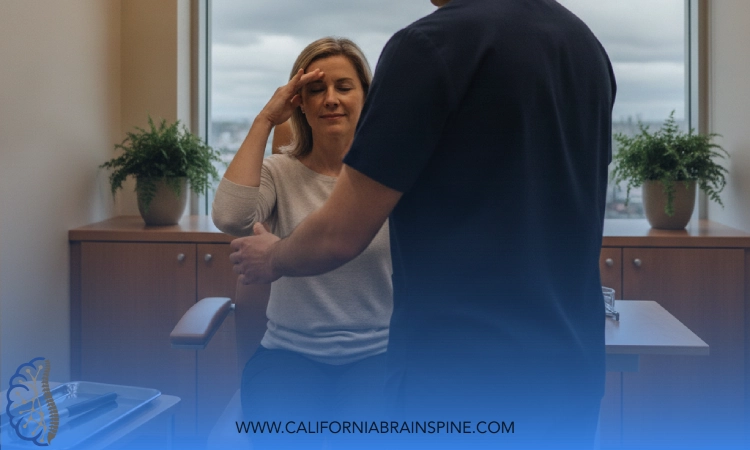
A functional neurology evaluation is not a test for anxiety, and it is not designed to rule anxiety in or out. What it measures is how well the systems that keep you oriented are doing their job. A 120-minute neurodiagnostic assessment at our clinic may include, when clinically appropriate after evaluation:
- Eye movement testing, because the eyes and the inner ear are wired directly together, and a balance system that is underperforming often shows it first in how the eyes move
- Positional testing, a bedside sequence of head positions that checks for BPPV
- Balance measured under changing conditions, eyes open and closed, firm surface and soft, to see which sense you are leaning on
- Autonomic responses to posture, heart rate and blood pressure recorded as you change position
- Visual dependence, meaning how much you rely on what you see to stay steady, which is often what makes busy environments so hard
The autonomic piece matters more than it gets credit for. Autonomic conditions such as POTS can produce lightheadedness, a racing heart, and shakiness on standing, and those symptoms can overlap closely with how anxiety or a panic episode feels from the inside (Cleveland Clinic health library, Postural Orthostatic Tachycardia Syndrome; Dysautonomia International, POTS overview). The overlap is close enough that the two are regularly mistaken for one another.
If that description lands, the piece on why POTS and panic episodes feel so similar goes through the comparison symptom by symptom, and the companion article on adrenaline dumps in POTS covers the surges that arrive out of nowhere and get read as panic.
Where the evaluation does point to a vestibular cause, vestibular rehabilitation is a supervised, exercise-based program that may help people with certain vestibular causes of dizziness by using the brain's own capacity to adapt (Hall et al., Academy of Neurologic Physical Therapy clinical practice guideline). It is not a treatment for anxiety and it is not offered as one. When it is appropriate, it is one part of a plan that continues alongside whatever mental health care you already have in place.
When Is Dizziness an Emergency?
Most dizziness is not an emergency. Some of it is, and the difference is usually about how fast it arrives and what arrives with it.
Seek emergency care, not a clinic appointment
If symptoms come on suddenly or severely - a sudden severe headache, weakness, trouble speaking, vision loss, or fainting - that is an emergency. Call 911 or go to an emergency room, not a clinic appointment.
The same applies to dizziness that arrives together with any of these:
- Facial drooping, or weakness or numbness on one side of the body
- Sudden trouble seeing, speaking, or understanding speech
- Chest pain, or a fainting episode
- Sudden hearing loss in one ear
- A new, severe headache unlike your usual ones
Those are stroke and cardiac warning signs, and they are checked in an emergency department (NHS urgent-care guidance on dizziness; AAN and American Heart Association stroke warning-sign guidance). No outpatient clinic, ours included, is the right place for them.
Dizziness and Anxiety Care in Calabasas and Woodland Hills
Patients bring this question from Calabasas, Woodland Hills and along the 101 corridor. If you have been managing it quietly for a long time, still working, still driving, but avoiding certain places and not mentioning it because it is hard to put into words, that is a familiar starting point rather than an unusual one.
The way we work is collaborative by design. California Brain & Spine Center works alongside primary care, medical neurology, ENT, physical therapy, and the mental health clinicians our patients are already seeing. We do not diagnose or treat anxiety, and we do not manage medication. What we can contribute is a measurement of how the balance and autonomic systems are performing, and an honest account of what those measurements do and do not explain.
Frequently Asked Questions About Anxiety and Dizziness
Can anxiety cause dizziness every day, or only during panic episodes?
It can do both. Dizziness from anxiety may arrive as a brief wave during a panic episode, or as a low, constant wooziness that tracks a generally anxious stretch of life. Daily dizziness lasting weeks or months is worth evaluating, because the longer it persists the more likely something else is contributing.
Can anxiety cause vertigo that makes the room spin?
Less often than you might expect. Anxiety can cause vertigo in the loose sense of unsteadiness or a swimmy head, but true rotational spinning more often comes from the inner ear: BPPV or vestibular migraine, for example. Anxiety can sit on top of either, which is why they appear together so frequently.
My scans were normal. Does that mean it is anxiety?
Not necessarily. Normal imaging tells you there is no structural damage of the kind a scan detects, which is genuinely reassuring. It does not measure how the balance and autonomic systems are functioning, and those need separate testing. Can anxiety cause dizziness when scans are normal? Yes, and so can a vestibular or autonomic problem.
Does reducing anxiety help the dizziness?
Often it helps, and for some people that is the larger part of the picture. Where a vestibular or autonomic problem is also present, treating anxiety dizziness on its own may leave part of the symptom untouched. That is the argument for looking at both sides rather than choosing between them.
Where can I have dizziness evaluated in Calabasas?
California Brain & Spine Center in Calabasas offers a 120-minute neurodiagnostic assessment that looks at eye movement, balance, and autonomic responses to a change in posture. Can anxiety cause dizziness, or is the inner ear involved? That is the question the assessment is built to examine. We see patients from Calabasas, Woodland Hills, and along the 101 corridor.
So, Can Anxiety Cause Dizziness? The Short Summary
If you take one thing from this article, let it be that the question is rarely either-or. Anxiety can cause dizziness. Dizziness can cause anxiety. And sometimes a third thing, in the inner ear or the autonomic nervous system, is quietly feeding both. Measuring is how you find out which, and the measuring is not complicated or unpleasant.
If you have been dizzy for months and anxiety is the explanation you have been handed, that explanation may well be part of the answer. In my experience it is worth checking whether it is the whole of it.
California Brain & Spine Center | (818) 649-5300 | Calabasas, CA 91302. You can book a complimentary consultation at californiabrainspine.janeapp.com.
This content is for educational purposes only and is not medical advice. Consult a qualified healthcare provider about your specific situation.
Have the dizziness question measured
If anxiety, vertigo, or unsteadiness has been shrinking where you go and what you do, an evaluation can tell you which systems are involved and which are not.






One thought on “Can Anxiety Cause Vertigo and Dizziness?”
Just wish to say your article is as surprising. The clarity in your post is just nice and i can assume you’re an expert on this
subject. Well with your permission allow me to grab your feed to
keep up to date with forthcoming post. Thanks a million and please
continue the enjoyable work.