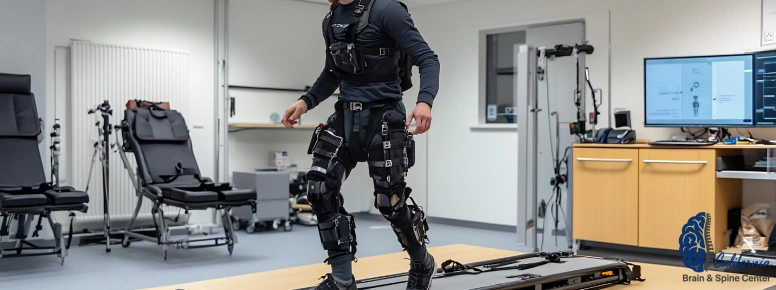
Walking can look automatic until the nervous system has to manage head movement, uneven ground, changing speed, visual motion and a conversation at the same time. Good gait training finds where that automaticity breaks down and rebuilds from there.
I am Dr. Alireza Chizari, DC, DACNB, at California Brain & Spine Center in Calabasas. When patients search for functional neurology exercises, they often expect a list of unusual “brain drills.” For gait rehabilitation, the useful answer is more practical: walking improves when we identify the specific sensory, timing, balance, coordination or cognitive demand that is disrupting the person's gait and train that function at an appropriate level.
You may walk comfortably down a quiet hallway but become less stable when turning your head. You may take shorter steps when someone starts talking to you. Your feet may cross when changing direction. One side may spend longer on the ground. Or your gait may simply feel less automatic, as if you now have to think about a movement you used to perform without effort.
Those differences matter because neurological gait training is not just strengthening the legs. Walking requires visual information, vestibular input, proprioception, motor timing, trunk and pelvic control, attention, anticipatory balance and continuous correction from one step to the next.
The most useful gait exercise is therefore not always the hardest drill. It is the drill that exposes the right deficit without making the task unsafe.
The short answer
- Functional neurology exercises are not one standardized protocol. They may include balance, visual, vestibular, sensory, coordination and cognitive-motor tasks selected according to examination findings.
- Gait training should be specific. A timing problem, short step length, visual dependence, vestibular instability and dual-task difficulty require different challenges.
- Start with control before complexity. Weight shifting, heel-toe mechanics and supported marching usually make more sense before complicated head-turn or cognitive drills.
- Real walking is a dual-task activity. Later rehabilitation may add conversation, visual scanning, numbers or directional decisions while walking.
- Progress should be criteria-based, not calendar-based. There is no responsible promise that gait speed will increase by a fixed percentage or within a fixed number of weeks.
- Fall risk changes the plan. Backward walking, grapevine patterns, narrowed stance and head-turn walking may require supervision or support.
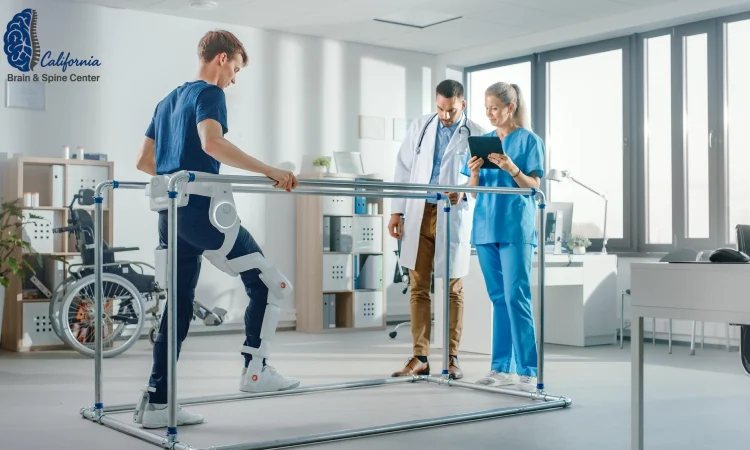
What Are Applied Neurology Exercises?
Applied neurology exercises generally describes sensory, motor, balance, visual, vestibular or cognitive tasks selected to challenge a specific nervous-system function. It is not one universally standardized exercise program. In gait rehabilitation, the exercise should be chosen according to the patient's diagnosis, fall risk, movement pattern and measurable functional deficit.
Why does the word “applied” matter?
The useful part of applied neurological rehabilitation is not simply performing an exercise that looks complicated. It is applying a task to a specific clinical finding.
If gait slows when the patient turns the head, the problem being tested is different from a patient whose walking becomes unstable only when performing mental arithmetic. A person with poor left-right step symmetry has a different target again.
This is also why copying another person's neuro drills from a video rarely produces a complete rehabilitation plan. The drill may be legitimate while still being wrong for the person performing it.
Are functional neurology exercises supported by gait science?
Many individual components used in neurological gait rehabilitation have established research bases, including task-specific walking practice, balance work, rhythmic cueing, vestibular exercises and cognitive-motor dual-task training. The strength of evidence varies by diagnosis.
For example, systematic reviews have found rhythmic auditory cueing can improve gait variables in some neurological populations, including people recovering from stroke and people with Parkinson disease. The effect should not be assumed to be identical across all diagnoses. A PubMed systematic review and meta-analysis describes rhythmic auditory cueing after stroke.
A useful distinction
“Functional neurology exercise” describes how an exercise may be selected and applied. It does not override the patient's neurological diagnosis. Parkinsonian gait, post-stroke gait, concussion-related balance problems and peripheral sensory loss do not become the same condition simply because some rehabilitation drills overlap.
Why Can Neurological Problems Change the Way You Walk?
Walking looks simple because a healthy nervous system performs thousands of adjustments without asking for conscious attention.
Each step requires the brain to estimate where the body is, predict where the center of mass is moving, place the next foot, stabilize the eyes, control the pelvis, adapt to the surface and prepare for whatever the environment does next.
Sensory integration influences every step
Vision gives information about the environment. Vestibular pathways contribute information about head movement and orientation. Proprioception provides continuous information from muscles and joints.
If those inputs do not agree, gait can become slower, stiffer or more visually dependent. Patients may stare at the floor, reduce head movement or widen their stance because those strategies make walking feel safer.
Motor timing affects rhythm and consistency
Walking also depends on timing. Cadence can become irregular. Step duration can vary from one side to the other. A patient may hesitate before initiating movement or struggle to maintain rhythm when turning.
For selected neurological conditions, external rhythm can provide an additional timing cue. A systematic review involving post-stroke gait found rhythmic auditory cueing was associated with improvements in walking velocity, stride length and cadence, although treatment response depends on patient population and protocol. Review the systematic analysis of rhythmic auditory cueing and gait after stroke.
Walking and thinking compete for attention
Walking is only partly automatic, especially after neurological injury or disease. A patient may look relatively stable until another cognitive demand is added.
Talking, counting, reading a sign or deciding where to turn can expose what clinicians call cognitive-motor interference.
A 2026 systematic review of randomized trials across neurologically impaired populations found that dual-task training may improve several physical and cognitive outcomes, but it did not demonstrate overall superiority over single-task training for gait speed across all diagnoses. The 2026 review is a useful reminder that dual-task training should be diagnosis-specific rather than treated as universally superior.
If walking changes as soon as the head turns, the eyes move or a conversation begins, that change is clinically useful information.
What Should Be Checked Before Starting Neurological Gait Training?
Dr. Alireza Chizari, DC, DACNB, does not begin gait training by choosing the most advanced drill. The first question is whether the person is ready to perform the task safely.
| Readiness question | Why it matters | What may change the plan |
|---|---|---|
| Can you walk safely without unexpected falls? | Complex drills increase instability | Assistive device, hand support or direct supervision may be needed |
| Does dizziness appear with head movement? | Head-turn walking adds vestibular demand | Gaze and vestibular testing may come first |
| Do you have new weakness or numbness? | New neurological change can represent a medical issue | Medical assessment before exercise progression |
| Can you stand and shift weight predictably? | Dynamic gait builds on controlled weight transfer | Begin with supported stance or stepping |
| Does walking change during conversation? | May reveal reduced cognitive-motor reserve | Single-task baseline should be measured before dual-task training |
| Is one side consistently shorter or slower? | May indicate a spatial or temporal gait asymmetry | Step length, stance time and other gait variables deserve measurement |
When gait exercises should wait
New weakness, new numbness, sudden severe dizziness, fainting, rapidly worsening coordination, new speech difficulty, a sudden severe headache or another acute neurological change should be medically evaluated before beginning or intensifying gait exercises.
A person with repeated falls or significant instability should also avoid unsupervised backward walking, eyes-closed work, narrow-base drills and complex crossing patterns until fall risk has been assessed.
Which Functional Neurology Exercises Can Build a Better Gait Foundation?
The old version of this article jumped quickly into advanced walking drills. In practice, better gait often starts with smaller pieces of the walking cycle.
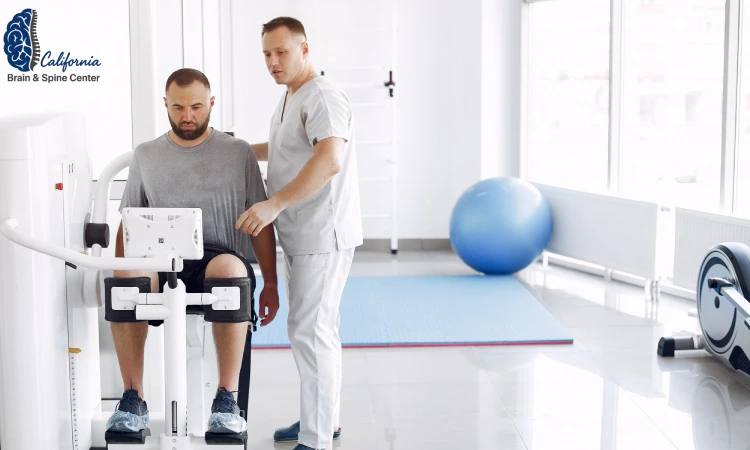
1. Ankle weight shifts
Ankle weight shifts teach controlled movement of the center of mass without requiring an actual step. The patient shifts forward, backward or laterally while keeping the movement smooth enough to return to the starting position.
This can reveal whether the person moves symmetrically or avoids loading one side.
The goal is not to move as far as possible. It is to transfer weight with control.
2. Pelvic control during weight transfer
The pelvis helps organize step length and trunk position. Excessive stiffness, rotation or lateral movement can change how efficiently weight transfers from one leg to the other.
Simple controlled weight-shifting or stepping tasks can be used to observe whether the pelvis follows the movement smoothly or compensates excessively.
3. Standing march and hold
A standing march and hold temporarily places the body on one supporting leg, resembling the single-support phase of walking.
The task can reveal excessive trunk lean, pelvic drop, reliance on hand support or difficulty stabilizing after the foot leaves the floor.
For someone with meaningful fall risk, this should be performed with appropriate support rather than in the middle of an open room.
4. Heel-toe roll
The normal step transitions from heel contact through the foot toward push-off. A controlled heel-toe roll drill can help a patient become aware of how the foot contacts and leaves the ground.
The point is not to force every person into one visually perfect gait pattern. Foot mechanics should be interpreted alongside diagnosis, strength, pain, range of motion and neurological findings.
5. Cross-body movement patterns
Walking involves reciprocal movement between the arms, trunk and legs. Cross-body stepping or reaching tasks can challenge coordination across the midline while maintaining weight transfer.
These drills can later be incorporated into gait when basic stepping is safe.
How Do Gait Drills Progress From Simple Walking to Dynamic Gait?
Gait drills should generally progress by changing one demand at a time. A patient may first improve weight transfer and step control, then add narrower foot placement, head movement, direction changes, visual scanning, altered rhythm or a cognitive task. Progress should follow gait quality and safety rather than a fixed weekly schedule.
Establish predictable stepping
Begin with comfortable forward walking and simple stepping tasks. Look at foot placement, step consistency, trunk control and whether the patient needs visual fixation on the floor.
The baseline should be repeatable before the environment becomes more complicated.
Narrow the base of support
Heel-to-toe or tandem-style walking increases the postural-control demand by narrowing the base of support.
This can be useful for selected patients but should not be treated as the universal “correct” way to train gait.
Add head movement
Head-turn walking asks the visual and vestibular systems to maintain orientation while the body continues moving forward.
This progression is particularly relevant when a patient is stable while looking straight ahead but less stable when checking traffic, scanning a store or turning toward another person.
Add directional changes
Side stepping, curved paths and controlled cross-step patterns can challenge lateral control and movement planning.
More complicated patterns such as grapevine or carioca walking belong later in progression because crossing the feet increases the consequence of a mistake.
Add rhythm or speed changes
A metronome or another external timing cue may be useful for selected patients when cadence and timing are specific rehabilitation targets.
The cue should be selected around the person's baseline gait rather than automatically set faster than their comfortable cadence.
Add cognitive demand
A number task, conversation or visual-search task can be added once single-task walking is sufficiently safe.
The goal is to see whether gait remains controlled when attention is shared, not to make the math problem as difficult as possible.
How Does Head-Turn Walking Train Visual and Vestibular Control?
Walking with the head completely still is not how normal life works. We turn to look at cars, people, store shelves and signs while the body keeps moving.
For some neurological and vestibular patients, that added head motion is exactly where gait becomes less stable.
What happens to the vestibulo-ocular reflex during walking?
The vestibulo-ocular reflex, or VOR, helps keep an image relatively stable on the retina while the head moves. When this system is impaired or poorly tolerated, head movement during walking may cause blur, dizziness or disequilibrium.
A gait progression may therefore combine a simple visual target with controlled walking and head movement. The exact speed, direction and duration should follow the patient's findings rather than a universal online dosage.
Why should head turns be added gradually?
Turning the head changes more than vestibular demand. It also temporarily changes visual orientation and can alter the person's direction of travel.
Someone who begins drifting, crossing the feet or becoming visually disoriented may need a simpler gaze or vestibular task before combining the challenge with walking.
Patients whose gait difficulty is strongly linked to vestibular symptoms can review the clinic's Balance Disorder Therapy in Calabasas page for more detail about balance and vestibular assessment.
Can Rhythm and Metronome Training Improve Motor Timing?
Sometimes, depending on the neurological condition and the gait problem being targeted.
External rhythm provides a timing reference. Instead of generating every step interval internally, the patient has a predictable external cue around which to organize the walking pattern.
When can rhythmic cueing make sense?
It may be considered when cadence is inconsistent, movement initiation is difficult or the neurological diagnosis is one in which external cueing has supporting evidence.
A meta-analysis of stroke rehabilitation found rhythmic auditory cueing associated with improvements in gait velocity, cadence and stride length. Similar cueing has also been studied extensively in Parkinson disease. A systematic review and meta-analysis describes rhythmic auditory stimulation in Parkinson disease.
Why not simply set the metronome faster?
Because faster is not automatically better.
An external cadence that exceeds the patient's current control can shorten steps, increase compensations or make gait less stable. The cue needs to serve the rehabilitation goal.
If the target is timing consistency, an initially comfortable rhythm may be more useful than chasing speed.
Motor timing is not the same as walking speed
A patient can walk faster while becoming less symmetrical or less stable. Another person may initially walk more slowly while developing better foot placement and control. Speed is an important measure, but it should be interpreted alongside gait quality and safety.
What Is Dual-Task Gait Training?
Dual-task gait training means walking while performing another task at the same time. The second task may be cognitive, verbal, visual or motor.
This matters because everyday walking is rarely isolated. People talk, make decisions, scan traffic, remember directions and carry objects while moving.
What is a dual-task number walk?
A simple example is walking while performing an easy number task. The clinician might ask the patient to count, alternate between simple numbers or answer basic questions while gait is observed.
The important measurement is not whether the person gives every answer perfectly. It is what happens to walking once attention is divided.
Does speed drop sharply? Does step length shorten? Do the feet begin crossing? Does the person stop walking while answering?
Why does cognitive overlay reveal hidden gait problems?
Neurological injury or disease can reduce how automatic walking feels. More conscious attention is then required simply to maintain gait.
When a cognitive task is added, the brain has to distribute limited attentional resources across both activities.
A systematic review examining cognitive-motor interference found that concurrent cognitive tasks can substantially alter walking performance and that the effect depends on the individual and the cognitive task used. Review the systematic analysis of cognitive-motor interference during walking.
Does dual-task training always work better?
No. That is an important 2026 update.
A recent systematic review across neurological populations found potentially useful multidomain effects but did not find dual-task training universally superior to single-task training for gait speed. Diagnosis-specific differences were substantial.
This supports a more careful strategy: first establish safe single-task walking, then add cognitive overlay when the patient's functional problem actually involves divided attention.
A dual-task drill is useful when divided attention is the problem. Complexity for its own sake is not neurological rehabilitation.
When Are Carioca or Grapevine Walking Drills Appropriate?
Carioca or grapevine walking involves lateral movement with one leg crossing in front of or behind the other. It places greater demands on lateral stability, coordination, trunk rotation and movement planning than ordinary forward walking.
That makes it potentially useful later in neurological gait rehabilitation, but it also makes it a poor generic starting drill.
What should come before a cross-step pattern?
The patient should first demonstrate enough lateral weight transfer, stepping control and recovery balance to handle crossing the feet without a significant fall risk.
Side stepping and controlled cross-body reaching may therefore come earlier in progression.
When should this drill be avoided?
Patients who are falling, catching their feet, experiencing unpredictable dizziness or requiring significant hand support should not assume that complex cross-step patterns are appropriate for unsupervised practice.
Fall prevention is part of neurological rehabilitation, not something added after a fall occurs.
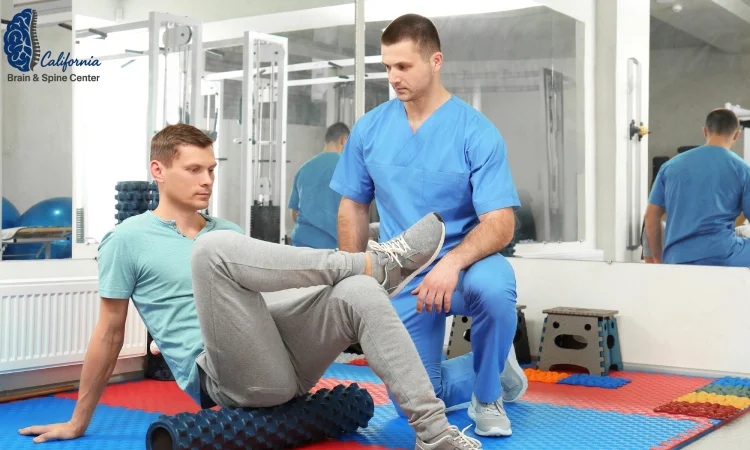
How Should Neurological Gait Progression Change Each Week?
Weekly gait progression should be based on performance rather than the calendar. A drill is usually ready to progress when walking is safer, more consistent and less dependent on compensation. Difficulty can then increase by changing one variable, such as speed, direction, sensory demand, head movement or cognitive load.
The old version of this article suggested fixed exercise frequency and predicted noticeable change within one month. That is not appropriate across the wide range of neurological conditions that can alter gait.
A stroke survivor, a patient recovering from concussion and a person with Parkinson disease can all perform a gait drill while having very different neurological problems and very different progression rates.
What should improve before a drill becomes harder?
Useful indicators include fewer unplanned steps, better foot placement, less need for hand support, more consistent cadence, improved tolerance for head movement and greater stability during directional changes.
If a patient is still performing the current drill inconsistently, adding instability or a cognitive task may simply produce more compensation.
Should only one variable change at a time?
Early in progression, usually yes.
If speed, head movement, surface, cognitive demand and direction all change at once, it becomes difficult to know what caused the decline in gait quality.
Later in rehabilitation, combining multiple demands becomes important because real-world walking is complex.
How Can Gait Improvement Be Measured Instead of Guessed?
Dr. Alireza Chizari, DC, DACNB, uses repeatable measurements because confidence alone can improve before gait does, and gait can improve before a patient notices it.
Several simple outcomes can make progression more objective.
| Measure | What it tells us | Why it matters |
|---|---|---|
| 10-meter walk test | Walking speed over a standardized distance | Provides a repeatable functional gait-speed measure |
| Step length | How far each foot advances | Can identify shortened steps or side-to-side asymmetry |
| Cadence | Steps taken over time | Helps characterize timing and response to cueing |
| Step-length symmetry | Difference between left and right stepping patterns | Can track spatial gait asymmetry when clinically relevant |
| Dual-task cost | How much gait changes when another task is added | Shows whether walking remains overly attention-dependent |
| Perceived stability | How secure walking feels in real environments | Adds the patient's experience to objective testing |
Why use the 10-meter walk test?
The 10-meter walk test is widely used in neurological rehabilitation because it provides a practical and repeatable measure of walking speed.
A systematic review of walking and mobility measures in neurological conditions identified the 10-meter walk test among measures with strong psychometric properties and practical clinical utility. Review the systematic evaluation of walking and mobility measures in neurological conditions.
A 2025 systematic review also examined modern technological applications of the 10-meter walk test in neuromuscular and neurodegenerative assessment. See the updated review of 10-meter walk testing and gait technology.
Why measure step-length symmetry?
A patient may increase gait speed while continuing to take a much shorter step on one side. That is why speed alone cannot describe the entire walking pattern.
Step length, swing time and stance time are among the variables used when researchers analyze gait symmetry after neurological injury. A PubMed study comparing methods of post-stroke gait symmetry measurement discusses these parameters.
Why record perceived stability?
A patient can improve on a timed walking test while still avoiding parking lots, busy stores or uneven sidewalks.
Tracking one real-life situation that feels difficult provides another layer of information. The goal of rehabilitation is not simply a better test result. It is better function outside the clinic.
What Are the Most Common Gait Training Errors?
Making the drill difficult before making it accurate
Unstable surfaces, fast head turns and cognitive tasks look advanced, but complexity is not useful if the basic movement pattern is already breaking down.
Staring at the feet during every exercise
Looking down can temporarily make some patients feel safer. It can also prevent the clinician from learning whether gait is overly dependent on visual monitoring.
Visual dependence should be changed deliberately rather than simply telling every patient to look straight ahead.
Chasing speed before controlling step quality
Increasing speed can sometimes improve rhythm, but it can also magnify asymmetry, reduce foot clearance or make turns less safe.
Speed should be one variable, not the only outcome.
Adding eyes-closed work too early
Removing vision substantially changes the sensory demands of balance and gait. It can be useful in selected assessment or rehabilitation situations, but it increases fall risk.
It should not be treated as the default “advanced level” of every neuro drill.
Making every session a fatigue test
Neurological training should produce enough challenge to create useful practice without turning movement quality progressively worse.
More repetitions are not helpful if the patient spends the second half of the exercise rehearsing a compensation.
Ignoring the diagnosis
There is no one gait protocol for concussion, stroke, Parkinson disease, peripheral neuropathy or vestibular dysfunction.
The overlap in exercises does not erase the differences in pathology, medication considerations, prognosis or fall risk.
A better question than “How many repetitions?”
Ask what changes as repetitions accumulate. Does step length become more equal? Does the trunk begin leaning? Does the patient need more visual fixation? Does dizziness rise? Does gait slow when cognition is added? Those changes help determine the useful dose.
How Does Sensory Integration Change Neurological Gait Training?
Walking requires continuous sensory integration. The nervous system must compare what the eyes see, what the vestibular system detects and what muscles and joints report about body position.
If one input becomes unreliable, the person may compensate by relying excessively on another.
What does visual dependence look like during gait?
The person may watch the floor constantly, become less stable in darkness or struggle in visually busy environments.
The rehabilitation challenge might involve gradually reducing visual dependence while maintaining enough safety for good movement practice.
What does vestibular dependence look like?
Head turns, looking upward or scanning while walking may provoke disequilibrium. A clinician may first assess gaze stability and vestibular responses before integrating head motion into gait.
What does reduced proprioceptive confidence look like?
Uneven terrain, soft ground or changes in foot placement may cause disproportionate instability. Weight-shift and stepping tasks can help assess how the patient uses body-position information.
For patients whose main problem is integrating visual, vestibular and proprioceptive information, the clinic's NeuroSensory Integration page explains how multisensory rehabilitation may be considered after detailed evaluation.
What Does a Neurological Gait Evaluation Look Like in Calabasas?
At California Brain & Spine Center in Calabasas, gait is not evaluated only by watching someone walk from one side of the room to the other.
The useful question is how gait changes when the task changes.
Depending on the patient's history and condition, Dr. Chizari may examine basic gait mechanics, step consistency, balance, eye movements, vestibular responses, head-turn walking, sensory dependence, dual-task performance and the patient's response to graded movement.
A patient may look completely stable under one condition and reveal the important deficit only when visual, vestibular or cognitive demand is added.
Patients recovering from a neurological injury can also review the Brain Injury Recovery Program to see how gait, balance, vestibular and cognitive findings may fit into a broader rehabilitation plan.
Why Does Dr. Chizari Use a Measurement-First Approach?
From engineering to clinical neuroscience
Dr. Alireza Chizari, DC, DACNB, began his professional path with a B.S. in Electrical Engineering in Iran. He later earned a master's degree in Advanced Engineering & Management in the United Kingdom and worked as a Solar Engineer in the United States before moving into healthcare.
He earned his Doctor of Chiropractic degree from Life Chiropractic College West, trained in the Gonstead technique, and later pursued postdoctoral education in Clinical Neuroscience.
That engineering background continues to shape the clinical approach: measure the system before deciding what should be adjusted.
For functional neurology exercises and gait training, this means a patient is not handed a routine simply because a drill looks neurological. Step length, gait speed, balance, eye movements, vestibular responses, sensory integration, cognitive-motor interference and real-world stability can all help determine what should be trained.
You can read more about his background on the About Dr. Alireza Chizari page.
Walking is fine until the task becomes complicated?
If head turns, uneven terrain, busy environments, directional changes or conversation expose a gait problem that is invisible during ordinary straight-line walking, a neurological and balance evaluation may help identify what is reducing automaticity.
What Can a Realistic Gait Rehabilitation Progression Look Like?
I evaluated a Calabasas-area patient who could walk normally enough during a short conversation in the exam room. The problem became obvious only when the task changed.
When head turns were added, the walking line became less consistent. When the patient had to answer questions while moving, step length shortened and gait slowed. Quick directional changes also produced several corrective steps.
The patient had already tried several “neuro drills” found online, including fast tandem walking and complicated cognitive tasks. They were difficult, but difficulty alone had not translated into more confident walking.
I simplified the progression first.
We worked on controlled ankle and lateral weight shifts, pelvic control and standing march-and-hold tasks. Those exercises made it easier to see when weight transfer became asymmetric.
Once stepping was more consistent, heel-toe control and simple tandem walking were introduced in a safer environment. Head movement was added later because the patient's gait changed significantly when visual and vestibular orientation had to occur during movement.
The next stage included controlled head-turn walking and changes in direction. A simple cognitive task was then layered onto walking to reproduce the situations that had been difficult outside the clinic.
The goal was not to make every session more complicated than the last. The goal was to preserve gait quality as the nervous system handled progressively more realistic demands.
Over time, the patient reported more confidence while walking through busy environments and less disruption when turning the head during movement. Objective walking measures also became more consistent under tasks that had initially exposed the problem.
The progression was not tied to a four-week promise, and no fixed percentage change in gait speed was predicted. Some variables improved before others. That is why repeatable measurements and real-world function were more useful than a generic rehabilitation timeline.
Frequently Asked Questions About Functional Neurology Exercises and Gait Training
What are functional neurology exercises?
Functional neurology exercises are sensory, motor, vestibular, visual, balance or cognitive tasks selected to challenge a particular nervous-system function. There is no universal list that fits every diagnosis. In gait rehabilitation, the useful drill depends on why walking is impaired, the patient's fall risk and what changes during examination.
What are applied neurology exercises for walking?
Applied neurology exercises for walking may include weight shifting, stepping, rhythm training, head-turn walking, sensory-integration work or cognitive dual-task gait. The word “applied” is most useful when the exercise is tied to a measurable clinical finding rather than performed simply because it is considered a brain exercise.
What are the best neuro drills for gait and balance?
There is no single best neuro drill. A patient with poor weight transfer may need a simpler exercise than someone whose only difficulty appears during cognitive dual-task walking. Appropriate drills can include marching, heel-toe work, gait with head turns, rhythm cues or dual-task training after safety and diagnosis are considered.
How do you know whether neurological gait training is working?
Progress can be tracked with repeatable measures such as the 10-meter walk test, step length, cadence, gait symmetry, dual-task performance and perceived stability in real-life situations. The goal is not merely to complete harder drills. The goal is safer, more efficient walking that transfers outside the treatment environment.
How quickly should gait exercises progress?
Progression should follow performance, not a fixed timeline. A task may be made harder when gait is safer, more consistent and better tolerated. Usually one variable is changed at a time early on, such as speed, direction, head movement or cognitive demand, before several challenges are combined.
Can I practice dynamic gait exercises alone at home?
Some basic exercises may be appropriate at home after evaluation, but drills involving backward walking, crossed stepping, narrow stance, reduced vision or significant head movement can increase fall risk. Patients with recent falls, marked dizziness or neurological weakness should get individualized guidance before practicing advanced dynamic gait exercises alone.
What to Remember About Functional Neurology Exercises for Gait
The best functional neurology exercises are not defined by how unusual they look. They are defined by whether they challenge a relevant deficit at the right level.
Neurological gait training may begin with ankle weight shifts, pelvic control, marching and heel-toe mechanics before progressing toward head-turn walking, sensory integration, direction changes, rhythm training or cognitive dual-task gait.
The nervous system also needs feedback. That is why measures such as walking speed, step length, symmetry, dual-task cost and perceived stability are more useful than promising that everyone will walk a fixed percentage faster after a certain number of weeks.
If a gait exercise repeatedly causes near-falls, growing compensation or poor movement quality, making it harder is not automatically the next step.
The goal is to make walking more automatic, adaptable and useful in ordinary life.
California Brain & Spine Center | (818) 649-5300 | Calabasas, CA 91302
Find the point where your gait stops being automatic
A complimentary consultation at our Calabasas clinic is a chance to discuss how your walking changes with head movement, balance demands, speed, terrain or cognitive load and whether a detailed neurological gait evaluation makes sense.