
What a central vestibular disorder is, which warning signs mean calling 911 today, and what testing involves when the dizziness is not an emergency but keeps coming back.
A central vestibular disorder is a condition that affects the parts of the brain that process balance signals coming from the inner ear, rather than the inner ear itself. I am Dr. Alireza Chizari, DC, DACNB, a Board-Certified Functional Neurologist in Calabasas. This page answers the two questions people usually arrive with. The first is which signs mean you should call 911. The second is what can be checked when the dizziness is not an emergency but keeps coming back.
Sudden dizziness, loss of balance or trouble walking can be a sign of stroke. This is especially true when it comes with sudden trouble seeing, numbness or weakness on one side of the body, trouble speaking, or a sudden severe headache with no known cause. The CDC's list of stroke signs advises emergency care right away for these symptoms. That means calling 911, not booking a clinic appointment with me or with anyone else.
Your dizziness may be neither sudden nor severe. It may still keep returning, follow you from the desk to the drive home on the 101, or make a busy store feel like a moving floor. If so, it is worth an evaluation. At California Brain & Spine Center, that starts with a complimentary consultation. A dizziness evaluation in Calabasas then looks at how your eyes, your balance and the signals from your inner ears work together.
Key takeaway
A central vestibular disorder affects how the brain processes balance signals, and it can feel like an inner-ear problem. Sudden dizziness with trouble seeing, speaking or walking, or one-sided weakness, is a possible stroke: call 911. Dizziness that keeps recurring or does not settle is worth an evaluation, which may include eye-movement and balance testing.
What Is Central Vestibular Dysfunction?
Usually, central vestibular dysfunction means that dizziness, imbalance or unusual eye movements are coming from the brain's balance-processing pathways rather than from the inner ear alone. A central vestibular disorder is mostly caused by a lesion in that circuitry, and its signs can mimic an inner-ear problem, including sustained spinning vertigo.
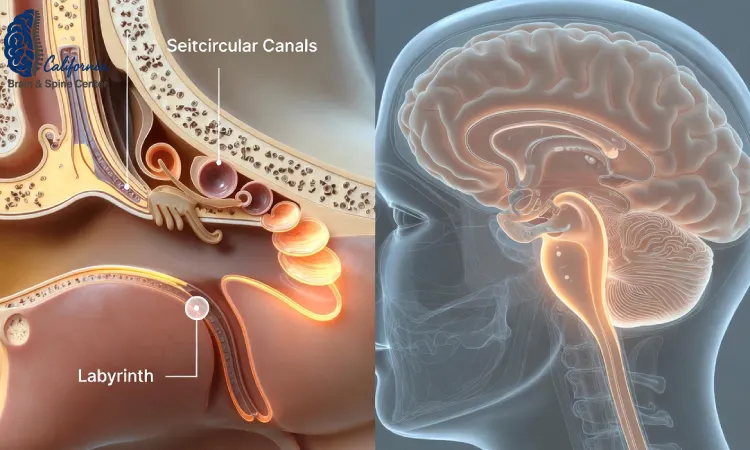
The vestibular system is the body's balance system. Its peripheral part sits in the inner ear. Its central part is the network in the brain that receives and processes what the inner ear reports. When the trouble lies in that central processing, the condition is called a central vestibular disorder. The plural, central vestibular disorders, covers the whole family of conditions that affect it. You may also see it written as central vestibular disease or described as a central vestibular syndrome.
Why Can a Central Problem Feel Like an Inner-Ear Problem?
The inner ear and the brain's balance circuitry work as one system, so trouble at either end can produce symptoms that look alike. In a published review, Dieterich and Brandt describe central vestibular disorders as mostly caused by lesions in the brain's vestibular circuitry. They also note that the signs can mimic inner-ear disorders, including sustained spinning vertigo.
The same review reports on one specialist outpatient dizziness unit. There, central vestibular disorders, including vestibular migraine, made up about 25% of established diagnoses. That unit is a referral center that sees complex cases, so the figure cannot tell you the odds for your own dizziness. It does mean a central cause belongs on the list when persistent dizziness is being worked out.
For the emergency side of this overlap, clinicians can read a systematic review of posterior circulation stroke and acute vestibular syndrome.
How central and inner-ear vertigo differ, and how each is approached, is covered on our page about central versus peripheral vertigo and its treatment pathways. This page stays with the central side.
Is Every Central Vestibular Disorder a Stroke?
No. Stroke is one cause of a central vestibular disorder, and it is the one that needs 911. The Dieterich and Brandt review also counts vestibular migraine among central vestibular disorders. After a concussion, dizziness can have central vestibular causes as well. Both are covered further down this page.
What Are Central Vertigo Symptoms?
Central vertigo symptoms can include spinning vertigo that lasts, unsteadiness, trouble walking and a sense of spatial disorientation. On their own, they can look much like an inner-ear problem.
When people describe dizziness to me, the words I hear are unsteady, off-balance, foggy and disoriented. There is usually a trigger attached: turning the head, walking down a crowded aisle, looking at a screen, standing up fast. Many are still working and driving, doing their jobs at a fraction of their usual capacity and bracing for the next wave.
I take those descriptions seriously. On their own, though, they do not tell anyone, me included, whether the cause sits in the brain or in the ear. The clues that can help separate the two tend to come from the examination, and in particular from how the eyes move. That is why eye-movement testing runs through the rest of this page.
The same symptoms can appear in conditions far from the inner ear. A review of vestibular deficits in neurodegenerative disorders suggests that impaired central processing of vestibular signals may contribute to balance problems and spatial disorientation in some of these conditions. Examples include Parkinson's disease and Alzheimer's disease.
What Are the Early Warning Signs of Central Vestibular Disorders?
The early warning signs of central vestibular disorders can include dizziness or vertigo that arrives with other signs of brain involvement, such as sudden trouble seeing, speaking or walking or one-sided weakness, and eye-movement patterns a clinician finds on examination.
The table below puts the signs in one place, with what each may point to and what to do. The first two rows are emergencies. The rest are findings for an evaluation, and several are things an examiner looks for rather than things you would notice yourself.
| Warning sign | What it may point to | What to do |
|---|---|---|
| Sudden dizziness, loss of balance or trouble walking, with sudden trouble seeing, one-sided numbness or weakness, confusion, trouble speaking, or a sudden severe headache | A possible stroke, according to the CDC | Call 911 now |
| Sudden vertigo that is continuous and does not stop | It can be a central cause that mimics an inner-ear problem. Emergency clinicians use a bedside eye exam called HINTS for this presentation | Emergency care, not a clinic appointment |
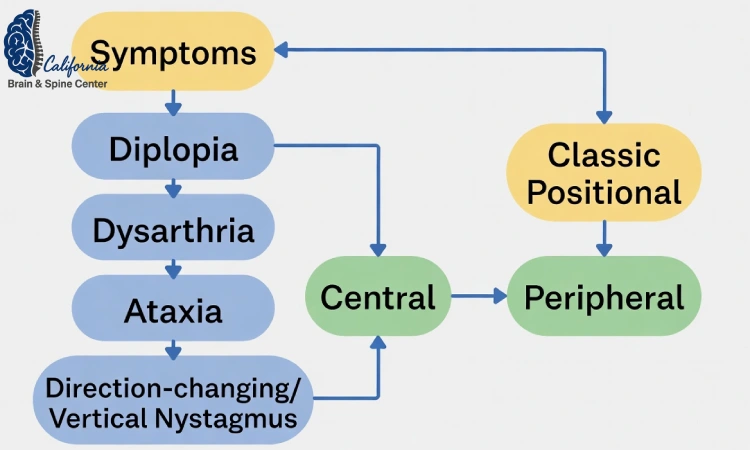
| Nystagmus that beats straight up or down, or twists | More often seen with a central cause | Needs a clinical evaluation |
| Side-to-side nystagmus that changes direction as the gaze changes | More likely to be central | Needs a clinical evaluation |
| Trouble with smooth tracking (pursuit) or quick eye jumps (saccades) | More likely to be abnormal with a central cause | Found on eye-movement testing |
| Vertigo attacks that keep coming back, with a normal exam between them | A published review describes vestibular migraine as the most common cause of recurrent spontaneous vertigo attacks | Worth an evaluation. Sudden or severe attacks are a 911 call |
| Dizziness that started after a concussion | It can have central, peripheral or non-vestibular causes, and the findings are often mixed | Worth an evaluation |
Which Dizziness Red Flags Mean You Should Call 911?
Dizziness red flags that mean calling 911 are sudden dizziness, loss of balance or trouble walking together with sudden trouble seeing, one-sided numbness or weakness, confusion or trouble speaking, or a sudden severe headache with no known cause. Each of these can be a sign of stroke, and the CDC's advice is emergency care right away.
Dizziness red flags: call 911
- Sudden dizziness, loss of balance, trouble walking or lack of coordination
- Sudden trouble seeing
- Sudden numbness or weakness in the face, arm or leg, especially on one side of the body
- Sudden confusion, trouble speaking or trouble understanding speech
- A sudden severe headache with no known cause
If symptoms come on suddenly or severely - a sudden severe headache, weakness, trouble speaking, vision loss, or fainting - that is an emergency. Call 911 or go to an emergency room, not a clinic appointment.
NINDS, part of the NIH, keeps its own page on stroke signs and symptoms. It is worth reading once while you are well, so the list is familiar if you ever need it.
What Is the HINTS Exam?
HINTS is a three-step bedside eye examination (Head Impulse, Nystagmus, Test of Skew). It is used in emergency care for people with sudden, continuous vertigo, a presentation called acute vestibular syndrome. In a prospective study by Kattah and colleagues, HINTS appeared more sensitive for stroke than early MRI in that setting.
HINTS is an emergency-department examination, done by a trained clinician for a specific group of patients. It is not a home test. Watching your own eyes in a mirror or filming them on a phone cannot stand in for it. If you are dizzy enough to wonder, use the red-flag list above as your guide.
Clinicians who want more detail can read a critical review of HINTS, HINTS Plus and central vestibular assessment.
Not an emergency, but the dizziness is still there?
If your dizziness keeps coming back or has not settled, a complimentary consultation at our Calabasas office is a chance to talk through what you are feeling. It is also a chance to decide whether eye-movement and balance testing makes sense for you.
What Does Nystagmus Tell a Clinician About a Central Cause?
Nystagmus, a repeating jerking movement of the eyes, can help a clinician judge whether dizziness is more likely central or inner-ear in origin. The main clues are its direction and how it behaves as the gaze moves.
According to the American Speech-Language-Hearing Association, nystagmus from a central cause is more often purely vertical or torsional, meaning it beats up, down or with a twist. When it is horizontal, it is more likely to change direction depending on where the person is looking. People with a central cause are also more likely to show abnormal pursuit, which is the smooth tracking of a moving target. The same goes for abnormal saccades, the quick jumps the eyes make between targets.
The Dieterich and Brandt review adds the bedside picture. It describes the head impulse test as one of the tools that can help distinguish central from peripheral syndromes. Eye-movement checks for spontaneous or gaze-evoked nystagmus are another, and so is skew deviation, a vertical misalignment of the eyes.
What Happens During a VNG Test?
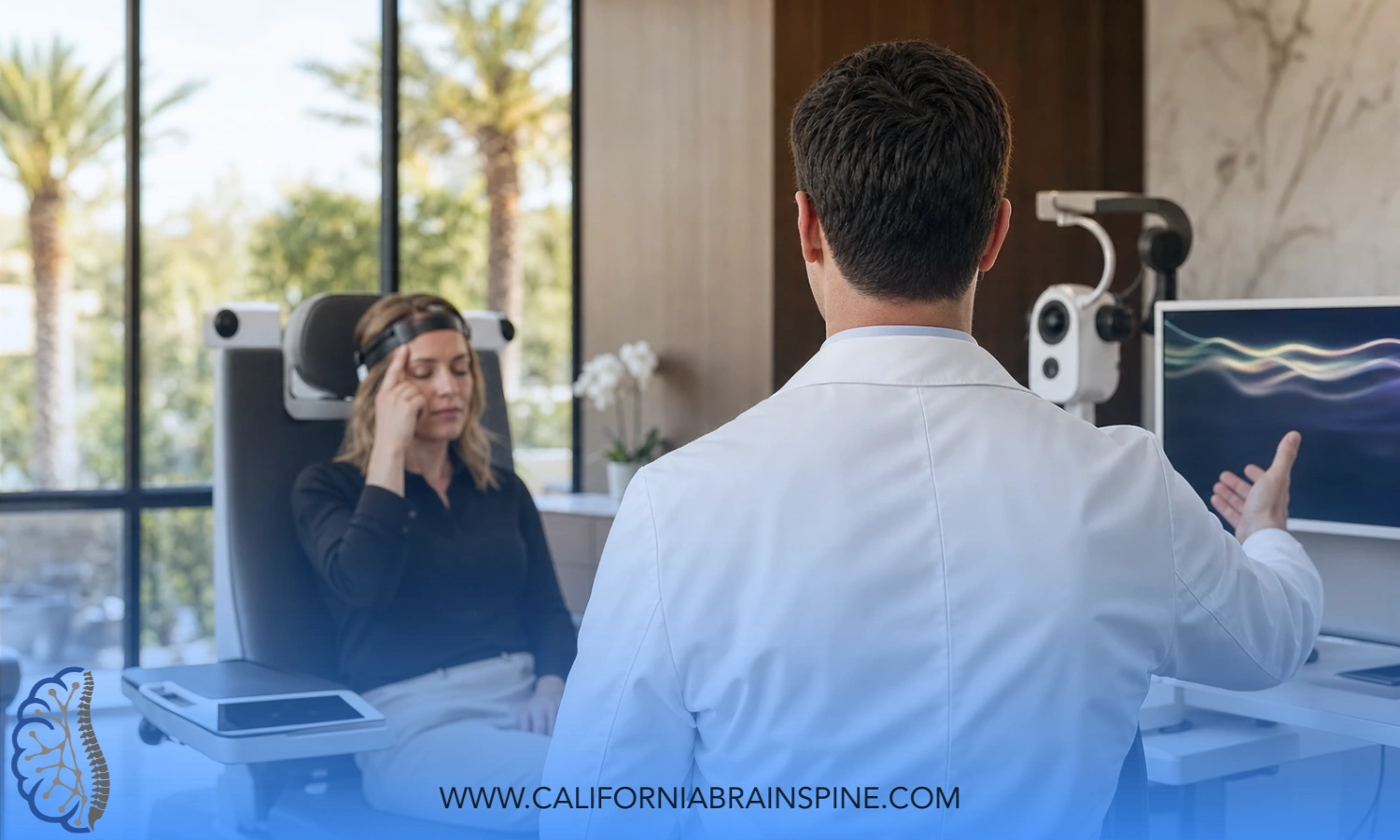
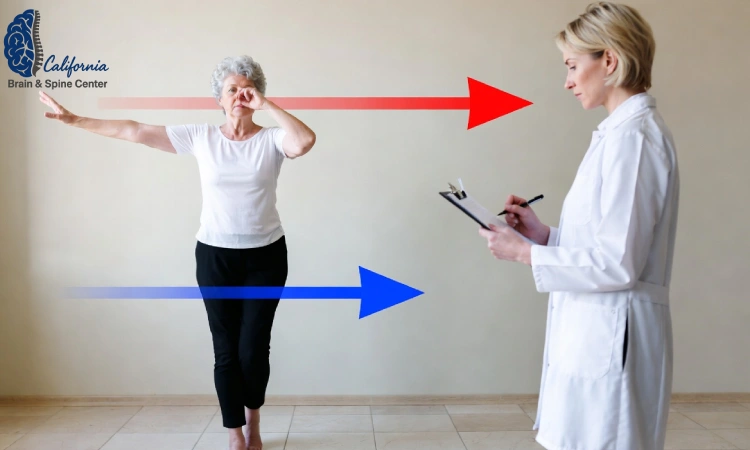
A VNG test, short for videonystagmography, checks the vestibular system by recording your eye movements through goggles fitted with small cameras. The Cleveland Clinic's description of videonystagmography lists three parts that a VNG may include:
- Ocular testing. You keep your head still and follow dots or patterns on a screen while the cameras record your eyes.
- Positional testing. You move your head or body in different directions while the goggles keep recording.
- Caloric testing. Small bursts of warm or cool water or air go into each ear, and the goggles record the nystagmus that follows.
A VNG is one part of an evaluation, and a VNG result is not a diagnosis on its own. It adds a recording of your eye movements, which can be reviewed alongside your history and the rest of the examination.
The video above walks through how VNG records eye movements and vestibular responses. For persistent dizziness that is not an emergency, a recording like this can help shape what happens next.
What Else Does Vestibular Testing Include?
Vestibular testing is broader than VNG. At the bedside it can include the head impulse test, in which the examiner turns your head quickly while you keep your eyes on a target. It can also include checks for spontaneous nystagmus, gaze-evoked nystagmus and skew deviation, the same set the Dieterich and Brandt review describes.
In my office, the assessment also includes balance and posture testing when clinically appropriate. Which tests make sense depends on your history, and not every person needs every test.
Is a VNG the Same as a Brain Scan?
No. A VNG records eye movements through camera goggles, and it does not image the brain. Whether dizziness needs an MRI is a medical decision based on the whole presentation. In a sudden emergency, that decision belongs to the emergency physician.
Imaging is one tool among several in an emergency, which is part of why the HINTS examination described above exists. A systematic review of bedside diagnosis and early imaging in acute vestibular syndrome covers the same ground for clinicians.
I do not interpret imaging as a diagnosis. Questions about scans belong with medical neurology and radiology. California Brain & Spine Center has a separate guide on when dizziness needs neuroimaging and specialist referral.
Can a Concussion Cause Central Vestibular Dysfunction?
Yes, a concussion can lead to dizziness with a central vestibular cause. After a concussion, dizziness is second only to headache in how often it is reported.
A review of post-concussive dizziness sorts its causes into central vestibular, peripheral vestibular and non-vestibular groups. The review also describes growing recognition that patients frequently show both central and peripheral findings on vestibular testing. Finding one problem after a head injury therefore does not rule out a second.
If your dizziness began after a head injury and has not settled, concussion treatment in Calabasas starts with the same kind of evaluation described on this page.
One caution applies here. Someone living with post-concussion dizziness may develop something new and sudden, such as trouble speaking, trouble seeing or weakness on one side. That belongs on the stroke list, and the old concussion does not explain it. Call 911.

Can Vestibular Migraine Be a Central Vestibular Disorder?
Yes, vestibular migraine is counted among central vestibular disorders in the review by Dieterich and Brandt. A separate review of vestibular migraine describes it as the most common cause of recurrent spontaneous vertigo attacks.
That review also reports that a neurological examination done between episodes, in the interval without symptoms, generally finds nothing abnormal. This matters if your attacks keep returning. With vestibular migraine, the research describes a normal examination on a good day, so a normal result does not end the conversation.
Recurring vertigo attacks are worth an evaluation even when each one passes. A sudden, severe attack that comes with any sign from the red-flag list is still a 911 call, whether or not you have a history of migraine.
When Should Non-Emergency Dizziness Be Checked?
If your dizziness keeps recurring, does not settle, or keeps getting in the way of driving, work or moving through busy places, it is worth an evaluation, even when each episode passes.
Watch for change. A new kind of dizziness, dizziness that is getting worse, or any new symptom from the red-flag list changes the answer. Sudden or severe symptoms are a 911 call, not a reason to wait for an appointment.
For non-emergency dizziness, your primary care physician is a reasonable first stop, and a vestibular evaluation can run alongside that care. Nothing on this page asks you to choose one over the other.
Before any evaluation
Write down what happened first, what followed, and how long each episode lasted. Note whether your vision, speech, hearing or coordination changed at the same time. That sequence is easy to lose by the end of a long day, and it is one of the most useful things you can bring to whoever examines you.
Can Vestibular Rehabilitation Help a Central Vestibular Disorder?
Vestibular rehabilitation may be part of care for a central vestibular disorder when it is clinically appropriate. A published review reports growing literature supporting it for both peripheral and central vestibular disorders.
A review of advances in vestibular rehabilitation notes that persistent postural-perceptual dizziness (PPPD) and vestibular migraine are now defined diagnoses. It adds that clinicians have a clearer sense of what to expect from rehabilitation and whom to refer. The review does not promise a result, and neither do I. How a person responds varies with the cause.
Rehabilitation comes after the safety question. An emergency cause has to be ruled out first. If the examination then points to specific problems with gaze, balance or visual motion, care may include, when clinically appropriate after evaluation, neurological rehabilitation built around those findings. Our page on vestibular rehab therapies describes what those sessions can involve.
Where Can People in Calabasas and Encino Get Persistent Dizziness Evaluated?
People in Calabasas, Encino and across the San Fernando Valley can be evaluated for persistent, non-emergency dizziness at California Brain & Spine Center, 4768 Park Granada, Suite 107.
Dr. Alireza Chizari, DC, DACNB, sees patients at California Brain & Spine Center in Calabasas. His work in functional neurology centers on how the brain handles balance, eye movement and posture.
You may commute the 101 and find that the head turn to check a lane has started to feel uncertain. An afternoon of screens may leave the room feeling half a step behind you. Both describe the kind of dizziness worth checking. An evaluation is a way to answer the question with measurements, whatever the answer turns out to be.
Ongoing dizziness is worth taking seriously even when earlier tests were reassuring. The useful next question is which parts of the balance system are not working as they should.
What Do Patients Ask Me About Testing for a Central Vestibular Disorder?
The question patients ask me most often about central vestibular testing is why they still feel dizzy when earlier tests came back normal.
My answer is that each test answers its own question. An eye-movement and balance assessment looks at how the balance system performs while it is working. That is a different question from the ones earlier tests may have been asked to answer. Vestibular migraine is one example: the research describes a generally normal examination between episodes. A normal day in the clinic is therefore part of the picture rather than the end of it.
Another question I hear often is what the first visit involves. After the complimentary consultation, the evaluation is a 120-minute neurodiagnostic assessment. I start with the sequence of events: what happened first, what followed, how long episodes last, and whether vision, speech, hearing, headache or coordination changed. Then come the eye-movement tests, which can include videonystagmography when clinically appropriate. The bedside checks described above, positional testing and balance testing follow. I go through the results with you in plain language before we talk about a plan.
"Then we did the full examinations like eye tracking and balance test and he explained my results and what they mean for my symptoms."
From a Google review
Sometimes the history or examination points toward a cause that needs medical care. When it does, I say so and refer you to your primary care physician, medical neurology or ENT, and I keep working alongside them. When the findings point toward a rehabilitation problem, care may include, when clinically appropriate after evaluation, neurological rehabilitation.
The misunderstanding I correct most often is that the word central means stroke. Stroke is the cause that needs 911, and it is on every red-flag list for good reason. Vestibular migraine and concussion can also involve central balance processing. When those are not sudden or severe, they are questions for an evaluation.
I trained as an electrical engineer before I became a doctor of chiropractic and went on to postdoctoral training in clinical neuroscience. The habit that stayed with me is to measure a system before trying to change it. With a central vestibular disorder, that means the examination comes first and the plan second.
What Else Do People Ask About Central Vestibular Disorders?
People reading about central vestibular disorders usually also ask about the terms, the tests and when to go to the emergency room. The short answers are below.
Is central vestibular disease the same as a central vestibular disorder?
Mostly, yes. Central vestibular disease, a central vestibular disorder and central vestibular dysfunction are used for overlapping ideas: a balance problem that starts in the parts of the brain that process signals from the inner ear, rather than in the inner ear. The terms describe where the problem sits, and several different conditions can cause it.
Can a VNG test show a central vestibular disorder?
A VNG test can record eye-movement patterns that are more likely with a central cause, such as vertical or direction-changing nystagmus and abnormal pursuit or saccades. It may include ocular, positional and caloric testing. A VNG is one part of an evaluation, though, and it does not diagnose a central vestibular disorder on its own.
What does vestibular testing look for?
Vestibular testing looks at how the balance system and the eyes work together. At the bedside it can include the head impulse test and checks for spontaneous or gaze-evoked nystagmus and skew deviation, which can help distinguish central vestibular dysfunction from an inner-ear problem. A VNG can add a camera recording of the eye movements.
When should someone in Calabasas or Los Angeles go to the emergency room for dizziness?
Call 911 for sudden dizziness, loss of balance or trouble walking that comes with sudden trouble seeing, one-sided numbness or weakness, confusion, trouble speaking, or a sudden severe headache. These can be signs of stroke. Wherever you are in Calabasas or Los Angeles, that is an emergency room visit, not a clinic appointment.
Can central vestibular syndrome symptoms follow a concussion?
Yes, they can. After a concussion, dizziness is second only to headache in how often it is reported, and it can have central vestibular, peripheral vestibular or non-vestibular causes. A published review notes that patients frequently show both central and peripheral findings on testing, so an evaluation after a head injury looks at each part.
Is dizziness that keeps coming back worth an evaluation?
Yes. Dizziness that keeps recurring, does not settle, or keeps you from driving, working or moving through busy places comfortably is worth an evaluation, even when each episode passes. An evaluation for a possible central vestibular disorder looks at eye movements and balance. Sudden or severe symptoms are different: those are a 911 call.
How Should You Think About a Central Vestibular Disorder?
I think about a central vestibular disorder in two steps: first, whether this could be an emergency, and then, if it is not, what the balance system is doing.
The first step belongs to 911 and the emergency room whenever a red flag is present. The second step is where an evaluation helps. Eye movements, positional responses and balance are measured and explained, so the plan that follows fits the findings. If you are living with the second kind of dizziness, I would be glad to look at it with you.
California Brain & Spine Center | (818) 649-5300 | Calabasas, CA 91302
Book online at californiabrainspine.janeapp.com
This content is for educational purposes only and is not medical advice. Consult a qualified healthcare provider about your specific situation.
Dizziness that has not settled is worth measuring
Book a complimentary consultation at California Brain & Spine Center in Calabasas. You can also call to talk through whether a neurodiagnostic assessment makes sense for you.