Vestibular and Laser Therapy in Westlake Village Clinic
If you live in Westlake Village and dizziness is controlling your days, you are not overreacting. When your balance feels unreliable, simple things like driving, shopping, or working on screens can start to feel risky. You deserve a plan that is calm, structured, and based on how your nervous system actually works.
I, Dr. Alireza Chizari, wrote this page to explain how vestibular and laser therapy in Westlake Village can be combined in a modern, non-invasive rehabilitation approach, especially when symptoms are persistent or complex. My goal is to help you understand what is happening, what a high-quality evaluation looks like, and what next steps make the most sense for your body.
At California Brain & Spine Center, I act as your guide. You stay the hero of the story. We build a plan around your symptoms, your triggers, your pace, and your real life, so you can move toward steadier function with more confidence.
Why vestibular and laser therapy in Westlake Village is sometimes the missing combination
Some people improve with basic vestibular exercises alone. Others do not, especially when symptoms include a mix of dizziness, visual sensitivity, head pressure, brain fog, fatigue, and that “my nervous system is always on” feeling.
In those more complex cases, I often think in layers:
- Vestibular rehabilitation helps the brain recalibrate balance, gaze stability, and motion processing.
- Low-level laser therapy (also called photobiomodulation) may support neurophysiologic recovery by influencing cellular energy processes and inflammation pathways, while research continues to evolve.
When used appropriately, the combination is not about doing “more stuff.” It is about doing the right inputs in the right order, so your system can adapt without crashing.
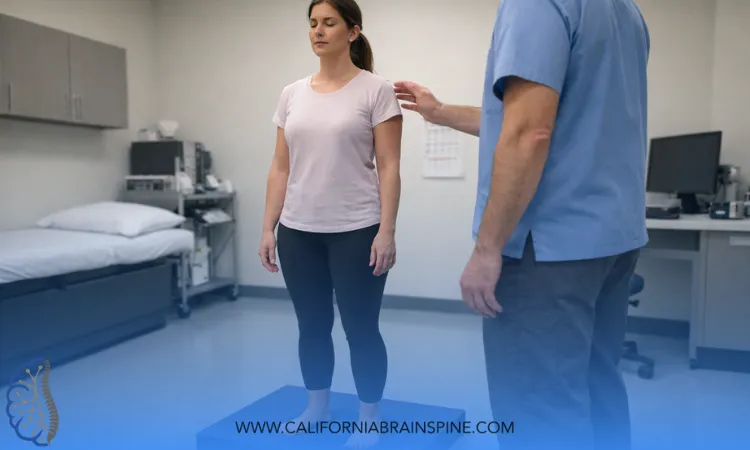
Image note: “Photorealistic image. A modern neurology and vestibular rehab room in a Southern California clinic. A calm white male doctor in a white coat reviews balance test results on a tablet with an adult female patient. Soft natural lighting, clean medical environment, realistic skin texture, shallow depth of field, documentary photography style.”
What I mean by “laser therapy” in vestibular and laser therapy in Westlake Village
When patients hear “laser,” they sometimes imagine heat, cutting, or something aggressive. That is not what we are talking about here.
In this setting, laser therapy typically refers to low-level laser therapy (LLLT) or photobiomodulation (PBM). It uses specific wavelengths of light at low power, with the intent of supporting tissue-level and neurophysiologic processes. In brain-related and neurologic contexts, a growing body of research discusses PBM and transcranial photobiomodulation as noninvasive approaches being studied for traumatic brain injury and related symptoms.
Important: evidence is still developing, and outcomes vary by person, device parameters, and diagnosis. In my clinic, laser is used as an adjunct when it fits the clinical picture, not as a standalone “magic fix.”
“Healing is not about pushing harder. It is about choosing inputs your nervous system can safely absorb, then repeating them with patience.”
The real reason dizziness can persist: it is rarely just the inner ear
When someone comes to me from Westlake Village saying, “I did vestibular exercises and I’m still dizzy,” I do not assume they failed. I assume the plan was incomplete.
Dizziness can be driven by several interacting systems:
Vestibular processing and motion sensitivity
Even if the inner ear is not “damaged,” the brain can become overreactive to motion, visual movement, and head turns.
Visual-vestibular mismatch
Screens, fluorescent lighting, driving, grocery aisles, and busy patterns can overload the visual system and provoke dizziness.
Cervicogenic contributors
Neck joint input and muscle tension can distort balance signaling, especially after whiplash or concussion.
Autonomic instability
Dysautonomia patterns can create lightheadedness, heart rate spikes, and “crash” fatigue that feels like dizziness but behaves differently than classic vertigo.
This is why I frame vestibular and laser therapy in Westlake Village as one possible strategy inside a larger neurological map, not as a one-size-fits-all solution.
Image note: “Photorealistic clinical diagram scene. A white male doctor points to a wall monitor showing a simplified balance system graphic (eyes, inner ear, neck, autonomic). Adult female patient listens. Modern clinic, realistic lighting, high detail, professional medical photography.”
How I evaluate you before starting vestibular and laser therapy in Westlake Village
A strong plan starts with the right diagnosis and the right drivers. If we skip that step, rehab becomes guesswork.
Here is what a high-quality evaluation commonly includes in my clinic (the exact mix depends on your history):
- History and trigger mapping ✅
What provokes symptoms: screens, head turns, stores, standing, heat, driving, stress, sleep disruption. - Vestibular and balance testing ✅
Positional testing when appropriate, gaze stabilization tolerance, balance under different sensory conditions. - Eye movement screening ✅
Tracking, convergence, visual motion sensitivity patterns. - Autonomic screening when relevant ✅
Orthostatic symptoms, hydration patterns, heat intolerance, heart rate spikes. - Cervical spine and posture assessment ✅
Especially if symptoms started after whiplash, concussion, or prolonged desk work.
If we find classic BPPV patterns, canalith repositioning may be the first step. Guidelines and evidence reviews support repositioning maneuvers such as the Epley for posterior canal BPPV.
“When your symptoms finally make sense, the fear shrinks. Clarity is not a luxury in neurological care. It is the beginning of progress.”
What a combined vestibular and laser therapy in Westlake Village plan can look like in real life
At California Brain & Spine Center, patients are not handed generic vestibular sheets and sent home. A combined plan is typically staged, because the nervous system adapts best when load is graded.
Phase 1: Stabilize and reduce unnecessary provocation
The early goal is to reduce spikes while building confidence. This can include gentle vestibular inputs, visual pacing, and foundational autonomic support strategies when indicated.
Phase 2: Rebuild gaze stability and balance integration
Vestibular rehabilitation is often built around repeatable drills that progressively challenge gaze stability, head movement tolerance, and balance control.
Phase 3: Add adjuncts when clinically appropriate
Photobiomodulation may be considered as an adjunct when the case suggests neuroinflammation, post-concussion sensitivity patterns, or prolonged recovery features, recognizing that evidence is evolving and individualized.
This is where vestibular and laser therapy in Westlake Village can become a practical pairing: vestibular rehab trains function, while PBM is considered as a supportive tool in the broader neuro-rehab context.
Image note: “Photorealistic treatment moment. A modern clinic room. White male doctor uses a small handheld low-level laser therapy device on the back of the head/upper neck area (noninvasive, no heat, no dramatic glow). Adult female patient seated comfortably. Realistic medical setting, soft lighting, natural colors, high realism.”
Why the “laser” part is never the whole plan
At California Brain & Spine Center, laser is not positioned as a replacement for rehabilitation. It is positioned as a possible support.
Research literature describes photobiomodulation as a modality that may influence mitochondrial activity, blood flow, and inflammatory pathways, with ongoing clinical investigation in neurologic conditions including TBI.
That is meaningful, but it is not a guarantee.
If your balance system is undertrained, your brain still needs targeted vestibular input. If your dizziness is mostly autonomic, your plan still needs autonomic stabilization strategies. If your symptoms are driven by visual motion sensitivity, you still need the right visual-vestibular progression.
“Tools matter, but sequencing matters more. The right therapy at the wrong time can still overwhelm you.”
What you can do between visits to make vestibular and laser therapy in Westlake Village work better
At California Brain & Spine Center, patients are evaluated with the idea that the clinic plan must survive real life: work, parenting, commuting, screens, and sleep.
Common high-impact adjustments include:
Environment and pacing
Reduce “stacking” triggers on the same day (for example: long screens + errands + social event).
Visual hygiene
Shorter screen blocks, more breaks, and less visual chaos can reduce flare frequency, especially early.
Hydration and heat strategy when relevant
If heat or standing worsens symptoms, we plan around hydration timing, cooling strategies, and gradual upright tolerance.
This is not about living in avoidance. It is about building stability so progress compounds.
Image note: “Photorealistic lifestyle scene in Westlake Village area. Adult female patient walking slowly in a quiet park path with sunglasses and a water bottle. Calm morning light, realistic environment, natural posture, documentary style.”
Safety first: when dizziness should not be treated as routine
Most dizziness patterns are not dangerous, but some are urgent. You should seek emergency evaluation if dizziness is paired with red-flag neurological signs such as sudden weakness, facial droop, slurred speech, severe new headache, fainting, or severe inability to walk.
Also, if you have sudden positional vertigo that fits BPPV, it is often very treatable, but it still needs proper assessment. Clinical guidelines emphasize accurate diagnosis and appropriate maneuvers rather than endless symptomatic medications.
“Your body is not betraying you. It is signaling. The goal is to learn which signals are urgent, and which are trainable.”
How to choose the right clinic near Westlake Village for vestibular and laser therapy
I want you to choose care confidently, even if it is not with us. Here is what matters most:
- Do they test, or do they guess?
You want vestibular, visual, balance, and cervical screening, not just a quick “it’s vertigo” label. - Do they understand multi-system dizziness?
Many patients need vestibular plus autonomic plus visual strategies. - Do they pace the plan?
If you crash after sessions, the dose is wrong. - Do they use adjunct tools responsibly?
Laser and other technologies should be used with honest expectations and clear clinical reasoning.
If you are searching specifically for vestibular and laser therapy in Westlake Village, I encourage you to prioritize clinics that can explain the logic behind their plan in plain English and adjust it based on your response.
A short case story that shows what vestibular and laser therapy in Westlake Village can look like
Some time ago, a patient named “M.” came to see me from the Westlake Village area. She was sharp, active, and frustrated. Her biggest complaint was not just dizziness. It was the unpredictability. Some mornings she could function, and then one busy store or one long screen session would trigger two days of rocking, head pressure, and exhaustion.
When I evaluated her, we found a layered picture: visual motion sensitivity, mild balance instability under sensory challenge, and a pattern that suggested autonomic vulnerability during stress and heat. Her prior care had focused only on generic balance exercises, without enough pacing or visual progression.
I built her plan in phases: structured vestibular rehabilitation with very specific gaze stability progressions, careful pacing rules to prevent crashes, and adjunct non-invasive tools when appropriate, including low-level laser therapy as part of a broader neurological strategy. Over time, her flare frequency decreased, her tolerance for errands improved, and most importantly, she stopped being afraid of her symptoms. She told me, “Now I can predict my limits, and I feel like I’m driving the plan again.”
That is the real win. Not perfection. Control and confidence returning to the patient.
“Progress is when your life expands again, not when your symptoms vanish overnight.”
Your most common questions about vestibular and laser therapy in Westlake Village
1) Is vestibular and laser therapy in Westlake Village right for post-concussion dizziness?
It can be, but only after the right evaluation. Post-concussion dizziness can come from vestibular, visual, cervical, and autonomic factors. I decide based on your drivers, not your label. I also emphasize that photobiomodulation evidence is evolving, so it is used thoughtfully as an adjunct when it fits the case.
2) How fast should I expect results?
Some vestibular problems such as classic BPPV can improve quickly with appropriate maneuvers.
Complex dizziness patterns usually improve in stages. The safest expectation is steady trend improvement, not a straight line.
3) Can laser therapy make dizziness worse?
Most people tolerate low-level laser therapy well, but any intervention can be too stimulating if the nervous system is reactive. That is why dosing and timing matter. If you flare after sessions, we adjust the plan.
4) Do I still need vestibular rehab if I do laser therapy?
In most cases, yes. Vestibular rehabilitation trains the brain’s balance and gaze systems through targeted repetition. Laser therapy does not replace that training.
5) What if my dizziness is mostly lightheadedness when I stand?
That pattern often points toward autonomic involvement rather than classic vertigo. In that case, the plan needs orthostatic screening and strategies for hydration, pacing, and gradual conditioning, not just balance drills.
6) Do you treat people who live in Westlake Village even though the clinic is in Calabasas?
Yes. Many patients travel to our Calabasas clinic from Westlake Village and nearby areas because they want a more detailed neurological and vestibular approach, especially when symptoms are complex or persistent.
Conclusion
If you are searching for vestibular and laser therapy in Westlake Village, I want you to remember one principle: the best outcomes come from clarity and sequencing. I, Dr. Alireza Chizari, start by identifying what is truly driving your symptoms, then we build a paced plan that your nervous system can adapt to. Vestibular rehabilitation remains the foundation for retraining balance and motion processing, and laser therapy (photobiomodulation) may be considered as a supportive tool in the right cases, with honest expectations and careful monitoring.
If you are tired of guessing, you do not have to do this alone. The goal is not to “power through dizziness.” The goal is to help you move toward steadier, more functional days, with a plan that respects your brain and your life.
If you would like a personalized neurological and vestibular evaluation, contact California Brain & Spine Center and request an appointment. We will help you understand your pattern, build a clear path forward, and work toward the best version of your function, not just symptom management.