Drug-Free Strategies for Regaining Balance After a Concussion
If you’re reading this, chances are the ground still feels a bit wobbly after your head injury. Please hear this first: your healing brain is remarkably adaptable, and there are natural ways to improve balance after a concussion that can help you feel steady, safe, and confident again. I’ve seen hundreds of patients reclaim rock-solid footing without relying on heavy medications. In this guide, I’ll reveal the science and the step-by-step strategies so you can do the same.
Before you try today’s home drills, scan “Dizziness After Concussion Happens And How to Fix”; it explains why those first wobbly weeks happen and what’s safe to push—or pause—during recovery.
Why Concussions Disrupt Balance in the First Place
A concussion temporarily scrambles the brain’s communication with three main balance systems:
| System | What It Does | How Concussion Disrupts It |
|---|---|---|
| Vestibular (inner ear) | Detects head motion | Swelling or neural “static” confuses motion signals |
| Vision | Stabilizes the horizon | Eye-tracking reflex slows or becomes imprecise |
| Proprioception | Feels body position | Muscles and joints send muddled feedback |
Natural ways to improve balance after a concussion work because they retrain these systems to cooperate again—without drugs that merely dull the symptoms.
A Clear Look at How Concussion Affects Balance and Body Control
In this clip you can see how we analyze leg movement and neurological coordination in real time. Many patients lose their sense of balance after a concussion because their brain is not processing sensory information correctly. This type of testing helps us find the weak links so natural strategies like vestibular work, balance drills, and sensory integration become far more successful.
The Six Pillars of Natural Recovery
1. Gaze-Stabilization Drills
Hold a business card at eye level, focus on a single letter, and gently shake your head “no” at two beats per second for 30 seconds. Rest, repeat facing up, down, left, and right. This simple drill is one of the most proven natural ways to improve balance after a concussion because it recalibrates the vestibulo-ocular reflex (your inner gyroscope).
2. Barefoot Proprioceptive Training
Stand on a folded yoga mat barefoot, feet together, eyes open for 30 seconds; progress to eyes closed. The brain must “listen” to ankle and foot receptors, a cornerstone of natural ways to improve balance after a concussion. Add gentle knee bends or light medicine-ball tosses as you improve.
3. Core & Cervical Strengthening
Your spine is the bridge between body and brain. Try cat-camel stretches, plank holds (start at 15 seconds), and gentle chin tucks. A resilient core and neck provide a stable platform so other natural ways to improve balance after a concussion can work more efficiently.
4. Rhythmic Breathing & Vagal Tone
Sit tall, inhale through the nose for 4, hold 2, exhale 6. Repeat five cycles. This activates the vagus nerve, calming the autonomic “fight or flight” surge that often heightens dizziness. Incorporating breathwork multiplies the success of other natural ways to improve balance after a concussion.
5. Anti-Inflammatory Nutrition & Hydration
-
Hydrate: Aim for half your body weight in ounces of water daily.
-
Eat: Omega-3-rich foods (salmon, chia), polyphenols (berries, green tea), magnesium sources (pumpkin seeds, leafy greens).
By lowering neuro-inflammation, diet quietly powers the more active natural ways to improve balance after a concussion.
6. Gentle Outdoor Movement
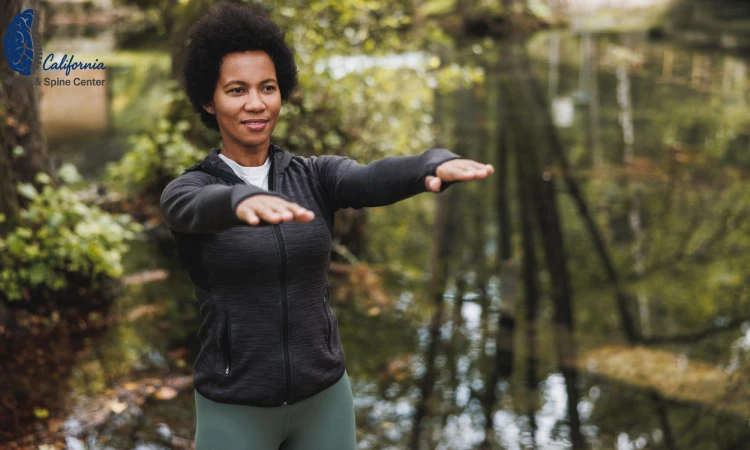
Nature offers an ever-changing visual field that trains eye tracking. Start with ten-minute walks on flat grass. As stability grows, try short hikes with slight inclines. This dynamic terrain is one of the most enjoyable natural ways to improve balance after a concussion and doubles as mood therapy.
A Seven-Day Sample Reset Plan
| Day | Morning | Midday | Evening |
|---|---|---|---|
| Mon | Gaze drill set | Core plank x3 | 10-min breath walk |
| Tue | Barefoot mat stance | Omega-3 lunch | Cat-camel 2 × 10 |
| Wed | Gaze + head-tilt drill | Tai-chi video 15 min | Vagal breathing |
| Thu | Single-leg stance eyes open | Nature walk 20 min | Foam roll calves |
| Fri | Gaze drill progress eyes closed | Light resistance band rows | Gratitude journaling |
| Sat | Yoga sun salutations | Farmers’ market (visual flow) | Neck stretches |
| Sun | Rest & hydration focus | Family picnic—soft play | Guided meditation |
Repeat the cycle, nudging difficulty up 5 % each week. Consistency, not intensity, drives results in these natural ways to improve balance after a concussion.
When to Seek Expert Guidance

If dizziness spikes above a 4 / 10 despite two weeks of diligent practice, or if blurred vision makes daily tasks unsafe, professional assessment can shorten your timeline dramatically. At the California Brain & Spine Institute, our balance team blends computerized posturography, infrared eye tracking, and tailored vestibular drills to complement the natural ways to improve balance after a concussion you’ve begun at home. Book your Comprehensive Balance Evaluation today and take the next confident step forward.
Summary
The most effective natural ways to improve balance after a concussion revolve around retraining the eyes, ears, muscles, and mind to communicate smoothly again. Gaze stabilization, proprioceptive challenges, core strengthening, mindful breathing, anti-inflammatory fuel, and graded outdoor movement form a synergistic toolkit that revitalizes stability without medication. With patience and daily practice, your equilibrium can—and will—return.
Frequently Asked Questions
1. How soon after a concussion can I start these exercises?
Begin light drills (e.g., gaze fixation, breathwork) once severe headaches or nausea subside, typically 48–72 hours, but confirm with your clinician.
2. Do I need special equipment?
A folded yoga mat, lightweight foam pad, or even a pillow can substitute for fancy balance tools.
3. What if exercises make me dizzier?
A mild, brief uptick (1–2 points) is expected; if symptoms linger beyond 15 minutes, scale back intensity and retest the next day.
4. Can I keep doing cardio workouts?
Yes—if you stay below the symptom-provoking threshold. Slow cycling or elliptical sessions often blend well with natural ways to improve balance after a concussion.
5. Are supplements necessary?
Whole-food sources usually suffice, but your doctor may recommend magnesium glycinate or DHA if dietary intake is low.
6. How long until I feel normal?
Most diligent patients notice measurable steadiness within three weeks; full resolution varies from one to three months.
7. Is it ever too late to start?
Neuroplasticity persists for life. Even long-standing imbalance can improve with focused, consistent training.
 Alireza Chizari, MSc, DC, DACNB
 Clinical Focus
 Assessment & Treatment Approach
Objective testing may include:
Treatment programs may involve:
 Clinic Information
 Medical Review
 Disclaimer