If you are a parent in Thousand Oaks trying to help a child who is not “back to normal” after a concussion, or you are an adult dealing with dizziness, brain fog, headaches, or fatigue that keeps disrupting family life, you deserve a clear path forward.
I am Dr. Alireza Chizari. In this article, I will explain what families should look for in a brain health center in Thousand Oaks, what a modern neurological and vestibular evaluation actually involves, and how my team at California Brain and Spine Center in Calabasas supports patients from Thousand Oaks and the Conejo Valley.
You are the hero of this story. You are the one carrying the symptoms, the responsibilities, and the questions. My job is to be the expert guide who listens carefully, tests the right systems, and builds a non-invasive plan that helps you move toward a steadier, more functional life.
What a family friendly brain health center in Thousand Oaks should feel like
When families search for a brain health center in Thousand Oaks, they are not only searching for technology or a diagnosis. They are searching for an environment that feels safe, organized, and human.
In my experience, “family friendly” means:
- your concerns are taken seriously even when basic tests are normal
- the plan is explained in plain language, without fear or hype
- the pace respects the nervous system, especially after concussion, dizziness, or chronic fatigue
- the clinic understands that a child, a teen, and an adult need different communication and different thresholds
A true brain health center in Thousand Oaks should not treat you like a problem to manage. It should treat you like a person to guide.
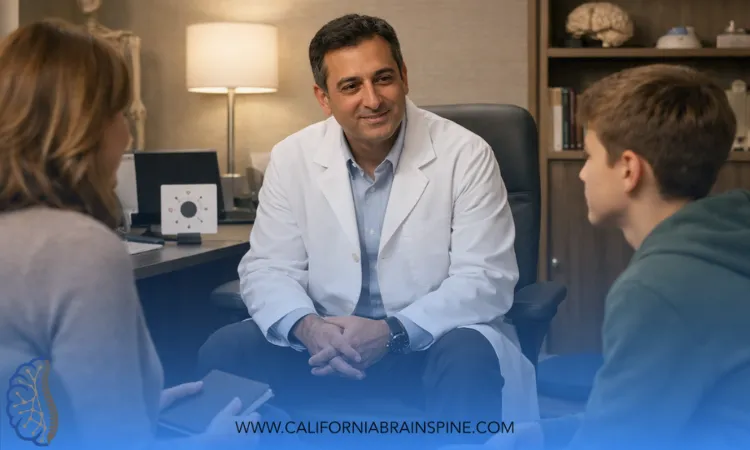
Image note: “An adult parent and teen sitting with a calm, focused doctor in a modern clinic near Calabasas, discussing concussion and dizziness symptoms, soft lighting, reassuring atmosphere, no text, no logos.”
Why dizziness, brain fog, and concussion symptoms often affect the whole family
Many patients feel guilty because symptoms change the rhythm of the household. A teen stops practicing sports. A parent stops driving at night. A spouse becomes the default planner because the other person crashes after errands.
If you are reading this, I want you to know something important: your family’s stress is not proof that you are failing. It is proof that your nervous system needs a smarter plan.
A common pattern I see in Thousand Oaks families is the “looks fine but is not fine” problem. A person can appear normal for short bursts, then deteriorate later in the day. That delayed crash pattern is very common in post-concussion cases, vestibular dysfunction, migraine physiology, and dysautonomia.
That is why choosing the right brain health center in Thousand Oaks matters. You need a clinic that understands the systems behind symptoms, not just the label.
Healing becomes possible when the family stops arguing about whether the symptoms are real and starts working together on what the nervous system needs.
How a brain health center in Thousand Oaks should evaluate both adults and kids, without guessing
At California Brain and Spine Center, patients are evaluated with advanced neurological, vestibular, and functional testing, because dizziness, brain fog, headaches, and balance problems are often multi-factorial. A modern brain health center in Thousand Oaks should look at the systems that create symptoms, not only at imaging results.
A thorough evaluation commonly includes:
- A detailed symptom timeline: what changed, when, and what triggers flares
- Vestibular and balance testing: how the inner ear and brain integrate motion and stability
- Eye movement and visual tracking assessment: because vision is often a hidden driver of dizziness and fatigue
- Cervical spine evaluation: because neck mechanics can amplify headaches and dizziness
- Screening for autonomic patterns: lightheadedness on standing, heart racing, heat intolerance, and crash episodes
✅ A key sign you may need a deeper evaluation is when symptoms persist despite “normal” basic tests, or when symptoms are triggered by screens, busy stores, car rides, or simple daily tasks.
Image note: “A clinician performing a balance and eye-movement assessment with a patient in a modern clinic setting, clean professional environment, no visible branding, no text.”
The questions that matter more than one test result
At California Brain and Spine Center, clinicians listen for patterns that point toward specific drivers, including:
- Is dizziness positional, motion-driven, or more like lightheadedness?
- Do symptoms spike with visual load, like screens and reading?
- Is there a delayed crash after activity?
- Does heat, standing, or showering worsen symptoms?
- Are headaches tied to neck position or sensory overload?
Those patterns help a brain health center in Thousand Oaks choose the right care pathway instead of cycling through generic advice.
Why family context changes the clinical plan
A teen athlete, a working parent, and an older adult may share dizziness, but the life demands and the triggers are different. In a family-friendly environment, the plan is designed around real schedules, school demands, work demands, and caregiver capacity. That is how care becomes sustainable.
What a modern brain health center in Thousand Oaks can actually treat, and what progress usually looks like
At California Brain and Spine Center, care is built around non-invasive rehabilitation and neurological support. The goal is not to “push through” symptoms. The goal is to help the nervous system integrate more efficiently so daily life becomes less reactive.
Common care pathways include:
- Concussion treatment and post-concussion recovery planning
- Vestibular rehabilitation for dizziness, vertigo patterns, and balance instability
- Cognitive rehabilitation strategies when attention, processing speed, and mental stamina are affected
- Neuroplasticity-based rehabilitation and NeuroSensory Integration (NSI) when the brain is stuck in hypersensitivity patterns
- Support for autonomic nervous system disorders such as dysautonomia when symptoms match that pattern
- Non-invasive neurology tools when appropriate, including LLLT, PEMF, HBOT, GammaCore vagus nerve stimulation, and the NeuroRevive Program as part of a broader plan
A good brain health center in Thousand Oaks helps you measure progress in practical ways: fewer crashes, improved tolerance to motion and light, clearer thinking, steadier balance, and better ability to participate in family routines.
The most meaningful progress is not a perfect day. It is the return of predictability and confidence.
Image note: “A calm modern clinic scene showing a patient doing gentle vestibular rehabilitation exercises with clinician supervision, safe posture, soft lighting, professional and reassuring.”
Family-friendly care means building a plan that fits school, work, and real-world triggers
At California Brain and Spine Center, care is designed to fit the reality that families face. That means planning around school drop-offs, homework, sports schedules, screen exposure, commutes, and sleep.
Helping kids and teens without overwhelming them
A family-friendly approach includes:
- explaining symptoms without fear language
- setting realistic return-to-learn and return-to-activity steps
- coordinating pacing so a good day does not turn into a three-day crash
- helping parents know what to encourage and what to pause
Supporting adults who have to keep life moving
A practical plan for adults often includes:
- pacing strategies to prevent boom-bust cycles
- structured screen breaks and sensory management
- gradual conditioning when fatigue and autonomic sensitivity are present
- clear guidance for driving, errands, and work meetings
For many people in Thousand Oaks, the turning point is not a single treatment. It is a coherent plan that respects how the nervous system actually adapts.
What to bring to your first visit if you are searching for a brain health center in Thousand Oaks
Families feel relieved when they arrive prepared, because it speeds up clarity.
Here is what I recommend bringing:
- A simple symptom timeline with start date and major turning points
- Any prior imaging reports or specialist notes you already have
- A list of medications and supplements
- A short list of your top 3 goals (example: drive again, return to work, tolerate school days)
- Notes on triggers (heat, screens, car rides, busy stores, exercise)
This helps a brain health center in Thousand Oaks quickly identify patterns and prioritize what matters most to you.
Image note: “A patient holding a simple symptom timeline notebook while sitting in a calm clinic office with a clinician, professional setting, no readable text, no logos.”
When you bring your story clearly, you give your clinician the most powerful diagnostic tool: context.
A short case story from my clinic
Some time ago, a family from the Thousand Oaks area came to see me because their teenage daughter had “recovered” from a concussion, but she still could not tolerate school days without headaches, dizziness, and brain fog. Her parents were frustrated because the outside world kept telling them she looked fine.
I sat with them and listened carefully to the patterns. Her symptoms spiked with fluorescent lighting, long screen use, and busy hallways. She also had neck tension and balance instability that showed up during testing, even though she could “push through” for short periods.
We built a non-invasive plan that combined vestibular rehabilitation, careful pacing strategies, and targeted neurological exercises designed to improve sensory integration. We also coached the family on how to structure school days so she could progress without crashing. Over time, she became steadier, her headaches became less frequent, and she regained confidence. Her parents told me the biggest relief was finally having a plan that made sense.
That is what I want for every family searching for a brain health center in Thousand Oaks. Not a vague reassurance. A structured, evidence-informed path forward.
Your most common questions about brain health center in Thousand Oaks
1) What does “family friendly” actually mean in a brain health setting?
In practice, it means the clinic communicates clearly, respects different ages and needs, and builds a plan that fits real family life. It also means symptoms are taken seriously even when basic tests appear normal.
2) Do we need imaging before visiting a brain health center in Thousand Oaks?
Not always. Imaging can be important in certain situations, but many dizziness and post-concussion patterns are functional and system-based. A thorough vestibular, neurological, and cervical evaluation can clarify direction even when imaging is not required.
3) Can a brain health center in Thousand Oaks help with dizziness that is not true spinning vertigo?
Yes. Many people experience lightheadedness, rocking sensations, visual-motion sensitivity, or imbalance rather than classic spinning. A modern evaluation looks at vestibular, visual, autonomic, and neck-related contributors.
4) How long does recovery take for post-concussion and brain fog patterns?
It depends on the drivers and how long symptoms have been present. Many patients improve with a structured plan, but timelines vary. The most important early goal is reducing flare frequency and restoring predictability, then building tolerance gradually.
5) What if my child is struggling but school is pushing them to “just get back to normal”?
This is common. A family-friendly plan often includes pacing strategies and return-to-learn steps that protect the nervous system while still allowing progress. The goal is not avoidance. The goal is smart progression without repeated crashes.
6) Is your clinic a brain health center in Thousand Oaks if you are located in Calabasas?
Our clinic is located in Calabasas, and we regularly serve families from Thousand Oaks and surrounding areas. Many patients choose us because of our focus on complex dizziness, post-concussion symptoms, vestibular rehabilitation, dysautonomia patterns, and non-invasive neurology-based care.
Conclusion
If you are searching for a brain health center in Thousand Oaks, I want you to feel confident that you can find care that respects both science and real life. The most important step is identifying what is driving the symptoms: vestibular function, visual processing, autonomic instability, cervical factors, or a combination.
I have seen many families regain stability when they stop relying on generic advice and start following a structured plan built around their specific pattern. If your life has been shrinking because symptoms keep interrupting school, work, and family routines, you deserve support that helps you move forward with clarity.
If you are in Thousand Oaks or the Conejo Valley and you want a personalized neurological and vestibular evaluation, contact California Brain and Spine Center in Calabasas to request an appointment. My team and I will help you understand your case, build a non-invasive plan, and move toward a more stable, functional version of life, one step at a time.