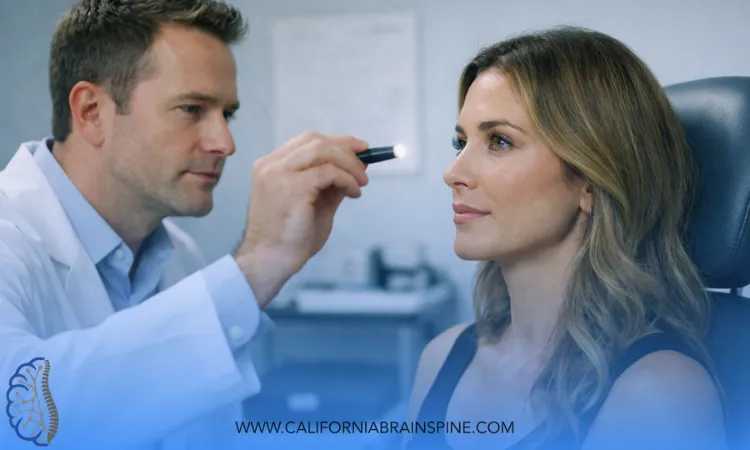
Central vs. Peripheral Vertigo
At our California Brain & Spine Center in Calabasas, I often meet patients who come in with one simple sentence: “I’ve been dizzy for weeks, and no one can tell me if it’s from my ear or from my brain.” That’s exactly the point where a clinic has to separate central vs peripheral vertigo. Getting that distinction right is the whole game — it determines whether we can treat you with office-based maneuvers and vestibular rehabilitation, or whether we should be thinking about imaging, neurology referral, or even ruling out stroke. Modern clinics can’t treat all dizziness the same way anymore, so the modern vertigo clinic workflow always begins with this question: is this central, or is this peripheral?
In this article I’ll explain how we approach central vs peripheral vertigo in a real, non-invasive neurology and vestibular setting, which clinical features make us more cautious, and when central vertigo needs neuroimaging or neurology referral rather than simple repositioning maneuvers. I’ll also show you what good management of peripheral vertigo in clinic looks like, because a lot of people in Southern California are living with fixable BPPV but haven’t had it treated correctly.
Why the Distinction Matters
When you put “dizziness” or “vertigo” into search engines, you get everything from inner-ear crystals to brain tumors. That’s not helpful for patients. Clinically, though, the split between central vs peripheral vertigo is very practical:
- Peripheral vertigo = problem in the inner ear or vestibular nerve (BPPV, vestibular neuritis, Meniere’s, post-infectious vestibular loss). Often episodic, often triggered, often treatable.
- Central vertigo = problem in the brainstem, cerebellum, or central vestibular pathways (stroke, demyelination, migraine variants, lesions). Often accompanied by other neuro signs, sometimes urgent.
So the whole point of a modern vertigo clinic workflow is to figure out which bucket you fall into as fast as possible so we don’t waste time or miss something serious.
Clinical Features of Central Vertigo vs Peripheral
There are classic differences — they’re not perfect, but they’re very useful. Here are the clinical features of central vertigo vs peripheral that we teach patients:
Peripheral vertigo tends to:
- Be clearly triggered by head position (rolling in bed, looking up)
- Cause spinning vertigo that’s intense but short
- Come with ear symptoms sometimes (fullness, tinnitus, hearing change)
- Produce nystagmus that fatigues or resolves
- Improve with canalith repositioning or vestibular rehab
Central vertigo tends to:
- Be less positional, or only slightly affected by head position
- Be accompanied by other neurological problems (double vision, ataxia, slurred speech, weakness)
- Produce nystagmus that does not fatigue, can be vertical or direction-changing
- Not improve with typical BPPV maneuvers
- Be more likely to need imaging — this is when central vertigo needs neuroimaging or neurology referral
So if a patient in our Calabasas clinic tells me, “I roll over and the room spins for 10 seconds, and then I’m fine,” I’m thinking peripheral. If they tell me, “I’m dizzy just sitting still and I can’t walk straight,” I’m thinking central until proven otherwise.
The Modern Vertigo Clinic Workflow
A lot of old-school approaches just said “vertigo = ear.” That’s not enough anymore. A modern vertigo clinic workflow — the kind we follow — goes like this:
- History first: onset, duration, triggers, ear symptoms, migraine history, recent infections, trauma, cardiovascular risk.
- Screen for central signs: trouble speaking, facial asymmetry, limb weakness, severe ataxia, vertical or direction-changing nystagmus.
- Bedside vestibular tests: positional tests (Dix–Hallpike, roll test), head impulse, gaze holding.
- Decide on pathway:
- Clear BPPV → do repositioning → vestibular rehab if needed.
- Likely peripheral but not BPPV → medical + vestibular rehab.
- Atypical, severe, or central signs → when central vertigo needs neuroimaging or neurology referral.
- Reassess: peripheral cases should improve in days–weeks; central causes may need longer, multidisciplinary care.
This structure lets us treat the people who can be fixed quickly — management of peripheral vertigo in clinic — without delaying care for the people who need a neurologist.
Management of Peripheral Vertigo in Clinic
When the diagnosis is peripheral, treatment can be very effective. In fact, this is one reason we tell patients not to live with vertigo for months. Management of peripheral vertigo in clinic usually includes:
- Canalith repositioning maneuvers for BPPV (posterior, horizontal, or anterior canal)
- Education on avoiding the provoking positions for a short period
- Vestibular rehabilitation to retrain balance, gaze stability, and head movement tolerance
- Follow-up to make sure it didn’t convert to another canal
- For some, dietary or migraine management if Meniere’s or vestibular migraine is suspected
Peripheral problems are where a clinic like ours can get you better fast — but only when we’re sure it’s not central. That’s why we insist on starting with central vs peripheral vertigo as the first decision.
When Central Vertigo Needs Neuroimaging or Neurology Referral
This is the part patients really want to know — “when should I worry?” We consider these scenarios clear indications of when central vertigo needs neuroimaging or neurology referral:
- New vertigo with double vision, slurred speech, facial droop, or limb weakness
- Severe imbalance — the patient cannot stand or walk without support
- Nystagmus that is vertical, purely torsional, or changes direction with gaze
- Sudden vertigo in an older patient with vascular risk factors
- Vertigo that does not match any typical peripheral pattern and does not respond to appropriate maneuvers
- Vertigo after head trauma with progressive symptoms
- Vertigo with new hearing loss on one side (to rule out retrocochlear pathology)
In those cases, we don’t just keep doing maneuvers. We explain to the patient that based on the principles of central vs peripheral vertigo, their case falls on the central-suspicious side, and we help coordinate imaging or neurology care. Missing a posterior circulation stroke is not an option.
What About Migraine-Related Vertigo?
Vestibular migraine is a funny in-between. It’s technically a central process, but it often behaves like a recurring peripheral one. In our California population, we see a lot of this — younger women, stress, screens, hormonal triggers. For them, central vs peripheral vertigo still matters because it tells us: the ear is fine, the brain’s processing is sensitive. These patients usually need a mix of trigger management, vestibular rehab, and sometimes autonomic support. They don’t necessarily need MRI every time, but they do need a clinic that recognizes central features.
Why This Matters for Patients in California
People in Calabasas and greater Los Angeles are very active — driving, screens, work, travel. A lingering vestibular problem affects all of that. If you’ve already been to an urgent care that said “it’s vertigo,” but you still don’t know which kind, this is the moment to get a real vestibular/neurology assessment. A proper modern vertigo clinic workflow saves you from endless symptomatic meds and actually puts you on the right treatment pathway.
Local CTA (Calabasas / Southern California)
If you are in Calabasas, elsewhere in Los Angeles County, or you can travel to us from Southern California, and you still don’t know whether your dizziness is inner-ear or brain-based, we can evaluate you. At California Brain & Spine Center we look specifically at central vs peripheral vertigo, we run positional and vestibular tests, and when we see central red flags we tell you — clearly — that this is a case when central vertigo needs neuroimaging or neurology referral. If it’s peripheral, we start management of peripheral vertigo in clinic right away so you don’t keep losing days to spinning.
You can explore our vestibular rehabilitation, post-concussion, and dysautonomia-related services at https://californiabrainspine.com/ — our team will build the non-invasive plan that fits your exact presentation.
Summary
- The very first decision in dizziness care is central vs peripheral vertigo.
- Peripheral vertigo is common and very treatable — that’s where management of peripheral vertigo in clinic works best.
- Central vertigo is less common but more serious — these are the cases when central vertigo needs neuroimaging or neurology referral.
- A modern vertigo clinic workflow makes this distinction early, so patients don’t get stuck in the wrong pathway.
- Our Calabasas clinic does exactly this for patients from California and those who travel to us for unresolved dizziness.
FAQs
1. How do I know if my vertigo is central or peripheral?
You can’t always tell on your own, but patterns help. Position-triggered, brief spinning is often peripheral. Vertigo with other neurological symptoms is more suspicious for central. That’s why clinics start with central vs peripheral vertigo as the main filter.
2. Do I always need an MRI for vertigo?
No. Only atypical, severe, or neurologically complicated cases are the ones when central vertigo needs neuroimaging or neurology referral. Typical BPPV does not.
3. Can peripheral vertigo turn into central vertigo?
They are different sources. Peripheral problems don’t “become” central, but a person can coincidentally develop a central problem later. That’s why worsening or changing symptoms should be re-evaluated using the same central vs peripheral vertigo logic.
4. What if my vertigo got better with maneuvers but then came back?
That’s common with BPPV. It still fits the peripheral side, and repeated management of peripheral vertigo in clinic plus vestibular rehab can help reduce recurrences.
5. Can post-concussion patients have both?
Yes. After a concussion, the brain, neck, and vestibular systems can all be involved. In those cases we still run through the modern vertigo clinic workflow to rule out dangerous central causes and then treat the vestibular/cervical pieces through non-invasive rehab at https://californiabrainspine.com/.