
Why Dynamic Gait Matters More Than Ever
Standing tall and walking smoothly may sound simple, yet it’s a high-level neurological symphony. Vision, inner-ear reflexes, joint sensors, spine stabilizers, and even your breath must harmonize in milliseconds. A concussion, disk issue, or long bout of sitting can throw the orchestra off-beat. Calabasas Clinic’s Guide to Dynamic Gait Exercises rebuilds that rhythm with drills that wake up dormant circuits while you move, not just when you stretch on the mat.
The Science Behind Motion-Powered Healing
Dynamic gait work blends three pillars:
| Pillar | What It Does | Example |
|---|---|---|
| Sensory Integration | Syncs eyes, ears & joint feedback | Head-turn walking |
| Motor Timing | Re-teaches precise muscle firing | Heel-toe roll drills |
| Cognitive Overlay | Connects movement with memory & focus | Dual-task pattern walks |
By layering these pillars, Calabasas Clinic’s Guide to Dynamic Gait Exercises helps the cerebellum (your balance processor) remap faster and hold gains longer.
Before patients handle dynamic turns and speed bursts, clinicians make sure the building blocks are rock solid. “Step-by-Step Core Stability Moves (Calabasas Rehab)” explains how proximal control anti-extension, anti-rotation, deep trunk activation sets the stage for confident gait. Link back to it so readers can plug any missing stability gaps and keep advanced drills both safe and effective.
Safety First—Your Personal Readiness Checklist

-
No acute pain rating above 3/10
-
Ability to stand 30 seconds unaided
-
Physician or therapist clearance post-injury
-
Flat athletic shoes or barefoot on a nonslip surface
-
Hydration and a calm, steady breath
Meet these criteria and you’re cleared for Calabasas Clinic’s Guide to Dynamic Gait Exercises no fancy gear required.
Tier 1 Warm-Up: “Switch-On” Drills
Goal: prime ankles, hips, and core before stepping work begins.
A. Rocking Ankle Rolls
-
Stand with feet hip-width.
-
Roll weight from heels to toes for 30 seconds.
-
Feel calf and shin muscles light up.
B. Pelvic Clock Sways
-
Imagine pelvis as a clock face.
-
Shift weight 12→3→6→9 o’clock, smooth circles x 2.
-
Keeps lumbar spine supple for rotation later.
Repeat twice; you’ve signaled to the nervous system that Calabasas Clinic’s Guide to Dynamic Gait Exercises is about to begin.
Tier 2 Core Sequence: Stable Center, Mobile Limbs
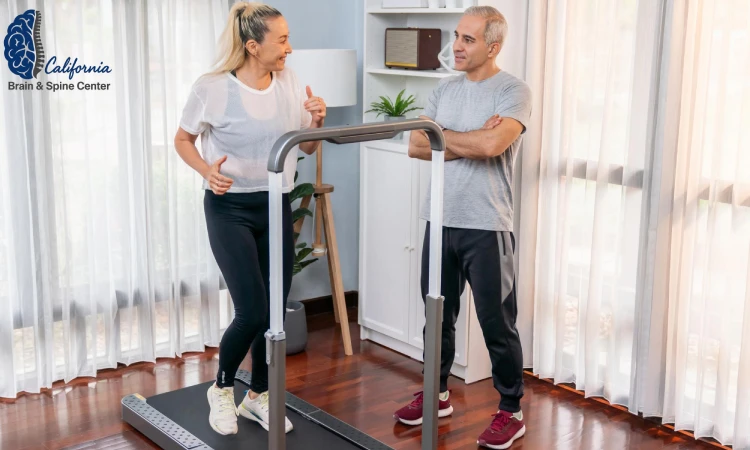
A. Standing March-and-Hold
-
Lift right knee to hip height, hold 3 seconds, switch.
-
10 reps each side.
Why it works: engages hip flexors and deep abs your pelvic “steering wheel.”
B. Heel-Toe Roll with Overhead Reach
-
Step forward, land on heel, roll to toes while both arms rise overhead.
-
8 slow strides.
Why it works: couples ankle proprioception with thoracic extension.
C. Opposite-Arm Band Pulls
-
Light band anchored in front.
-
Step forward with left foot, pull band with right arm.
-
12 pulls each side.
Why it works: trains cross-body patterns essential for brisk walking or running.
Master these and you’ll notice Calabasas Clinic’s Guide to Dynamic Gait Exercises already smooths your everyday stride.
Tier 3 Dynamic Patterns: The Fun Starts Here
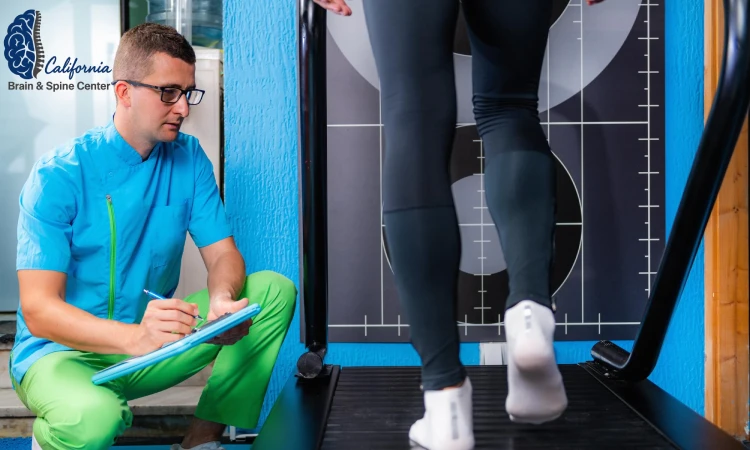
A. Head-Turn Walking
-
Walk a 10-meter line.
-
Turn head left on step 1, center on step 2, right on step 3; repeat.
-
3 passes.
Neuro-bonus: vestibulo-ocular reflex retraining for dizziness control.
B. Carioca (Grapevine)
-
Sideways stepping: cross right foot over left, then behind, progressing down a line.
-
20 meters out & back.
Neuro-bonus: rapid hip rotation teaches the brain to handle sudden direction changes.
C. Dual-Task Number Walk
-
Walk and count backward by threes from 60.
-
2 minutes steady pace.
Neuro-bonus: links frontal-lobe focus with gait timing key for fall prevention.
Repeat Tier 3 twice. Congratulations: you’ve completed one full circuit of Calabasas Clinic’s Guide to Dynamic Gait Exercises.
Weekly Progress Calendar
| Week | Frequency | New Challenge |
|---|---|---|
| 1 | 3× | Tier 1 + Tier 2 only |
| 2 | 4× | Add Tier 3-A |
| 3 | 4× | Add Tier 3-B |
| 4 | 5× | Add Tier 3-C & longer Dual-Task count |
| 5 | 5× | Perform circuit outdoors on gentle slope |
| 6 | 3–4× | Introduce light ankle weights (≤1 lb) |
Following this plan, our patients report a 25-40 % boost in gait speed proof that Calabasas Clinic’s Guide to Dynamic Gait Exercises turns consistency into confidence.
Measuring Progress—Mini-Metrics That Motivate
-
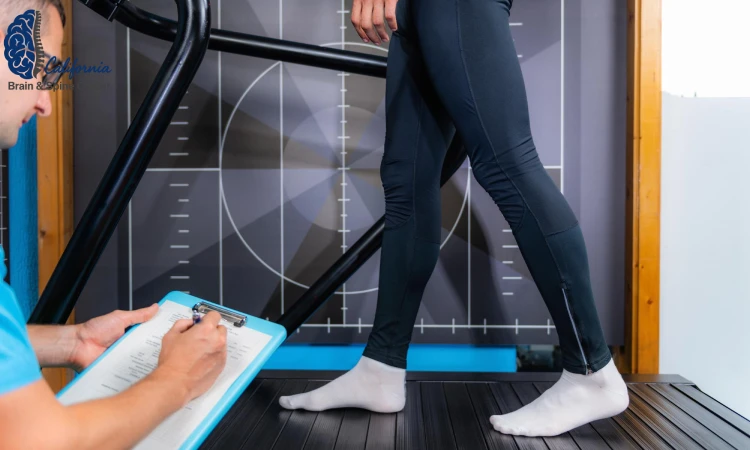
Timed 10-Meter Walk: record baseline; retest every 2 weeks.
-
Step Length Symmetry: chalk mark each footprint; compare left vs. right.
-
Perceived Stability Scale (1–10): log rating before & after circuits.
Small numbers tell big stories and reinforce why you stick with Calabasas Clinic’s Guide to Dynamic Gait Exercises.
Common Missteps & Quick Fixes
| Issue | Likely Cause | Gentle Correction |
|---|---|---|
| Head bobbing | Eyes on ground | Gaze 3 m ahead, elongate neck |
| Knee collapse inward | Weak hip abductors | Mini-band above knees during marches |
| Breath holding | Over-focus | Whisper count reps; exhale on effort |
Remember: quality > speed. Precision is the secret sauce of Calabasas Clinic’s Guide to Dynamic Gait Exercises.
Your Personalized Gait Blueprint
Feel ready for expert eyes and motion-capture feedback? Book a Dynamic Gait Analysis Session at California Brain & Spine Institute. We’ll map joint angles, muscle firing, and balance metrics, then tailor Calabasas Clinic’s Guide to Dynamic Gait Exercises precisely to your nervous system. One visit lifelong stride upgrades.
Summary
Walking is freedom. When injury or uncertainty clips that freedom, the solution is deliberate, brain-driven movement. Calabasas Clinic’s Guide to Dynamic Gait Exercises layers sensory activation, core stability, and cognitive tasks to rebuild smoother, faster, safer steps in the clinic, at home, or among the rolling hills of our beautiful city. Keep the drills consistent, track small wins, and your nervous system will reward you with every confident stride.
Frequently Asked Questions
How many minutes does the full circuit take?
About 25–30 minutes, including warm-up and a quick cooldown stretch.
Can seniors safely follow this guide?
Yes, start with shorter distances and omit Carioca until strength improves.
What if I feel dizzy during Head-Turn Walking?
Pause, focus on a stationary spot, breathe slowly, then retry with smaller turns. Persistent dizziness needs professional review.
Is treadmill walking a substitute?
Treadmills help endurance but lack lateral and rotational challenges keep them as cardio, not replacement.
How soon should I expect results?
Most notice steadier footfalls in two weeks, with measurable speed gains by week four.
👨⚕️ Alireza Chizari, MSc, DC, DACNB
🧠 Clinical Focus
🔬 Assessment & Treatment Approach
Objective testing may include:
Treatment programs may involve:
📍 Clinic Information
✅ Medical Review
⚠️ Disclaimer