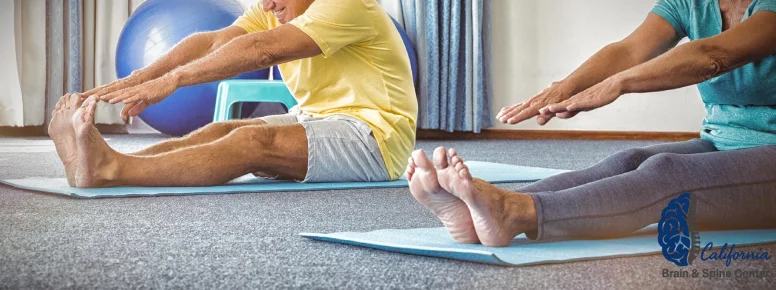
Why “Sitting Still” Is Actually a Moving Experience
When life hands you a concussion, spinal strain, or flare-ups of dizziness, the idea of standing on an unstable surface can feel as distant as summiting Everest. Seated Balance Workouts for Neurological Recovery bridge that gap. By challenging the tiny stabilizer muscles of your trunk, hips, eyes, and inner-ear reflexes—while you remain firmly planted on a chair—they rebuild the brain’s sense of “where am I?” without the fear of falling. That is exactly why Calabasas patients love them: you can train in your living room, at a shaded picnic table in Juan Bautista de Anza Park, or in the comfort of our clinic studio, and still make measurable neuroplastic gains.
The Neuro-Balance Connection in Everyday English
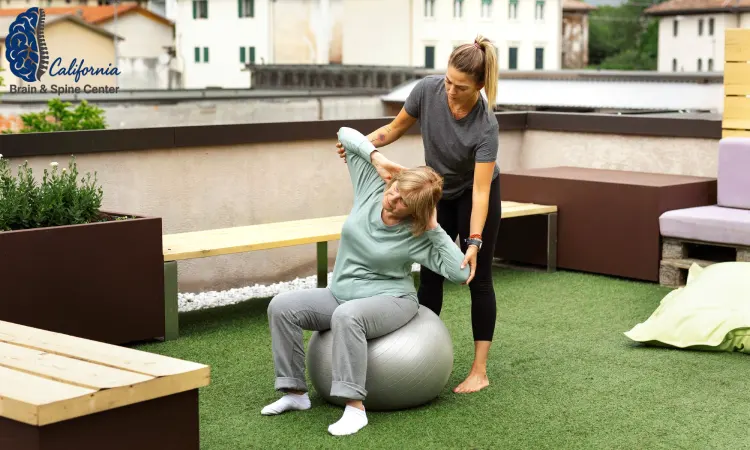
Balance isn’t one skill; it’s a committee. Your eyes, inner-ear canals, skin sensors, neck receptors, and deep core muscles send electrical “votes” to the cerebellum several hundred times per second. An injury drops static on that line, and the brain digs its heels in, producing stiffness and anxiety. Seated Balance Workouts for Neurological Recovery act like a Wi-Fi booster: they clarify the signal by forcing small, safe perturbations that awaken dormant circuits. Within weeks the brain upgrades its software, and movement feels smooth again.
Safety First—Your Green-Light Checklist
Stable chair with no wheels, ideally one you can place against a wall.
Flat shoes or barefoot on a nonslip surface.
Symptom barometer: Stop if dizziness climbs above 4/10 or vision blurs.
Hydration and calm breathing—sip water, exhale longer than you inhale.
With these guardrails in place, you’re ready to explore the world of Seated Balance Workouts for Neurological Recovery.
Progressive Circuit: From Wake-Up to Wow
| Tier | Exercise | How to Perform | Reps × Sets | Brain Cue |
|---|---|---|---|---|
| A | Shoulder Blade Slides | Sit tall, palms on thighs; glide shoulders forward & back. | 10 × 2 | “Slide magnets, don’t shrug.” |
| A | Seated Pelvic Rock | Hands on hips; tilt pelvis ant-post slowly. | 8 cycles | “Pour water forward, then backward.” |
| B | Eyes-Fixed Head Turns | Thumb at arm’s length; eyes on thumb, rotate head side to side. | 10 × 2 | “World stays still, head moves.” |
| B | Single-Leg March Hold | Lift right knee 10 cm, hold 5 s; alternate. | 8 each | “Zip up core, balance candle.” |
| C | Opposite Arm/Leg Reach | Lift right knee; reach left arm overhead; hold 3 s. | 6 each | “Grow tall through crown.” |
| C | Band-Resisted Trunk Twist | Band anchored to left; hold handle at chest; rotate right, resist return. | 8 each | “Move ribs, keep hips.” |
Perform Tier A for the first week, add Tier B in week 2, and graduate to Tier C by week 4. This “stacking” method keeps the nervous system curious and engaged—an essential ingredient in Seated Balance Workouts for Neurological Recovery.
Chair-based drills are a powerful bridge, but they shouldn’t become a ceiling. When symptoms calm and confidence rises, transition to the upright routine in “Balance-Boosting Exercises for Concussion Recovery.” That page walks you through safe progressions narrow bases, head turns, dual-tasking that rebuild standing balance without guessing. Link it here so readers know exactly when and how to graduate from seated work.
Breathing, Vision, and Vibration—The Hidden Multipliers
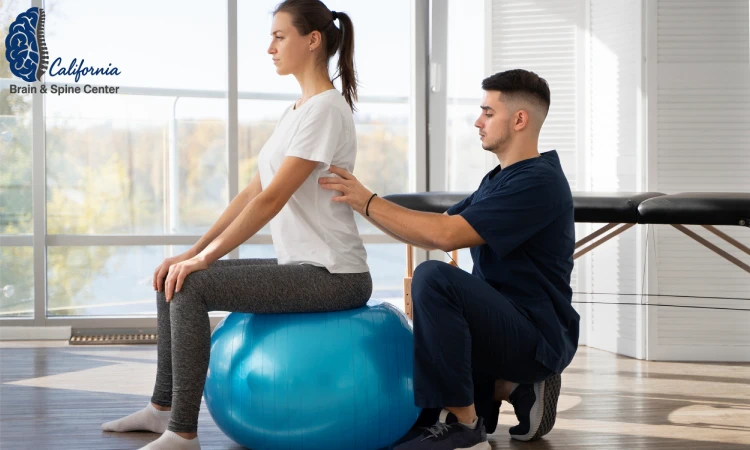
Breathing: Pair every effort phase with a long, controlled exhale. Carbon dioxide rise nudges the vagus nerve, calming overactive fight-or-flight reflexes.
Vision: Change focal distance—thumb, then wall clock, then distant tree—to integrate depth cues.
Vibration: Place a folded towel under one sit-bone for asymmetric input; the brain loves variety.
Layering these subtleties turns simple chair drills into next-level Seated Balance Workouts for Neurological Recovery.
The Calabasas Twist: Outdoor Upgrades

Terrace Terrace: Use the low stone wall at Gates Canyon Park as your “chair” for fresh-air circuits.
Stream-Side Sound Cues: Close your eyes near Las Virgenes Creek; let the flowing water guide right–left awareness.
Sunset Visual Tracking: Follow a slow-moving cloud with head still, eyes only—a relaxing vestibulo-ocular challenge.
Nature adds textures, sounds, and light shifts impossible to replicate indoors, making Calabasas the perfect backdrop for Seated Balance Workouts for Neurological Recovery.
Common Pitfalls and Simple Fixes
| Pitfall | Why It Happens | Quick Fix |
|---|---|---|
| Slouching mid-set | Fatigued core | Shorten set, add lumbar pillow |
| Breath-holding | Over-focus | Whisper counting as you move |
| Knee knocking inward | Weak hip abductors | Light resistance band above knees |
| Neck tension | Looking down | Gaze straight ahead, chin nod 5° |
Awareness beats intensity—always. Remember, the goal of Seated Balance Workouts for Neurological Recovery is precision, not perspiration.
Tracking Your Wins—Small Numbers, Big Motivation
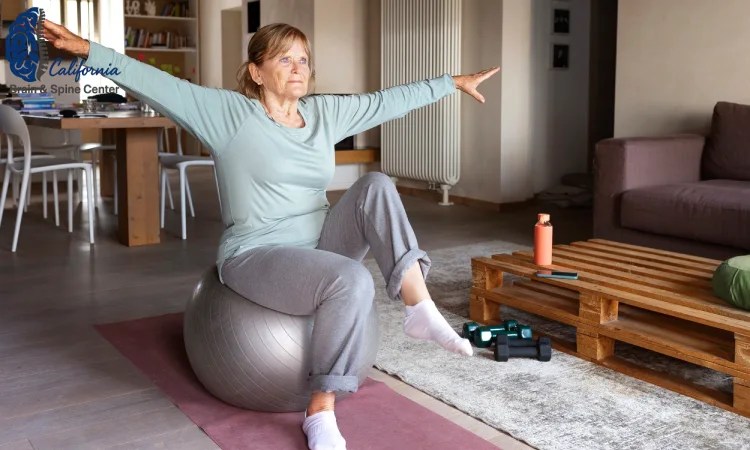
Sway Time: How long you can hold the Single-Leg March Hold without tapping down.
Head-Turn Smoothness: Mirror test—less facial grimace means better vestibular calm.
Symptom Diary: Rate dizziness or fatigue before and after each session; watch the numbers drop over two weeks.
Data turns “I guess I’m better” into “Wow, look at the chart!”—a secret sauce for sticking to Seated Balance Workouts for Neurological Recovery.
Your Personalized Balance Blueprint
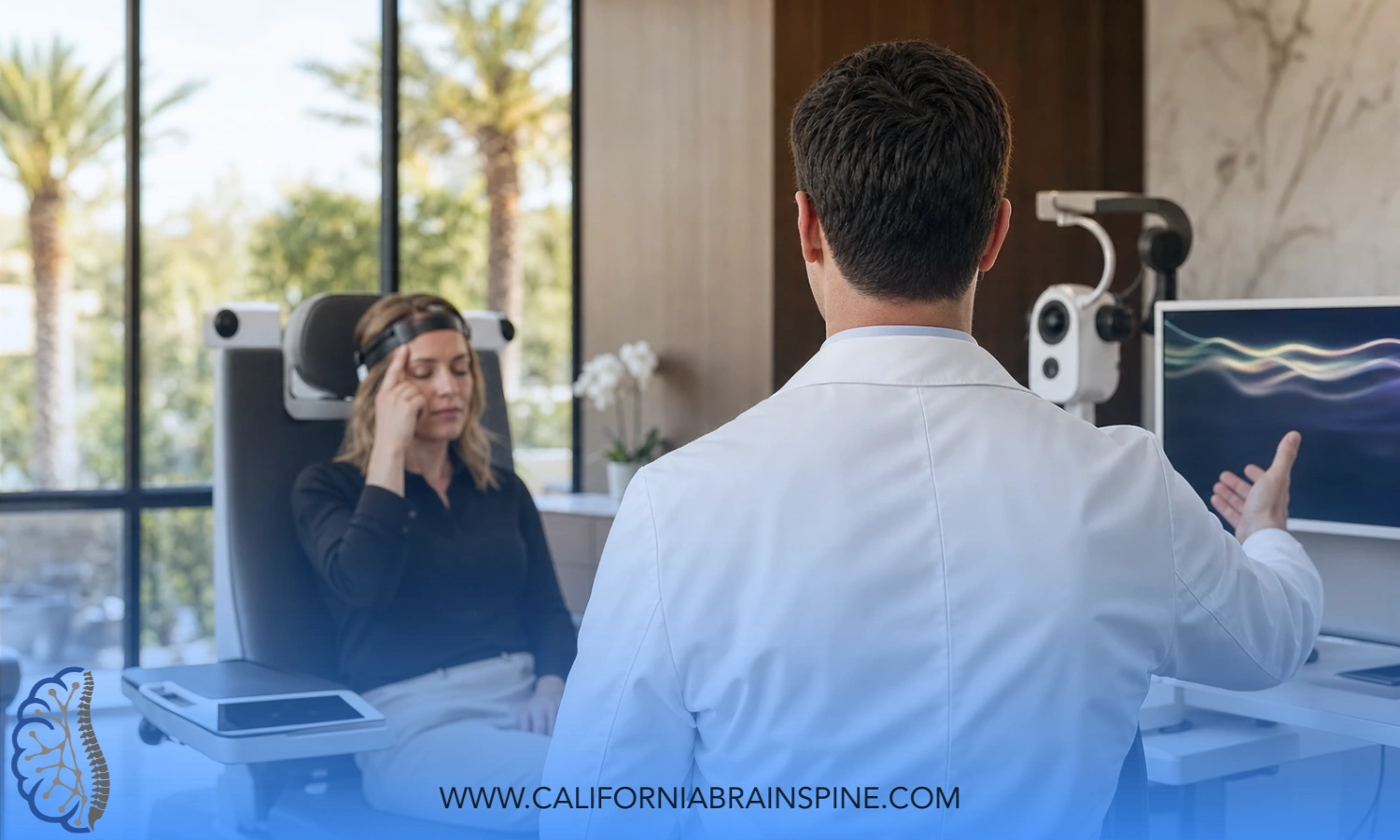
If you crave expert eyes and biofeedback tech, schedule a Seated Neuro-Balance Evaluation at California Brain & Spine Institute. We’ll map your trunk muscle timing with surface EMG, test eye–head coordination on our laser-guided tracker, and send you home with a video program tailored to your unique nervous system. In short, we supercharge your Seated Balance Workouts for Neurological Recovery so every rep counts twice.
Summary
Chair doesn’t mean passive; it means controlled. By practicing Seated Balance Workouts for Neurological Recovery three to four times a week, you teach your brain to trust movement again, expand lung capacity, and lay the groundwork for standing and dynamic drills down the road. With Calabasas’ parks as your playground and a supportive clinical team nearby, the journey from wobble to wow is only a seated step away.
Frequently Asked Questions
- How many weeks before I transition to standing balance drills?
Most patients see solid seated mastery in four to six weeks. Your clinician will green-light standing work once core endurance and symptom stability meet target scores. - Can seniors or kids use these routines?
Absolutely. We adjust hold times and resistance for age and ability. The principles of Seated Balance Workouts for Neurological Recovery—small perturbations, clear breathing, steady progression—apply to all brains. - What if I don’t have exercise bands?
A water bottle, small dumbbell, or even a rolled-up towel can serve as load. Creativity often boosts engagement. - I get mild nausea during head-turn drills; should I stop?
Pause, breathe, sip water, and retry with a smaller range. Gradual exposure is key; persistent moderate symptoms warrant professional review. - Do I need a special chair?
A simple, armless dining chair on a nonslip surface works fine. Stability trumps fancy features.
👨⚕️ Alireza Chizari, MSc, DC, DACNB
🧠 Clinical Focus
🔬 Assessment & Treatment Approach
Objective testing may include:
Treatment programs may involve:
📍 Clinic Information
✅ Medical Review
⚠️ Disclaimer