Antisaccades in Parkinson’s Disease and Motor Control
- Published
- No Comments
- Updated September 17, 2026
An antisaccade is a deceptively simple eye-movement task: a target appears on one side, and you must deliberately look the other way. Researchers use that tiny movement to study inhibition, voluntary motor control and executive function in Parkinson's disease.
I am Dr. Alireza Chizari, DC, DACNB, at California Brain & Spine Center in Calabasas. This article is intentionally educational. It explains what researchers mean by antisaccades in Parkinson's disease, what an antisaccade task measures, and what the current evidence can and cannot tell us.
The most important boundary comes first: an antisaccade test does not diagnose Parkinson's disease. Eye-movement findings overlap across neurological conditions and even vary between people with the same diagnosis. If you or a family member has new tremor, slowness, rigidity, gait changes or other Parkinsonian symptoms, diagnosis and medical management belong with a physician, usually a neurologist and often a movement-disorder specialist.
That distinction does not make antisaccades unimportant. In research, they provide a remarkably precise way to study how the nervous system suppresses an automatic response and generates an intentional one.
The short answer
- An antisaccade is an intentional eye movement away from a suddenly appearing visual target.
- The task tests response inhibition. The brain must suppress the automatic movement toward the target before generating the opposite movement.
- Research in Parkinson's disease has found higher antisaccade error rates and longer antisaccade latencies on average.
- These findings are group-level research findings, not a stand-alone diagnostic test for one individual.
- Antisaccade performance can also reflect attention, executive function, task design, medication state and other neurological factors.
- Suspected Parkinson's disease should be assessed medically. Eye tracking does not replace a neurologist or movement-disorder evaluation.
What Is the Antisaccade Definition?
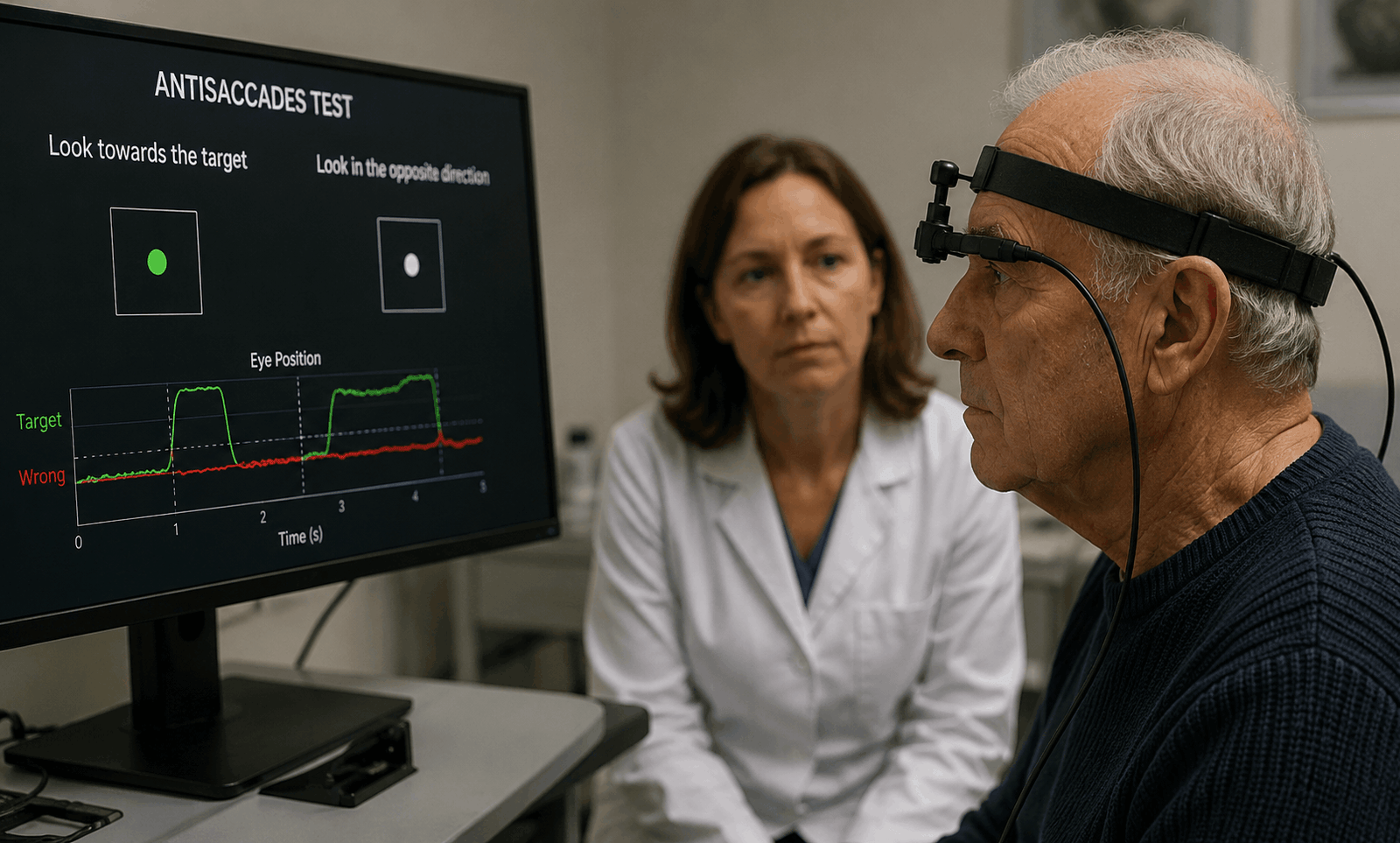
Antisaccade definition: an antisaccade is a voluntary eye movement made in the direction opposite a visual stimulus. The person must first suppress the normal reflex to look toward the stimulus, calculate the opposite direction, and then intentionally move the eyes there.
A normal reflexive gaze shift toward a new target is often called a prosaccade. If a light suddenly appears to your right, the natural response is to look right.
During an antisaccade task, the instruction changes. When that light appears on the right, you must avoid looking at it and deliberately look an equivalent distance to the left.
This adds a cognitive-control requirement that is not present in the simplest visually guided saccade.
What does the brain have to do during an antisaccade?
The nervous system must detect the stimulus, remember the task rule, inhibit the reflexive prosaccade, transform the location into an opposite spatial command, generate the voluntary movement and monitor whether the response was correct.
Research links antisaccade control with distributed networks that include frontal and parietal cortical regions, basal ganglia, superior colliculus, cerebellar circuitry and brainstem ocular-motor structures.
This is one reason the task is useful experimentally. A very small movement requires sensory detection, inhibition, spatial transformation, motor planning and execution within a short period of time.
What Is the Antisaccade Meaning in Plain English?
The simplest antisaccade meaning is: do not look where your reflex wants to look; deliberately look the other way.
That makes an antisaccade a useful laboratory model of response inhibition.
The interesting part of an antisaccade is not where the eyes end up. It is the nervous system's ability to stop the first response and replace it with the instructed one.
That ability is relevant far beyond eye movement. Human movement constantly requires suppression and selection. We stop one action, choose another, correct errors and change behavior as the environment changes.
However, the antisaccade task should not be interpreted as a miniature diagnostic version of every real-world movement. It is a controlled experimental paradigm that gives researchers a relatively precise way to investigate inhibitory and voluntary motor processes.
Why Are Antisaccades Studied in Parkinson's Disease?
Parkinson's disease affects neural networks involved in movement as well as cognitive and executive processes. Because basal-ganglia circuits contribute to action selection and inhibition, researchers have long been interested in whether ocular-motor tasks can provide measurable information about those networks.
A meta-analysis specifically examining antisaccades in Parkinson's disease found that people with Parkinson's had, on average, increased antisaccade error rates and longer antisaccade latency compared with control participants. The PubMed meta-analysis can be reviewed here.
The same analysis found that greater motor disease burden was associated with increased antisaccade latency. Importantly, the researchers described antisaccade latency as a potential marker requiring further longitudinal confirmation, not a validated diagnostic replacement for clinical examination.
What is an antisaccade error?
An error commonly occurs when the participant initially looks toward the visual target even though the rule says to look away from it.
In research terminology, the reflexive response has not been successfully inhibited before the voluntary response is generated.
Error rate can therefore provide information about response inhibition, but it is not specific to Parkinson's disease. Antisaccade abnormalities have been investigated in numerous neurological and psychiatric conditions.
What does antisaccade latency mean?
Latency describes the time between presentation of the stimulus and initiation of the eye movement.
Longer latency can indicate that more time was required to process the task and initiate the voluntary response. In Parkinson's research, increased antisaccade latency has been reported at the group level.
That does not mean one slow antisaccade proves bradykinesia or Parkinson's disease. Individual latency depends on many variables, including age, attention, task parameters, equipment and experimental design.
What Does the Antisaccade Test Measure?
An antisaccade test can produce several measurements rather than a single pass-or-fail result.
| Measurement | What it describes | What it does not prove |
|---|---|---|
| Error rate | How often the eyes initially move toward the stimulus instead of away from it | That Parkinson's disease is present |
| Latency | How long it takes to initiate the instructed eye movement | The cause of a slow response in one individual |
| Amplitude | How far the eyes travel relative to the intended target location | A specific neurological diagnosis by itself |
| Accuracy | How closely the eye movement reaches the intended location | That a movement disorder is confirmed |
| Error correction | Whether and how quickly an incorrect first movement is recognized and corrected | A complete measure of executive function |
| Trial variability | How consistent performance is across repeated attempts | That inconsistency has one specific neurological cause |
Why do researchers measure more than one variable?
Two people can have the same overall number of correct responses while completing the task in very different ways.
One participant may be consistently slow but accurate. Another may react quickly but make more direction errors. Someone else may make an incorrect first movement and immediately correct it.
Those patterns can support research into different components of inhibitory and motor control, but they still require careful interpretation.
What Do Antisaccade Errors Mean in Parkinson's Disease Research?
At the group level, increased errors are commonly interpreted as evidence of greater difficulty suppressing the automatic prosaccade response.
This is relevant because Parkinson's disease involves networks that include the basal ganglia and frontal circuitry involved in motor selection, inhibition and executive control.
A 2024 review in Trends in Neurosciences summarized decades of research on ocular-motor abnormalities in Parkinson's disease and emphasized the potential of eye movements for studying disease mechanisms and symptom burden. It also made an important clinical point: current eye-movement measures do not have sufficient sensitivity and specificity to function as a stand-alone Parkinson's diagnostic test. Read the review on eye movements and Parkinson's disease.
Research signal does not equal diagnosis
If a research group with Parkinson's disease makes more antisaccade errors than a control group, that can be scientifically meaningful. It does not mean an individual who makes several errors has Parkinson's disease. The same distinction applies to latency, amplitude and other eye-tracking measurements.
How Are the Basal Ganglia Related to Antisaccades?
The basal ganglia are interconnected subcortical structures involved in selecting, scaling and regulating movement. Parkinson's disease is associated with degeneration of dopamine-producing neurons and altered activity across basal-ganglia circuits.
Eye movements are part of those motor systems.
During an antisaccade task, basal-ganglia circuitry interacts with cortical and midbrain networks involved in suppressing the reflexive response and allowing the instructed voluntary response to occur.
A clinical review of saccadic eye movements in Parkinson's disease describes abnormalities across several saccadic paradigms and discusses how basal-ganglia dysfunction can influence both automatic and internally generated gaze behavior. The clinical review is available through PubMed.
Does an antisaccade measure dopamine directly?
No.
Antisaccade performance is behavior generated by a network. It should not be described as a direct dopamine measurement.
Dopaminergic state can influence aspects of behavior, and medication effects have been investigated, but an eye-movement trace is not equivalent to measuring dopamine concentration or proving dopaminergic degeneration.
Are Antisaccades Related to Executive Function?
Yes, but again with an important qualification.
The antisaccade task requires the participant to hold the rule in mind, suppress a competing response, select the correct response and monitor performance. Those requirements overlap with processes commonly grouped under executive function.
Parkinson's disease can involve executive changes in addition to motor symptoms. Research has reported difficulties involving cognitive flexibility, working memory and response inhibition in some populations with Parkinson's disease.
A 2024 systematic review and neuroimaging meta-analysis examined neural alterations underlying executive dysfunction in Parkinson's disease across working memory, flexibility and response-inhibition tasks. The review can be accessed through PubMed.
Does an antisaccade error mean someone has cognitive impairment?
No.
An antisaccade task samples particular aspects of inhibitory and executive control. Cognitive assessment is much broader and may include memory, attention, language, processing speed, visuospatial abilities and other domains.
A person should not be labeled cognitively impaired because of one eye-movement task.
Can Antisaccades Diagnose Parkinson's Disease Early?
No. Antisaccades are promising research measures, but current evidence does not support using an antisaccade test alone to diagnose Parkinson's disease, rule it out, or distinguish every Parkinsonian syndrome. Parkinson's remains a clinical medical diagnosis based on history and neurological examination, with additional testing used when appropriate.
This is especially important because several eye-movement abnormalities overlap between Parkinson's disease and other neurological conditions.
A 2023 review of abnormal eye movements in Parkinson's disease described potential applications of eye tracking to diagnosis, progression and cognition, but framed these as developing biomarker applications rather than established stand-alone diagnostic tools. Review the clinical eye-movement literature here.
A 2024 systematic review of more naturalistic eye-movement tasks similarly found several recurring differences between Parkinson's groups and healthy older adults, while emphasizing inconsistencies and a lack of standardized tasks. Read the systematic review of naturalistic eye movements.
How is Parkinson's disease actually diagnosed?
Parkinson's disease is primarily a clinical diagnosis based on the patient's history, symptoms and physical neurological examination.
The Parkinson's Foundation notes that there is no single laboratory or imaging test that independently confirms Parkinson's disease in every patient. Additional tests may sometimes support the diagnosis or help exclude conditions that can mimic it. A movement-disorder specialist is a neurologist with specific expertise in Parkinson's disease and related disorders. The Parkinson's Foundation explains the diagnostic process here.
If you are concerned about possible Parkinson's disease
New resting tremor, progressive slowness, rigidity, reduced arm swing, persistent gait change, freezing, unexplained falls or another progressive movement change should be discussed with a physician. When Parkinson's disease or another movement disorder is suspected, evaluation by a neurologist or movement-disorder specialist is appropriate.
Do not use an online antisaccade exercise, eye-tracking app or this article to diagnose or exclude Parkinson's disease.
Are Antisaccades Different From Prosaccades?
Yes.
A prosaccade is generally a movement toward a visual target. An antisaccade requires the participant to suppress that movement and look in the opposite direction.
| Task | Instruction | Primary experimental demand |
|---|---|---|
| Prosaccade | Look toward the appearing target | Visually guided gaze shift |
| Antisaccade | Do not look at the target; look to the opposite side | Inhibition plus voluntary gaze generation |
| Memory-guided saccade | Remember a location, then look toward it later | Spatial memory plus internally generated movement |
| Smooth pursuit | Follow a continuously moving target | Continuous visual tracking |
| Fixation | Keep the eyes steadily on one location | Gaze stability and suppression of unwanted movements |
This distinction matters because Parkinson's disease does not affect every eye-movement paradigm in exactly the same way.
Older and newer reviews have generally found more consistent abnormalities in voluntary or internally generated saccades than in the simplest reflexive gaze shifts, although findings vary substantially by paradigm and disease characteristics. A review of eye movements in Parkinson's and inherited Parkinsonian syndromes discusses these differences.
What Other Eye Movements Are Studied in Parkinson's Disease?
Antisaccades are only one part of ocular-motor research.
Prosaccades
Researchers can measure latency, amplitude, velocity and accuracy when participants look toward a target.
A meta-analysis of visually guided saccades found that people with Parkinson's disease were, on average, slower to initiate reflexive saccades than controls, but results were heterogeneous and strongly influenced by experimental factors such as target eccentricity. Read the meta-analysis of visually guided saccades.
Smooth pursuit
Smooth pursuit allows the eyes to continuously follow a moving object. Altered pursuit has been reported in Parkinson's disease, but it is not unique to Parkinson's.
Fixation and saccadic intrusions
Researchers may also examine whether the eyes remain stable during fixation or show unwanted small movements.
Vergence
Vergence allows the eyes to move toward or away from each other when changing viewing distance. Convergence problems and other binocular visual symptoms have also been described in Parkinson's populations.
Vestibulo-ocular reflex
The vestibulo-ocular reflex helps stabilize visual targets while the head moves. It answers a different physiological question from an antisaccade task and should not be treated as interchangeable with response-inhibition testing.
A 2023 review of eye-movement monitoring in Parkinson's disease discusses saccades, fixation, convergence and other ocular-motor findings while emphasizing that the visual system can be affected in multiple ways. The review is available through PubMed.
Do Antisaccades Explain Parkinsonian Gait or Freezing?
Not by themselves.
Walking and freezing of gait are complex behaviors involving motor, sensory, cognitive and attentional networks. Eye movements and gait can interact because visual scanning and movement planning occur together, but an abnormal antisaccade should not be presented as the cause of someone's freezing or balance problem.
Recent research continues to investigate links among ocular-motor control, cognition, gait and freezing. A 2026 review describes eye movements as a research window into executive behavior, gait, freezing and neuromodulation in Parkinson's disease, while also framing many of these applications as evolving biomarker science. Read the 2026 review of eye movements in movement disorders.
Association is not a treatment target by default
If an eye-movement variable is statistically associated with gait impairment in a research population, that does not prove that training the eye movement will treat the gait impairment. Mechanistic association, diagnostic measurement and therapeutic efficacy are separate questions.
Do Dopamine Medications Change Antisaccade Performance?
Researchers have studied this question, but the answer is not simple enough to use antisaccade performance as a medication-management tool in routine consumer guidance.
The antisaccade meta-analysis found no significant effect of acute levodopa administration in the relatively small subset of studies eligible for that analysis. The authors emphasized limitations in the available evidence. The medication sub-analysis is described in the same meta-analysis.
Different ocular-motor outcomes, medication states and research designs can produce different findings.
Parkinson's medication decisions belong with the prescribing medical clinician. An eye-movement task should not be used by a patient to change medication dose or timing.
Can Antisaccade Exercises Treat Parkinson's Disease?
There is not adequate evidence to present antisaccade exercises as a treatment for Parkinson's disease. Studying an abnormal eye-movement measure does not automatically mean repeatedly practicing that same task will modify the disease or improve the patient's broader motor symptoms.
This is a major distinction from the previous version of this article.
Research may identify a measurable difference between people with Parkinson's disease and healthy controls. That establishes a possible marker or mechanistic clue. A treatment claim requires separate clinical evidence showing that an intervention meaningfully improves relevant patient outcomes.
I would therefore not tell a person with Parkinson's disease to practice antisaccades, gaze drills or visual exercises as a substitute for evidence-based medical management.
If a patient with an established medical diagnosis has a separate visual complaint, balance disorder, vestibular problem or other rehabilitation need, the appropriate professionals should determine whether targeted rehabilitation is indicated for that specific impairment.
What Can Eye Tracking Tell Researchers That Observation Alone Cannot?
Human observation is useful but limited when movements occur within tens or hundreds of milliseconds.
Eye-tracking equipment can quantify timing and position with greater precision. Researchers can compare:
- How quickly a response begins.
- Whether the first movement was in the instructed direction.
- How far the eyes moved.
- Whether a directional error was corrected.
- How performance changes across repeated trials.
- How performance differs under changing cognitive or experimental conditions.
Those quantitative measurements are valuable in research because they can reveal patterns that are difficult to characterize reliably by casual observation.
They still need context. Different laboratories may use different stimulus locations, timing rules, eye trackers, instructions and analytical definitions.
Why Isn't There One “Normal” Antisaccade Score?
Antisaccade research is highly dependent on protocol.
A result can be influenced by age, task instructions, how long the fixation point remains visible, where the target appears, the delay between trials, fatigue, attention, cognitive status and the hardware or algorithm used to identify a saccade.
This methodological variability is one reason eye-movement biomarkers remain an active research field rather than a simple diagnostic number that can be interpreted outside context.
The 2024 review of naturalistic eye-movement tasks specifically highlighted inconsistencies and lack of standardization as barriers to interpretation across studies. See the systematic review here.
An antisaccade result is a measurement produced by a task. Its meaning depends on who was tested, how the task was performed and what clinical question is being asked.
What If Someone Has Tremor, Slowed Movement, or Parkinsonian Symptoms?
This is where the boundary between an educational article and medical diagnosis matters most.
If you have unexplained tremor, slowness of movement, rigidity, reduced arm swing, progressive gait changes, freezing, falls or another symptom that raises concern for Parkinson's disease, start with appropriate medical evaluation.
A neurologist can perform a complete neurological examination. When the diagnosis is uncertain or specialized expertise is needed, a movement-disorder neurologist may provide a more focused assessment.
The National Institute of Neurological Disorders and Stroke explains that a neurological examination evaluates areas such as movement, sensation, vision, coordination, balance, mental status and medical history, with additional diagnostic testing selected according to the suspected disorder. NINDS describes neurological diagnostic evaluation here.
What if the diagnosis is not Parkinson's disease?
Eye-movement abnormalities, dizziness, balance difficulty and coordination problems can occur for many reasons. That is exactly why a single eye-movement finding should not be assigned to Parkinson's disease without a medical diagnostic process.
California Brain & Spine Center's published clinical services focus on the neurological and rehabilitation conditions listed on our Neurological Evaluation and Rehabilitation services page. This educational Parkinson's article should not be interpreted as adding Parkinson's disease diagnosis or treatment to that service list.
For example, patients whose established problem is a separate dizziness or balance disorder can read more about the clinic's Balance Disorder Therapy and Dizziness and Vertigo care. Those links describe their own clinical indications and should not be interpreted as Parkinson's treatment.
What Has Changed in Antisaccade Research More Recently?
One meaningful shift is that researchers increasingly treat eye movements as multidimensional digital measures rather than searching for one single abnormal number.
Newer studies combine multiple eye-movement features, cognitive measurements, gait findings and other disease indicators. Machine learning and portable eye tracking are also being investigated.
The 2024 Trends in Neurosciences review concluded that eye movements may ultimately be most useful when combined with other disease indicators in larger datasets rather than used as isolated diagnostic tests. Review the 2024 perspective here.
A 2026 review similarly describes emerging work connecting eye movements with cognition, gait, freezing of gait, neuromodulation and machine-learning approaches. These are important research directions, but emerging research should not be rewritten as an already established clinical diagnostic service. Read the 2026 review here.
What Should You Remember About Antisaccades in Parkinson's Disease?
The scientific value of antisaccades in Parkinson's disease is real, but it needs to be described precisely.
An antisaccade asks the brain to suppress a reflexive gaze shift and generate an intentional movement in the opposite direction. This gives researchers a measurable window into voluntary motor control, inhibition and executive processes.
Across studies, Parkinson's groups tend to show more antisaccade errors and longer latency than healthy control groups. Those differences help researchers study neural circuits and may contribute to future multidimensional biomarkers.
They do not make the antisaccade task a stand-alone Parkinson's test.
The same eye-movement abnormality can occur for more than one reason, research protocols vary, and an individual's diagnosis depends on the complete medical picture.
If Parkinson's disease is suspected, the appropriate next step is a medical neurological evaluation, not an online eye-movement exercise.
What is an antisaccade?
An antisaccade is a voluntary eye movement directed away from a visual target. The task requires the person to suppress the automatic urge to look toward the stimulus and deliberately generate a gaze shift in the opposite direction. Researchers use it to study response inhibition and voluntary motor control.
What is an antisaccade task?
In a typical antisaccade task, a participant fixates centrally until a target appears to one side. Instead of looking at the target, the participant is instructed to look toward the mirror location on the opposite side. Eye tracking can measure errors, reaction time, amplitude and correction behavior.
What does an antisaccade test show in Parkinson's disease?
Research has found higher antisaccade error rates and longer latency on average in Parkinson's disease groups compared with controls. These differences may provide information about inhibitory, executive and motor networks, but they are not specific enough to diagnose Parkinson's disease in an individual patient.
Can an antisaccade test diagnose Parkinson's disease?
No. Current reviews conclude that eye-movement measurements do not have sufficient sensitivity and specificity to function as a stand-alone Parkinson's diagnostic test. Parkinson's disease is diagnosed clinically using medical history and neurological examination, with additional testing used when the medical clinician considers it appropriate.
Why do people with Parkinson's make more antisaccade errors?
Researchers believe increased errors can reflect altered inhibitory and executive control across networks involving frontal cortical regions and basal-ganglia circuitry. However, error rates vary between patients and are influenced by task design and cognition, so an error cannot be assigned one neurological meaning in isolation.
Are antisaccade errors unique to Parkinson's disease?
No. Antisaccade abnormalities have been reported across several neurological and psychiatric conditions. This lack of disease specificity is one reason the task is valuable for studying brain function but insufficient for independently diagnosing Parkinson's disease.
Do antisaccade exercises treat Parkinson's disease?
There is not adequate evidence to present antisaccade exercises as a treatment for Parkinson's disease. A task can be useful for measuring a neurological process without being an effective treatment for the disease. Parkinson's treatment and rehabilitation decisions should be made by the appropriate medical and rehabilitation professionals.
Who should evaluate suspected Parkinson's disease?
A person with progressive Parkinsonian symptoms should seek medical evaluation. A neurologist can assess movement and neurological signs, and a movement-disorder specialist has additional expertise in Parkinson's disease and related conditions. Eye tracking, apps or antisaccade tasks should not be used to diagnose or exclude the condition at home.
Conclusion
I view antisaccades as a useful example of how much information can be hidden inside a very small movement.
The instruction sounds simple: do not look at the target; look away from it. Yet completing that instruction requires sensory processing, inhibition, spatial transformation, voluntary movement and error monitoring.
That is why antisaccades in Parkinson's disease continue to be valuable in research.
The responsible interpretation, however, is equally important. Eye movements can help scientists investigate Parkinson's-related neural circuits, but they do not replace the clinical diagnostic process and should not be used to advertise a Parkinson's treatment program that is not part of the clinic's published service scope.
For suspected Parkinson's disease or another progressive movement disorder, seek evaluation from a physician, neurologist or movement-disorder specialist.
For information about the conditions and rehabilitation services actually offered at California Brain & Spine Center, visit our Neurological Services in Calabasas page.
California Brain & Spine Center | (818) 649-5300 | Calabasas, CA 91302
This page is educational, not a Parkinson's treatment page
If Parkinson's disease or another movement disorder is suspected, a medical neurologist or movement-disorder specialist should guide diagnosis and disease-specific treatment. California Brain & Spine Center's website separately lists the neurological and rehabilitation conditions that fall within the clinic's published services.

Dr. Alireza Chizari
This article has been medically reviewed for clinical accuracy by Dr. Alireza Chizari, DC, DACNB. Committed to evidence-based practice, Dr. Chizari ensures all content reflects the highest standards of functional neurology care.
Comments
Find our article more easily in Google.
FAQ
What is Functional Neurology?
Functional Neurology is a healthcare specialty that focuses on assessing and rehabilitating the nervous system’s function. It emphasizes neuroplasticity—the brain’s ability to adapt and reorganize—using non-invasive, evidence-based interventions to improve neurological performance.
How does Functional Neurology differ from traditional neurology?
Traditional neurology often concentrates on diagnosing and treating neurological diseases through medications or surgery. In contrast, Functional Neurology aims to optimize the nervous system’s function by identifying and addressing dysfunctions through personalized, non-pharmaceutical interventions.
Is Functional Neurology a replacement for traditional medical care?
No. Functional Neurology is intended to complement, not replace, traditional medical care. Practitioners often collaborate with medical professionals to provide comprehensive care.
What conditions can Functional Neurology help manage?
Functional Neurology has been applied to various conditions, including:
• Concussions and Post-Concussion Syndrome
• Traumatic Brain Injuries (TBI)
• Vestibular Disorders
• Migraines and Headaches
• Neurodevelopmental Disorders (e.g., ADHD, Autism)
• Movement Disorders
• Dysautonomia
• Peripheral Neuropathy
• Functional Neurological Disorder (FND)
Can Functional Neurology assist with neurodegenerative diseases?
While Functional Neurology does not cure neurodegenerative diseases, it can help manage symptoms and improve quality of life by optimizing the function of existing neural pathways.
What diagnostic methods are used in Functional Neurology?
Functional Neurologists employ various assessments, including:
• Videonystagmography (VNG)
• Computerized Posturography
• Oculomotor Testing
• Vestibular Function Tests
• Neurocognitive Evaluations
How is a patient’s progress monitored?
Progress is tracked through repeated assessments, patient-reported outcomes, and objective measures such as balance tests, eye movement tracking, and cognitive performance evaluations.
What therapies are commonly used in Functional Neurology?
Interventions may include:
- Vestibular Rehabilitation
- Oculomotor Exercises
- Sensorimotor Integration
- Cognitive Training
- Balance and Coordination Exercises
- Nutritional Counseling
- Lifestyle Modifications
Are these therapies personalized?
Absolutely. Treatment plans are tailored to the individual’s specific neurological findings, symptoms, and functional goals.
Who can benefit from Functional Neurology?
Individuals with unresolved neurological symptoms, those seeking non-pharmaceutical interventions, or patients aiming to optimize brain function can benefit from Functional Neurology.
Is Functional Neurology suitable for children?
Yes. Children with developmental delays, learning difficulties, or neurodevelopmental disorders may benefit from Functional Neurology approaches.
How does Functional Neurology complement other medical treatments?
It can serve as an adjunct to traditional medical care, enhancing outcomes by addressing functional aspects of the nervous system that may not be targeted by conventional treatments.
How is technology integrated into Functional Neurology?
Technological tools such as virtual reality, neurofeedback, and advanced diagnostic equipment are increasingly used to assess and enhance neurological function.
What is the role of research in Functional Neurology?
Ongoing research continues to refine assessment techniques, therapeutic interventions, and our understanding of neuroplasticity, contributing to the evolution of Functional Neurology practices.