Why dizziness can linger months after a head injury, what may be behind it, and how each possible source is checked.
Dizziness after concussion can last longer than most people expect. It is one of the most frequently reported concussion symptoms, it can take days to weeks to settle, and in some people it may last six months or longer, even after the other symptoms have eased, according to a study in Physical Therapy in Sport.
I am Dr. Alireza Chizari, DC, DACNB, a Board-Certified Functional Neurologist, and at California Brain & Spine Center in Calabasas I look at concussion dizziness through functional neurology: how the inner ear, the eyes, the neck and the autonomic nervous system are working together after the injury.
You may be weeks or months out from the injury, back at work, and still unsteady in a crowded store or when you turn your head to check a lane on the 101. Your scans may have come back normal. A normal scan does not show which balance system is involved, and testing each one does, which is where I begin with concussion treatment at the practice.
Key Takeaway
Dizziness after concussion is one of the most frequently reported concussion symptoms. It can take days to weeks to settle, and in some people it may last six months or longer. It may be associated with the inner ear, eye-movement and balance processing, the neck or the autonomic nervous system. Past 10 days, consensus guidance recommends targeted rehabilitation.
Can a Concussion Cause Vertigo Months Later?
Yes, in some people. Dizziness, including vertigo, may last six months or longer after a concussion, even after the other symptoms have settled. Months later, the cause can be one of several, each tested differently: displaced inner-ear crystals, eye-movement and balance processing, the neck, the autonomic nervous system, or persistent postural-perceptual dizziness (PPPD).
Why Dizziness Can Outlast the Other Symptoms
Vestibular and eye-movement (oculomotor) problems are commonly seen in the days to weeks after a concussion, and the same study notes that they are associated with developing persisting concussion symptoms. That is one reason dizziness can still be present after the headache has faded.
Researchers describe post concussion dizziness as complex and multifactorial. It may be associated with the vestibular and eye-movement systems, with the neck, or with both at once, so finding one problem does not rule out a second.
How Long Does Dizziness Usually Last After a Concussion?
The CDC notes that most people with a concussion recover quickly and fully, but for some, symptoms can last days, weeks or longer. Dizziness on its own can take days to weeks to settle, and some people may still notice it at six months.
Elapsed time is also a guide to the next step. The international consensus statement on concussion in sport, from the international conference in Amsterdam and published in the British Journal of Sports Medicine, recommends cervico-vestibular rehabilitation (exercises aimed at reducing symptoms and improving function) for people with dizziness, neck pain or headaches lasting more than 10 days.
What Does Dizziness After Concussion Feel Like?
Dizziness after concussion is a feeling of spinning (vertigo), lightheadedness, imbalance or motion sensitivity that follows a head injury. You may notice more than one of these, which fits research describing the symptom as multifactorial.
Vertigo after concussion is the sense that you or the room is moving. Lightheadedness sits closer to feeling faint. Imbalance shows up on your feet, on stairs or on uneven ground, and motion sensitivity can show up in a car or a busy aisle. These feel different because they can come from different systems, and the kind you describe is the first clue to which one.
The detail that helps most
In my experience, what sets the dizziness off tells me more than the word you use for it. Brief spinning that starts with a change of head position can suggest displaced inner-ear crystals. Lightheadedness on standing, with poor tolerance for exercise, can point toward the autonomic nervous system. Dizziness on most days that worsens when you are upright or in busy visual places fits the pattern of PPPD.
Why Does a Concussion Cause Dizziness?
A concussion can cause dizziness through several routes: the inner ear, the brain's processing of balance and eye-movement signals, the neck, and the autonomic nervous system. These routes can overlap in the same person.
Displaced Inner-Ear Crystals (BPPV)
A concussion can shift the tiny calcium crystals (otoconia) in the inner ear. When they move out of place, the brain receives mixed signals, and brief spinning spells can follow a change in head position, usually lasting less than a minute. This is benign paroxysmal positional vertigo, or BPPV.
BPPV after a concussion is commonly treated with precise repositioning maneuvers that guide the displaced crystals back into place. Testing comes first, because the maneuver depends on which part of the inner ear is involved.
Vestibular and Eye-Movement Processing
The brain's own balance and eye-movement processing can be part of the picture as well. Specialists at Stanford Medicine describe post-concussive dizziness as coming from a combination of vestibular dysfunction in the brain and inner ear, neck muscle tension and changes in brain processing. It can show up as vertigo, lightheadedness, imbalance or motion sensitivity, which is why eye movements and balance are tested directly rather than inferred.
The Neck (Cervicogenic Dizziness)
Cervicogenic dizziness can occur when the position signals from the neck are disturbed, so the brain receives conflicting information from the inner ear, the eyes and the neck, according to a narrative review in the Journal of Clinical Medicine. Neck trauma such as whiplash can disturb those signals, which is worth knowing if the blow that caused your concussion also jolted your neck.
The same review calls cervicogenic dizziness a diagnosis of exclusion: other possible sources of dizziness, including the inner ear and the brain, should be ruled out before it is diagnosed. So the neck is tested alongside the other systems and named as the cause only once they have been checked.
The Autonomic Nervous System
In some people, the dizziness after a concussion is better described as lightheadedness on standing, exercise intolerance and feeling faint. An abstract presented at the AAN annual meeting reported autonomic nervous system dysfunction as a common and previously unrecognized cause of dizziness following concussion. That is early evidence from a meeting abstract, and this kind of dizziness is checked differently from vertigo: by watching how heart rate and blood pressure respond when you stand.
Persistent Postural-Perceptual Dizziness (PPPD)
Persistent postural-perceptual dizziness (PPPD) is dizziness on most days that persists and tends to worsen when you are upright or around busy visual environments, and a head injury such as a concussion can trigger it, as the Cleveland Clinic explains. Vestibular rehabilitation is among the treatments that may be recommended for it. Because PPPD is persistent by nature, it belongs in any conversation about dizziness that is still present long after the injury.
Still Dizzy Weeks After a Concussion?
The 120-minute neurodiagnostic assessment in Calabasas looks at the inner ear, eye movements, balance, the neck and your response to standing one at a time, so any plan is built around what the tests show.
What Does an Evaluation for Dizziness After Concussion Check?
An evaluation for dizziness after concussion checks each system that can produce the symptom, one at a time, because the causes can overlap and each is tested differently. The table sets out the main possibilities.
| Possible source | What it may feel like | What the evaluation looks at |
|---|---|---|
| Displaced inner-ear crystals (BPPV) | Brief spinning after a change in head position, usually under a minute | Positional testing to find which part of the inner ear is involved |
| Vestibular and eye-movement processing | Vertigo, imbalance or sensitivity to motion | Eye-movement and balance testing |
| The neck (cervicogenic) | Dizziness from conflicting neck, inner-ear and visual signals, sometimes after whiplash | Neck position sense, once other sources are ruled out |
| Autonomic nervous system | Lightheadedness on standing, exercise intolerance, feeling faint | Heart rate and blood pressure lying down and standing |
| PPPD | Dizziness on most days that persists, worse upright or in busy visual places | The symptom pattern over time, alongside the other tests |
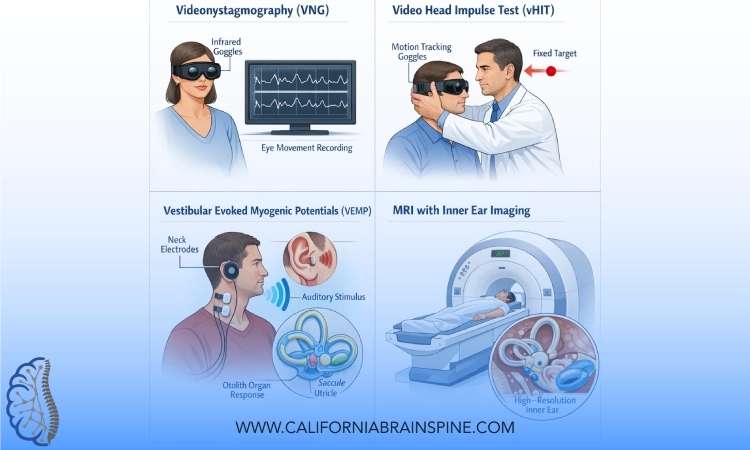
At California Brain & Spine Center, Dr. Alireza Chizari, DC, DACNB, carries out this testing as part of a 120-minute neurodiagnostic assessment. Depending on your history, it may include:
- positional testing, to look for displaced inner-ear crystals and identify which part of the inner ear is involved
- eye-movement testing, since oculomotor problems are commonly seen after a concussion
- balance testing under different conditions
- tests of how accurately the neck senses its own position
- heart rate and blood pressure lying down and after standing, for the autonomic response
When the source is clear, care may include, when clinically appropriate after evaluation, canalith repositioning for BPPV and neurological rehabilitation built around vestibular, eye-movement and neck exercises, the cervico-vestibular approach the consensus statement recommends. Some of the movements involved are shown in these head-movement exercises for post-concussion dizziness, though which ones suit you depends on what testing finds.
If anything in the testing calls for imaging or a medical neurology opinion, Dr. Chizari refers for it. The practice works alongside primary care, medical neurology, ENT and physical therapy, not in place of them.
When Is Dizziness After a Concussion an Emergency?
Dizziness after a concussion is an emergency when it comes with any of the CDC's concussion danger signs, such as a headache that gets worse, repeated vomiting or slurred speech.
Concussion danger signs: get emergency care
The CDC lists these danger signs after a head injury:
- a headache that gets worse and does not go away
- repeated nausea or vomiting
- slurred speech, weakness, numbness or decreased coordination
- increasing confusion or agitation
- convulsions or seizures
- one pupil larger than the other, or double vision
- increasing drowsiness or trouble staying awake
If symptoms come on suddenly or severely - a sudden severe headache, weakness, trouble speaking, vision loss, or fainting - that is an emergency. Call 911 or go to an emergency room, not a clinic appointment.
Outside an emergency, dizziness that lasts more than 10 days, keeps getting worse, or comes with new symptoms is worth an evaluation.
What Do Patients in Calabasas Ask About Concussion Dizziness?
Patients in Calabasas often ask me two things about dizziness after a concussion: why they are still dizzy when their scans were normal, and whether they should keep resting.
One question patients often ask me is how an MRI or CT can be normal while the dizziness carries on. A normal scan does not show which balance system is involved, and testing each one does. The tests described above look at whether the inner ear, the eyes, the neck and the standing response are doing their jobs together, and a normal scan leaves that question open.
On rest, I point people to the consensus threshold. Once dizziness, neck pain or headaches have lasted more than 10 days, the international guidance recommends cervico-vestibular rehabilitation, and an evaluation is how you find out which parts of it apply to you.
The part people most often misunderstand is the first visit. It is a 120-minute neurodiagnostic assessment, and I go through the results with you before any plan is discussed, so you can see which test pointed where.
"He took the time to perform a detailed evaluation, explain my condition, and create a personalized treatment plan."
From a Google review
People come to the practice in Calabasas from Agoura Hills and along the 101 corridor. If your main problem is dizziness or vertigo without a recent head injury, the dizziness and vertigo evaluation follows the same system-by-system approach.
Post-Concussion Dizziness: Common Questions
Post-concussion dizziness raises a handful of shorter questions, and the answers below draw on the same research cited above.
Can a concussion cause dizziness when lying down or rolling over?
Yes. A concussion can shift the calcium crystals in the inner ear, and that can cause brief spinning with position changes, such as lying down or rolling over in bed. This is BPPV, one possible source of dizziness after concussion, and it is commonly treated with repositioning maneuvers once testing shows which part of the inner ear is involved.
Is it normal to still have concussion dizziness when other symptoms are gone?
It can happen. Research on concussion dizziness reports that it may last six months or longer after other symptoms have settled. That does not mean it should be left alone: if dizziness lasts more than 10 days, consensus guidance recommends targeted rehabilitation, and an evaluation can show which system is behind it.
Can whiplash cause dizziness after a concussion?
It can contribute. Neck trauma such as whiplash can disturb the position signals from the neck, so the brain can receive conflicting information from the inner ear, eyes and neck, a pattern called cervicogenic dizziness. Because it is a diagnosis of exclusion, other sources of dizziness after concussion are ruled out before the neck is named as the cause.
Where can I get dizziness after concussion evaluated near Calabasas or Los Angeles?
California Brain & Spine Center in Calabasas evaluates dizziness after concussion with a 120-minute neurodiagnostic assessment that may cover the inner ear, eye movements, balance, neck position sense and the response to standing. The practice is at 4768 Park Granada, Ste 107, and sees people from across Los Angeles. Call (818) 649-5300.
Where Should You Start If You Are Still Dizzy?
If dizziness after concussion is still with you after 10 days, start with an evaluation that tests each balance system, because the right next step depends on which one is involved.
Before you come in, I suggest writing down for a week what sets the dizziness off: standing up, turning your head, rolling over in bed, busy places, screens. A precise description of the triggers helps more than a guess about the cause, and it gives the testing a starting point.
California Brain & Spine Center | (818) 649-5300 | Calabasas, CA 91302. You can book online at californiabrainspine.janeapp.com.
This content is for educational purposes only and is not medical advice. Consult a qualified healthcare provider about your specific situation.
Find Out Which System Is Behind the Dizziness
Start with a complimentary consultation in Calabasas to talk through your symptoms and whether the full assessment makes sense for you.