
If you have POTS and your mind feels slower, you are not alone. Many people describe it as walking through mental fog: words feel harder to find, focus slips quickly, and even simple tasks can feel like they require extra effort. This can be especially frustrating when you know how sharp and productive you used to be.
I, Dr. Alireza Chizari, DC, DACNB, will explain in this article what POTS brain fog is, why thinking can feel slower, and what a careful evaluation and non-invasive plan can look like. You are the hero of this story. You are the one managing symptoms that affect your work, your relationships, and your confidence, and you deserve a clear explanation and real next steps.
POTS Brain Fog: Causes, Triggers, and What Helps
At California Brain and Spine Center in Calabasas, California, my team and I evaluate complex neurological and vestibular cases, including dysautonomia patterns like POTS, dizziness, balance disorders, fatigue, memory issues, and post-concussion symptoms. This page will help you understand the common drivers behind POTS brain fog, what to rule out for safety, and how you can use our services to move toward steadier cognitive function.
Why POTS brain fog can feel like you are not yourself
I want to validate something that matters. POTS brain fog can feel personal. Patients often tell me, “This is not me,” or “I feel like my brain is lagging.” That emotional impact is real. Brain fog can reduce confidence, increase anxiety about performance, and make you feel isolated because others cannot see it.
Brain fog in POTS is often not a sign of low intelligence or lack of effort. It is more often a sign of nervous system and circulation instability. When your body is spending more resources just to maintain upright stability, your brain may have less consistent support for attention, processing speed, and working memory.
Brain fog is often a physiology problem, not a personality problem
When POTS brain fog improves, many patients describe a sense of “returning to themselves.” That is a clue that the fog is not who you are. It is what your system is doing.
“You are not losing yourself. You are navigating a system under strain, and systems can be stabilized.”
What POTS brain fog looks like in daily life
People experience POTS brain fog in different ways, but common patterns include:
slower thinking and processing speed
difficulty focusing, especially in busy environments
trouble finding words or recalling names quickly
mental fatigue after short periods of concentration
feeling worse when standing, walking, or in heat
brain fog after meals or during flares
mistakes at work that feel uncharacteristic
difficulty multitasking or switching tasks

The main reasons thinking feels slower in POTS
I approach POTS brain fog as a multi-driver symptom. In clinical practice, there is rarely one single cause. Multiple systems can be contributing at the same time.
1) Upright blood flow instability and cognitive efficiency
When you stand, gravity changes blood distribution. In many POTS patterns, blood pools in the lower body and less stable blood return reaches the heart and brain. The nervous system compensates by increasing heart rate and stress response. That compensation can affect concentration, memory, and processing speed.
If you notice that POTS brain fog improves when you lie down, that posture link is an important clue.
2) Autonomic overactivation and “background noise” in the brain
The autonomic nervous system influences attention and arousal. When the system is overactivated, your brain can feel as if it is constantly scanning for threat. That creates internal background noise. Even if you are calm emotionally, your physiology can still be running “hot,” which can reduce cognitive clarity.
3) Sleep that looks long but is not restorative
Many patients with POTS brain fog sleep for hours but wake up feeling unrefreshed. Poor sleep quality can impair attention, memory consolidation, and emotional regulation. Sleep disruption can be subtle, including frequent micro-awakenings or breathing-related sleep disruption that is not obvious.
4) Sensory overload from dizziness or visual strain
At California Brain and Spine Center, we frequently see a connection between cognitive symptoms and vestibular or visual processing issues. If your balance system is unstable, the brain must work harder to interpret motion and visual input. That added load can worsen POTS brain fog, especially in busy stores, scrolling on screens, or driving.
“Your brain is not failing. It is spending energy on survival tasks that most people never have to think about.”
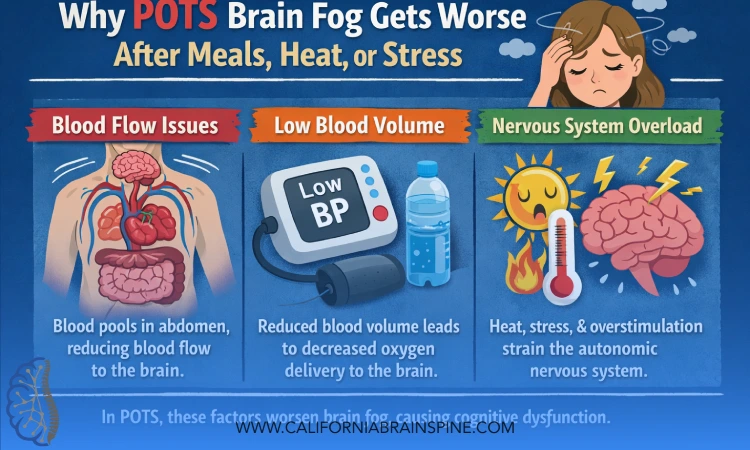
Why POTS brain fog gets worse after meals, heat, or stress
Many patients notice their POTS brain fog is not constant. It rises and falls. That variability can feel confusing until you understand common triggers and how long brain fog lasts with other causes.
Post-meal crashes and cognitive slowing
Digestion changes blood flow distribution. If your autonomic system already struggles with upright stability, a large or carb-heavy meal can intensify fatigue, dizziness, and mental slowing. This is a common driver of mid-day brain fog.
Heat intolerance and cognitive load
Heat widens blood vessels near the skin and can increase blood pooling. For someone with POTS, that can reduce stable blood return and increase heart rate response. The brain may feel under-supported, and POTS brain fog can spike quickly.
Stress physiology and cognitive narrowing
Even positive stress can activate the autonomic system. When stress response increases, cognitive flexibility often drops. You may feel more rigid, more forgetful, or less able to switch tasks.
How we evaluate POTS brain fog at California Brain and Spine Center
At California Brain and Spine Center, patients are evaluated with attention to both autonomic patterns and neurological contributors. This matters because brain fog can be amplified by dizziness, balance issues, post-concussion changes, and sensory processing overload.
At California Brain and Spine Center, patients with POTS brain fog are evaluated with attention to:
symptom timing: posture link, post-meal link, heat link, flare patterns
orthostatic measures: heart rate and blood pressure response to posture change
neurological screening for cognition, attention, and sensory integration
vestibular and visual contributors when dizziness or visual strain is present
sleep patterns, recovery capacity, hydration, and electrolyte strategy
medication and lifestyle review, plus safety-based differential thinking
When appropriate, guidance for additional medical evaluation or coordination is recommended. The goal is clarity and safety, not assumptions.
“Your symptoms deserve a structured evaluation, not a guess. When the pattern becomes clear, the plan becomes simpler.”
Differentials: what else can mimic POTS brain fog
Because brain fog is a broad symptom, it is important to consider other contributors. Even if you have POTS, other conditions can worsen cognitive clarity.
Depending on history and red flags, differentials can include:
anemia or iron deficiency
thyroid dysfunction
vitamin deficiencies
medication effects or interactions
sleep apnea or sleep-disordered breathing
migraine patterns, including vestibular migraine
post-concussion symptoms when history fits
mood disorders, which can coexist but should not replace physiological evaluation
If you experience sudden confusion, severe headache unlike your usual, neurological weakness, slurred speech, or sudden vision changes, seek urgent evaluation.
Practical strategies that may improve POTS brain fog
I want to be realistic. There is no single hack. But many patients improve when they reduce autonomic volatility and reduce sensory load. Small changes, repeated consistently, can raise the baseline.
A practical approach that supports cognitive stability
Here are strategies that often help patients with POTS brain fog:
✅ Hydration and electrolytes to support circulation when appropriate
✅ Smaller meals and pacing to reduce post-meal crashes
✅ Short, planned breaks before your brain hits overload
✅ Sleep stabilization and recovery planning
✅ Graded conditioning that begins within tolerance and progresses slowly
The most critical point is avoiding the “push then crash” pattern. That pattern trains volatility. A steadier pacing pattern supports clarity.
When vestibular rehabilitation and cognitive rehabilitation are the missing link
At California Brain and Spine Center, patients are evaluated with advanced vestibular and neurological tools when needed. If dizziness, visual strain, balance issues, or post-concussion symptoms are present, the brain may be spending extra energy stabilizing sensory input.
Depending on evaluation findings, patients may benefit from vestibular rehabilitation, cognitive rehabilitation, neuroplasticity-based training, and NeuroSensory Integration (NSI). These strategies can reduce sensory mismatch and support improved cognitive efficiency over time.
Select non-invasive neurology options when clinically appropriate
In select cases, supportive non-invasive neurology therapies may be considered as part of a broader plan, depending on the clinical picture. Options may include Low-Level Laser Therapy (LLLT), Pulsed Electromagnetic Field (PEMF), Hyperbaric Oxygen Therapy (HBOT), GammaCore vagus nerve stimulation, or the NeuroRevive Program when appropriate.
“Clarity often returns in layers. First fewer crashes, then longer focus, then the quiet confidence of a steady brain.”
Red flags: when brain fog needs urgent evaluation
Most POTS brain fog is not an emergency, but some cognitive symptoms are red flags. Seek urgent care or emergency evaluation if you experience:
sudden confusion that is new or rapidly worsening
one-sided weakness, facial droop, or slurred speech
sudden vision loss or severe vision changes
severe headache unlike your typical pattern
fainting with injury, repeated fainting without warning
chest pain or severe shortness of breath at rest
If you feel unsafe, choose safety first. Then return to longer-term planning once urgent causes are ruled out.
“Being cautious is not overreacting. It is protecting your future self with wise decisions.”
A short patient story: when the mind started feeling clear again
Some time ago, a patient I will call A. came to see me because POTS brain fog was affecting her work. She described forgetting simple details, rereading emails multiple times, and feeling mentally exhausted after meetings. She also had dizziness in busy environments and felt worse after standing for long periods.
I approached her case with a dysautonomia-informed evaluation, including orthostatic measures, and I also performed a vestibular and neurocognitive screen because the dizziness and visual sensitivity suggested sensory load. We built a plan focused on hydration and pacing, smaller meals to reduce post-meal crashes, and a gradual conditioning progression that began within tolerance. Based on findings, we also integrated vestibular rehabilitation and targeted cognitive rehabilitation strategies to support processing speed, attention stamina, and sensory integration.
Over time, A. reported fewer mental crashes and improved focus. The moment that mattered most was when she said, “I can read again without feeling lost.” That is what I want for you: a plan that helps your brain feel like a safe place to live again.
Your most common questions about POTS brain fog
- Is POTS brain fog real even if my brain MRI is normal?
Yes. Many patients have normal imaging and still experience significant brain fog. POTS brain fog is often related to circulation stability, autonomic regulation, sleep quality, and sensory processing load rather than structural brain damage. - Why is POTS brain fog worse when I stand up?
Upright posture changes blood distribution. If stable blood return to the brain is reduced, the body compensates with increased heart rate and stress response. That can worsen cognitive clarity and processing speed. - Can POTS brain fog be worse after eating?
Yes. Digestion changes blood flow distribution. Large or carb-heavy meals can trigger post-meal crashes, fatigue, and brain fog in many POTS patterns. - Can vestibular problems make brain fog worse?
Yes. Vestibular dysfunction and visual overload can increase cognitive load because the brain must work harder to interpret motion and visual input. This can worsen dizziness, nausea, and brain fog together. - What helps POTS brain fog the most?
For many patients, consistent pacing, hydration strategy when appropriate, sleep stabilization, graded conditioning, and addressing vestibular or cognitive contributors can reduce brain fog intensity over time. The plan should be individualized. - When should I seek urgent care?
Seek urgent evaluation for sudden confusion, severe headache unlike usual, neurological weakness, slurred speech, sudden vision loss, chest pain, or severe shortness of breath at rest.
Conclusion
If you are dealing with POTS brain fog, it can feel like you are living at a slower mental speed than you want. POTS brain fog often happens because upright posture strains circulation, the autonomic system increases threat signaling, sleep is not fully restorative, and dizziness or sensory overload increases cognitive load. The result is real, measurable mental fatigue and slower thinking.
I, Dr. Alireza Chizari, DC, DACNB, approach POTS brain fog with a safety-first evaluation and an individualized, non-invasive plan designed to improve regulation and function. Many patients improve when hydration and pacing are structured, post-meal crashes are addressed, and vestibular and neurocognitive contributors are treated when present.
If you want help clarifying your pattern and building a plan to support steadier thinking, contact California Brain and Spine Center in Calabasas to request an appointment for a personalized neurological and vestibular evaluation. The goal is not to manage symptoms in isolation. The goal is to help you move toward a more stable, functional life.