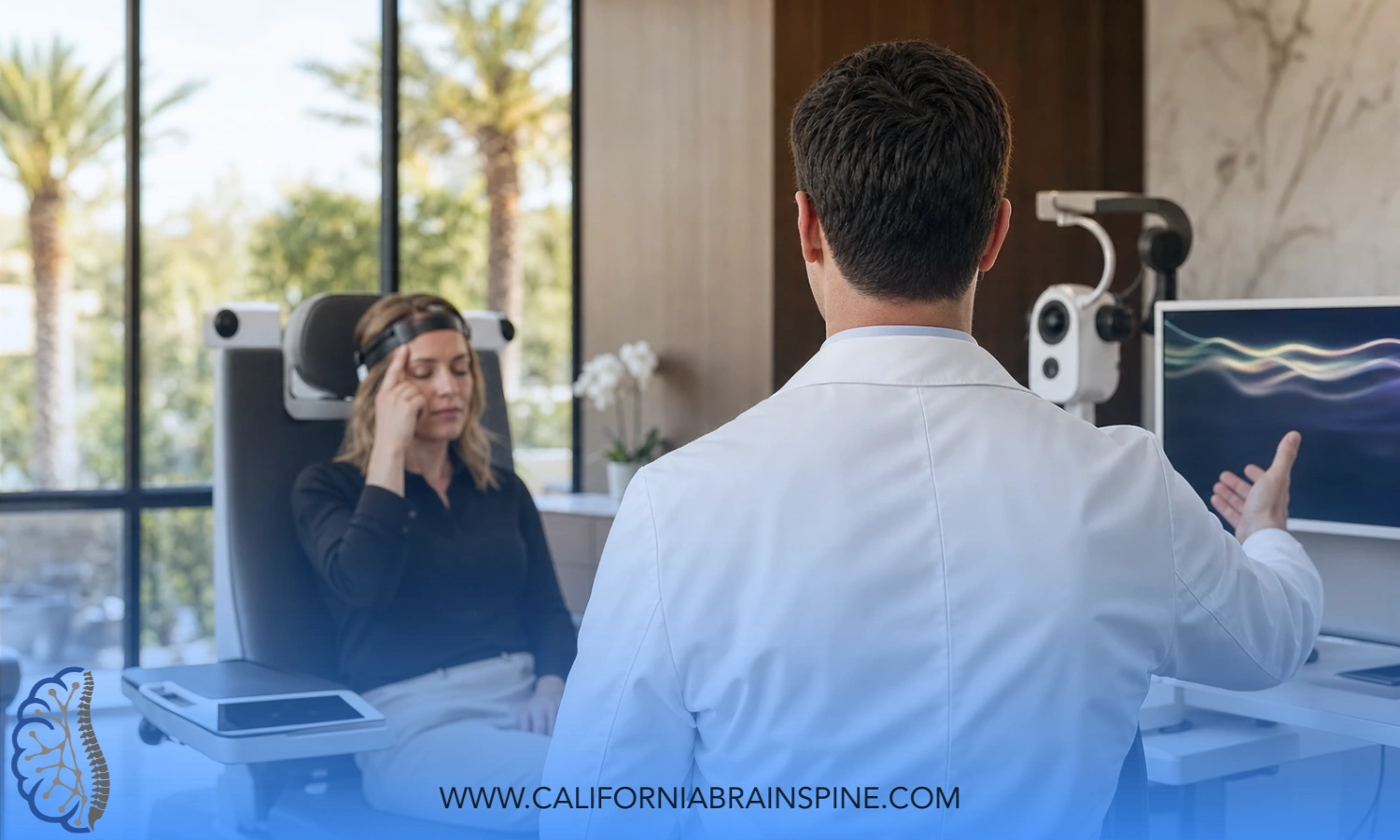
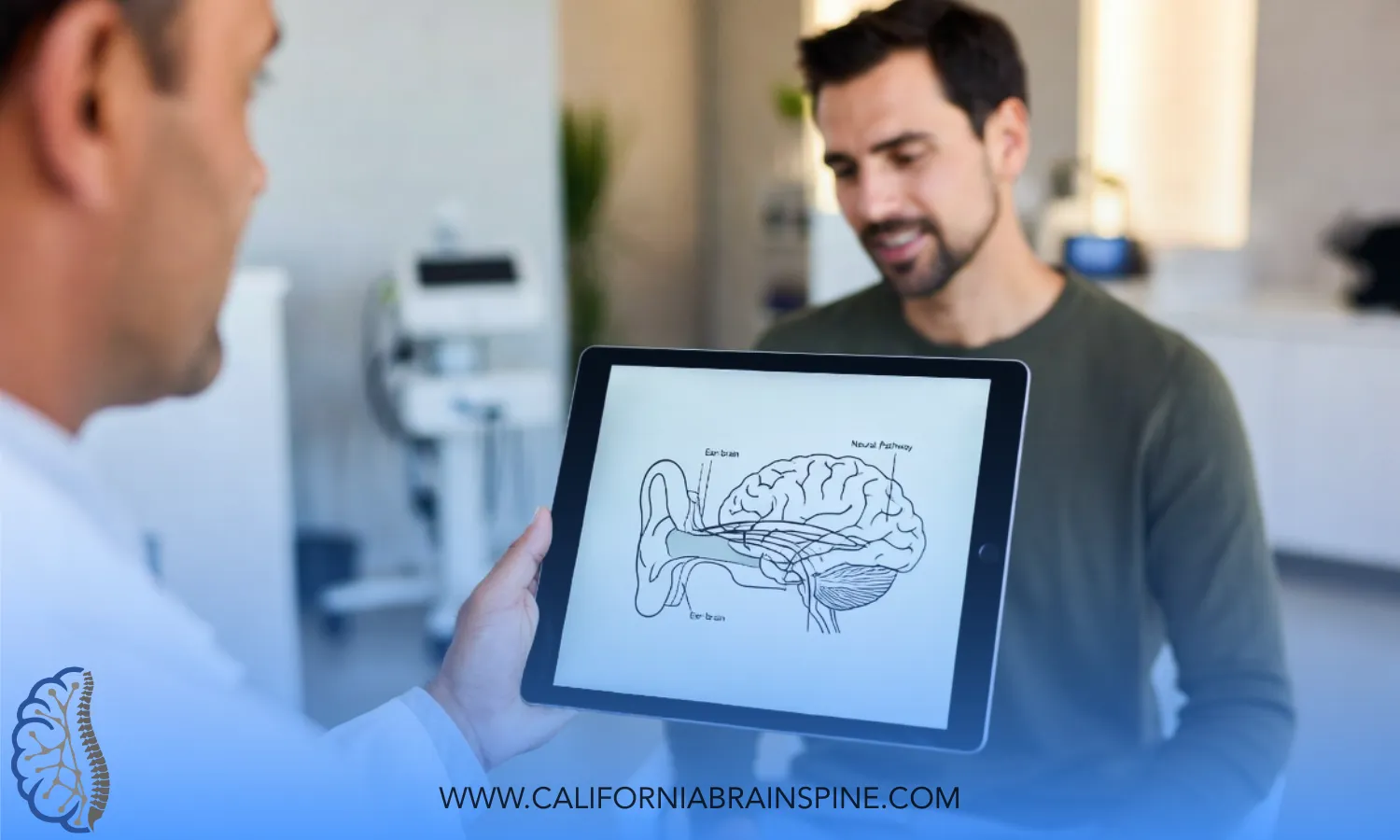
Ringing, buzzing, hissing or pulsing in the ear can be distracting and sometimes frightening. The most useful first step is not assuming where it comes from, but recognizing which tinnitus patterns need hearing or medical evaluation and which accompanying symptoms may point to a broader neurological problem.
I am Dr. Alireza Chizari, DC, DACNB, at California Brain & Spine Center in Calabasas. People throughout Los Angeles often search for help because tinnitus is interfering with sleep, concentration or confidence in quiet environments.
There is an important distinction I want to make at the beginning of this article: California Brain & Spine Center does not present tinnitus as a standalone treatment service.
Tinnitus is primarily an auditory symptom. When it is new, persistent, one-sided, associated with hearing change or pulsatile, an appropriate medical, ENT or audiology evaluation may be the most important next step.
Where our existing services may become relevant is when tinnitus occurs as one part of a larger, in-scope symptom pattern, such as tinnitus after concussion accompanied by dizziness, visual motion sensitivity, imbalance or other persistent neurological symptoms.
The short answer
- Tinnitus is the perception of sound without a corresponding external sound source. It may sound like ringing, buzzing, hissing, humming or other noises.
- Hearing loss and noise exposure are common associations. Ear conditions, medication effects and other medical causes may also contribute.
- Sudden hearing loss with tinnitus is a medical emergency. It should not wait for a routine neurological rehabilitation visit.
- Persistent pulsatile or one-sided tinnitus deserves appropriate medical or ENT assessment.
- Tinnitus can sometimes change with head, neck or jaw movement. That phenomenon exists, but it does not prove the neck or jaw is the primary cause.
- When tinnitus accompanies dizziness, imbalance or post-concussion symptoms, those associated symptoms may justify a separate neurological or vestibular evaluation.
What Is Tinnitus, and Why Can It Be So Distracting?
Tinnitus is the perception of sound when there is no matching external acoustic source. It is a symptom rather than one single disease. Many people describe ringing, buzzing, humming, hissing or roaring, and the sound may be perceived in one ear, both ears or more generally inside the head.
The National Institute on Deafness and Other Communication Disorders, or NIDCD, explains that tinnitus is common and that most people who experience it have some degree of hearing loss. However, tinnitus can occur in different contexts and the underlying cause is not always immediately obvious. NIDCD provides a detailed overview of tinnitus here.
Tinnitus can become especially disruptive when the brain repeatedly notices it.
A person may begin monitoring whether the sound is louder or quieter, worry about what it means, struggle to fall asleep in a silent bedroom or find it difficult to concentrate when the tinnitus is prominent.
That impact is real even when the tinnitus itself is not caused by a dangerous disease.
Is tinnitus always a problem with the ear?
Not necessarily, but auditory and hearing assessment remains central.
Hearing loss, noise exposure, earwax, ear infection and medication effects are among the associations described by NIDCD. Some tinnitus can also vary when a person moves the head, neck, eyes or jaw. This is sometimes described as somatosensory tinnitus.
That does not mean every patient whose tinnitus changes with movement has a cervical problem that should be treated chiropractically.
Movement-related modulation is one piece of information. It does not replace an appropriate auditory and medical assessment.
Tinnitus is a symptom. The safest approach is to understand its pattern before deciding which system, if any, should be treated.
Which Tinnitus Symptoms Should Never Be Ignored?
Most tinnitus is not a medical emergency. A few accompanying features change the urgency substantially.
Seek prompt or urgent medical evaluation when tinnitus is accompanied by:
- Sudden hearing loss in one or both ears.
- New facial weakness, numbness, difficulty speaking or another acute neurological deficit.
- Tinnitus following significant head trauma with worsening neurological symptoms.
- Persistent pulsatile tinnitus that appears synchronized with the heartbeat.
- New persistent tinnitus in one ear, particularly with asymmetric hearing loss or other ear symptoms.
- Severe or rapidly progressive balance or neurological changes.
Sudden sensorineural hearing loss is considered a medical emergency. NIDCD advises people with sudden deafness symptoms to seek medical attention immediately because delays can reduce treatment effectiveness.
NIDCD's sudden hearing loss guidance explains that sudden sensorineural hearing loss can develop all at once or over several days and may occur with ear fullness, dizziness or tinnitus.
Why does sudden hearing loss matter so much?
Someone can wake up with muffled hearing and assume it is wax, congestion or an ear infection. That assumption can delay medical assessment.
The problem is that sudden sensorineural hearing loss is time-sensitive. The American Academy of Otolaryngology-Head and Neck Surgery also emphasizes prompt recognition, audiometric confirmation and appropriate medical management. AAO-HNS provides its sudden hearing loss guideline here.
Why does pulsatile tinnitus need a different evaluation?
Tinnitus that seems to pulse in time with the heartbeat differs from the more common continuous ringing or buzzing pattern.
Because pulsatile tinnitus can have vascular or structural causes, it should not be assumed to reflect stress, muscle tension or neurological sensory amplification.
ENT or medical evaluation may include additional testing based on the history and physical examination.
Should One-Sided Tinnitus Be Evaluated?
Persistent tinnitus confined to one ear deserves more attention than simply assuming it is harmless.
Guidelines from NICE recommend referral pathways for persistent unilateral tinnitus and persistent pulsatile tinnitus. The NICE tinnitus assessment guideline can be reviewed here.
The American Academy of Otolaryngology-Head and Neck Surgery has also recommended a comprehensive hearing examination for patients with tinnitus in one ear, persistent bilateral tinnitus or reported hearing difficulty. AAO-HNS summarizes its tinnitus recommendations here.
This does not mean one-sided tinnitus automatically indicates a serious disorder. It means the pattern is worth evaluating rather than self-diagnosing.
Who Should Evaluate Tinnitus First: ENT, Audiology, or a Neurological Clinic?
For tinnitus itself, an ear and hearing pathway often makes the most sense.
NIDCD recommends starting with medical evaluation and notes that patients may be referred to an otolaryngologist, commonly called an ENT, and to an audiologist who can measure hearing and evaluate tinnitus.
| Situation | Useful starting point | Why |
|---|---|---|
| New tinnitus with hearing loss | Medical / ENT / audiology evaluation | Hearing loss and ear pathology need direct assessment |
| Sudden hearing loss | Urgent medical evaluation | Sudden sensorineural hearing loss is time-sensitive |
| Persistent one-sided tinnitus | ENT / audiology pathway | Unilateral symptoms warrant appropriate hearing and medical assessment |
| Pulsatile tinnitus | Medical / ENT evaluation | Structural or vascular causes may need consideration |
| Tinnitus plus persistent post-concussion dizziness | Concussion care may complement ENT / audiology evaluation | The dizziness, balance and post-concussion symptoms may require separate neurological rehabilitation |
| Tinnitus plus chronic imbalance or motion sensitivity | Vestibular / balance evaluation may complement hearing care | The associated balance symptoms may reflect a separate vestibular problem |
These pathways can overlap
Seeing an ENT or audiologist does not prevent someone with a separate vestibular or post-concussion problem from also receiving neurological rehabilitation. The key is that each clinician addresses the part of the symptom picture that falls within their scope rather than treating every complaint as one condition.
Why Can Tinnitus Occur With Dizziness or Balance Problems?
The auditory and vestibular systems are anatomically close within the inner ear, and some conditions can affect hearing and balance symptoms at the same time.
That is one reason clinicians pay attention when tinnitus appears alongside vertigo, disequilibrium, ear fullness or hearing changes.
But dizziness itself is a broad symptom.
Someone can describe spinning, rocking, floating, lightheadedness, visual motion sensitivity or general unsteadiness. Those experiences can come from different causes, and tinnitus does not identify which cause is present.
If tinnitus has already been appropriately evaluated from an ear and hearing perspective but you also experience persistent dizziness, motion sensitivity or imbalance, the dizziness itself may warrant further assessment.
California Brain & Spine Center's Dizziness and Vertigo Care in Calabasas focuses on identifying and rehabilitating vestibular and neurological contributors to dizziness. It is not presented as tinnitus treatment.
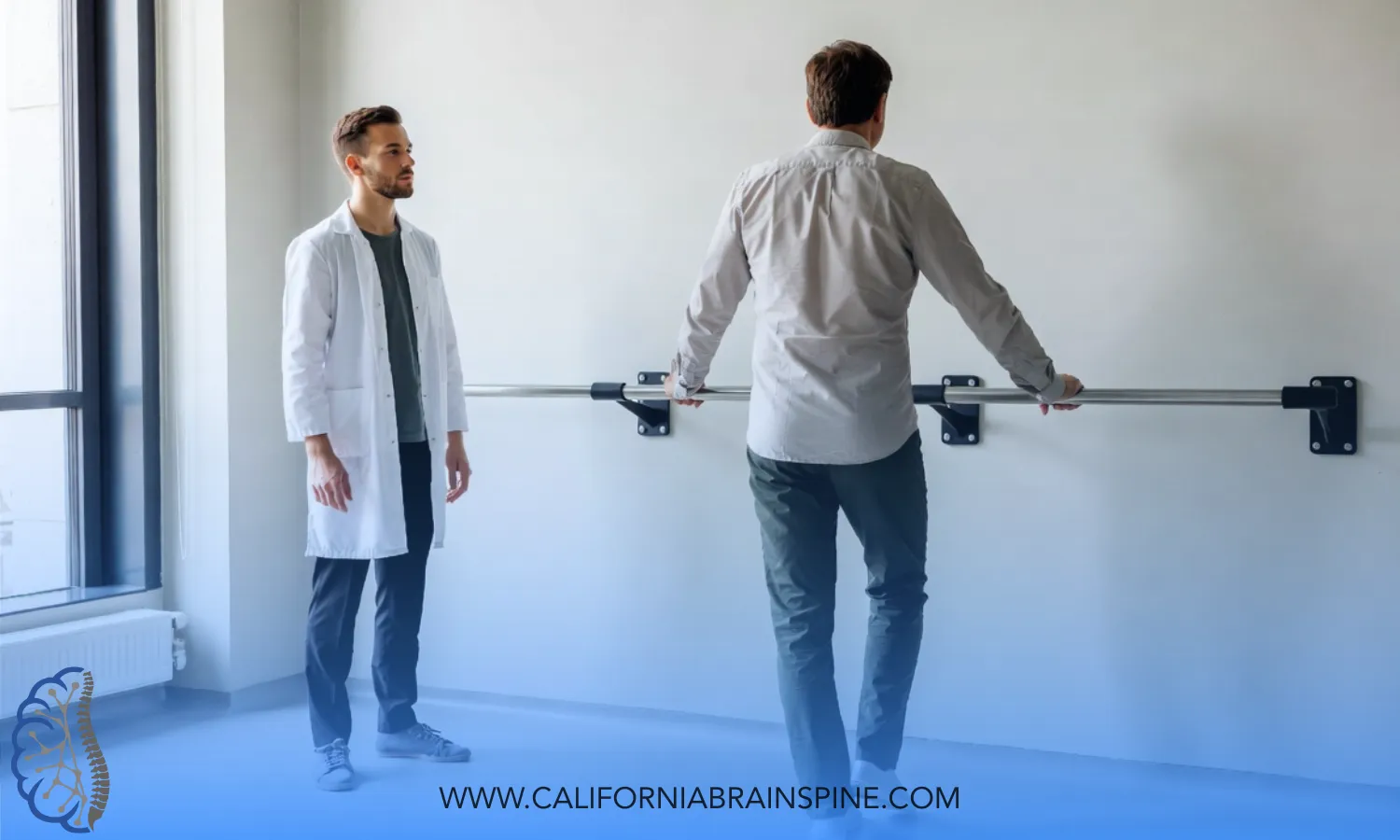
What if balance is the main limitation?
Some people are much more concerned about unsteadiness, falls or feeling unstable in visually complex environments than they are about the ringing itself.
In that situation, the relevant clinical target may be balance rather than tinnitus.
Our Balance Disorder Therapy page explains how visual, vestibular and proprioceptive systems can be assessed when imbalance is the primary complaint.
Can Tinnitus Happen After a Concussion?
Yes. Tinnitus and sound sensitivity can occur after head injury, sometimes alongside headache, dizziness, visual symptoms, cognitive fatigue or balance difficulty.
That does not mean every case of tinnitus after a concussion comes from one neurological mechanism.
A head injury can also involve the ear, auditory pathways, neck or other structures. Hearing changes after trauma deserve appropriate ear and hearing evaluation.
When does CBS's concussion service become relevant?
When tinnitus occurs alongside a broader pattern of persistent post-concussion symptoms, the concussion-related symptoms may fall within the clinic's established scope.
For example, a patient may have persistent dizziness, motion sensitivity, headaches, visual problems, imbalance and cognitive fatigue after a concussion, with tinnitus as one additional symptom.
California Brain & Spine Center's Concussion Treatment in Calabasas focuses on the neurological and functional consequences of concussion. It does not replace ENT or audiology assessment for tinnitus or hearing loss.
If ringing began after a head injury, do not let the word “concussion” prevent appropriate hearing evaluation, and do not let the word “tinnitus” hide important post-concussion balance or neurological symptoms.
Can Neck or Jaw Movement Change Tinnitus?
For some people, yes.
NIDCD recognizes that moving the head, neck or eyes, or touching certain areas of the body, can temporarily change the perceived tinnitus sound in some individuals. This is often described as somatosensory tinnitus.
Patients may notice a temporary change when clenching the jaw, opening the mouth, turning the neck or changing posture.
Does that prove the neck is causing the tinnitus?
No.
This is an important correction to the previous version of this article.
If tinnitus changes during a neck movement, we know that somatosensory input can modulate the perception. We do not automatically know that cervical dysfunction is the primary cause.
A patient with tinnitus should not skip hearing or medical assessment simply because turning the neck changes the pitch.
What about jaw symptoms?
Temporomandibular joint disorders, clenching and other jaw problems can coexist with tinnitus in some patients.
If jaw pain, clicking, restricted opening or dental symptoms are prominent, a dentist, physician or other appropriately qualified professional may need to evaluate that component.
Does Tinnitus Mean the Nervous System Is “Stuck on High Alert”?
That phrase is sometimes used to describe how distressing tinnitus feels, but it is too simplistic as a medical explanation.
The auditory system, attention, emotion and perception can interact. NIDCD notes that tinnitus-related activity may involve auditory and non-auditory brain regions, including networks related to attention and emotion.
That can help explain why the exact same perceived sound may be mildly noticeable for one person and extremely disruptive for another.
It does not establish that tinnitus is simply caused by stress or autonomic dysregulation.
Stress and poor sleep can increase how intrusive tinnitus feels, while tinnitus itself can worsen sleep and emotional distress. Those relationships can become self-reinforcing without making stress the original cause.
Can Tinnitus Affect Sleep and Concentration?
Yes. For people with bothersome tinnitus, quiet environments can make the contrast between the tinnitus and background sound more noticeable.
Some people therefore struggle most at bedtime or during concentrated desk work.
The AAO-HNS guideline distinguishes between tinnitus that is bothersome and tinnitus that does not significantly interfere with daily life. That distinction matters because treatment decisions are influenced not only by whether tinnitus exists, but also by how strongly it affects function.
Is gentle background sound reasonable?
For some people with persistent bothersome tinnitus, sound therapy may be one management option discussed with a qualified tinnitus or hearing professional.
AAO-HNS guidelines state that clinicians may offer sound therapy for persistent bothersome tinnitus. Hearing-aid evaluation is also recommended when hearing loss coexists with persistent bothersome tinnitus.
This does not mean louder masking is always better, and it does not mean someone should expose themselves to excessive sound.
What about cognitive behavioral therapy?
Cognitive behavioral therapy does not claim to remove an auditory signal from the ear. Its goal is to reduce the distress, attention and behavioral consequences associated with bothersome tinnitus.
AAO-HNS recommends cognitive behavioral therapy for patients with persistent bothersome tinnitus. That service belongs with appropriately trained mental-health or tinnitus professionals and is not being represented here as a CBS tinnitus treatment.
Should Supplements Be Used to Treat Tinnitus?
Not routinely based on current guideline recommendations.
The American Academy of Otolaryngology-Head and Neck Surgery guideline specifically advises against recommending ginkgo biloba, melatonin, zinc or other dietary supplements as treatment for persistent bothersome tinnitus.
That distinction is useful because tinnitus marketing frequently includes products promising to “support auditory nerves,” improve circulation or silence ringing without adequate clinical evidence.
If you are taking supplements or medications and notice a change in tinnitus, discuss the complete medication and supplement list with an appropriate physician or pharmacist.
Do PEMF, HBOT, GammaCore, or Laser Therapy Treat Tinnitus?
California Brain & Spine Center does not represent PEMF, hyperbaric oxygen therapy, GammaCore, photobiomodulation or other supportive technologies as established tinnitus treatments. A technology being available in a neurological clinic does not mean it should be applied to every symptom the patient reports.
This is another important correction from the previous page.
Treatment should follow the diagnosed or evaluated condition and the evidence relevant to that condition.
For example, a patient receiving rehabilitation for a concussion or balance disorder may happen to also have tinnitus. That does not make every component of the rehabilitation plan a tinnitus therapy.
Keeping that distinction clear protects both clinical accuracy and patient expectations.
What Can You Safely Track Before Your Appointment?
A simple symptom history can make an ENT, audiology or medical visit more productive without requiring you to diagnose yourself.
| Question | What to note |
|---|---|
| When did it begin? | Suddenly or gradually, and whether it followed noise exposure, illness, injury or another event |
| One ear or both? | Left, right, both ears or difficult to localize |
| What does it sound like? | Ringing, buzzing, hissing, clicking, humming, roaring or pulsing |
| Is it synchronized with your heartbeat? | Important for identifying a pulsatile pattern |
| Has hearing changed? | Sudden or gradual hearing loss, muffled hearing or difficulty understanding speech |
| Are dizziness or balance problems present? | Spinning, rocking, motion sensitivity, unsteadiness or falls |
| Does movement change it? | Whether neck, jaw, eye or head movement temporarily changes pitch or intensity |
| What medications are you using? | Prescription drugs, over-the-counter products and supplements |
This kind of information gives the appropriate clinician a better starting point without encouraging self-treatment.
What Can California Brain & Spine Center Evaluate, and What Should Go to ENT or Audiology?
At California Brain & Spine Center, Dr. Alireza Chizari, DC, DACNB, focuses on the neurological and rehabilitation conditions listed within the clinic's established services.
Those include concussion and post-concussion symptoms, dizziness and vestibular dysfunction, balance disorders, cognitive changes, dysautonomia and other defined neurological rehabilitation concerns.
Tinnitus itself is not being added to that service list through this article.
Situations that primarily belong with ENT, audiology or medical care
- New or unexplained hearing loss.
- Sudden hearing loss.
- Persistent unilateral tinnitus.
- Pulsatile tinnitus.
- Ear pain, drainage or another suspected ear disorder.
- Primary tinnitus without a separate neurological rehabilitation indication.
Situations where a CBS service may separately become relevant
- Tinnitus after concussion when persistent dizziness, balance problems, visual motion sensitivity or cognitive symptoms are also present.
- Tinnitus occurring alongside an already identified vestibular or balance disorder requiring rehabilitation.
- Persistent dizziness and imbalance after appropriate hearing or medical evaluation.
- Post-concussion neurological symptoms that interfere with work, driving, screens or daily activity.
One symptom can involve more than one professional
A patient does not necessarily have to choose between ENT care and neurological rehabilitation. If both an auditory problem and a separate vestibular or post-concussion problem are present, each can be evaluated by the professional whose scope and expertise match that component.
Why Is It Important Not to Label Tinnitus as a Neurological Rehabilitation Diagnosis?
Because a symptom label is not the same as identifying its cause.
If every patient with ringing in the ears is told the problem comes from sensory integration, cervical dysfunction or nervous-system dysregulation, clinically important auditory or medical causes could be overlooked.
The reverse is also true. If someone has been evaluated for tinnitus but continues to have disabling post-concussion dizziness or balance problems, those additional symptoms should not automatically be ignored simply because their hearing evaluation did not explain them.
Good care separates the questions.
What is causing the tinnitus? What is causing the dizziness? What changed after the concussion? Those may overlap, but they should not be assumed to have one answer.
What If Tinnitus Started After a Car Accident or Head Injury?
A head or neck injury can be followed by tinnitus, dizziness, headache, visual symptoms, neck pain and cognitive complaints.
The first priority is appropriate acute medical assessment when the injury is recent or symptoms are worsening.
If hearing has changed, appropriate ear and hearing assessment remains important.
When persistent concussion-related neurological symptoms remain after the acute stage, a neurological rehabilitation evaluation may help clarify visual, vestibular, balance or cognitive findings.
This is where CBS's concussion service may be relevant, but the distinction remains explicit: the clinic is evaluating the concussion-related neurological symptoms, not advertising a tinnitus treatment program.
Can Tinnitus Improve Over Time?
For some people, tinnitus improves or becomes less noticeable over time. For others it persists.
NIDCD notes that tinnitus can improve or go away in some people but may persist or worsen in others.
The goal of evidence-based tinnitus management also depends on what is causing it.
If an identifiable underlying problem such as earwax or another treatable condition is responsible, addressing that cause may change the tinnitus.
When persistent tinnitus does not have a readily reversible cause, management may focus on reducing its effect on hearing, sleep, attention and quality of life.
No responsible clinician should guarantee that a particular intervention will make the tinnitus disappear.
Frequently Asked Questions About Tinnitus in Los Angeles
What is the first type of doctor I should see for new tinnitus?
Primary medical care, ENT and audiology are common starting points, particularly when tinnitus is new, one-sided, associated with hearing difficulty or otherwise unexplained. NIDCD advises medical evaluation and notes that patients may be referred to an ENT and an audiologist for ear and hearing assessment.
When is tinnitus an emergency?
Tinnitus associated with sudden hearing loss requires urgent medical evaluation. New acute neurological deficits, significant head trauma with worsening symptoms or other severe changes also warrant urgent care. Pulsatile or persistent unilateral tinnitus should receive appropriate medical or ENT evaluation even when it is not an emergency.
Can dizziness and tinnitus happen together?
Yes. Some inner-ear, vestibular and post-traumatic conditions can produce both symptoms. The combination does not identify one diagnosis by itself. Hearing changes should be assessed appropriately, while persistent dizziness or imbalance may require its own vestibular or neurological evaluation.
Can a concussion cause tinnitus?
Tinnitus can occur after head injury and may coexist with dizziness, headache, sound sensitivity or other post-concussion symptoms. Because injury can affect more than one system, tinnitus after concussion should not automatically be assigned to one mechanism. Hearing changes may need ENT or audiology assessment while persistent neurological symptoms can require concussion-focused evaluation.
Why does my tinnitus change when I move my neck or jaw?
Some people experience somatosensory modulation, where head, neck, eye or jaw movement temporarily changes tinnitus. This is a recognized phenomenon, but it does not prove that the neck or jaw is the sole cause. Persistent tinnitus still deserves appropriate hearing and medical assessment when indicated.
Does California Brain & Spine Center treat tinnitus?
Tinnitus is not presented as a standalone CBS service. The clinic evaluates and rehabilitates defined neurological problems such as dizziness, balance disorders and persistent post-concussion symptoms. When tinnitus accompanies one of those conditions, CBS may address the neurological or vestibular findings within its established scope while ENT, audiology or medical professionals evaluate tinnitus and hearing concerns as appropriate.
Can sound therapy help tinnitus?
Sound therapy is one option recognized in tinnitus-management guidelines for some people with persistent bothersome tinnitus. Hearing aids may also be useful when hearing loss is present. The appropriate choice depends on hearing status, tinnitus pattern and professional assessment.
Should I try supplements for tinnitus?
Current AAO-HNS guidance does not recommend dietary supplements such as ginkgo biloba, melatonin or zinc for treating persistent bothersome tinnitus. If you are already using medications or supplements, review them with an appropriate physician or pharmacist rather than adding multiple products based on tinnitus marketing claims.
What to Remember About Tinnitus, Dizziness, and Neurological Symptoms
Tinnitus deserves a careful explanation, not a treatment promise.
For many people, hearing loss or changes within the auditory system are central. In others, medications, ear conditions, somatosensory influences or other medical factors may contribute.
The red flags matter most. Sudden hearing loss should be treated as a medical emergency. Persistent unilateral or pulsatile tinnitus deserves appropriate medical or ENT evaluation.
If tinnitus appears alongside persistent dizziness, imbalance or a broader post-concussion symptom complex, those additional symptoms may warrant a vestibular or neurological evaluation after appropriate medical considerations have been addressed.
California Brain & Spine Center's role is to remain within that boundary: evaluate and rehabilitate the neurological conditions the clinic actually treats, and refer auditory or medical problems to the professionals whose scope best matches them.
For a complete overview of the neurological conditions evaluated at our Calabasas clinic, visit our Neurological Services page.
California Brain & Spine Center | (818) 649-5300 | Calabasas, CA 91302
Is tinnitus only one part of a larger dizziness or post-concussion problem?
If your primary concern includes persistent dizziness, imbalance, visual motion sensitivity or post-concussion neurological symptoms, we can discuss whether one of California Brain & Spine Center's established neurological services is appropriate. For tinnitus, hearing loss or ear-specific concerns, ENT and audiology evaluation may still be necessary.