TBI Fatigue: Low Impact Balance Training Guide
At our center in Calabasas, I often meet patients who tell me a very specific story. They survived a traumatic brain injury, finished the acute phase of care, and were told they were “lucky” or “doing well.” Yet months later they still fight overwhelming fatigue, unsteadiness, and a constant fear of falling. Many of them say something like:
“I want to move more, but every time I try to exercise, my balance gets worse and I crash for days.”
This is exactly the group I think about when I design Low-Impact Balance Training for Patients Recovering from TBI-Related Fatigue. My background in engineering and clinical neuroscience has taught me to look at the nervous system as a complex, adaptable network that can be retrained in the right conditions. When we respect fatigue, protect the brain from overload, and challenge balance gently in the right directions, recovery often becomes more stable and less frightening.
In this article, I will step out of the first person and walk through how clinicians think about Low-Impact Balance Training for Patients Recovering from TBI-Related Fatigue, why it matters, and how patients in California can know when it is time to seek a more specialized evaluation.
Why fatigue and balance problems often travel together after TBI
After a traumatic brain injury, many patients develop a combination of:
- Persistent fatigue
- Dizziness or lightheadedness
- Unsteady or “wobbly” walking
- Difficulty tolerating busy environments
- Problems with concentration and multitasking
Research and clinical experience show that balance problems after TBI are common and can often improve with targeted exercise and physical therapy.
However, standard exercise programs are frequently too intense for people who are still dealing with TBI-related fatigue and autonomic instability. When patients try to push through, they may experience a spike in dizziness, brain fog, or exhaustion that lasts for days. This pattern leads to fear of movement and further deconditioning.
Low-Impact Balance Training for Patients Recovering from TBI-Related Fatigue offers a middle path. It focuses on rebuilding balance control, confidence, and strength with minimal stress on joints, cardiovascular load, and sensory systems, which makes it more sustainable in the context of chronic fatigue.
What exactly is Low-Impact Balance Training for Patients Recovering from TBI-Related Fatigue?
Low-Impact Balance Training for Patients Recovering from TBI-Related Fatigue is a structured approach to rehabilitation that targets postural control and stability without asking the nervous system to tolerate high impact forces or long, exhausting sessions.
Key characteristics include:
- Low mechanical impact
Movements avoid jumping, running, or abrupt changes that would stress the joints or inner ear. - Short, frequent sessions
Exercises are broken into small, manageable blocks that fit within the patient’s current energy budget. - Graded sensory challenge
Visual, vestibular, and proprioceptive demands are increased gradually rather than all at once. - Close monitoring of fatigue and symptoms
The intensity and duration of training are adjusted based on real time responses instead of a rigid schedule.
The overall goal of Low-Impact Balance Training for Patients Recovering from TBI-Related Fatigue is to help the brain integrate information from the eyes, inner ears, and body more efficiently, while respecting the reduced physical and cognitive reserves that often follow TBI.
Systems behind the symptoms: why balance is so fragile in TBI-related fatigue
To design effective Low-Impact Balance Training for Patients Recovering from TBI-Related Fatigue, clinicians look at several interacting systems:
- Vestibular system
Injury to the inner ear or central vestibular pathways can impair the brain’s ability to detect head motion and maintain stable vision. This leads to unsteadiness, blurred vision with movement, and motion sensitivity. Vestibular rehabilitation has been shown to reduce dizziness and improve balance in people with TBI and other vestibular disorders. - Somatosensory and proprioceptive input
The brain relies on feedback from muscles and joints to know where the body is in space. TBI or associated musculoskeletal injuries can distort this information, especially in the neck, hips, and ankles. - Visual and oculomotor function
Problems with eye movements, depth perception, or visual crowding can make standing and walking in complex environments much more demanding for the brain. - Autonomic nervous system and fatigue
Dysautonomia and central fatigue often follow TBI. The brain’s “energy budget” is reduced, so tasks that were once easy now consume significant resources, quickly leading to exhaustion and symptom flares.
Low-Impact Balance Training for Patients Recovering from TBI-Related Fatigue is built around these realities. It asks: how can we safely nudge these systems toward better integration without provoking a crash?
Who is a good candidate for Low-Impact Balance Training for Patients Recovering from TBI-Related Fatigue?
While every case is unique, typical candidates include:
- Individuals months or years after TBI who still feel unsteady or afraid of falling
- Patients who report that “ordinary” physical therapy or gym routines leave them wiped out for days
- People with a history of concussion who now have chronic dizziness and fatigue when they stand, walk, or turn their head
- Patients with autonomic symptoms such as heart rate spikes, lightheadedness on standing, or heat intolerance
- Individuals who have already been cleared for medical stability but still feel far from their prior level of function
Before starting Low-Impact Balance Training for Patients Recovering from TBI-Related Fatigue, a thorough evaluation is essential. This often includes:
- Review of TBI history and previous imaging
- Vestibular and balance testing
- Assessment of eye movements and visual tracking
- Screening for dysautonomia or orthostatic intolerance
- Musculoskeletal and cervical spine evaluation
This assessment helps determine which elements should be emphasized and which should be introduced more cautiously.
Core principles of safe Low-Impact Balance Training for Patients Recovering from TBI-Related Fatigue
A well designed program follows several guiding principles.
1. Start below the tolerance threshold
Patients recovering from TBI-related fatigue often have a narrow window between “just enough challenge” and “too much.” Low-Impact Balance Training for Patients Recovering from TBI-Related Fatigue intentionally starts well below this threshold, then slowly approaches it over time.
That might mean:
- 5 to 10 minute sessions instead of 45 minute workouts
- Very simple stances and movements before complex tasks
- Stable surfaces before foam or dynamic surfaces
In many cases, the safest place to begin is at a level that feels almost “too easy,” then progress steadily as the nervous system adapts.
2. Use the body, not just equipment
Balance training after TBI does not need to be complicated. Classical elements like:
- Narrow stance, semi tandem, and tandem stance
- Gentle weight shifting in different directions
- Slow head turns while standing
- Reaching movements within a safe base of support
can all be adapted into Low-Impact Balance Training for Patients Recovering from TBI-Related Fatigue. Equipment such as foam pads or balance boards may be added later, not at the beginning.
3. Progress sensory load carefully
For many TBI patients, visual and vestibular overload are major triggers. So Low-Impact Balance Training for Patients Recovering from TBI-Related Fatigue progresses sensory challenge in small steps, for example:
- Starting in a quiet, well lit room with minimal background movement
- Adding gentle head turns once basic stance feels safe
- Only later introducing more complex backgrounds, such as a busy clinic environment or virtual reality scenarios in specialized settings
The idea is to retrain the sensory systems, not shock them.
4. Integrate breathing and autonomic regulation
Because dysautonomia and central fatigue are common after TBI, breathing and pacing strategies are woven into Low-Impact Balance Training for Patients Recovering from TBI-Related Fatigue. Patients are taught to:
- Notice early signs of autonomic overload, such as heart racing or sudden heat
- Use slow, nasal breathing to stabilize the system
- Take structured breaks before a full crash occurs
This integration can reduce symptom spikes and help patients feel safer during training.
Practical examples of low-impact balance exercises for TBI-related fatigue
Every program should be individualized, but practical examples can help illustrate how Low-Impact Balance Training for Patients Recovering from TBI-Related Fatigue might look in a clinic or home setting.
Early stage examples
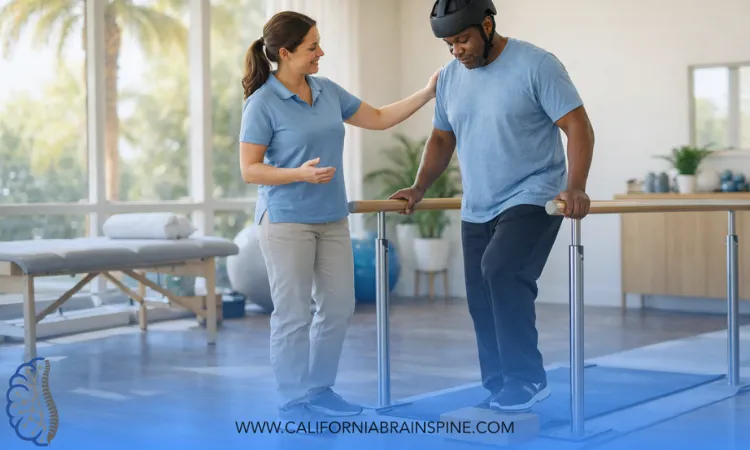
- Supported stance with gentle weight shift
Standing with feet hip width apart, lightly holding a counter or sturdy chair, the patient gently shifts weight side to side or forward and back within a small range. - Seated marching or ankle pumps
For patients with significant orthostatic intolerance, initial work may begin sitting, building blood flow and light muscle activation without overtaxing the system. - Slow head turns in sitting
The patient sits on a stable chair and slowly turns the head left and right, later up and down, monitoring for dizziness or visual instability.
These early tasks represent Low-Impact Balance Training for Patients Recovering from TBI-Related Fatigue at a very accessible level, suitable for people who currently feel fragile.
Intermediate examples
Once tolerance improves:
- Narrow stance with light head movements
Feet closer together, perhaps with one foot slightly ahead of the other, while turning the head slowly as if saying “no.” - Gentle step taps
Standing with support nearby, tapping one foot forward and back, then side to side, encouraging weight shift and dynamic stability. - Eyes closed brief holds
In a stable stance, the patient may close the eyes for a few seconds at a time, only progressing duration if symptoms remain manageable.
These drills represent Low-Impact Balance Training for Patients Recovering from TBI-Related Fatigue that gently increases complexity while still respecting fatigue.
Advanced low-impact work
For patients who have progressed well:
- Walking with head turns in a quiet hallway, practicing looking left and right while maintaining a steady path.
- Tandem stance or tandem walking on a flat floor, possibly near a wall for safety.
- Light multi tasking, such as holding a conversation while performing simple balance tasks, once basic mechanics are stable.
Even at this level, the emphasis remains on control and consistency, not speed or intensity. Low-Impact Balance Training for Patients Recovering from TBI-Related Fatigue is not about “pushing through” but about teaching the nervous system to function more efficiently.
Home practice versus supervised therapy
Many patients ask whether they can simply follow videos or home programs. While home practice is very important, supervised sessions have several advantages:
- Accurate assessment of which systems are most affected
- Safe progression of difficulty
- Real time feedback on posture, eye movements, and breathing
- Early detection of red flags or maladaptive patterns
In many cases, a hybrid model works well. Patients learn the core of Low-Impact Balance Training for Patients Recovering from TBI-Related Fatigue under supervision, then practice shorter routines at home between visits.
When to stop or modify training
It is normal for symptoms to increase slightly during or shortly after challenging balance exercises. However, patients recovering from TBI-related fatigue need clear “stop signals” to prevent major crashes.
Training should be paused or modified if:
- Dizziness or unsteadiness suddenly intensifies
- Vision becomes significantly blurred or doubled
- Heart rate remains elevated far above baseline despite rest
- Fatigue is so severe that daily activities are impaired for more than 24 hours
If these patterns occur frequently despite careful pacing, Low-Impact Balance Training for Patients Recovering from TBI-Related Fatigue may need to be adjusted, or additional factors such as dysautonomia or medication side effects should be evaluated.
How specialized care in California supports Low-Impact Balance Training for Patients Recovering from TBI-Related Fatigue
In a specialized neurological and vestibular clinic, Low-Impact Balance Training for Patients Recovering from TBI-Related Fatigue is rarely used in isolation. It is typically integrated into a broader plan that may include:
- Vestibular rehabilitation targeted to the specific deficits identified on testing
- Visual and oculomotor exercises to address eye movement issues
- Autonomic regulation strategies for patients with dysautonomia or orthostatic intolerance
- Gentle cervical spine care if neck dysfunction is contributing to dizziness
- Cognitive pacing and activity management to respect limited mental energy
This integrated approach recognizes that fatigue and balance issues after TBI are usually multi-factorial. When these elements are coordinated, Low-Impact Balance Training for Patients Recovering from TBI-Related Fatigue becomes more effective and more tolerable.
How California Brain & Spine Center in Calabasas can help
At California Brain & Spine Center in Calabasas, we regularly see patients from across Southern California and other parts of the state who are still struggling with fatigue, dizziness, and balance problems long after their traumatic brain injury. Many have already completed standard physical therapy or generic exercise programs that were simply too intense for their nervous system.
In our clinic, we take the time to understand which systems are driving the problem. We use neurological, vestibular, and autonomic assessment to design truly individualized plans. For many patients, that includes carefully structured Low-Impact Balance Training for Patients Recovering from TBI-Related Fatigue, combined with vestibular rehabilitation, autonomic support, and cognitive pacing strategies.
If you are in California and feel that your recovery has plateaued, or that each attempt to exercise leaves you more exhausted and unstable, our team can help you clarify what is happening and guide you toward a safer, more sustainable path forward.
You can learn more about our clinic at
https://californiabrainspine.com/
Short summary
Low-Impact Balance Training for Patients Recovering from TBI-Related Fatigue focuses on rebuilding balance and confidence without overwhelming a nervous system that is already coping with dizziness, autonomic instability, and reduced energy. By starting below the tolerance threshold, progressing sensory challenges slowly, and integrating breathing and pacing strategies, this approach can help patients move more freely while reducing post exercise crashes.
In a specialized clinic setting, Low-Impact Balance Training for Patients Recovering from TBI-Related Fatigue is combined with vestibular rehabilitation, visual and autonomic interventions, and careful clinical monitoring. Patients in California who still feel unsteady and exhausted months after a TBI should consider an in person evaluation to understand which systems are involved and how a non invasive, individualized program can support their recovery.
FAQs about Low-Impact Balance Training for Patients Recovering from TBI-Related Fatigue
1. What is the main goal of Low-Impact Balance Training for Patients Recovering from TBI-Related Fatigue?
The main goal of Low-Impact Balance Training for Patients Recovering from TBI-Related Fatigue is to improve postural control, stability, and confidence while respecting the reduced energy and autonomic resilience that often follow TBI. It aims to retrain the brain’s integration of vestibular, visual, and body signals without triggering severe fatigue or symptom flares.
2. Is it safe to exercise if I still feel very tired months after my TBI?
In many cases, yes, but the type and dose of exercise matter greatly. Low-Impact Balance Training for Patients Recovering from TBI-Related Fatigue uses short, low intensity sessions and gradual progression to avoid overloading the nervous system. Before starting, it is important to have a medical and neurological evaluation so that red flags are ruled out and the program can be tailored to your specific needs.
3. How often should I do Low-Impact Balance Training for Patients Recovering from TBI-Related Fatigue?
Frequency is individualized, but many patients do best with short sessions most days of the week rather than long workouts a few times per week. For example, 10 to 15 minutes of low-impact balance work one or two times per day may be more effective and tolerable than a single 60 minute session. A clinician experienced in TBI rehabilitation can help you find the right rhythm.
4. Can I just follow online videos instead of seeing a specialist?
General balance videos may not account for vestibular dysfunction, visual issues, or dysautonomia. For someone with TBI-related fatigue, that can lead to symptom spikes and loss of confidence. It is usually safer to begin Low-Impact Balance Training for Patients Recovering from TBI-Related Fatigue with guidance from a clinician who understands brain injury and can adapt exercises in real time, then transition to a more independent home program.
5. What is the difference between vestibular rehabilitation and Low-Impact Balance Training for Patients Recovering from TBI-Related Fatigue?
Vestibular rehabilitation is a broader category of therapy focused on reducing dizziness and improving balance by retraining the inner ear and brain. Low-Impact Balance Training for Patients Recovering from TBI-Related Fatigue is a specific way of structuring balance exercises within that framework, with a strong emphasis on minimizing mechanical impact and managing fatigue and autonomic symptoms. In practice, the two often overlap and support each other.
6. How will I know if Low-Impact Balance Training for Patients Recovering from TBI-Related Fatigue is working?
Signs of progress include feeling more stable in everyday activities, fewer near falls, increased confidence in walking on uneven surfaces, and less dramatic crashes after activity. Many patients also notice that they can tolerate slightly longer sessions or more complex tasks without a major increase in symptoms. Tracking these changes with your clinician can help guide progression.
7. When should I seek specialized care rather than trying to manage this alone?
You should seek specialized care if you continue to feel unsteady or fearful of falling months after a TBI, if standard exercise makes your symptoms significantly worse, or if you have signs of vestibular dysfunction or dysautonomia such as motion induced dizziness or frequent lightheadedness on standing. In those cases, a clinic experienced in neurological, vestibular, and autonomic assessment can design a Low-Impact Balance Training for Patients Recovering from TBI-Related Fatigue program that fits your nervous system, not just a generic template.
If you are in California or can travel to our clinic in Calabasas and you recognize yourself in this description, you do not have to navigate recovery alone. At California Brain & Spine Center, our team can evaluate your balance, fatigue, and autonomic function, then create a Low-Impact Balance Training for Patients Recovering from TBI-Related Fatigue plan that fits your current capacity and supports long term recovery.