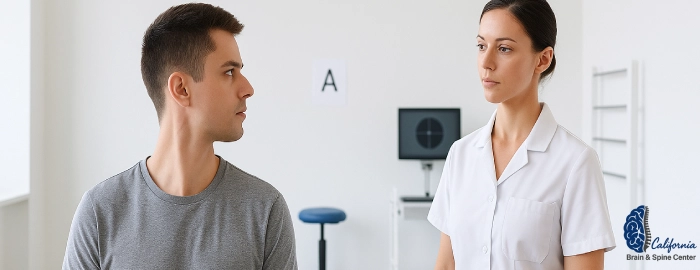
At our California Brain & Spine Center here in Calabasas, I often meet patients who tell me something like this: “My concussion was months ago, the headaches are better, but as soon as I turn my head quickly, the room swims.” That pattern is classic. The brain has healed in some areas, but the vestibular system and the neck–eye–head coordination haven’t fully recalibrated. In those situations, carefully designed Head Movement Exercises For Post-Concussion Dizziness can be the missing link between “I’m mostly okay” and “I can finally move without getting dizzy.”
We see this a lot in Southern California, especially in people who are active, drive a lot, or went back to work too early. Their imaging is normal, their primary doctor may have said “give it time,” but every time they look over their shoulder, reach for something, or walk in a busy store, dizziness comes back. That is exactly the scenario where structured Head Movement Exercises For Post-Concussion Dizziness make sense, because they retrain the brain to tolerate motion again instead of avoiding it.
Why Does Head Movement Trigger Dizziness After a Concussion?
After a concussion or mild TBI, your brain can become overly sensitive to motion signals. Three systems must agree for you to feel steady:
The inner ear/vestibular system
The eyes/visual system
The neck and proprioceptive system
A concussion can desynchronize these. So when you turn your head, the vestibular system says “we’re moving,” but the eyes or the neck don’t send a perfectly matching signal. The brain reads that mismatch as dizziness. Head Movement Exercises For Post-Concussion Dizziness are basically a controlled way of telling the brain: “These signals belong together. Don’t overreact. Integrate them.”
This is also why some people feel worse in grocery stores, busy parking lots, or when riding in a car — your system is being asked to process head motion plus visual motion at the same time, and post-concussion brains don’t love multitasking at first.
Principles Before You Start

Before I explain what Head Movement Exercises For Post-Concussion Dizziness look like, it helps to understand the rules we give our patients in Calabasas:
Start small, then progress. If you trigger a 7/10 dizziness every time, your brain won’t adapt — it’ll just protect.
Move the head, not the whole body. We want the inner ear and eye systems to do the work.
Short, frequent sessions. 1–2 minutes, several times per day, is often better than a single long, exhausting session.
Eyes stay engaged. A lot of vestibular recovery is about keeping vision stable while the head moves.
When these rules are respected, Head Movement Exercises For Post-Concussion Dizziness become therapeutic instead of irritating.
After a concussion, head movements that used to feel effortless can suddenly trigger spinning, swaying, or a delay before your vision catches up. Sometimes this comes from central changes in the brain, and sometimes from inner ear conditions like BPPV that need specific repositioning maneuvers. If you notice short bursts of vertigo when rolling in bed or looking up, our article on positional vertigo and BPPV explains how we test for these crystal related issues and why the right canal specific treatment can dramatically reduce your dizziness.
Step 1: Seated Horizontal Head Turns
This is one of the simplest starting points we teach in the clinic.
Sit upright, feet on the floor.
Pick a target straight ahead — maybe a letter on the wall.
Gently turn your head right, then center, then left, then center.
Keep your eyes on the target the whole time.
This looks basic, but for someone with post-concussion dizziness, it is already a form of vestibular/ocular rehab. You’re asking the eyes to stay stable while the head moves — that’s the core of Head Movement Exercises For Post-Concussion Dizziness. If symptoms rise slightly (1–3/10) and then settle within a minute, that’s a good response.
Step 2: Vertical and Diagonal Head Movements
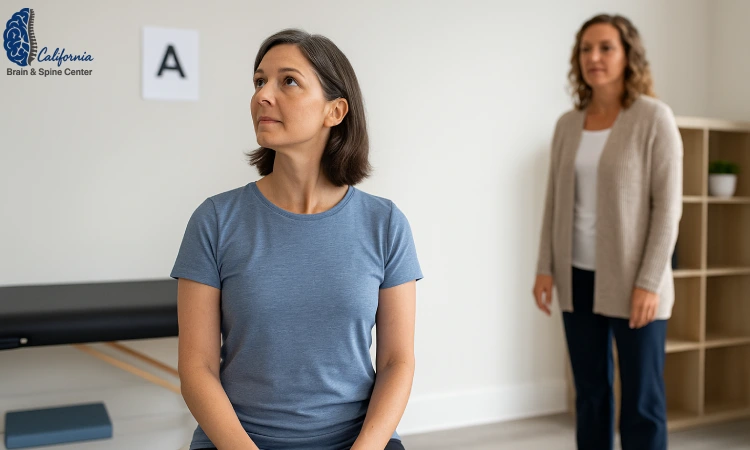
Many patients only practice side-to-side, but real life doesn’t work that way. You look up at shelves, down at your phone, and diagonally at people. So the next level of Head Movement Exercises For Post-Concussion Dizziness is to add:
Up–down head nods while looking at a target
Down-right / up-left diagonals
Down-left / up-right diagonals
Diagonal movements are important because they demand more precise coordination from the neck and midbrain structures. If diagonals make you dizzier than horizontals, that tells us there is still vestibular or cervicogenic involvement — something we often confirm and treat at the center.
Step 3: VOR-Based Head Movement (The Classic “Keep the Letter Clear” Drill)
This is a classic vestibulo-ocular reflex exercise, but applied to post-concussion patients:
Hold a business card or letter in front of you at arm’s length.
Keep your eyes on the letter.
Move your head side-to-side at a comfortable speed.
The letter should stay as clear as possible.
This is still part of Head Movement Exercises For Post-Concussion Dizziness, but it’s a little more demanding because you’re adding speed and visual clarity as goals. Over time, you can increase the speed — as long as symptoms stay in the manageable range.
Step 4: Adding Postural Challenge

Once seated versions are tolerated, we make the exercises more “real world”:
Standing with feet together
Standing in tandem (one foot in front of the other)
Standing on a soft surface
Walking slowly while turning the head
This is the point where Head Movement Exercises For Post-Concussion Dizziness stop being just “neck and eyes” and become “full balance system.” Many patients tell us, “This finally feels like the way I get dizzy in daily life.” That’s exactly what we want — to imitate real triggers in a safe environment.
When to Be Careful
Not every patient should do these on their own. If you have any of the following, you should be evaluated in person — for example at our Calabasas clinic — before doing aggressive Head Movement Exercises For Post-Concussion Dizziness:
Double vision or new visual field loss
Severe neck pain or limited neck range after the injury
Fainting, near-fainting, or suspected dysautonomia/POTS
A history of central vestibular disorders
Dizziness that does not go away after 1–2 minutes of rest
In those cases we often combine vestibular work with cervical treatment, autonomic testing, or even neuro-ophthalmic-style drills. Sometimes the dizziness isn’t just “inner ear,” it’s a mix of post-concussion, neck, and autonomic issues — and that’s exactly the kind of complex case our team is set up to handle.
Why These Exercises Work
The reason Head Movement Exercises For Post-Concussion Dizziness help is neuroplasticity. After a concussion, the brain is still capable of adapting, but it needs graded, repeated, meaningful input. Randomly spinning around won’t help. Guided, symptom-controlled head motion will.
What we see clinically is:
Symptoms get triggered slightly.
The brain learns, “this is safe.”
The threshold for dizziness goes up.
Patients return to driving, shopping, sports, or screens more comfortably.
That’s why doing these once a week isn’t enough — the brain learns through repetition.
Integrating With Full Vestibular and Post-Concussion Care
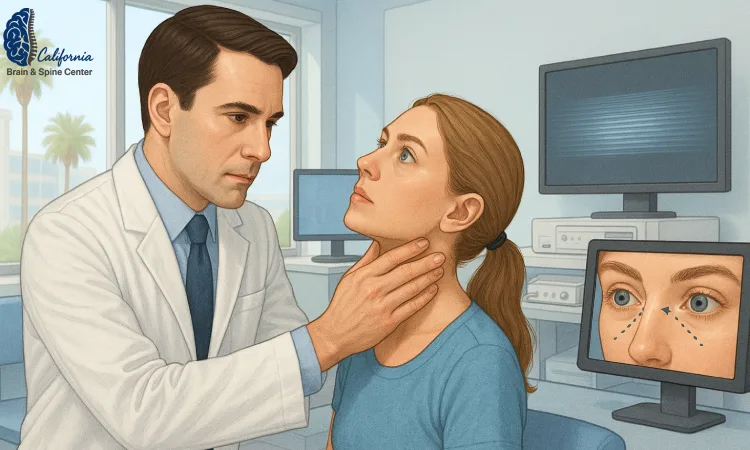
If a patient in California comes to us and says, “I get dizzy every time I look over my shoulder,” we don’t just hand them a sheet of Head Movement Exercises For Post-Concussion Dizziness and send them home. We also check:
Cervical spine mechanics (cervicogenic dizziness is real)
Eye movements and saccades
Visual–motion sensitivity
Autonomic signs (heart rate changes when standing)
Sleep disruption and migraine tendency
That’s because dizziness after concussion is rarely from just one thing. The good news is that non-invasive, rehab-based care — vestibular rehabilitation, post-concussion programs, dysautonomia management — is exactly what we offer at California Brain & Spine Center. You can see our services at californiabrainspine.com and choose the most relevant one for your symptoms.
If you live in Calabasas, elsewhere in Los Angeles County, or you’re willing to travel to us in Southern California, and your symptoms match what I described, our team can evaluate you in person. We will determine whether simple Head Movement Exercises For Post-Concussion Dizziness are enough, or whether you need a combined approach that addresses the vestibular system, the neck, and the autonomic nervous system. Our clinicians work with post-concussion and dizziness patients every week, so you won’t have to keep guessing which exercise is right for you — we’ll build the plan for you.
Summary
Post-concussion dizziness is common, frustrating, and very treatable when you target the right systems. Head Movement Exercises For Post-Concussion Dizziness are one of the simplest and most powerful tools because they retrain the brain to tolerate motion again. Start seated, use a visual target, keep symptoms in the mild range, and progress toward standing and walking tasks. If symptoms are intense, long-lasting, or mixed with neck and autonomic problems, get evaluated — especially if you are in California and can come to our Calabasas clinic. This is exactly the kind of patient we designed our programs for.
Not all post concussion symptoms fade with time. When dizziness persists for weeks or months, it often signals that brain and vestibular networks need targeted rehabilitation instead of simple rest. Our program for post concussion syndrome and mild traumatic brain injuries uses detailed eye movement, balance, and cognitive testing to map out exactly which circuits are struggling, then builds a custom plan to help your brain adapt and stabilize again.
FAQs
1. How often should I do these exercises?
Most patients do best with short, frequent sessions — 1 to 2 minutes, 3 to 5 times per day. That gives the brain many small chances to adapt to the head motion.
2. What if I get more dizzy right after the exercise?
A small, temporary increase is normal with Head Movement Exercises For Post-Concussion Dizziness, as long as it settles within a few minutes. If it lingers or gets worse over the day, the exercise was too hard and needs to be scaled back.
3. Can I do these while I’m still having neck pain?
Sometimes the neck is part of the dizziness, especially after whiplash or sports injuries. In those cases we often treat the neck and the vestibular system together. It’s safer to be assessed first.
4. How long does it take to see results?
Many patients report early improvement in 2–4 weeks of consistent practice. More complex cases — for example, those with dysautonomia or strong visual-motion sensitivity — may need a longer, clinic-guided program.
5. Do I need special equipment?
No. Most Head Movement Exercises For Post-Concussion Dizziness can be done with a chair, a wall target, and a quiet room. In the clinic we sometimes add computerized or dynamic balance tools, but they’re not required to start.
👨⚕️ Alireza Chizari, MSc, DC, DACNB
🧠 Clinical Focus
🔬 Assessment & Treatment Approach
Objective testing may include:
Treatment programs may involve:
📍 Clinic Information
✅ Medical Review
⚠️ Disclaimer