
If you are dealing with dizziness after a concussion, it can feel confusing and even scary. You may look fine on the outside, yet bright lights, busy stores, scrolling on your phone, or even simple head turns can make your body feel unsteady.
I, Dr. Alireza Chizari, wrote this article to help you understand sensory mismatch after concussion and the dizziness triggers that often come with it. You are the hero here. You are the one living with the symptoms, trying to work, drive, parent, and feel like yourself again. My role is to be your guide, to bring clarity, testing, and a step by step plan that respects your nervous system and your goals.
This page explains what sensory mismatch after concussion means, why it happens, what dizziness triggers to watch for, and how we evaluate and treat these patterns at California Brain & Spine Center in Calabasas, California. If you want a practical path forward, you will know exactly how to use our concussion, dizziness, vestibular, and neurological services to get help.
What sensory mismatch after concussion really means in your brain and body
Sensory mismatch after concussion happens when your brain receives information from your eyes, inner ears, and body position sensors, but the signals do not match well enough to create a stable sense of orientation. Before the injury, your nervous system blended these signals smoothly, so walking through a crowd felt normal. After a concussion, the brain may become more sensitive, slower to process motion, or less able to filter competing inputs.
When that blending is off, you can feel dizziness, rocking, lightheadedness, nausea, visual strain, or a strange floating sensation. Many people describe it as being “not steady” rather than classic spinning vertigo. That distinction matters because sensory mismatch after concussion often sits at the intersection of vision, vestibular processing, and neuroinflammation, not only the inner ear.
In my clinic, I explain it like this: your brain is trying to solve a puzzle in real time. If the pieces arrive late, or the picture on the box is blurry, the brain works harder and your symptoms flare. That is not weakness. That is a stressed system asking for better inputs and better training.
Dizziness triggers that point to sensory mismatch after concussion
Sensory mismatch after concussion often shows itself through predictable patterns. The trigger is not random. It is usually tied to visual motion, busy environments, head movement, or rapid focus changes.
Common dizziness triggers include walking into large stores with long aisles, bright ceiling lights, and fast moving visual scenes. Screens are another frequent trigger, especially scrolling, fast video cuts, gaming, or switching between tabs. Crowds, traffic, and patterned floors can also create a sensory overload that your brain struggles to reconcile.
Here is what I want you to remember: your symptoms are information. They can help us identify which sensory system is driving the mismatch.
Healing often begins the moment you stop blaming yourself and start studying the pattern with compassion.
Why stores, screens, and crowds can feel brutal after a concussion?
Visual motion sensitivity and the busy scene problem
Many concussion patients develop visual motion sensitivity. In a store, your eyes track shelves, signs, people, and moving carts. Your brain must stabilize your gaze while your body is walking. After injury, that stabilization can be impaired, so the scene feels like it is sliding, bouncing, or rushing at you.
The vestibular and ocular connection
Your inner ear and eye movement systems are tightly linked. When you move your head, your eyes should automatically counter move to keep vision steady. If this reflex is not calibrated well after concussion, you may get dizziness, nausea, or a sense of disorientation. This is one of the core mechanisms behind sensory mismatch after concussion.
Crowds and the threat response
Crowds can activate the nervous system’s threat response. If you have already felt dizzy in a crowd, your brain learns to anticipate danger in that setting. That anticipation can increase muscle tension, breathing changes, and symptom intensity. We approach this carefully, because the goal is not to push through fear, but to retrain safety and stability.
The hidden symptoms patients do not realize are part of sensory mismatch after concussion
Sensory mismatch after concussion does not always feel like dizziness alone. It can appear as brain fog, headaches, neck tension, fatigue, trouble focusing, or anxiety that seems to come out of nowhere. Sometimes the first clue is that you feel worse after driving, walking in sunlight, or being under fluorescent lighting.
I often hear this: “My MRI was normal, so I thought it was in my head.” I want to be very clear. A normal scan does not mean your processing is normal. Many concussion issues are functional and network based, not structural. Your experience is real, and it deserves a real evaluation.
You are not “too sensitive.” Your nervous system is simply asking for the right kind of support.
How I evaluate sensory mismatch after concussion in Calabasas?
When you come to California Brain & Spine Center, the goal is to identify why your brain is struggling to integrate sensory input, and then build a personalized plan. Because my training includes Clinical Neuroscience and a precise chiropractic foundation, I look at the full system, including neck function, vestibular processing, vision related function, autonomic balance, and how your brain adapts under load.
A thorough evaluation may include symptom mapping, balance and gait observation, eye movement screening, head movement tolerance, and vestibular style challenges that are scaled to your capacity. We also look for patterns that suggest dysautonomia, migraine overlap, or cervicogenic dizziness, because those can amplify sensory mismatch after concussion.
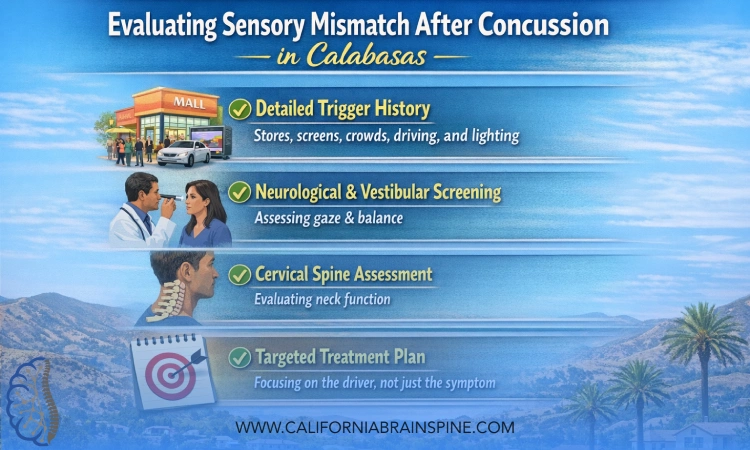
The goal is clarity. When you know your driver, the fear often decreases, and progress becomes measurable.
What treatment can look like when dizziness triggers come from sensory mismatch
At this point in the article, I want you to feel hopeful, not overwhelmed. Treatment for sensory mismatch after concussion is often noninvasive and progressive. It is not about doing everything at once. It is about doing the right things in the right order, at the right intensity.
Here are examples of what may be included, based on your evaluation:
• Vestibular Rehabilitation to retrain balance integration and gaze stability
• NeuroSensory Integration to improve how the brain blends visual, vestibular, and proprioceptive input
• Cognitive Rehabilitation when brain fog, attention, and processing speed are part of the picture
• Neuroplasticity Rehabilitation to support adaptive change through structured stimulation and recovery
• Supportive noninvasive therapies when appropriate, such as LLLT, PEMF, HBOT, GammaCore Vagus Nerve Stimulation, and the NeuroRevive Program
These tools are not used as generic add ons. They are chosen based on what your nervous system is doing today, and what it can handle safely.
Progress is not about forcing your body to tolerate chaos. It is about teaching your brain to feel steady again.
Image note: “A patient doing a gentle balance exercise in a modern clinic, clinician nearby for safety, calm confident mood, no text.”
A simple at home approach to reduce dizziness triggers safely
Before we move into more technical detail, I want to give you a safe starting point. This is not medical advice for every person, but it is a practical framework I often discuss with patients as we prepare for treatment.
Use these principles:
• Keep exposure gentle and structured, not random and exhausting
• Reduce rapid scrolling and fast cutting videos temporarily, then reintroduce with a plan
• Build recovery breaks into your day before symptoms spike, not after
• Prioritize sleep consistency and hydration because the brain processes sensory input better when regulated
If you have severe symptoms, new neurological deficits, fainting, chest pain, or sudden severe headache, seek urgent medical care. Safety always comes first.
Why the right plan feels different than “just rest and wait”?
Rest is important, but the nervous system also needs smart input
Many people are told to rest until symptoms disappear. Rest can be necessary early on, but prolonged avoidance can lead to deconditioning and increased sensitivity. For sensory mismatch after concussion, the brain often improves through targeted retraining, not endless avoidance.
The neck can quietly drive dizziness
After concussion, neck stiffness and joint dysfunction can distort proprioceptive input. That distortion can contribute to sensory mismatch after concussion and dizziness triggers. When the neck is part of the driver, precise care and rehabilitation can make a meaningful difference.
Migraine patterns can amplify sensory mismatch
Some patients have migraine physiology after concussion, even if they never had migraines before. Light sensitivity, sound sensitivity, nausea, and visual discomfort can overlap with sensory mismatch after concussion. This is why evaluation matters. The plan changes depending on the dominant pattern.
Image note: “Close up of a clinician assessing gentle neck range of motion with a patient, modern clinic, calm supportive vibe, no text.”
What you should expect during care at California Brain & Spine Center?
At California Brain & Spine Center, patients are guided through a structured process that is designed to reduce symptom spikes while building real adaptation. The care experience focuses on personalized assessment, measurable progress markers, and education so patients understand what is happening and why.
The clinic serves Calabasas and surrounding areas across Southern California, and many patients come in after months of feeling dismissed. The approach typically includes a progression from stabilization to integration. Stabilization may focus on calming the nervous system, improving cervical input, and reducing the most disruptive dizziness triggers. Integration may involve vestibular rehabilitation, visual vestibular retraining, and neurosensory work that improves tolerance for real world environments.
Noninvasive neurology therapies may be considered when clinically appropriate. LLLT and PEMF may be used as part of an evidence informed plan to support recovery processes. HBOT may be considered in specific cases based on history and response. GammaCore Vagus Nerve Stimulation can be relevant for some patients with autonomic imbalance or headache patterns, and the NeuroRevive Program can help organize multiple therapies into a coherent progression.
This is not a one size plan. It is a guided process with safety and precision as the foundation.
How we measure improvement when symptoms feel unpredictable?
At California Brain & Spine Center, progress is tracked through functional markers, not only how you feel on one random day. Patients often notice improvement as:
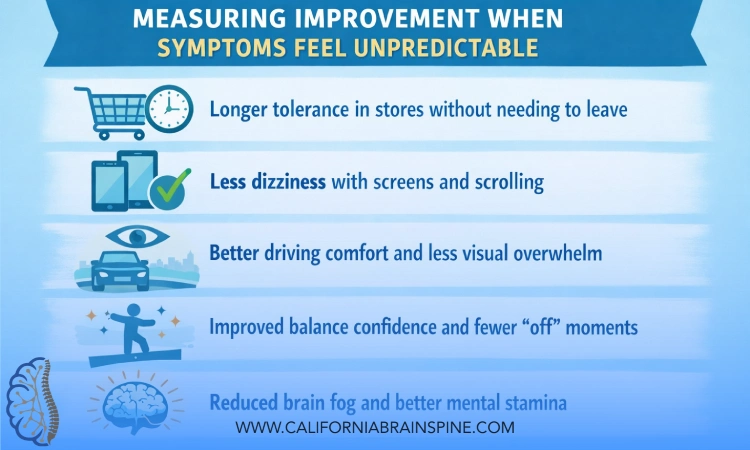
Most importantly, the pattern becomes predictable in a good way. When the brain learns stability, life opens back up.
When your body feels safer, your brain learns faster. That is the quiet power of the right environment and the right plan.
Image note: “A patient walking steadily in a clinic hallway while focusing on a simple target, clinician observing, clean modern space, no text.”
A short patient story that may feel familiar
Some time ago, a patient named A. came to see me after a concussion with persistent dizziness. A. told me that grocery stores were unbearable, screens triggered nausea, and crowds created a wave of panic and instability. The scans were normal, but daily life was shrinking. A. stopped driving and began avoiding outings, not because of fear alone, but because the body truly felt unsafe in motion.
I started by mapping the sensory mismatch after concussion patterns carefully. We identified strong visual motion sensitivity, reduced gaze stability with head movement, and neck tension that was feeding distorted position signals. We built a plan that combined Vestibular Rehabilitation, targeted NeuroSensory Integration, and gentle cervical work, with careful pacing so symptoms did not flare into exhaustion. Over time, we added structured exposure to stores and screens with recovery breaks and progression rules. In the right case, we may also integrate parts of the NeuroRevive Program to support neuroplasticity goals in a cohesive way.
After several weeks, A. reported something simple but powerful: “I walked through a store and did not feel like the floor was moving.” Later, A. drove again, then attended a family gathering, then returned to normal routines with confidence. The goal was never perfection. The goal was a stable, functional life. And A. earned that step by step.
Your most common questions about sensory mismatch after concussion
- What is sensory mismatch after concussion in plain language
Sensory mismatch after concussion means your brain is getting mixed signals from your eyes, inner ears, and body position system. When the signals do not blend smoothly, you can feel dizziness, disorientation, nausea, visual strain, or imbalance, especially in motion heavy environments. - Why do I feel dizzy in stores after a concussion
Stores combine bright lights, long aisles, fast visual movement, and constant head and eye shifts. If you have sensory mismatch after concussion, your brain may struggle to stabilize the scene, which can create dizziness triggers like rocking, nausea, or a sudden need to leave. - Is sensory mismatch after concussion the same as vertigo
Not always. Vertigo often implies a spinning sensation, commonly tied to inner ear disorders. Sensory mismatch after concussion can feel more like unsteadiness, floating, rocking, visual overwhelm, or motion intolerance. Some patients can have both, which is why evaluation matters. - How long does sensory mismatch after concussion last
It varies. Some people improve quickly with the right pacing and retraining, while others need a more structured program, especially if symptoms have lasted months. Duration depends on factors like vestibular function, vision related function, neck involvement, sleep, stress load, and autonomic balance. - What tests help confirm sensory mismatch after concussion
A good clinical evaluation often includes symptom mapping, balance and gait observation, eye movement screening, gaze stability challenges, head movement tolerance, and cervical assessment. The goal is to identify which system is driving the mismatch so treatment is targeted. - What treatment helps dizziness triggers from sensory mismatch after concussion
Many patients benefit from Vestibular Rehabilitation, NeuroSensory Integration, neuroplasticity based retraining, and cervical support when the neck is a driver. In select cases, supportive noninvasive options like LLLT, PEMF, HBOT, GammaCore Vagus Nerve Stimulation, and the NeuroRevive Program may be considered as part of a personalized plan.
Conclusion
I, Dr. Alireza Chizari, want you to leave this page with clarity and hope. Sensory mismatch after concussion is a real neurological pattern where the brain struggles to blend input from vision, vestibular function, and body position signals. That mismatch can create powerful dizziness triggers, especially in stores, on screens, and in crowds. The good news is that when we identify your driver and build a structured plan, the nervous system can relearn stability through targeted rehabilitation and evidence informed care.
If you are dealing with sensory mismatch after concussion, you do not have to keep guessing. You deserve an evaluation that respects your symptoms, your timeline, and your goals. If you are in Calabasas or anywhere in Southern California, my team and I at California Brain & Spine Center are here to guide you through a calm, precise, noninvasive process toward a more steady and functional life.
If you are ready, contact California Brain & Spine Center to request an appointment or reach out for a personalized neurological and vestibular evaluation. My goal is to help you move toward the best version of your life and function, not just manage isolated symptoms.