When the scans come back clean and the room still tilts, there is usually a reason, and a careful evaluation is how you find it.
Dizziness after car accident injuries often traces back to the inner ear, a concussion, the neck, or more than one of these at the same time. Rarely, it comes from an injured artery in the neck, and that is an emergency.
You may have been checked after the crash, told the scans looked fine, and still feel the floor shift when you roll over in bed or turn to check a blind spot. I am Dr. Alireza Chizari, DC, DACNB, a board-certified chiropractic neurologist, and at California Brain & Spine Center in Calabasas I use functional neurology to work out which part of the balance system a collision has disturbed. That sorting matters, because each cause is tested and managed differently.
The short answer
Dizziness after a car accident often comes from dislodged inner-ear crystals (BPPV), a concussion, or a whiplashed neck, and more than one cause can be present at once. Rarely, an injured neck artery is responsible, which is an emergency. A careful evaluation tests each system, and care is matched to what it finds.
Why Does Dizziness After a Car Accident Happen?
Often, dizziness after a car accident happens because the impact disturbs one or more parts of your balance system at once. The jolt can knock tiny crystals loose in the inner ear, shake the brain enough to cause a concussion, or strain the neck, and each of these can make the world feel unsteady.
Why it can start after the day of the crash
You may feel shaken but steady at the scene and only notice the room tilting later. That fits what is known about head injury: the CDC notes that some concussion symptoms appear right away, while others may not appear for hours or days after the injury, and it lists dizziness or balance problems among them. Dizziness that shows up late can still belong to the crash.
Why one treated cause can leave others behind
After trauma, more than one source of dizziness can be present at once. A Frontiers in Neurology review of post-traumatic BPPV describes dizziness that continues after successful canalith repositioning (head maneuvers that guide loose crystals back into place) as common. It links that dizziness to other vestibular problems, meaning problems elsewhere in the inner-ear balance system. Inner-ear and brain-related problems often coexist after a head injury. So when the spinning settles and the unsteadiness stays, the evaluation keeps looking.

What Causes Dizziness After Car Accident Injuries?
These are the main branches an evaluation has to consider. They overlap often enough that finding one is never the end of the search.
Loose inner-ear crystals (BPPV)
Your inner ear holds tiny calcium crystals called otoconia. A blow or a jolt can detach them, most often from a small sensing chamber called the utricle, and they can migrate into the semicircular canals. That produces benign paroxysmal positional vertigo, or BPPV, and the Frontiers review names trauma as a recognised cause of secondary BPPV. Crash-related BPPV also more often involves the horizontal canal or several canals at once.
Concussion
A concussion can cause dizziness and balance problems of its own, and the CDC includes both among the symptoms of mild traumatic brain injury. Labyrinthine concussion, where the injury involves the inner ear itself, is also on the list of conditions a careful evaluation has to rule in or out.
The neck and whiplash
Whiplash is the neck injury caused by a sudden, forceful back-and-forth motion of the head, often in rear-end collisions, and it can be associated with vertigo and other types of dizziness as well as neck pain. The NINDS keeps a plain-language overview of whiplash for background.
What people often call whiplash dizziness has a clinical name. Cervicogenic dizziness is a clinical syndrome of dizziness together with neck pain. A clinical review in Archives of Physiotherapy notes there is no definitive clinical or laboratory test for it, which makes it a diagnosis of exclusion: the neck is named as the source only after other causes have been ruled out.
An injured neck artery, rarely
Rarely, dizziness after a crash comes from an injury to one of the arteries in the neck, called cervical artery dissection. Cleveland Clinic describes head or neck injury, including a car accident, as the most common cause of dissection, with warning signs that include sudden severe head or neck pain and, with stroke symptoms, dizziness, vertigo, balance problems, double vision, limb weakness or difficulty speaking. That is an emergency, never a reason to book a clinic appointment.
Still dizzy since the crash?
A functional neurology evaluation at our Calabasas clinic works through the inner ear, the neck and the effects of concussion, so care is aimed at what the testing actually found.
Can Whiplash Cause Vertigo After a Car Accident?
It can. Whiplash can be associated with vertigo, other types of dizziness and neck pain. Spinning after a crash also has a second explanation in the inner ear, though, so vertigo after car accident injuries can come from two quite different places, and the neck is the one that has to wait its turn.
The reason is how cervicogenic dizziness is diagnosed. With no definitive test for it, the same Archives of Physiotherapy review sets out steps to exclude conditions that can look similar first: central and peripheral vestibular disorders, vestibular migraine, labyrinthine concussion, cervical arterial dysfunction and whiplash-associated disorder. Only when those have been worked through does the neck become the working explanation.
If you want general background before an appointment, MedlinePlus keeps a plain-language page on dizziness and vertigo.
What Does an Evaluation Check After a Crash?
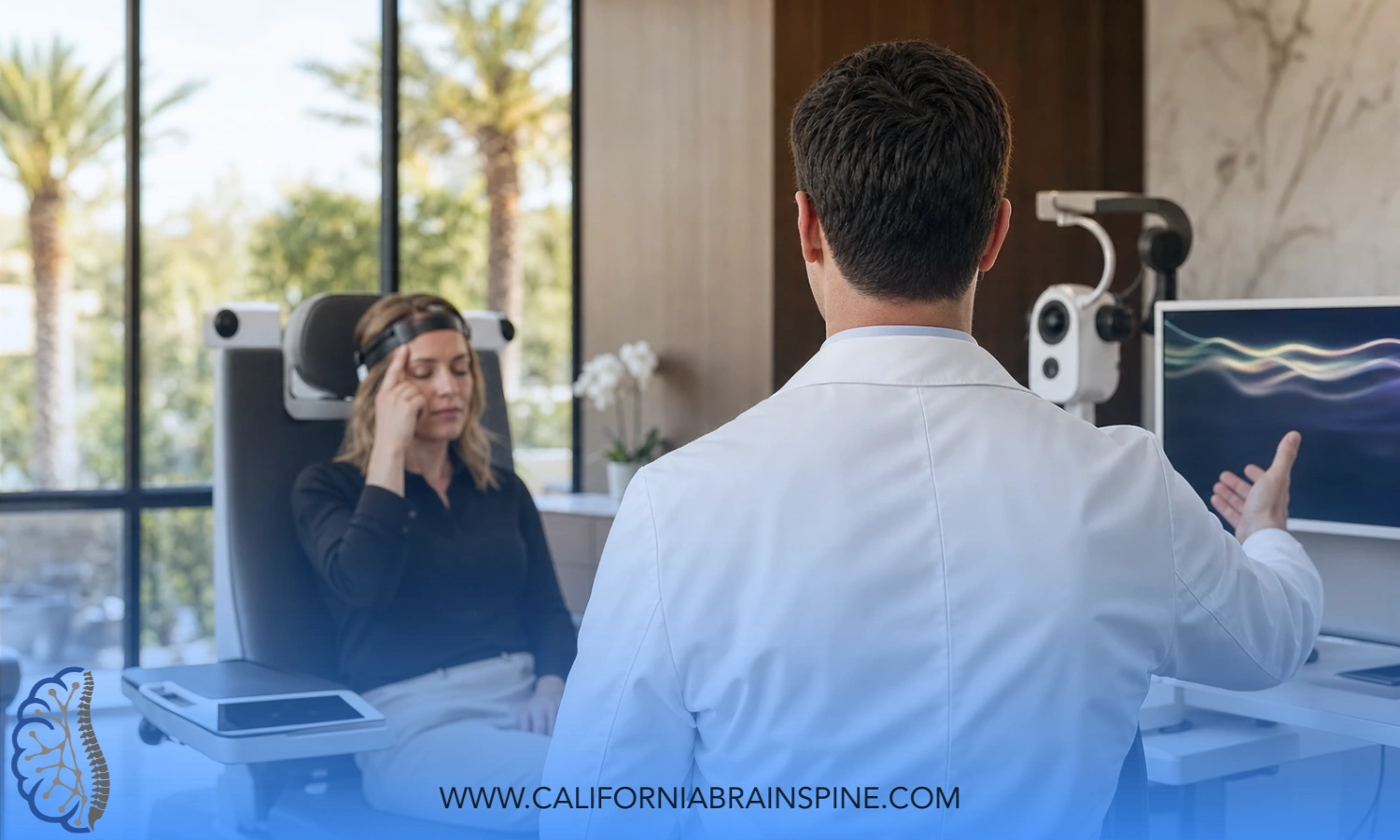
At California Brain & Spine Center, when dizziness after a crash brings you in, the evaluation begins with the collision itself: the direction of impact, where your head was turned, and what changed in the hours and days that followed. From there, Dr. Alireza Chizari, DC, DACNB, works through the possibilities in order, screening for the danger signs first and coming to the neck last.
Positional testing gets particular care after trauma. Because post-traumatic BPPV more often involves the horizontal canal or several canals, the Frontiers review recommends comprehensive testing that includes both the Dix-Hallpike and the supine roll tests, two positional head-and-body tests.
The neurodiagnostic assessment also covers eye movements, balance, and a hands-on neurological and neck examination, so the findings can be set against how you feel day to day. When findings call for imaging or ENT care, you are referred to your physician, medical neurology or an ENT, and the results go with you.
The NIDCD's page on balance disorders is a useful plain-language read if you want to understand this kind of testing before you come in.
The table below is a guide to the patterns, not a diagnosis. Several of them can be present together.
| Typical presentation | Patterns that suggest something more | What the evaluation looks at |
|---|---|---|
| Spinning set off by lying down, rolling over or looking up | Positional spinning in more than one test position | BPPV, with both the Dix-Hallpike and supine roll tests, since crash-related BPPV more often involves the horizontal canal or several canals |
| Dizziness or unsteadiness alongside other concussion symptoms | A headache that keeps worsening, repeated vomiting, confusion or unusual drowsiness (emergency care first) | Concussion-related balance problems, after the CDC danger signs have been ruled out |
| Dizziness together with neck pain after whiplash | Sudden severe head or neck pain, or stroke-like signs (emergency care first) | Cervicogenic dizziness, considered only once other causes have been excluded |
| Unsteadiness that remains after the spinning has been treated | Dizziness between spins, or with head movement in general | Other vestibular problems existing alongside the BPPV |
| Symptoms that began after the day of the crash | Symptoms that are severe or rapidly worsening (emergency care first) | Delayed concussion symptoms, which may appear hours or days after the injury |

How Are Vertigo and Dizziness Treated After a Crash?
Care for crash-related dizziness follows what the evaluation found. When clinically appropriate, it may combine several approaches, and each one is re-checked rather than assumed to be working.
Repositioning when BPPV is confirmed
When positional testing confirms BPPV, care may include canalith repositioning maneuvers, the treatment for BPPV, when clinically appropriate after evaluation. Crash-related BPPV may need more repositioning maneuvers than BPPV with no known cause, so reassessment is planned from the start rather than assumed to be unnecessary.
Vestibular rehabilitation
When clinically appropriate after evaluation, neurological rehabilitation may include vestibular rehabilitation, which uses guided exercises for the balance system and may help reduce dizziness after concussion. A systematic review of randomized trials found it seems useful for reducing symptoms in concussion, with short-term improvement in dizziness handicap scores. The same authors found the studies varied widely and called for more research, so the fair summary is that the evidence is promising and still developing.
For balance exercises to talk over with your clinician, see Natural Ways to Improve Balance After Concussion.
Neck care, once red flags are ruled out
When clinically appropriate after evaluation, and only once red flags such as an arterial injury have been ruled out, care may also include Gonstead chiropractic care for the neck. These are options chosen from the findings, never a set menu. Medication decisions stay with your physician.
How the clinic approaches dizziness from any cause, crash-related or otherwise, is set out on the dizziness and vertigo care page.
When Is Dizziness After a Crash an Emergency?
Danger signs after a crash: emergency care first
The CDC lists danger signs after a head injury that call for emergency care right away. They include:
- A headache that gets worse and does not go away
- Weakness, numbness or decreased coordination
- Repeated vomiting, slurred speech, or one pupil larger than the other
- Seizures, confusion or agitation, or loss of consciousness or unusual drowsiness
Sudden severe head or neck pain, especially with dizziness, double vision, limb weakness or trouble speaking, can be a sign of an injured neck artery.
If symptoms come on suddenly or severely - a sudden severe headache, weakness, trouble speaking, vision loss, or fainting - that is an emergency. Call 911 or go to an emergency room, not a clinic appointment.
Everything else in this article applies only after those have been ruled out.
Where Can I Get Dizziness Evaluated Near Calabasas?
California Brain & Spine Center is at 4768 Park Granada, Ste 107, in Calabasas, close to the 101 for people coming from Agoura Hills and the rest of the West Valley.
Crashes often come with an insurance or legal claim attached. When yours does, the evaluation findings can be written up at your request as a clear record of what was examined, and the information for attorneys page explains how that works. The clinical plan is the same whether or not a claim is involved.
Common Questions About Dizziness After a Crash
How soon should I get dizziness checked after a crash?
Get any danger signs checked in an emergency room first. After that, dizziness after car accident injuries is worth evaluating whenever it appears, because the CDC notes some concussion symptoms may not show up for hours or days. Starting with a clear picture of what was disturbed makes it easier to choose the right care.
Is dizziness after a car accident always a concussion?
No. Dizziness or vertigo after a car accident can come from loose inner-ear crystals, a concussion, a whiplashed neck, or several of these together, and rarely from an injured neck artery. Each is tested differently, which is why a careful evaluation checks the ear, the neck and the brain's balance systems before naming a cause.
Why am I still dizzy after my vertigo was treated?
After trauma, dizziness that continues after successful canalith repositioning is common and may reflect other vestibular problems present alongside BPPV. Inner-ear and brain-related problems often coexist after a head injury. When the spinning settles but unsteadiness remains, that is a reason to look further at the rest of the balance system, including the neck.
Where can I get dizziness evaluated after a crash near Calabasas?
California Brain & Spine Center, at 4768 Park Granada in Calabasas, evaluates whiplash dizziness, vertigo and balance problems after a crash for people across the West Valley. The neurodiagnostic assessment works through the inner ear, the neck and concussion-related balance problems, and anything outside functional neurology is referred to your physician, medical neurology or an ENT.
Can the clinic document my evaluation for an insurance or legal claim?
Yes, at your request. The evaluation findings and any re-tests can be written up as a clear record of what was examined and what was found, and shared with your attorney or insurer. That record describes the clinical picture only; questions about the claim itself belong with your attorney.
What Should You Do If You Are Still Dizzy After a Crash?
If you were checked after the crash and the world still has not settled, I would like to help you find out why. Dizziness after car accident injuries often has more than one source, and the way forward starts with testing each one in order, with the emergencies ruled out first.
California Brain & Spine Center | (818) 649-5300 | Calabasas, CA 91302
Book online at californiabrainspine.janeapp.com, or call to talk through whether an evaluation makes sense for you.
This content is for educational purposes only and is not medical advice. Consult a qualified healthcare provider about your specific situation.
Find out what the collision disturbed
A complimentary consultation at our Calabasas clinic is a chance to talk through the crash, your symptoms since, and whether a full evaluation makes sense before anything else is recommended.