
A plain guide to the features that separate a migraine from other headaches, and the signs that mean a headache needs emergency care.
The short answer to migraine vs headache is that a migraine is one specific kind of headache, with its own set of features. A migraine headache tends to be moderate or severe, often throbbing, and made worse by ordinary things like climbing stairs, and it usually comes with nausea or with sensitivity to both light and sound.
I am Dr. Alireza Chizari, DC, DACNB, a Board-Certified Functional Neurologist at California Brain & Spine Center in Calabasas, and whether a headache is “really” a migraine is a question I hear often. You may be getting through a full workday with a pounding head, closing the blinds at your desk and telling yourself it is just stress. Knowing which pattern you have changes which questions are worth asking, and which steps make sense next.
Key Takeaway
Migraine is a primary headache disorder of recurring attacks. Clinicians look for at least two of four pain features, plus nausea or sensitivity to both light and sound, so a migraine does not have to be one-sided. A sudden, extremely painful headache is an emergency. Start with a symptom diary; an evaluation can help sort out the rest.
Migraine vs Headache: How Can You Tell Which One You Have?
Usually, migraine vs headache comes down to a checklist. Under the international criteria, a migraine headache has at least two of four features: one-sided, pulsating, moderate or severe, or worse with routine activity. It also comes with nausea or vomiting, or with sensitivity to both light and sound.
The Four Pain Features Clinicians Look For
The International Classification of Headache Disorders, published by the International Headache Society, sets out what counts as migraine without aura. Its pain criterion lists four features, and at least two must be present:
- Pain located on one side of the head.
- A pulsating quality, often described as throbbing.
- Pain of moderate or severe intensity.
- Pain that gets worse with routine physical activity, such as walking or climbing stairs, or that makes you avoid it.
During the headache, at least one more feature has to be present: nausea or vomiting, or sensitivity to both light and sound. The same criteria describe attacks lasting 4 to 72 hours when untreated or when treatment has not worked.
Why a Migraine Does Not Have to Be One-Sided
A migraine can involve both sides of the head, because one-sided pain is only one of the four features and two are enough. If your head throbs on both sides, the pain is strong, and it gets worse every time you take the stairs, that pattern meets the pain criterion with no one-sided pain at all.
Aura is not required either. The criteria above describe migraine without aura, and NHS guidance describes aura as something some people get first. If your headaches keep coming back in a pattern like this, our page on headaches and migraines explains how they are evaluated at the practice.
What Is a Migraine, and What Is a Headache?
Migraine is a primary headache disorder, which means it is not caused by another condition, and it is characterized by recurring attacks that are often life-long, according to the World Health Organization.
“Headache” is the everyday word for pain in the head, so migraine sits inside it as one type, alongside tension-type headache, cluster headache and headaches with an identifiable cause, such as medication overuse. For many readers, the real question behind migraine vs headache is migraine versus tension-type headache.
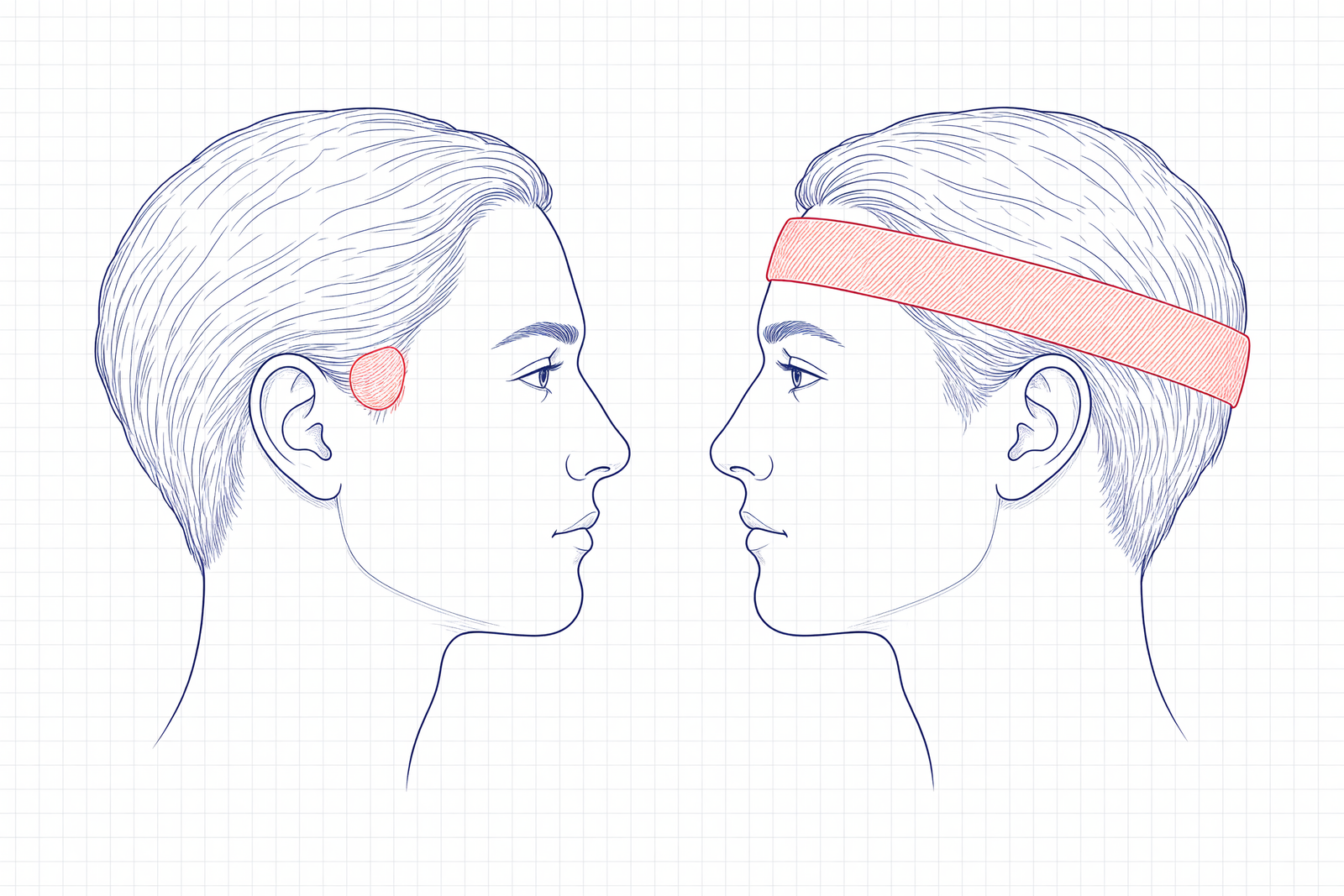
WHO describes tension-type headache as pressure or tightness, often like a band around the head. That pressing, band-like quality is the first thing to compare with the throbbing of a migraine.
Cluster Headache
Cluster headache is a separate pattern that NHS guidance describes as a sharp, burning or piercing pain, usually on one side of the head, around the eye. If that description fits your headaches better than either migraine or tension-type headache, say so at your evaluation.
Medication-Overuse Headache
Medication-overuse headache is caused by chronic, excessive use of medication to treat headache, according to WHO, so frequent headaches and frequent pain relievers are worth mentioning together.
That is a reason to talk with the clinician who prescribes or advises on your medication, never a reason to stop or change it on your own. Decisions about medication stay with your prescribing physician.
Migraine vs Headache: How Do They Compare Side by Side?
Side by side, migraine and tension-type headache differ in the quality of the pain, in how it responds to routine activity, and in the symptoms that come with it.
| Feature | Migraine | Tension-type headache |
|---|---|---|
| Where it hurts | Often one side, but both sides can still meet the criteria | Often like a band around the head |
| What it feels like | Often pulsating or throbbing; often moderate or severe | Pressure or tightness |
| Stairs and walking | Often made worse, or avoided; one of four features, not required | Daily activities usually do not make it worse |
| What comes with it | Nausea or vomiting, or sensitivity to both light and sound | The pressure or tightness is the main feature |
| How long it lasts | 4 to 72 hours when untreated, under the international criteria | It varies; log it in a headache diary |
| Before the pain | Some people get an aura, such as zigzag lines or flashing lights | Log anything you notice before the pain starts |
Migraine vs Tension Headache: Does Activity Make It Worse?
Whether routine activity makes the pain worse is one of the most useful questions you can answer yourself. The migraine criteria list pain that is made worse by walking or climbing stairs, or that makes you avoid them. NHS guidance on tension headaches says you should usually be able to keep up daily activities without making the headache worse.
A simple check is to notice what happens on the next flight of stairs. If the throbbing climbs with each step, write that down; if you get through the afternoon and the pressure stays about the same, write that down too.
What Does a Migraine Aura Look Like?
A migraine aura is a set of symptoms some people get before the headache, such as zigzag lines or flashing lights, according to NHS guidance. The same guidance says aura symptoms should not last longer than 1 hour. Aura that goes on longer is a reason to get checked, and aura that comes with weakness or trouble speaking belongs in the emergency section below.
Not Sure Which Column Your Headaches Fit?
If your headaches do not sit neatly on one side of the table, a detailed evaluation at our Calabasas office can look at the whole pattern before any plan is discussed.
Where Does Dizziness Fit In?
Dizziness can be part of migraine in some people, a pattern called vestibular migraine, and its episodes can happen with little or no headache.
Consensus criteria from the Barany Society and the International Headache Society diagnose it from recurrent vestibular symptoms such as vertigo, a history of migraine, a link in time between the two, and ruling out other causes (Lempert and colleagues, Journal of Vestibular Research).
Our article on vestibular migraine vs regular migraine covers that comparison in detail, so this guide stays with headache types.
If dizziness, rather than headache, is the main problem, the dizziness evaluation page describes how that assessment is approached.
How Can You Find What Triggers Your Headaches?
Keeping a migraine diary can help you work out what might trigger your attacks, according to NHS guidance, and a headache diary is simply a record of each attack.
Set out against the criteria above, a diary can also give a clinician the details needed to classify the headache. For each episode, note:
- When it started, how long it lasted, and whether you took anything for it.
- Where it hurt, and whether it felt throbbing or like pressure.
- Whether stairs or walking made it worse.
- Whether you had nausea, or sensitivity to light and sound.
- Any aura before the pain, and how long the aura lasted.
If you want a structured way to describe how headaches affect your daily life, the Headache Impact Test self-assessment is a short questionnaire you can complete before a visit.

When Is a Headache an Emergency?
A headache that comes on suddenly and is extremely painful, or a headache after a recent head injury, needs emergency care rather than a wait-and-see approach, according to NHS guidance.
When to call 911
If symptoms come on suddenly or severely – a sudden severe headache, weakness, trouble speaking, vision loss, or fainting – that is an emergency. Call 911 or go to an emergency room, not a clinic appointment.
The same goes for a headache after a recent head injury: emergency care comes first, and a clinic visit can wait until you have been seen.
What Do Patients in Calabasas Ask Me About Headaches?
One question patients often ask me is whether a headache on both sides of the head can still be a migraine, and the answer is yes, when the other features are there. That is why I ask about stairs, nausea, and light and sound before I ask where it hurts.
Another is whether a migraine is simply a worse headache. The criteria treat migraine as its own disorder with its own features, so I look at the whole pattern of attacks rather than how bad any single one felt.
Patients from Calabasas and Agoura Hills reach our office on Park Granada from the 101, and the functional neurology evaluation centers on a 120-minute neurodiagnostic assessment. It includes a detailed history of your headaches, a neurological examination, and testing chosen for your symptoms, and the findings are explained to you as part of the visit. If anything points toward medical neurology, imaging or a medication review, I say so and suggest who to see; the practice works alongside primary care and medical neurology.
When clinically appropriate after evaluation, a personalized plan may include neurological rehabilitation or non-invasive options such as gammaCore vagus nerve stimulation, as one part of the plan.
“Dr. Chizari took the time to explain everything clearly and made the whole process easy to understand.”
From a Google review
Questions About Migraine vs Headache
The questions below go beyond the comparison above, each answered in a few lines.
Is a migraine just a bad headache?
No. In the migraine vs headache comparison, migraine is a primary headache disorder of recurring attacks, according to WHO, with its own criteria: at least two of four pain features plus nausea, or sensitivity to both light and sound. A headache can be severe without meeting those criteria.
Can a migraine be on both sides of the head?
Yes. One-sided pain is only one of the four pain features in the international criteria, and two are enough. That is a useful point in migraine vs tension headache, because a two-sided headache that throbs and worsens on the stairs can still meet the migraine criteria if nausea or light and sound sensitivity come with it.
How long does a migraine last?
The international criteria describe a migraine attack without aura as lasting 4 to 72 hours when untreated or when treatment has not worked. Recording how long each of your headaches lasts, migraine or tension-type, in a headache diary gives a clinician a clearer picture than memory alone.
Can headache medication cause more headaches?
It can. WHO describes medication-overuse headache as caused by chronic, excessive use of medication to treat headache. If you are taking pain relievers often for a migraine or a tension headache, raise it with your prescribing physician rather than stopping or changing anything yourself.
Where can I get migraine vs headache symptoms evaluated in Calabasas?
California Brain & Spine Center in Calabasas offers a complimentary consultation, and the full evaluation centers on a 120-minute neurodiagnostic assessment. Bring your headache diary. If the migraine vs headache question points toward medical neurology or medication changes, Dr. Chizari says so and suggests who to see.
The migraine vs headache question usually comes down to how the pain behaves: whether it throbs, whether stairs make it worse, and whether nausea or light and sound sensitivity come with it. If your answers keep pointing toward migraine, or you cannot tell, a diary and an evaluation are reasonable next steps, and I am glad to go through the pattern with you.
California Brain & Spine Center | (818) 649-5300 | Calabasas, CA 91302
Book online at californiabrainspine.janeapp.com.
This content is for educational purposes only and is not medical advice. Consult a qualified healthcare provider about your specific situation.
Bring Your Headache Diary With You
A complimentary consultation in Calabasas is a chance to go through your headache pattern and decide together whether a full neurodiagnostic assessment makes sense for you.