
If moving has felt risky since a head injury or a bout of dizziness, there is a name for it and a careful way back.
If turning your head, walking faster or getting back to exercise has started to feel risky since a concussion or a spell of dizziness, what you are living with may have a name: kinesiophobia. Kinesiophobia is a fear of physical movement and activity that follows an injury, rooted in a sense of being vulnerable to pain or to getting hurt again, as a systematic review of injured athletes defines it.
I am Dr. Alireza Chizari, DC, DACNB, and I practice functional neurology at California Brain & Spine Center in Calabasas. If a head injury has left you wary of moving, you may have been anything but timid about your body before. You might still drive the 101 to a demanding job or hike the Santa Monica Mountains on weekends, and yet find yourself planning each day around whatever might set symptoms off.
That gap, between the person you were and how carefully you move now, deserves a real explanation. The short version is that your nervous system learned something from an unpleasant experience, and what it learned can be looked at, measured and worked with.
Key takeaway
Kinesiophobia is a fear of movement that can follow an injury, including a concussion or a dizzy spell. After a concussion it is associated with more severe symptoms and a longer recovery. It is a learned protective response, and it can be measured. Graded exposure, stepping back into feared movements gradually, may help.
What is kinesiophobia?
Kinesiophobia is a fear of physical movement and activity that follows an injury, driven by a sense of being vulnerable to pain or re-injury. After a concussion or with a vestibular (inner ear balance) problem, it can grow from real symptoms that movement provoked, so the brain begins treating turning, bending or exercise as a threat worth avoiding.
How the fear gets learned
The brain learns from perceived threats. When dizziness hits in a particular setting, such as a crowded store, a parking structure or a gym floor, the brain may link that setting with danger. In vestibular disorders, fear avoidance is described as a behavioral response aimed at not provoking dizziness, and research on vestibular fear avoidance across cultures reports that these beliefs can lead to real activity limitations.
From the inside, that learning does not feel like a belief. It feels like common sense: the last time you turned quickly, the room tilted, so you stopped turning quickly.
When caution is sensible, and when it has become the problem
Some caution after a head injury is reasonable, and when to return to a given activity is a question for the clinician who examined you. The trouble starts when caution becomes the default for months. Fear of movement can affect you physically, through lost strength, poorer proprioception (your sense of where your body is in space) and reduced range of motion, and psychologically, through anxiety, low mood and a lower quality of life.
That is the point at which kinesiophobia stops protecting recovery and starts shaping it.
What does fear of movement after a concussion feel like?
Most of the time it looks like a string of small, sensible decisions. You take the elevator because the turn on the stairwell landing once made you woozy. You stop doing a full head turn to check your blind spot and lean on the mirrors instead. The evening walk goes, then the weekend hike, and your calendar quietly rearranges itself around what might set symptoms off.
It can have a real starting point. When dizziness has come on with a movement or in a particular place, the brain may link that movement or place with danger, so kinesiophobia after a concussion can begin with a moment when moving genuinely did make things worse.
A learned association, not a character flaw
Patient-education writing on vestibular fear avoidance describes it as the nervous system learning from a perceived threat. That framing matters. You were not weak for protecting yourself. Your brain did what brains do after an unpleasant surprise, and that learning may be updated with the right kind of gradual exposure.

Why does the brain start guarding movement after a concussion?
There is rarely a single reason. Several threads tend to run together, and it helps to pull them apart.
Symptoms taught it to
The first thread is plain experience. When a head turn or a busy environment has brought on dizziness, avoiding it again is the brain's reasonable next move, and that avoidance is the heart of fear avoidance in vestibular problems.
Advice to rest
The second thread is subtler. Researchers who studied kinesiophobia in collegiate athletes after concussion suggest that advice to rest completely may lead some people to view physical activity itself as harmful, which can feed a fear of movement through what is called the fear-avoidance model. Rest advice is often given with care in the first days. The concern is how it gets heard, and how long it keeps steering the day.
Avoidance keeps the loop going
The third thread is the loop itself. Avoidance can feel protective at first, but over time it can shrink a person's world and reinforce the anxiety that started it. In people with vestibular disorders, stronger fear-avoidance beliefs have been linked to higher anxiety, a greater sense of handicap and lower confidence during balance activities. Less confidence means less movement, and less movement gives the fear fewer chances to be tested.

Can kinesiophobia slow concussion recovery?
The research points that way, with an important caveat. Research on adolescents after concussion reports that high kinesiophobia after a concussion is associated with more severe symptoms, more frequent persistent symptoms, longer recovery, slower reaction times and worse results on vestibular and eye movement testing. It is also associated with less physical activity and a lower quality of life after the injury.
In the collegiate study mentioned above, athletes with high kinesiophobia measured within days of their concussion may have taken longer to reach clinical recovery than athletes with low levels.
The caveat is that association is not cause. These studies do not show that fear alone slows healing, and none of them can predict how an individual recovers. The collegiate study's authors draw a practical conclusion instead: clinicians should consider measuring kinesiophobia after a concussion, to identify who may benefit from early psychological or physical support.
Has moving started to feel risky since your injury?
An evaluation looks at what your balance, eye movement and autonomic (automatic heart rate and blood pressure control) systems are doing, so your next step is chosen instead of guessed.
How is kinesiophobia assessed?
The Tampa Scale for Kinesiophobia is a commonly used questionnaire for measuring fear of movement, and it is the scale behind some of the concussion research above. A questionnaire shows how strong the fear is. Working out what the fear is responding to takes an examination.
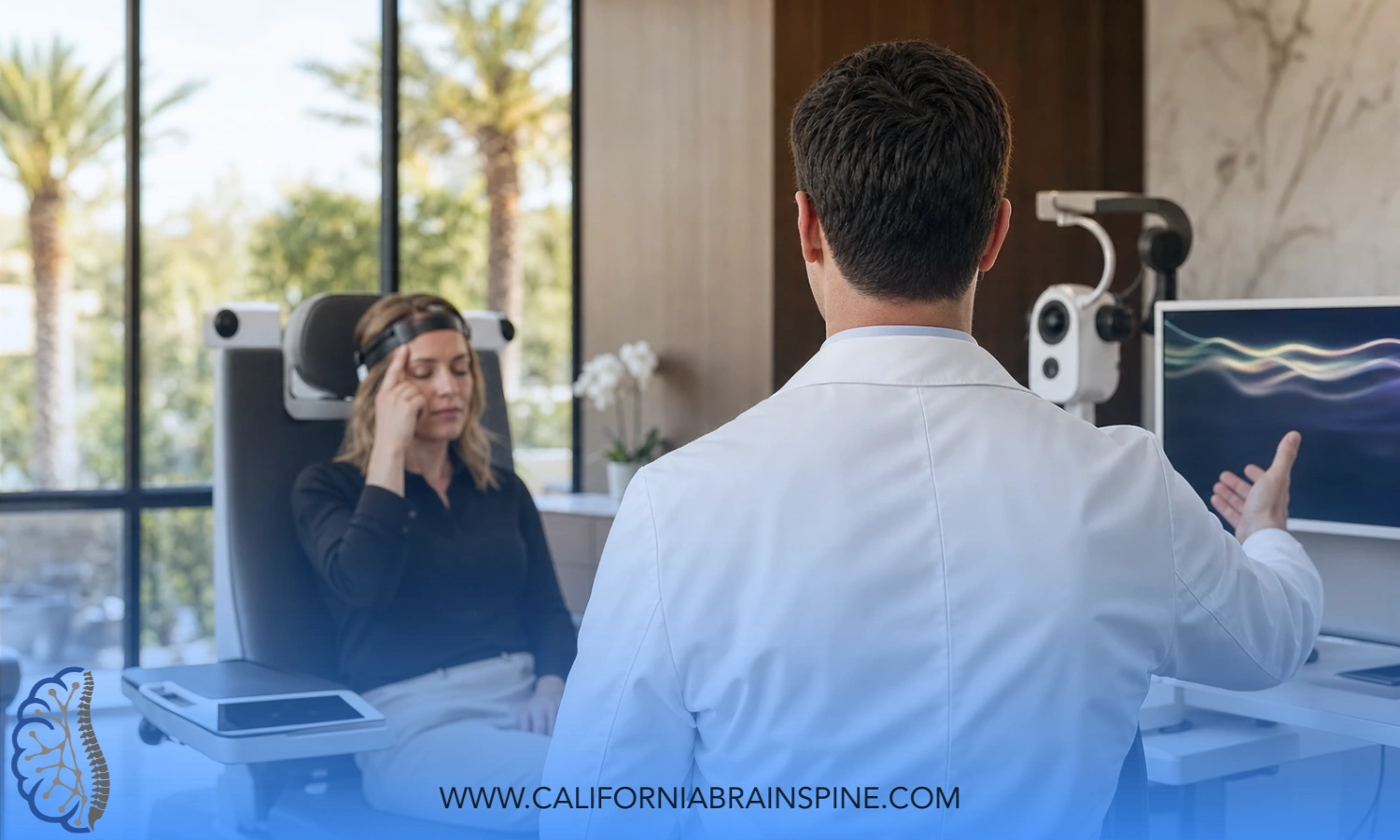
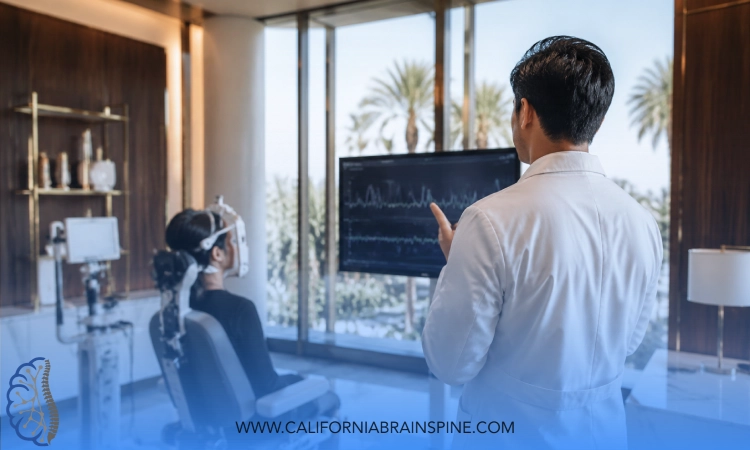
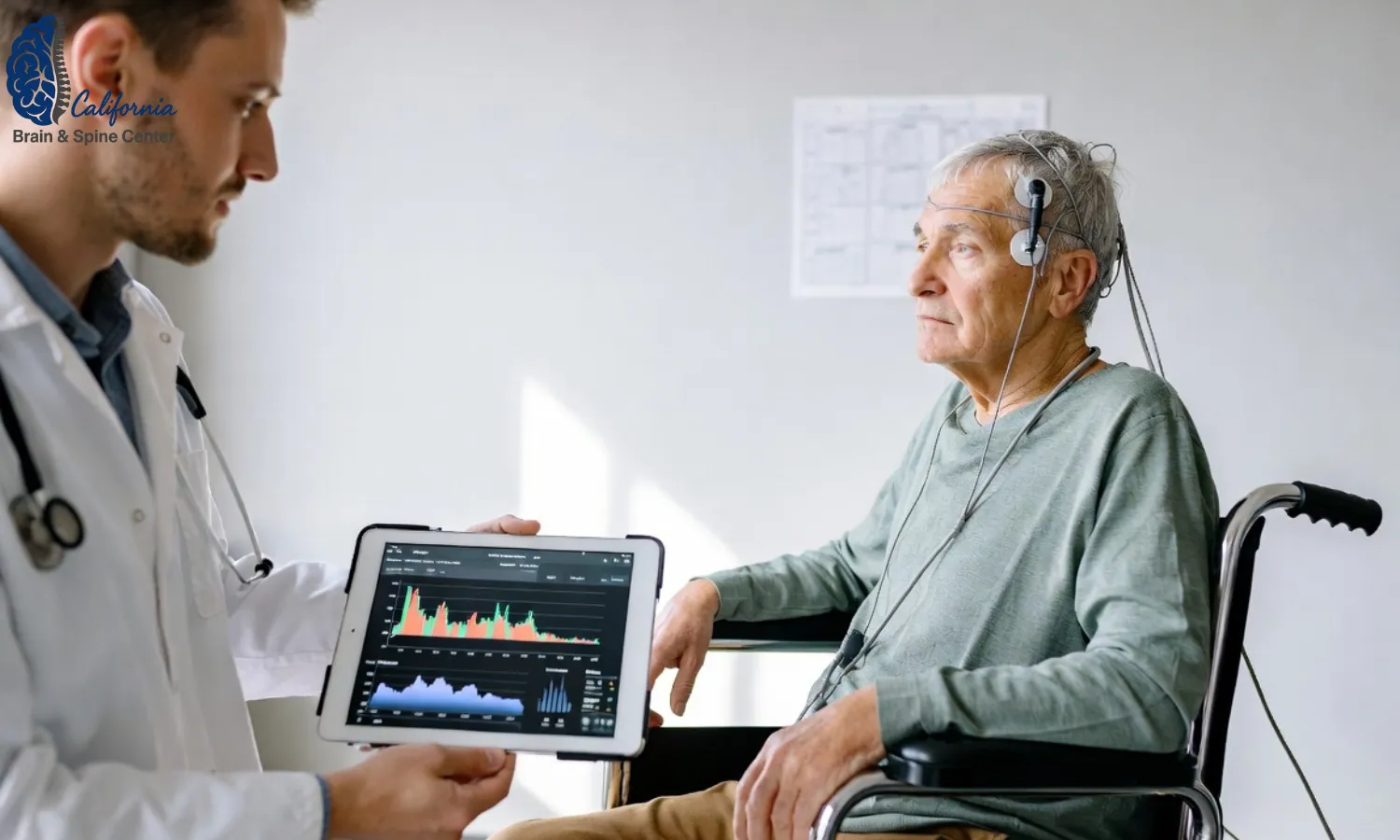
That second question is where my work sits. At California Brain & Spine Center, a detailed neurodiagnostic assessment may include eye movement testing, balance tasks, positional testing, and heart rate and blood pressure measured across positions, when clinically appropriate. The aim is a plan built on what your vestibular, visual and autonomic systems are doing today.
When standing up is what sets off a racing heart or lightheadedness, the autonomic side deserves its own look, and our article on POTS and heat intolerance is a useful companion read.
| Typical presentation | What the evaluation looks at |
|---|---|
| Hesitating before turning your head quickly | Positional testing and eye movement assessment |
| Avoiding busy stores or scrolling screens | Visual and oculomotor (eye movement) function under sensory load |
| Skipping exercise since the injury | Heart rate and blood pressure across positions |
| Walking carefully on uneven ground | Balance on firm and compliant surfaces |
| Holding the neck stiff while moving | Neck range of motion and proprioception |
| Planning the day around possible triggers | Screening, with referral to mental health care when appropriate |
Read the table as a guide to what gets checked. Sorting one pattern from another takes an examination.
How does graded exposure help fear of movement?
Graded exposure is one approach being studied for dizziness-related fear. A vestibular rehabilitation trial protocol describes it as beginning with what a person avoids and the safety behaviors they rely on, then building a hierarchy of feared activities from least to most threatening. Working through that ladder in order lets the catastrophic outcome you expect be tested against what happens.
For injured athletes, introducing feared movements gradually may help reduce kinesiophobia, and education, goal-setting and relaxation techniques are also used. Vestibular rehabilitation approaches the same problem from the physical side. It aims to help the central nervous system compensate, using exercises built on habituation (repeating a provoking movement gently, so the brain can grow less reactive to it) and on adaptation or substitution (retraining the balance system, or letting other senses such as vision help cover for it).
Movement itself appears to matter as well. In adolescents with persistent symptoms after a concussion, a study of physical activity during recovery found that regular activity, of any duration or intensity, may help reduce kinesiophobia. That was an observational finding, so it points in a direction without proving one.
Each step in our brain injury recovery program is chosen from what the evaluation found, so you are not left guessing which movement to try next. Progress is paced to how your nervous system responds, never to a calendar.
For some people the fear of moving is tangled up with racing thoughts, panic or feeling on edge all day. If that sounds familiar, our article on post-concussion anxiety treatment looks at that side of the picture.

When to seek emergency care instead
If symptoms come on suddenly or severely - a sudden severe headache, weakness, trouble speaking, vision loss, or fainting - that is an emergency. Call 911 or go to an emergency room, not a clinic appointment.
After a head injury specifically, the CDC lists danger signs that need emergency care, including seizures, repeated vomiting, slurred speech, weakness or numbness, increasing confusion, a headache that gets worse and does not go away, one pupil larger than the other or double vision, and loss of consciousness or trouble staying awake. Fear of movement is never a reason to delay that call.
Questions about kinesiophobia
Is kinesiophobia a sign that my symptoms are in my head?
No. Kinesiophobia can grow from real experiences where movement brought on symptoms, and the brain may learn to treat that movement as a threat. It is a protective response that has outlasted its usefulness. Naming it is a way of taking the fear seriously and giving it a plan, rather than dismissing it.
Can kinesiophobia happen after a concussion even if my scans were normal?
Yes. Kinesiophobia describes a fear of movement, and the brain can learn it when moving has brought on dizziness or other symptoms. Questionnaires such as the Tampa Scale for Kinesiophobia, together with an examination of balance and eye movements, give a fuller picture of what the fear is responding to and where rehabilitation can begin.
Should I keep resting until the fear of movement goes away?
Not usually without guidance. Researchers have noted that advice to rest completely may lead some people to see activity as harmful, which can feed the fear. In adolescents with persistent symptoms, regular activity of any intensity was correlated with less kinesiophobia. The right starting level is something to set with the clinician who examined you.
Does vestibular rehabilitation help with fear avoidance and dizziness?
It may. Vestibular rehabilitation aims to help the central nervous system compensate through habituation and adaptation exercises, and graded exposure to feared activities is being studied alongside it for dizziness-related fear. Whether it suits you depends on what an evaluation finds, and progress is paced to your response rather than a calendar.
Do you see patients with kinesiophobia after a concussion in Calabasas and Los Angeles?
Yes. At California Brain & Spine Center in Calabasas, we evaluate kinesiophobia as part of concussion and dizziness care, for people across Los Angeles and the San Fernando Valley. Care may include vestibular rehabilitation and graded activity when clinically appropriate after evaluation, working alongside your primary care doctor and other providers.
Where can I get help for kinesiophobia near Calabasas?
California Brain & Spine Center sits at 4768 Park Granada in Calabasas, and people reach us from across the San Fernando Valley and the 101 corridor, including Woodland Hills, a short drive east. You can learn more about the clinic on the californiabrainspine.com home page. We work alongside primary care, medical neurology, ENT and physical therapy, and if your evaluation points to something outside functional neurology, I say so and help you find the right referral.
If moving has started to feel dangerous, I would like you to hear two things. The fear is understandable, because it can begin with a real symptom. It is also workable, because what the nervous system learned about movement may be updated with a careful, graded plan. As Dr. Alireza Chizari, DC, DACNB, my part is to find out what your balance, eye movement and autonomic systems are doing, explain it in plain terms, and help you choose a first step you can trust.
Kinesiophobia after a concussion or with dizziness is a researched, recognized problem, and you do not have to work through it by guessing.
California Brain & Spine Center | (818) 649-5300 | Calabasas, CA 91302
Book online at californiabrainspine.janeapp.com
This content is for educational purposes only and is not medical advice. Consult a qualified healthcare provider about your specific situation.
Ready to find a safe place to start?
A complimentary consultation is a chance to talk through what has changed since your injury and whether an evaluation makes sense for you.