Dysautonomia-informed · Non-invasive · Calabasas
POTS Treatment
Calabasas
Stability you can plan your week around.
Standing up makes your heart race. Dizziness hits out of nowhere. Brain fog and fatigue keep derailing your day — and you've spent months, maybe years, in a loop of "normal tests" and worsening function. Dr. Alireza Chizari, DC, DACNB, our board-certified functional neurology specialist, approaches POTS with a dysautonomia-informed evaluation and a non-invasive plan built around your actual physiology.
The quick, honest answer
What POTS care here actually involves
What it is
Evaluation before any plan
A dysautonomia-informed evaluation that confirms the orthostatic pattern, rules out look-alikes, and identifies what's actually driving your symptoms — then a layered, non-invasive plan built from those findings.
Who it may help
When standing became the problem
People with racing heart on standing, unpredictable dizziness, exercise intolerance, post-viral or post-concussion instability — especially those told their tests look normal while function keeps declining.
Best next step
Get the pattern measured
If you've been searching for a POTS specialist near me, start with orthostatic vitals taken correctly, plus neurological and vestibular screening where dizziness is part of the picture. No plan is built until the pattern is understood.
Why patients come in
Most people don't arrive saying "I have POTS"
They arrive saying "something is off when I stand up." These are the patterns we hear most.
Racing Heart on Standing
Heart pounding or racing within minutes of standing — the hallmark orthostatic pattern
Dizziness & Near-Fainting
Light-headed in lines, warm rooms, or on standing — sometimes with no warning at all
Brain Fog
Slowed thinking and reduced concentration that worsens the longer you stay upright
Fatigue & Crashes
Exhaustion disproportionate to activity, plus post-exertional crashes hours or days later
Heat Intolerance
Heat, hot showers, and warm rooms trigger flares — see our guide to POTS and heat intolerance
Exercise Intolerance
Activity that used to be routine now triggers symptoms — or a crash the following day
Flares often follow illness, stress, or a concussion. POTS also frequently overlaps with broader dysautonomia patterns.
Evaluation comes first
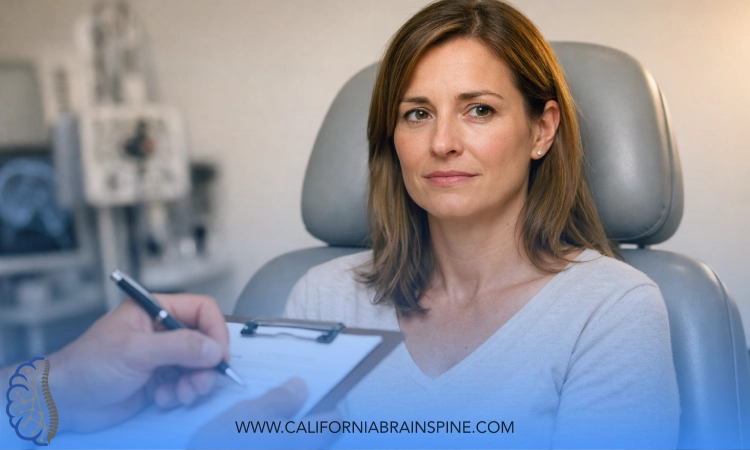
What a POTS specialist near me should actually do
A good dysautonomia evaluation is both clinical and practical — connecting posture, heart rate, blood flow, triggers, and your real-life limitations. Your evaluation typically includes:
- Deep history and pattern mapping — when symptoms started, what worsens them, what helps, how crashes unfold
- Orthostatic measures — heart rate and blood pressure from lying to standing, taken correctly
- Neurological and vestibular screening — especially where dizziness, balance issues, visual strain, or post-concussion symptoms are present
- Medication and lifestyle review — hydration, electrolytes, sleep, nutrition, stress load
- Care coordination guidance — when labs, cardiology input, or tilt-table testing are appropriate
The plan
What a practical POTS plan looks like
Plans are individualized, but the most effective ones are layered — small consistent inputs that build more stable days.
Clinically responsible care
What we rule out — and when to seek urgent care
Even when someone strongly fits a POTS pattern, your safety depends on not skipping the differential.
Conditions we consider or coordinate on
- Orthostatic hypotension and vasovagal syncope patterns
- Anemia and iron deficiency
- Thyroid dysfunction
- Medication effects
- Cardiac rhythm concerns
Where your case calls for cardiology testing, labs, or medication management, we recommend coordination with the appropriate provider. POTS care works best as a team approach. For background reading, see NIH/NINDS on postural tachycardia syndrome and Dysautonomia International.
Seek urgent medical care for
- Chest pain, chest pressure, or new severe shortness of breath
- Fainting with injury, repeated fainting, or fainting without warning
- Sudden one-sided weakness, facial droop, slurred speech, or sudden vision loss
- Black or bloody stools, vomiting blood, or severe dehydration
- A new severe headache unlike your usual pattern
If you're unsure, choose safety. The deeper pattern can be sorted out once urgent issues are ruled out.
A realistic patient story
"I could plan my week without fear"
Details changed to protect privacy. Representative of possible outcomes — not a guarantee of any specific result.
M. came in after months of dizziness, palpitations, and brain fog that spiked whenever she stood up. She'd started avoiding lines, warm environments, and social plans because she didn't trust how her body would respond. Her tests were "mostly normal," and she was exhausted from explaining symptoms that changed by the hour. Her evaluation combined careful history, correctly measured orthostatic vitals, and a broader neurological screen — because her dizziness had vestibular features. The plan focused on hydration and pacing, a gradual recumbent exercise progression, and targeted vestibular rehabilitation to reduce the sensory overload amplifying her symptoms.
Over time her crashes decreased and her standing tolerance improved. That's what progress looks like when the plan matches the physiology.
Common questions
Frequently asked questions
Do you treat POTS directly, or do I need a cardiologist first?
POTS usually benefits from a team approach. We focus on dysautonomia-informed evaluation, neurological and vestibular contributors, and non-invasive strategies that support regulation and function. If your case requires cardiology testing or medication management, we'll recommend coordination with the appropriate provider — no referral is needed to be evaluated here.
What should I look for in a POTS specialist near me?
Look for a clinic that takes orthostatic symptoms seriously, understands dysautonomia patterns and differentials, offers a structured plan rather than generic advice, and can address vestibular, visual, and neurocognitive contributors when they coexist.
Can POTS be identified in your office?
A strong clinical picture can often be identified through detailed history and correctly measured orthostatic vitals. Some patients also benefit from additional medical testing — labs or tilt-table testing — for confirmation or care coordination. The right approach depends on your symptoms and risk factors.
What if my symptoms have been blamed on anxiety?
Anxiety and POTS can overlap in sensation, but they aren't the same problem. POTS symptoms are typically posture-linked and physiologically consistent when measured correctly. We evaluate the pattern and explain findings clearly. If anxiety is also present, it can be addressed without dismissing the autonomic component.
How long until I see improvement?
Timelines vary. Many patients see early gains from stabilizing triggers, hydration, and pacing, while deeper improvements in conditioning and upright tolerance take longer. The strongest predictor is consistency with a plan matched to your baseline that avoids repeated crashes.
Take the next step
You're looking for one thing
more than any other: stability.
To stand, work, drive, exercise, and live without constant symptom negotiations. If you've been searching for a POTS specialist near me, care should feel structured, personalized, and grounded in real physiology — not vague reassurance. Serving Calabasas, Woodland Hills, Encino, Tarzana, West Hills, Agoura Hills, Thousand Oaks, and greater Los Angeles.
California Brain & Spine Center · 4768 Park Granada, Ste 107, Calabasas, CA 91302